magic moments

shenzhen buses have televisions, which broadcast pre-recorded programs which coble together news reports of major events (such as the expo in shanghai), as well as produced clips of famous skits (小品), imported western comedies (home video moments of children jumping and cats in baby carriages), strange competitions (in which restaurant staff compete to set a banquet table the most quickly), and top ten music video countdowns (which are often repeated and always interrupted midway to announce bus stops).

i understand these programs to be negotiations of the tension between ongoing propaganda campaigns (it was on a bus that i first heard of the campaign to conserve water in shenzhen, for example) and approved-yet-profitable popular culture (the buses also provide advertising blitzes for movies and pop singers). that is, these bus programs are useful indications of both what the party thinks shenzhen people should be thinking and what actually engages shenzhen people’s minds. consequently, when these programs added clips of magic tricks – card tricks, woman sawed in half tricks, vanishing boat tricks, multiplying cheer leader tricks – to their programming, i began wondering about when and why the manipulation of appearances had become so popular in a city that is explicit in its support for and origin in science.

[side note: shenzhen was an explicit realization of the four modernizations. as such, it has used scientific (科学) to describe what in the u.s. we would call “rational” as in “rational development (科学的发展)” and “rational management (科学的管理)”. “scientific” is also a term of commendation, as in: she does things in a rational/scientific way (她做事很科学).]

so what follows is speculation on why magic in shenzhen, now. Continue reading

more thoughts on education


at the park

Originally uploaded by maryannodonnell

the question of what to believe is is troubling and profound, even in cities like shenzhen, notwithstanding all this capitalism with chinese characteristics. some days it feels like people only say they want to make money because that is what they think they’re expected to say. at heart, i sense that people are making money and how far they are willing to go to make that money (because yes, questions of ideology are also questions of belief) is tied up in reworked versions of what constitutes a “household (家)”. indeed, neotraditionalism and neoconfucianism are profoundly shaping (what i am told is the most feudal of chinese institutions) – early childhood education.

a few years ago a friend of mine gave me a copy of the “three character jing (三字经), a text that chinese children used to memorize as part of a traditional education. my friend told me that after her son had memorized the three character jing, he had become a better student, more filial, and overall a more considerate human being. she concluded that traditional education educated the entire person, whereas modern education was necessary, but incomplete.

i am also aware of a strong impulse toward home-schooling among many people my age. many had their children memorizing chinese classics and indeed, i bought my own recitation copy of the “book of changes”. the set came with pinyin, simplified and standard versions of the text in addition to cds of a man and girl reciting the text. the many who sold me this set told me that when children recited the classics their voices became clearer and more beautiful.

recently, the push toward remaking the self through the classics seems both stronger and more popular – in all senses of the word. a new favorite text is the “standards for being a good student and child (弟子规)”. meanwhile, an administrative assistant has left her job to take her three-year old daughter to a mother-child camp, where she will learn how to teach her daughter the classics.

it is worth noting that although students had been memorizing tang poems as part of their elementary education, the new push for “three characters” and “standards” is (a) part of grassroots pre-school training; (b) involves a moral impulse that combines education with obedience; and (c) is re-coding shenzhen’s nuclear families in confucian terms.

so i am learning to listen to chinese debates about education, debates which frankly did not interest me when i thought of them as being merely about how the gaokao (高考) has ruined the possibility of true learning. in fact, the closer we get to the june test dates, the more incessant and shrill these debates become and the lower my tolerance for parents who say, “but we had no choice [except to force our child to study ten hours a day and give up their dreams of being an artist]”. however, as i have learned to hear how questions about what and how to believe inform these debates, i have become more interested in and yes, more sympathetic to the chinese obsession with education.

there are, after all, many ways of trying to become human.

what exactly is an urban village anyway?

Shenzhen’s urban villages confound easy categorization precisely because they are sites where Mainland Chinese distinctions between “farmers (农民)” and “city people (市民)” have been constantly negotiated and renegotiated for over thirty years.

In the 80s and early 90s, the question facing the Shenzhen government was: how to transfer collective land to urban work units (to establish urban patterns of property ownership) while providing villagers with a livelihood. The resolution to that problem took the form of “handshake buildings (握手楼)” and village level manufacturing and commerce. These villages were called “new villages (新村)” – as in “Guimiao New Village and Xiangnan New Village, for example. However, the economic success of both the new villages and the pace of Shenzhen’s growth has meant that new villages have constantly bumped up against more intensive forms of urban expansion. Consequently, since the mid-90s, the question facing Shenzhen’s government has been: how to integrate the new villages into the city. Suddenly, the government was pursuing a policy of “[urban] village renovation (旧村改新)”. Of course, the so-called “old villages” were in fact the “new villages” of the past decade. More tellingly, the “new villages” were now called “urban villages (城中村)”, an expression which might conjure images of a massive city surrounding and absorbing a small yet resistant village.

The project to renovate Gangxia [New] Village began in 1998 with a plan to construct the Shenzhen central axis along and through Gangxia. However, it was not until 2008 that the government began negotiating with residents of Gangxia Heyuan (岗厦河园片) to transfer land from villagers to city developers. By that time, Gangxia Heyuan had 580 buildings (mostly handshake buildings) and an estimated population of 70,000 people. Obviously, most of the 70,000 inhabitants were migrant workers and not Gangxia Villagers with landrights and property holdings. Nevertheless, the government had to begin a complicated process of negotiated the terms under which Gangxia Heyuan would be transferred from Gangxia [New Village / Juweihui – and there’s a whole ‘nother story told in another post] to Shenzhen City by way of Futian District.

The crux of the matter was, of course, how to define an equitable transfer because once Gangxia Heyuan became a part of the Central Axis it would cease being an “urban village” and become an “urban center”, with all the symbolic and economic capital implied. Consequently, city reps, the development company, and the Gangxia Heyuan villagers needed to work out the amount of ratio of replacement housing to actual housing and the compensation per meter of housing to which each villager was entitled. In the end, the ratio was established at 1:082 for first floor holdings and 1:088 for second story and above. Compensation was fixed at 12,800 per meter of housing space and 23,800 per meter of commercial space.

Inquiring minds want to know: just how much richer did some villagers become anyway? Well, it depended on how much housing one owned and where it was. A villager who owned one of the 580 buildings, which might have 6-800 square meters would be entitled to anywhere from 475-600 square meters of new housing and 7.5 million to 10.2 million rmb if they only owned residential space and much, much more if commercial. In total, there are figures as high as 9 billion rmb in compensation flying through the rumor mill.

Here’s the rub. All this money seems like a lot until we go back and start factoring in the 70,000 migrant workers and several thousand Gangxia villagers who had unequal access to handshake buildings less than 20 years ago. Thus, because Gangxia New Village included unequal redistributions of handshake buildings and landuse rights, some villagers are now much much richer than others. Rumor has it that one such villager had 6,000 square meters of space, while several others had 3,000 square meters. All told (in hushed voices, of course) Gangxia is rumored to have over 20 billionaires and at least 10 residents with over 10 million in property holdings.

And it doesn’t stop there. None of this takes into account how much the real estate developers are going to earn off the wheeling and dealing that re-building Gangxia into Central Axis luxury condos, high-end commercial areas, and business centers. There are a few non-villagers who will become even richer than the few Gangxia billionaires.

So yes, urban village renovation is not only creating new landscapes, but also accelerating the pace of economic polarization in Shenzhen.

If we include Maoist attempts to ameliorate differences between rural and urban settlements, we’re looking at over sixty years of concerted negotiation of Chinese identity as a debate about rural (tradition) versus urban (modernity). Such that its possible to think of the past 100-odd years of Chinese modernization as a process of rural urbanization and concomitant forms of inequality, legislated, negotiated, and otherwise.

For the curious, the Chinese web has facts, figures, and rumors: here, here, and here.

5 minutes in luohu (蔡屋围)


1 alley

Originally uploaded by maryannodonnell

luohu seethes contradictions, especially in the area surrounding the train station and railroad tracks, which connect shenzhen to hong kong (in the south) and guangzhou by way of buji and dongguan (in the north). in fact, the area immediately surrounding the railway station is frequently (and distastefully) referred to as “chaotic (乱).”

this part of the city was originally part of caiwuwei (蔡屋围), location of the previous administrative headquarters of bao’an county (once it was moved from nantou in 1953). consequently, it was one of the first areas occupied by national work units that built shenzhen. in fact, this area is one of the few in shenzhen where there are work unit residential compounds.

although shenzhen’s explosion has repeatedly transformed caiwuwei, the area’s historic importance has meant that past buildings and dreams accumulate in the shadows of upgraded versions.

i have uploaded a five minute walk through two blocks of caiwuwei. it begins in the alley next to the the ministry of shipping compound (航运大院), scuttles through the driveway entrance to the chengshi tiandi plaza, crosses bao’an south road and moves through the newer section of the mix-c mall to park lane manor.

the point of this walk is not simply to draw attention to the contradictions that structure everyday life in shenzhen, but also to emphasize that critical irony is built into the physical environment. benjamin reminds us that when innovations appear in modern life they do so by calling attention to the past. and not merely any past. but collective dreams and fantasies for completion and wholeness that have not yet been satisfied.

pay attention. the the mix-c’s name in chinese is 万象城 – “city of every phenomenon”, evoking the dao de jing, where “the way gives rise to one, the one to two, the two to three, the three to every phenomenon (道生一,一生二,二生三,三生万物). ask yourself. if the way is not capitalism (with or without chinese characteristics), what is it?

chiwan 2009


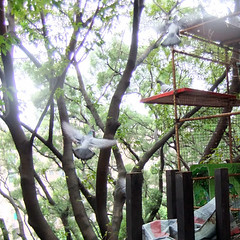
pigeons

Originally uploaded by maryannodonnell

today was the 15th of the 10 month of the lunar calendar, so i did what all good girls do – went temple hopping. chiwan is one of the natural harbors that constitute the port of shenzhen. before reform, chiwan could only be reached by way of a boat launched from shekou, heading north up the pearl river. today, chiwan is easily accessible by the 226 or 355, but still retains something of a backwater feel. indeed, chiwan has the scruffy feel of a potentially hip artist colony, except for the lack of artists and the vanishing coastline.

that said, chiwan is fun because it also boasts some of the oldest sites in shenzhen – the tianhou temple (technically the oldest in the area. zheng he reputedly stopped here, and emperors from the ming and qing gifted stele to commemorate upgrades and rennovations (!) to the temple). chiwan is also site of the grave of the last song emperor – a child who was drown with and by a loyal follower so he would not be dishonored by the yuan. the little emperor’s tomb is maintained by the zhao family.

hop, hop.

计划赶超变化–a new era in Shenzhen development

赶 is often translated as “to overtake”, but can also mean “to drive away”. It first appeared in Chinese political discourse in 1957 when Mao Zedong responded to Nikita Khrushchev’s statement that “the Soviet Union would overtake the United States in 15 years” by saying that “In 15 years the PRC would overtake England”.  In 1958, Liu Shaoqi supported the Great Leap Forward with the idea of “Surpassing England and overtaking the United States (超英赶美)”. Indeed, in Shenzhen’s previous incarnation as Baoan County, there once were two communes named Surpass England and an Overtake America, respectively.

In many of the online interpretations of 赶英超美 (here and here, for example) Reform and Opening (改革开放) is offered as the correct policy for achieving surpassing and overtaking. This scenario is one way of understanding both the importance of Shenzhen (first and largest experiement in reforming and opening the planned economy) and why it is often experienced as “not Chinese”. Indeed, residents have often asked me how similar the United States and Shenzhen are.

赶 reappears in Shenzhen popular discourse in the late 80s and early 90s in the expression “plans can’t keep up with change (计划赶不上变化)”, which comments sarcastically on the governments inability to implement its urban plans. In Shenzhen, for example, the overall plans have been done in 15 year bursts. This has meant that what is planned isn’t built for years. More often than not, village developers and others have taken advantage of this situation to errect their own buildings. Thus, in the 90s, I frequently heard the expression “计划赶不上变化” to explain this situation.

During the 80s and 90s, de facto independence from government plans in Shenzhen resulted in a kind of pioneering exuberence that was often called “the Shenzhen spirit (深圳精神)”, but also found expression in slogans such as “little government, big society (小政府,大社会)” that moved with Shenzhen mayor Liang Xiang to Hainan in 1986 and which continues to inspire debates about changing the relationship between the government and the people (here, here, and here).

However, in conjunction with urban village renovation [administratively located in “Urban village (old village) renovation offices (城中村(旧村)改造办公室)],the government has  recently begun razing buildings that were erected on these unused sites, justifying their actions (with or without compensation depending on various) with respect to the plan. This means that Shenzhen may have entered a period of that could be called “plans overtake change (计划赶超变化)”, whereby neighborhoods of several years are being razed to make way for roads and other public infrastructure (the subway) that have been planned for years.

I am interested in how “plans overtake change” because it describes several of the important contradictions that over time have taken root and flourished in Shenzhen.

Continue reading

玉历宝钞:return of the repressed, reworked for the current age


old museum entrance

Originally uploaded by maryannodonnell

Recently I have noticed that buddhist iconography is seeping into local shrines, which have been growing stronger this past decade. At the Daxin Tianhou Temple, for example, Guanyin (boddhisattva of compassion, but also the Goddess of conception) and 天花娘娘 (Tiānhuā niángniáng the Goddess of pox -cow, small, and vaccines thereof, who also heals disease in general and is somehow related to conception) have joined Tianhou on the alter. Also, popoular Buddhist texts and sutras are being distributed in local shrines and temples. In fact, the Shenzhen Hongfa Temple in Fairy Park is actively publishing and presumably delivering these tracts. Other sutras are published by very local printers, whose addresses include place markers such as “side alley”. Continue reading

Tianmian: East West South North

About a year ago, I had the privilege of participating in Vexed Urbanism: A Symposium on Design and the Social at The New School. I contributed Tianmian: East West South North an image poem that mapped four of Shenzhen’s formative ideologies along east-west and north-south axes.  In this piece, I aim to show – quite literally – how landscape is never simply place, but also and always a symbolically organized world, a cosmos. Thus, Tianmianillustrates how it is possible to read not only Shenzhen’s history, but also the values that have informed the city’s construction in the lay of the land, the placement of a building, and movements in and out of an urban village.

East West South North

Shekou 30th anniversary

This year marks the 30th anniversary of the China Merchants (招商局) Shekou Industrial Zone (possibly park). Shekou was established one year before Shenzhen, which celebrates the city’s thirtieth next year or the following year, depending on whether one counts from the year Guangdong approved the decision to establish Shenzhen (1979), or the Central government (1980). The SEZ border with the rest of the country wasn’t fully in place until 1986… Anyway, all sorts of commemorative events have already begun, including randomly posted pictures of Old Shenzhen, here, here and here, which are worth checking out to get a sense of the scale of change.

(Although the first set are actually from the 25th anniversary. I really do have to write about the ongoing and seemingly compulsive revisions of Shenzhen history. In a city that is constantly referred to as having no history, the historic compulsion is not only alive and well, it also shows up in advertising as “11 years of experience” as if 11 years was a long time, and of course, it is, but only in the context of thirty years, which are considered nothing in the history of 5,000 years of civilization… contradictions, contradictions…)

One of the more famous pictures from the early years is of Deng Xiaoping writing the characters for Seaworld (海上世界), here. His daughter stands to his right and, looking over his shoulder is Yuan Geng, the man who initiated many of the reforms that are today considered central to reform and opening, including: the first industrial park open to foreign investment, directly hiring and firing employees (rather than using centralized work assignments), and introducing market driven management principles (time is money, efficiency is life.

This picture is interesting for what it tells us about the political culture in which Shekou came into being as well as the kind of political and social change that Shekou once symbolized.

1. 1984 was the first time that Deng Xiaoping came to Shenzhen. He visited many places, but the two symbolically most important were Guomao (in Luohu, near the train station) and the Minghua cruise ship in Shekou. He inscribed characters for both the Shenzhen and Shekou governments. Shenzhen received the famous lines: 深圳的发展和经验证明,我们建立经济特区的政策是正确的 (the development and experience of shenzhen proves that the policy to establish an economic special zone was correct, picture of Deng Xiaoping writing inscription.) In contrast, Shekou received four characters: 海上世界 (seaworld).

2. The actual content of the inscriptions points to the differences between the early eighties Shenzhen and Shekou models of reform. Shenzhen was explicitly linked with politics. This is confirmed by the importance of Guomao, which was built as both a shopping center and an office building to house representatives from Chinese provinces, cities, and ministries. In contrast, Shekou was explicitly linked re-orienting everyday life from models of third world mutual support and mass production to capitalist trade and individualized consumption as a brief history of the Minghua and the four characters “Seaworld” shows.

The Minghua was a French cruise ship christened by DeGalle (1962). The Chinese bought it to transport engineering support to Tanzania in 1973 to build railroad in support of villigization—a form of African socialism based on the Chinese model. In 1979, then used as part of relinking Sino-Japanese relations. In 1983, the Minghua was moved to Shekou and refurnished as a floating restaurant and nightclub, where it anchored a westernized club scene.

3. When Deng Xiaoping inscribed the characters for Seaworld, he not only signaled his support of the Shekou model, he made the kinds of reforms that were taking place in Shekou a model for national development. Chinese leaders inscribe (题词) calligraphy to support organizations and policies. As of 1984, reform and opening did not only refer to administrative reorganization (as signaled by the Shenzhen inscription), but also to social and cultural reform. This is important because before 6.4 individual desires and political reform had not yet been brutally separated, so that in pursuing their dreams, young people in Shenzhen also represented a new kind of Chinese future.

4. The fascinating and ongoing politics of the smiling face. Smiling continues to be, like inscribing phrases and words, a way that Chinese leaders publicly express political support. This picture of happy leaders was a metonym for reform society: following this path will lead to a happy future. It ties into traditional paternalism, in which strict fathers only smiled when their children truly did something well.

historic preservation

i have been reading about ideas and efforts to renovate shenzhen, and have discovered an intense interest in historic preservation. there are several obvious examples–the chiwan tianhou temple (museum), the renovated dongmen commercial area (west of dongmen road), nantou old city, the hakka compounds in longgang, pengcheng garrison–and several more recent “discoveries”–any of the early 1980s light industry parks, remnants of older villages, a ming dynasty temple in baoan, older ancestral halls, dongmen commerce before historic renovation (east of dongmen road), 4 and 5 star hotels from the late 80s and early 90s, including the eastern pearl luxury cruise ship landlocked behind a golf practice range in seaworld. in various ways and with various degrees of success, all of these areas have been integrated into the new shenzhen.

of course, at stake is the question: what counts as history? the current effort to renovate inner city villages acknowledges that shenzhen’s only living cradles of pre-urban history are the villages, but on the other hand, what makes shenzhen “special” has been its urbanization. this contradiction means that even when village histories are chronicled and preserved, they do not resonate with shenzhen’s migrant communities. nor have i heard (note: what follows is highly anecdotal) that historic preservation in one village means anything to folks from other villages, except to encourage them to write their own histories. these histories re-write village history in terms of urbanization and what shenzhen has done for them.

so one telos, with history becoming the search for one origin. perhaps this is where the difficulty lies in writing shenzhen history. there isn’t one origin, nor one telos for that matter. even bracketing multiple development trajectories at any one time, there is still the fact that shenzhen’s official goals for urbanization have changed with every urban plan. this means that the editorial choice for one origin becomes deng xiaoping’s decision to establish sezs, and the telos becomes whatever has been built to date. so writing shenzhen’s history becomes tracking the history of changing teloses…and this is invisible. we lurch from one state of being to another, but can’t remember what was here before, or are compelled to forget what was here, even yesterday… we are busy explaining the link between deng xiaoping and shenzhen today.

the difficulty of trying to make shenzhen’s multiple teloses visible became clear to me several weeks ago. i met with a friend to show him several years of pictures of houhai and he said, “i thought the change would be more obvious. i can’t tell which pictures were taken first.” image quality told part of the story–i’ve used better cameras over time, so the better the resolution, the more recent the picture. its true. houhai has changed, but the way its changed–reclaim land, build tall buildings–hasn’t. so signs of change include building style, height, materials, distance from original coastline, which is marked by the oldest buildings, green space (as shenzhen has become richer, landscaping has increasing relied on imported, rather than local plants). but who has this kind of knowledge, which might form the basis of some kind of historic recognition? this knowledge is excruciatingly site specific. and people like my friend who haven’t repeatedly walked the coastline, don’t see the change. they see, instead, more of the same and when i visit places in shenzhen, i often find myself relying on knowledge of other places to read the extent of urbanization…

i am tempted to compare this feeling of eternally recreated present to the scene in the matrix, where the keanu reeves character (who’s name i’ve confused with nemo the fish) figures out he’s in a computer program because of a glitch; the same woman in the same dress walks by the same building twice, and only that experience, that moment of awareness reveals change. so history writing becomes looking for these glitches that otherwise go unnoticed.