train station blues

The Spring Transport (春运) continues. The railway has moved waiting areas outside the station, and people with placards announce departures and lead travelers into the appropriate terminal. The place names — Chengdu, Wuhan, and Nanning — remind me how large the country and diverse Shenzhen’s immigrant population.

I also visited the Luohu Commercial Center, where the English spoken by the various shopkeepers caught my attention. It seemed as if copied out of a stereotype of Hong Kong movie because it was so standardized, “Missy, copy watch. Missy, DVD.” In English, speakers shared the same accent, vocabulary, grammar, and inflections despite the fact that they spoke different Chinese dialects and had different levels of formal education. Some spoke Cantonese, others Mandarin, still others conversed in Hakka and I think I heard Chaozhou language, but the English had smoothed out into something recognizably “Luohu”.

So, I’m thinking about the way that situations — like immigrating to Shenzhen or working at the Luohu Commercial Center, for example — mold us into expected types, making it easy for our diversity to be discounted because rendered superfluous. I’m also wondering how we train ourselves to see beyond expected type, not only when interacting with others, but also when presenting ourselves because the differences actually make us interesting.
two walks in guangzhou

Just spent three lovely days in Guangzhou, enjoying conversation at Sun Yat Sen University and visiting tourist spots, including a walk along the river and a ride on the bubble train atop the Guangzhou Tower. Very Tale of Two Cities simply because looking down is so different from looking through even though vertigo set in when I tried to walk out onto a glass bottom viewing deck. No, I didn’t leave the opaque floor and yes, strangely did not feel as afraid when I walk outside onto the viewing tower and into the bubble train. Images below:

This slideshow requires JavaScript.

Reflexive Anthropology, yes??

Over the course of a year, we live so many lives it seems simultaneously naive and cynical to claim that we are always the same, demanding constancy of ourselves and others. In terms of knowledge production, those lives intersect and abut and transform each other despite housekeeping efforts to maintain distinctions between private and public, rational and sentimental, emic and etic, the known and everything else. So, rather than end 2011 by reviewing other people’s lives and events of global importance, instead I’m offering a facebookish mash-up my 2011. Glimpses of the sharing that has made my year possible and thus created conditions of possibility for writing Noted, situating knowledge, below.

This slideshow requires JavaScript.

Christmas thoughts

This Christmas, while wandering through spaces decorated for Christmas parties and romance, I realized that in Shenzhen, Christmas is a night of countdowns and parties  because folks here think about Christmas as “western new year”. My Chinese friends and many others use associated festivities as means of making new intimacies, rather than confirming old intimacies, which is what they do at Chinese New Year’s. So last night, there were Christmas parties, romantic dinners, and declared intentions; today, I will go to a spa with friends and then have dinner at another friend’s house.

I’m not sure how many圣诞节s I have now spent in Shenzhen, however, I remain both dazed by interpretations of how Christmas might be celebrated in the total absence of religiosity and also overwhelmed by the kindness people have shown me because they know how hard it is to be away from family on days when we remember and assert intimate belonging. Alas, it is far too easy to reduce Chinese Christmas celebrations to another excuse to sell decorations and presents that didn’t get shipped to western markets, especially, when less than ten years ago people were still asking me which was more important, Christmas or Halloween? Nevertheless, today, I’m remembering that any shared holiday potentially exceeds our cynicism and yes, offers the chance of mutual redemption precisely because we gather.

Happy holidays.

happy happy

Walk about pictures and bus, Dec 24.

This slideshow requires JavaScript.

productivity PK understanding

I have been having disturbing thoughts about compulsive productivity in the arts and academia, and yes, I know, Marx wrote eloquently about alienation, but it bears repeating: when we become cogs in whatever machine we find ourselves, we loose our humanity – our ability to empathize, to feel joy, to surrender to unhappiness, to accept responsibility for the consequences of our actions even though we cannot control how things will turn out. And that’s the rub: I keep thinking that if we gave ourselves time to ripen, our artistic and intellectual activities would bear rich harvest, rather than simply withering away as we scramble to complete the next assignment. Dust to dust, yes, but in good time.

Specifically, I’ve been wondering about how “accountability” is measured – a book every three years (tenure track jobs) or an artwork at the end of a residency (global AIR programs), and then, I recall that the words themselves show up the economic metaphors that strangle compassionate creativity. Account-able. Measure-able. Profit-able. As if our work was to make count-able objects, rather than to create more fully human lives.

Rant over.

What is an election?

This past week, I learned that I didn’t know how Chinese elections are actually organized, a confessional moment that speaks to the heart of how deeply cultural assumptions construct my understanding of Shenzhen. (Oh yes, reader beware!) I thought that as a citizen of the – land of the free, home of relentless election campaigning even when its not an election year – United States, I knew what it meant when a Chinese newspaper printed pictures of Chinese people voting.

What did I think and how did I learn I was wrong? Continue reading

Japan Talk

Yesterday at lunch, a friend from Hong Kong talked about the influx of Japanese and how there was now speculation about how the local housing market would be impacted. This led to speculation that soon Shenzhen might also see Japanese home buyers. Someone then commented that the problem had been caused by arrogance — the Japanese thought a dike would be enough to protect them, when they should have sited the nuclear plants well above the coast. Then partial sentences about Japanese national character and a pause in the conversation, which was broken when someone commented, “The Japanese really are to be pitied.”

My friends are of an age that they were raised to hate Japan. Indeed, a large component of their nationalism has been anti-Japanese. No matter how bad CCP abuses of power have become, nor how strongly they support anti-corruption efforts, nevertheless every National Day, they have celebrated winning the War against Japan and remembered Japanese atrocities in Nanjing. So yesterday was interesting because my friends were actively processing anti-Japanese sentiments along with a strong ethical sense that victims of disasters are to be pitied and helped. Their ethical sense carried the lunch.

Obviously human empathy can be engaged before tragedies of this magnitude occur; my friends had been amazingly sympathetic for Wenchuan earthquake victims, for example. Yet yesterday’s lunch conversation  has me wondering about how much tragedy or meditation or ethical training is needed to get each of us out of the complacent antagonisms that define us as individuals or activists or patriots. And as citizens, how do we learn to hold our leaders more accountable for nationalistic hate-speach even when (and yes because) we have come to believe so much of it?

吃一堑长一智 – lessons from being robbed

Yesterday, while waiting for my rice to be weighed at the Coastal City Jusco, my purse was robbed. The thief made off with cash, a camera, my keys, bankcard, and Shenzhen metro pass. Unexpected and disquieting. What did I learn?

First of all, I learned the proverb, 吃一堑长一智 (chī yī qiàn zhǎng yī zhì), which literally means in taking a moat, you gain knowledge. A bit of wisdom a la trench warfare, where for the military to take a city, they lost a lot crossing the moat. It seems to be used, however, in the way I might say “live and learn” or Oscar Wilde once said, “Experience is the name we give to our mistakes”. Continue reading

who’s the happiest in your circle?

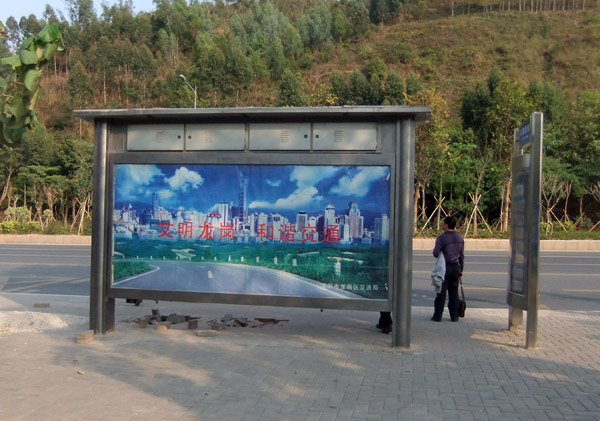
I have gotten somewhat inured to spiritual civilization campaigns like Longgang’s “Civilized Longgang, Harmonious Traffic” (above). After all, the offices have to do something with their budget and I actually support calls for more and better observation of traffic regulations, as well as teaching children to wait for others to get off a bus before charging on. However, this weekend YQ informed me that Shenzhen’s various Spiritual Civilization Bureaus (usually a division of the Ministry of Propaganda  精神文明办公室) have been asked to produce documentaries on “the happiest person I know (我身边最幸福的人)”. Nanshan is filming him because “we want to teach Shenzhen people that there’s more to life than making money.” Apparently, I was not selected because “foreigners do whatever they want, so there’s no educational value in [my] life.” — hee!