local is as local does. or not.

This week I have been thinking about iterations of the “local” in two sites: the 2015 Shenzhen Hong Kong Biennale of Urbanism/Architecture and the Baishizhou Street Museum. In particular, I’m thinking about the possibility of making connections from “here” to “there” when they hinge on the distance between (a) some outside understanding of what the local might be and (b) what might be interesting to actual locals. The possibility of meaningful dialogue is further complicated when “outsiders” and “locals” are organized by global hierarchies, internal class structures, and unquestioned ideas of what might be intellectually and/or aesthetically engaging. Continue reading

week in review: Sunday October 11 through Saturday October 17

I’ve decided to try posting weekly reviews; I’ve been busy, but missed the blog. I’m hoping that by scheduling a week in review post, I’ll reach a happy medium. Today, I’m publishing a short review, after today, I will be publishing the week in review on Friday mornings, Beijing standard time, which is conveniently the standard time for the whole country!

Bureaucratic hoop jumping:

Last week to extend my visa, I went to the police department. It is necessary to fill out the forms online, but those forms can only be accessed in the building. However, before I was permitted to enter my data, I had to show one of the officers that my documents were complete. They weren’t, so I went upstairs to make a photocopy. After I filled in the form, online, I took a picture of the screen so that an officer could print out my application by reading the registration number. This is necessary because it is impossible to enter more than one letter (A B C) in the line. Then I got my number and waited. Everything was okay, except that I had to bring my husband to the police department to fill our a guarantee letter that day, other wise I would have to do it again. We persevered and documents were submitted and accepted. Continue reading

the shenzhen anti-terrorism campaign

Although China has been strengthening its anti-terrorism campaign over the past year or so, the Shenzhen anti-terrorism campaign is recent. Ideologically, the campaign promotes a Neo-Confucian message of family first–a value that terrorists are purported not to share. Unfortunately, terrorists are more or less consistently represented as Muslim. In fact, the stereotypes used in the campaign are familiar from conversations I’ve had with friends over the past decade, when I have been told that Islam is not a religion but a terrorist organization. More alarmingly, as in the United States, Chinese anti-terrorism feeds anti Muslim sentiments and justifies increasing militarization of public life. Sigh.

Of note: the May 22, 2014 attack (in which men in ski masks jumped out of two vans to attack people in Urumqi) has become the stereotype of terrorist attack in the campaign. The following Inside Story by Aljazeera attempts to understand the increasingly violent situation.

handshake 302 at the shenzhen art museum!

3:00 this afternoon at the Shenzhen AT Museum, Handshake 302 presents “Of a Piece”, an interactive project that includes sewing, conversation, and relief from the summer heat. We’re also organizing pamphleteers (see above) to generate an audience for the project in the neighboring park. That’s right, SZAM is located in the East Lake Park/ Reservoir at the very edge of what (in 1982) was the eastern edge of the SEZ.

Please join us at S(ha)ZAM! The museum and its location (East Lake Park/ Resevoir) are “Old Shenzhen” from its 1980s’ incarnation. There’s even a nearby dim sum restaurant that as old as the SEZ just outside the park’s main gate. Below, a video snippet from the Dongmen Fabric emporium:

Jack Ma: World War III is coming, but in a good way

Thinking about hi-tech and Shenzhen? Well, actually Alibaba isn’t based in Shenzhen, but that said, the idea of setting up platforms to enable exchange and small-scale business is a very Shenzhen strategy of development. Indeed, according to David Li, this strategy distinguishes the Huaqiangbei model of shanzhai maker-ship from the Silicon valley model of R&D. Full article, here.

Ethics Asylum's avatarEthics Asylum

Image Credit: CNBC

World War III is coming, but it will be a good thing, according to one of Asia’s richest men.

Jack Ma, founder and executive chairman of Alibaba Group (NYSE: BABA), said Tuesday that the Internet and its various platforms will usher in a wave of global conflict. It will not, however, pit countries against each other, but instead will see the likes of China and the U.S. teaming up to defeat societal ills.

“The third world war is going to happen, and this war is not between nations,” Ma said during a speech hosted by the Economic Club of New York. “In this war we work together against the disease, the poverty, the climate change-and I believe this is our future.”

Ma said working to incite such a conflict is his life’s passion, and Alibaba’s mission of globalizing e-commerce can help.

“It’s not about the…

View original post 360 more words

houhai / xuefu rd

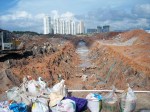
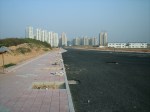
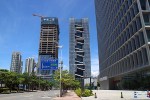
Today, I went to the Software Incubator Area and what to my wondering eyes did appear, but a landmark tried and true and watched for the past decade. It’s true and unexpected, but for years I have been documenting the land reclamation area east of Guimiao and north of Binhai (first impressions, here), and today on an errand to meet someone about the upcoming Maker Faire, I realized the road I was on–Xuefu Road–was in fact the road I had walked while documenting the emergence of New High Technology Park. Anyway, some before and after pictures:

dining at mao’s homestyle restaurant

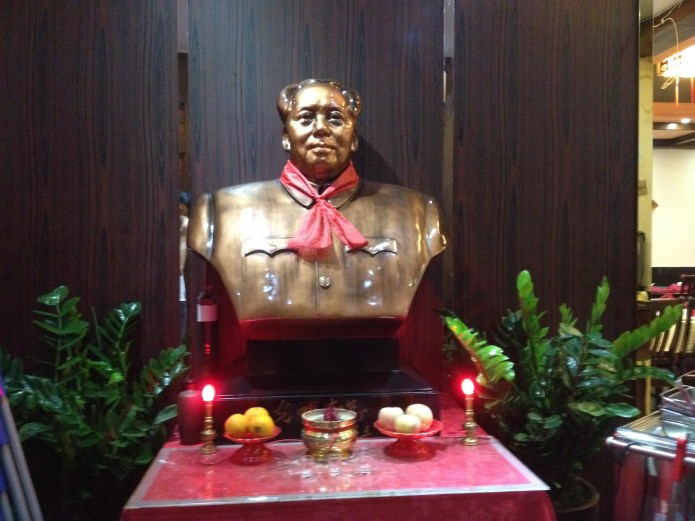
Mao’s style food is barbaric spicy Hunan food. At an eponymous restaurant (毛家菜), he and his red handkerchief occupy the entryway. There is a God of wealth in the corner. My interest in Mao’s godhead caused a bit of awkwardness with a friend, who is anti-superstition and often finds things anthropological condescending. She let me know in no uncertain terms, it would be inappropriate for me to use this image as a WeChat avatar. And then she softened the blow, “You like to use your art work. Keep doing that, everyone likes it.”

shen kong: the different faces of state capitalism

A recent article from the Epoch Times asserts that Shenzhen has surpassed Hong Kong in competitiveness because of the way Beijing has intervened in the economies of the two cities. Indeed, the establishment of the Qianhai Free Trade Zone speaks to the continued transfer of international economic functions from Hong Kong to Shenzhen through the deployment of “special” policies. This is, in fact, a solution to the one country-two systems policy that–for years–many foreign commentators ignored, when it was thought would Shenzhen become more like Hong Kong? Well, it has. And inquiring minds want to know: cui bono?

From the Epoch Times article: For the first time in a decade, Hong Kong no longer tops the list of competitive cities in China, and its due to the stifling hand of the Chinese regime, commentators note.

According to the Chinese Academy of Social Sciences’ recently released Blue Book on Urban Competitiveness—a survey of 294 China cities, Taiwan included—Hong Kong now ranks number two, falling behind its neighbor just across the border in mainland China, the metropolis Shenzhen.

The survey report claims Shenzhen topped Hong Kong, a bustling international financial hub and former British colony, because the mainland city better backed innovation—in 2014, Shenzhen government spent 4.05 percent of its gross domestic production supporting its innovation and technology sector compared to Hong Kong’s 0.73 percent.

The report also said Hong Kong’s standing was affected by last year’s student-led Occupy protests. From the end of September to mid December, hundreds of thousands of Hongkongers held three areas of the city to protest a restrictive Beijing diktat on political reform in Hong Kong (more).

handshake with the future: shenzhen’s maker plus culture

The world has glommed on to Shenzhen’s Maker culture, but what is often left undetected is just how Maker Plus the city actually is. Yesterday afternoon at Handshake 302, we held the opening for projects by interior design students from the Guangdong Xin’an Polytechnic College. During the opening, the conversation about their work focused on bridging the distance between design and implementation. A key thought came from Lei Sheng, Handshake 302’s master craftsman (seriously, he can make anything): in an information age, information isn’t the most important element for creativity. Instead, the knowledge of making things with our hands–craftsmanship–is the key to a successful design career.

Continue reading

handshake 302: WeChat connections

Handshake 302 has been we-chatting in Chinese for half a year now. We are now starting to offer updates in English as well. If you scan our barcode (above), you will receive updates in English and Chinese about one of Shenzhen’s most vibrant public arts projects. The updates also include information about upcoming events and instructions about how to join our events. Welcome to the conversation!