Enlightenment is where we find it. Today, the mountain village of Zhanglang, Menghai County, Xishuangbanna, Yunnan. Impressions, below.

Enlightenment is where we find it. Today, the mountain village of Zhanglang, Menghai County, Xishuangbanna, Yunnan. Impressions, below.

One of the more interesting architectural continuities between Maoist Tangtou and Handshake Baishizhou is the ideology of egalitarianism (平均主义).
When Tangtou villagers first came to Baishizhou in 1959, they gave up their rural status and became members of the Shahe Farm (沙河农场). As members of the Farm, their hukou status was “non-rural (非农)”. This meant that they had rights to socialist welfare benefits, including housing, a salary, a rice allocation, and education for their children. In turn, they gave up their land rights. All this, even though they continued to do agricultural labor. Thus, as a architectural typology, Tangtou’s flat houses were not rural buildings — traditional or modern — but rather socialist dormitories.
According to the Maoist planned economy, non-rural members of socialist work units were entitled to dormitory housing, or “one houselhold, one room (一户一间)”. Within these dormitories, all facilities were the same — the same size sleeping and communal areas, the same number of windows, and the same access to the collective canteen and outhouses, differences in family size, notwithstanding. This type of dormitory construction was the architectural manifestation of a larger egalitarian ideology.
Of course, architectural egalitarianism was relative to regions as well as local resources. For example, the dormitories that Tangtou villagers built in Baishizhou were one story structures made of cement admixtures, wooden beams, and Hakka technology. After the canteen system broke down, families constructed small stoves outside their front doors, but continued to share nearby outhouses and wells. In contrast, dormitories in cities ranged from buildings of stacked, one-room efficiencies with a bathroom at the end of the hallway to buildings of multiple room apartments. In the colder northern cities, the decision to turn on and off central heating for everyone in a dormitory was an extension of this theory as was the decision not to provide central heating to dormitories south of the Yangtze River.
The construction of urban villages in Shenzhen has been an extension of architectural egalitarianism in the post Mao era. All handshakes were built on plats of 10 X 10 meters. To insure equal access to sunlight, there is a mandatory distance of 3 meters on the east-west axis between buildings and a distance of 8 meters on the north south axis. This mandated layout is the basic grid of an urban village. Moreover, when juxtaposed against older settlements, including rural dormitories like Tangtou or village settlements at Hubei, for example, the layout of a handshake settlement extends and often further rationalizes the egalitarianism of the previous layout.
This form of development has brought with it two urban planning conundrums:
The ongoing ruralization of Tangtou (and other urban villages neighborhoods) has had paradoxical ideological effects. On the one hand, thinking of Tangtou as rural empowered Tangtou residents to make handshake land grabs. On the other hand, thinking of Tangtou as rural continues to justify the exclusion of Tangtou residents from discussions of future development, differing to the expertise of “urban” intellectuals and authorities. Moreover, the urban planning problems presented by Tangtou are considered effects of “rural” and “traditional” thinking. However, Tangtou is as “rural” and as “traditional” as Greenwich Village, NYC. The current built environment of Mao-era dormitories and post Mao handshakes is itself a product of non-rural socialism, first as the Shahe Farm and then as the Shenzhen Special Economic Zone.
And there’s the rub: what does it mean that “rural” and “traditional” Tangtou Baishizhou has come to represent all that is good and problematic about Shenzhen’s “urban villages”? More generally, what are we to make of Maoist egalitarianism — both its continued appeal to the broad masses of Chinese people and its problematic manifestations — when we confuse it with a Chinese past that never happened?

Window of the World opened in 1984, on the auspicious day of 6.18 (June 18). Yesterday, I visited WoW with Constant Dullaart, one of the residents in this years OCT Art Residency. The featured image for this post is a snap of us in front of Niagara Falls.
This is the first time I’ve visited WoW since 1997, and was impressed by two of the new installations — a plane ride trip through the United States (installed 2004) and a toy train ride through mountainous Europe (June this year). The plane ride uses IMAX technology and moving seats to give the impression of flying coast to coast on a double wing plane. At each landmark, white Americans wave to visitors, yelling, “Welcome to the United States”; in watery areas, visitors are lightly spritzed with water. The toy train is less high-tech, but more popular with young children. According to one of the friendly staff members, these rides are part of plans to shift WoW entertainment from viewing miniature landscapes to interactive rides and activities; I’m thinking WoW goes Epcott.
I was struck not only by the yearning for elsewhere manifest in the WoW installations, but also by the continuing nostalgia for a particular kind of elite life. Tourism as an activity of early 20th century elites continues to shape built forms of this yearning. (Or perhaps we experience nostalgia in search of an object?) This neo-liberal appropriation of colonial forms of pleasure was also been reproduced at Shekou’s Seaworld, circa 1984, where the plaza houses western consumption in quaint buildings and the landlocked Shining Pearl.
Seaworld was one of the first efforts to materialize Chinese yearnings for the better (relentlessly global) life. Nevertheless, by the early 1990s, when WoW was built and developers put up European style estates (with appropriate tributes to Versailles excess), Shenzhen grappled to implement neo-liberal economic policies without neo-liberal political changes. The political-economy of both early Shekou and 1990s Shenzhen were reminiscent of early 20th century capitalism, when all sorts of material wealth began to appear, but only a few people were positioned to enjoy it. Or more to the point, perhaps, only a few elites had both the leisure and resources to enjoy it, including romantic alpine train rides and virtual plane rides on double wing planes a la the Wright brothers.
The fantasy life infusing representations of the early 20th century high life — the fashionable world — were a fixture of 1990s Shenzhen architecture. Seaworld and WoW, for example, were conceived and built in the post Tian’anmen era, when “European-style” housing estates were also popular, including OCTs upscale Portofino. In fact, throughout Shenzhen, but especially along Shennan Center Road, the mini-fascades that wrap WoW and Seaworld dreams have been enlarged in themed real estate developments, where many of Shenzhen’s solidly middling middle class still live and to which many migrants aspire.
Yesterday morning while waiting for Constant, I stood at the subway exit that is located beneath the Jiang Zemin inscribed glass pyramid and watched ticket scalpers approach tourists. The tourists spoke accented Mandarin, and had organized themselves into small groups of carefully dressed visitors. They examined the pamphlets, considered their options, and then opened their umbrellas to embark a rainy day of exploration. Those I later saw again within the park seemed to be enjoying themselves; I certainly enjoyed the toy train and virtual plane rides.
In recent years, of course, Shenzhen’s vision of the world has gone SciFi glassy — steeled if you will — against the imaginary onslaught of encounters with alien lives. However, that kind of elite consumption does not resonate with the same visceral pleasure of early 20th century elites enjoying both their traditional privileges and the mass produced delights of a new era. I’m trying to figure out why. Guess du jour: we want elite agency, but we want it as pleasure,in the play of tourism and leisurely meals, for example, rather than as the high stress, overwhelmed and overwhelming agency that seems to characterize elite life on the ninety-first story of a 21st century glass tower.
Postcards from my Alpine excursion, below:

I have an ambivalent relationship to academic conferences. On the one hand, I find them physically exhausting because structured to produce the largest amount of intellectual work in the most efficient way. Sadly, intellectual efficiency, like all forms of efficiency is a statistical concept that can only be represented through quantification. The success of an academic conference tends to be measured in numbers of participants, sessions, and published proceedings — measurements which effectively transform intellectuals into academic line workers and make conferences just another station in what might be described as toolpath control over knowledge production. Thus, I experience diminishing returns in a conference’s progression; early on, I am able to listen more actively and participate more fully simply because I’m rested and able to engage a diversity of theoretical positions and claims. In contrast, as the conference unfolds, I become physically tired and often find myself aware that my only contribution is the effort to engage a presenter’s work; I try to listen and understand.
On the other hand, I attend academic conferences because I yearn for intellectual conversations with people I do not meet in the general unfolding of my life. I have colleagues and friends in Shenzhen with whom I debate and discuss various issues. But in order to be inspired and challenged, or simply unsettled and honed, I need both the stability of familiar conversations and the jolt of unexpected encounters. Consequently, I continue to see old friends and opponents, while making new at conferences, which are by and large international and place me in proximity to scholars working both in and beyond Chinese borders. Thus, the conference format, especially when funded by academic and public institutions, offers opportunities to nurture and grow intellectually — precisely through intellectual companionship — both during and in the off time between stations sessions.
In other words, both the strengths and limits to Fordist knowledge production are relentlessly human; international conferences provide opportunities to be surprised and inspired outside the paths of everyday life, however, tired bodies can only do so much, even and especially when we are going through the privileged motions of academic conferencing.
On Oct 18-19, I had the pleasure of participating in the Masterplanning the Future Conference, which was organized and hosted by the Department of Architecture at the recently established Xi’an Jiaotong Liverpool University in the Suzhou Industrial Park. Organizers, Austin Williams and Theodoros Dounas’ attempted to address the inherent problems of academic conferences through a schedule, which started late enough in the morning and ended early enough in the evening to allow for conversations about and around the the question of high-speed development(s). Moreover, the conference structure attempted to open discussion to the widest possible audience, including a local audience for these ideas. On day one, for example, the public sessions raised general issues, their lay representations, and potential representatives, while on day two, the academic sessions provided more detailed analysis and examples of these issues. Finally, the conference itself was small enough to allow for participants to leave with a sense of the whole, satisfied that if someone were to ask me, “So, what was the conference about?” I could confidently answer, “English language efforts to come to terms with how China has shaped post Cold War thinking about and experience of urbanization. With a few divergences.”
That said, my interpretation of the point and purpose of the Conference differs importantly from the full title of the conference which was Masterplanning the Future: Modernism — East, West & Across the World. The aim to generalize at this scale meant that during sessions we inevitably stereotyped both ourselves and our interlocutors. All too often, the conversation reduced to statements that began with “The West this” or “China that”, rather than staying focused on more specific examples or standpoints that might allow for the negotiation of similarity and difference as shifting aspects of human experience, rather than as identifiable characteristics of mass populations. In this sense, the underlying assumptions of the academic sessions did not differ significantly from that of the public sessions, or even from a more general representation of China and The West at the university itself.
And there’s the rub: this tendency to stereotype distresses me not only because it seems intellectually dodgy, but also because it invariably reduces international relations and cross cultural understanding to semiotic match-making, in all senses of the term. Romancing the factory, so to speak. After all, the conference did take place in an industrial park, with an eye to global knowledge production and consumption.
Outside the XJTLU conference centered where we convened, for example, was a sculpture of a Tang lady and an English gentlemen playing polo (image below).
 Both ride culturally appropriate horses and wear culturally appropriate costumes. Both the Tang Lady and English Gentlemen are stylized representations of a recognizable elite, which in turn represent English and Chinese cultures, while glossing internal hierarchy and inequality within the United Kingdom and People’s Republic of China; Tang Ladies and English Gentlemen may represent the current elite of each of these countries, but in no way do they represent the lives of contemporary workers. Moreover, while I’m willing to entertain the idea that contemporary Sino-British relations are simply a game played by elites from the PRC and UK, nevertheless, the gendering of this statue is itself so stereotypically neo-colonial that I don’t know where to begin my critique.
(But really, if we insist on representing international relations through figures of hetero-normative couples, might we not consider a male Chinese zither player and a female British mandolin player, aiming for musical harmony rather than competitive sportsmanship as a unifying metaphor of international intercourse?)
All this to say: I think that these stereotypical elites and their games continue to echo throughout cross cultural conversation because leisure is one of the predicates of meaningful conversation. Here I mean leisure in all senses of the word — as unstructured time, as non-productive time, as pleasurably engaged time and the resultant inspirations, solidarities, and new beginnings. We know that we need to play together in order to create more meaningful relationships and concomitant social orderings; children do it everyday and, unlike us adults, they do it well, creating community out of mud pies and whatever else is at hand. However, unless we restructure the inequalities built into contemporary chains of production and consumption, including cross cultural production and consumption of knowledge, we will remain nostalgic for forms of elite leisure that we cannot have experienced, even as we mistake this deluded nostalgia with the necessary realization of leisure in society.
Sigh.

The walk from Central Walk Mall to the Civic Center by way of Central Park suggests the contradictory temporalities of Shenzhen speed, which was set when Guomao went up — one story every three days. Shenzhen Speed is time zoned urbanization, where architecture appears as a function of place X project-time subdivided by GDP expectations and the inevitable algorithm of actual buildings + entropy gains momentum in the absence of mindful inhabitation. Impressions from yesterday’s walk:

Below I republish my summary of the First AW Roundtable Discussion, which was held in March this year. The Chinese version of this essay appeared in the June edition of AW. An ipad version of Architectural Worlds can be downloaded at itunes store under ipad apps. We’re working on producing an iphone version.
I begin my report on the First AW Roundtable on Gossip and Architectural Practice with gossipy self-disclosure: I’m more interested in gossip about architecture than I am in architecture itself. I enjoy stories about buildings and their ghostly hauntings, listen attentively to the elegant yet doomed romances of medieval castles, and relish boomtown whispers of kickbacks and permit hassles. I have a fondness for gossipy architects. I appreciate their tales of thwarted efforts to transform a wasteland into a children’s park and admire their desire to realize social and aesthetic ideals through mud and clay, wood and rock, metal, glass, plastic, foam, and concrete. In other words, I value architecture to the extent that it provides a context – a stage, if you will – for the unfolding performances of everyday life, but I delight in gossip because it reveals not only the who, what, and where of a particular moment in a human life, but also and more importantly because it suggests the contours of shared and sometimes colliding moral worlds. In fact, I am tempted to suggest that gossip may be more important to the social life of architecture, than architecture is to social life.
Seven architects participated in the AW Roundtable, including Doreen LIU, LIU Xiaodu, Michael PATTE, RAO Xiaojun, Hilary ROBIE, ZHANG Miao, and Young ZHANG. They represented a range of cultural homelands (China, the United States, and France), a variety of architectural firms (international corporate, domestic partnerships, and individual practices), and a mélange of professional training, which encompassed top schools in China, the United States and Europe, in addition to their various apprenticeships in earlier stages of their careers. All interrupted extremely busy schedules to chat with others beyond the scope of their daily routines. Indeed, from my perspective as a non-architect, one of the most striking commonalities that participants shared was a hectic working life and in retrospect I now suspect that unless architects set aside time for chats, their “natural” gossip circle will not grow beyond the demands of a particular project or the time it takes to send and receive a micro-blog post. At the time, however, my artificial creation of a gossip circle had another motive; I was curious to not only hear how architects viewed gossip and its impact on their practice, but also to see how they interacted with non-architects who also cared about buildings and the construction of shared spaces.
All seven architects who participated in the AW Roundtable maintained that gossip had nothing to do with the actual practice of architecture, emphasizing instead that common technical training and aesthetic vision not only defined both their profession and their professional ethics, but has also created a circle of globetrotting professionals who receive similar technical and aesthetic training. Nevertheless, these architects have neither inherited common cultural traditions nor are familiar with the scale, scope, and changing players in each other’s hometown mass media, which are an important vehicle for national gossip. Even more narrowly, most are blithely unaware of the actual pedagogical process through which their foreign colleagues were certified in their home country. This lack of shared cultural experience means that amongst architects – especially those who work outside their home cultures whether domestically or internationally, technical training becomes the primary source of ethical standards and aesthetic choice emerges as an important marker of individual identity, begging the question: to what extent is an architect’s reputation nothing other than an “anthology” of the gossip about his concern for public engineering safety and his fidelity to a personal aesthetic vision?
The Backyard Reading Club hosted the AW Roundtable. The bohemian clubhouse reflected eclectic tastes and we sat in rattan chairs amidst Jack Daniel’s whiskey bottles, African masks, and quirky postcards from countries as diverse as Peru and Indonesia. Like the list of participants, the choice of the clubhouse was intentional; I thought that a relaxed and clubby environment would cause the distance between the architects and reading club members to soften, encouraging all to engage in lively conversation. AW provided snacks and drinks for precisely the same reason; hospitality generates the trust and good will necessary to meaningful dialogue. Robin Dunbar (1996) speaks directly to this point, “Gossip is good for you. Perhaps it is the development and equivalence of mutual grooming among other primate species, and that human language evolved precisely for this purpose: to soothe, reassure, and strengthen the bonds that exist in a community. Where chimpanzees will spend hours grooming each other’s fur, human beings will sit and chat for ages – in fact gossip makes up most of our everyday conversations – and the result is the same: a feeling of well-being and belonging. Rather than to make hunting in teams easier, or to allow us to express some metaphysical truths, language evolved to enable us to gossip.”
Dunbar’s chimps importantly remind us that proximity is a precondition for gossip to do its social work. Unlike rumors, which have no identifiable origin and flit nebulously along unmarked paths, gossip occurs between people in close proximity to each other. Chimps, for example, care about removing flees from their fur, while humans care about their family, friends, and neighbors and thus, as Dumbar notes, chimps and humans spend most of their waking hours near each other, grooming or chatting, depending on the species. These needs for mutual comfort are not simply psychological, but are also prerequisites to efficiently and pleasurably achieving common goals, such as healthy skin or designing, planning, and constructing an architectural project, respectively. During the AW Roundtable, for example, Michael Patte noted that as a foreigner who did not speak Chinese, he found it difficult to work in Shenzhen for the simple reason that trust relationships grow out of gossip sessions in which he could not participate. Hilary Robie made a related claim, when she provocatively suggested that what architects do is design places for people to gossip, small corners and winding halls, where unexpected encounters might occur, ideas might be nourished, and egos stroked, illustrating her point with observations a gossip map of her office.
Robie works in an open office, where desks are spread through out the space, representing several levels of space and thus several levels of gossip. On her interpretation, physical spaces provide opportunities for gossip which range from public to private. In the most public space, when the young architects and staff wish to gossip they walk over to a friend’s desk, pass notes, or qq. The content of this gossip is simple and its purpose, as Dunbar suggests, is to generate trust and a sense of belonging by sharing opinions about whether dislikes a design, has a favorite color, or admires a building. The next level of gossip occurs in semi-private spaces, like a glassed off office, where people feel more comfortable to gossip. Likewise, the staff canteen provides another space which encourages people to gossip and strengthen intimate bonds. The final level of gossip takes place behind the closed doors of the managers and partners’ private offices, where the topics of gossip include how to win from a certain investor or the aesthetic predilections of a particular urban planner.
Robie’s discussion importantly highlighted the ways in which “gossip proximity” is not simply a spatial concept, but also a metaphor for social position or power. Insofar as we are human, we gossip. However, insofar as we humans are a hierarchical species, we gossip with those of our own level (because they are next to us) about others (who may or may not be within touching distance). In fact, just as the firm partners gossip about officials in order to strategize the best way to pitch a design proposal, so too young staff members head off to the restroom to talk about said partner in order to figure out how to ameliorate an uncomfortable work situation. All this to say, in many instances the subject of a good chinwag is precisely someone we wish to influence because we have no formal means to control them, or as Max Gluckman argued in his foundational essay in social anthropology, Gossip and Scandal, “Gossip is a game, undertaken by members of a social group in order to maintain the coherence and unity of that group. When people gossip about each other, and about outsiders, they make ethical judgments about behavior and maintain their group’s social values.”
Gluckman’s point is two-fold, reminding us that although the content of gossip maybe trivial, nevertheless the purpose of gossip is anything but; when we talk about others we define ourselves as belonging to a particular circle – of friends, intellectuals, or even social class. This is important because none of us acts within only one social circle. Instead, we are constantly negotiating and redefining the boundaries of our various social identities, the relative importance of our various social memberships, and the extent to which we are willing to harden, police, and enforce the separation between our crowd and another.
I kept Gluckman’s insight in mind while editing my notes from the AW Roundtable because as the conversation unfolded it became clear that in addition to proximate intimacy, there must be moral ambiguity to make for an enticing and stimulating tête-à-tête. And there’s the rub: architects value engineering and aesthetics, while emotional wellbeing and social power are considered lesser or secondary professional values. This is perhaps why Doreen Liu suggested that the question of individual character was fundamental to holding social office such as politician or functionary, but that with respect to architecture private morality and professional ethics were separate issues: the standard for judging an architect was the quality of the object she designed and build. Young Zhang pushed the argument further, maintaining that creativity exists outside of morality. Liu specified that the creation of an architectural object is internal and personal to the architect, in contrast, once the design plans have been submitted to a competition or as a project bid, the object has a social life, which extends beyond the architect and over which she has limited control.
And yet. Architecture is fundamentally social. The built environment has meanings and possibilities that necessarily exceed the limits of architectural engineering and aesthetics. Importantly, engineering skills may be learned and standards specified, nevertheless architects and their work are talked about and evaluated within a diversity of gossip circles, which range from the City Hall, where government leaders meet to debate policy through the restaurants where developers and property owners meet to celebrate a sealed deal to the parks, where ordinary families relax after work. Crucially, if Dunbar and Gluckman are correct, then gossip and gossip circles external to architectural practice will have an important role in determining which buildings get built, where they are built, and to what purpose. In other words, to the extent that the planning, design, construction and aesthetics of diverse buildings place different groups of people into proximity with each other (thereby creating gossip circles), these same architectural practices also express the values of that society and as such are the legitimate topics of gossip, begging the question of how to delimitate the relationship between the specialist knowledge and tastes of those who design and the social values of those who will inhabit?
Doreen Liu usefully focused the roundtable discussion on two stages in the life trajectory of an architectural object, the personal and the social. Rao Xiaojun agreed with Liu’s characterization of architectural objects having double lives, but distinguished instead between the rational and irrational lives of architectural objects. On his interpretation, gossip was a manifestation of an object’s irrational social life. Urban planners and real estate developers award architectural commissions for reasons other than strictly aesthetic or technical standards. Rao maintained that if architects were to see their projects realized, then they needed to learn to successfully participate in non-architectural gossip circles – a provocative thought that cries for gossipy speculation: to what extent is the social life of successful architecture irrational and how might we take that irrationality into account when designing modern buildings and planning 21st century megacities? I ask this rather flippant question to make an unsettling observation: gossip is one way of dealing with the irrationality of modern cities, especially in the absence of organized public participation in contemporary architecture and urban design projects.
In reviewing my notes, I also kept returning to the fact that Dunbar’s chimps not only lived in close proximity to each other, but also in small bands, where any chimp could reach out and touch another. In contrast, AW Roundtable architects work all work in Shenzhen, where most of the Municipality’s 14.5 million inhabitants have never met an architect, while even the most active architects have gossip circles significantly smaller than the City’s official population. In fact, many of members of the Reading Club admitted that they had never been around so many architects at one time. Consequently, they were excited to have the opportunity to natter on about why there are so many ugly buildings as well as to satisfy their curiosity about architects as members of a profession. One Reading Club member expressed architects’ strange fascination for the public, “There are buildings everywhere we go, but I’ve never talked with an architect. I’m curious about their motivations and how they see the world.”
AW Roundtable participants had obviously thought about these questions and offered answers that highlighted the complexity of lives lived beyond the intimacy of mutual grooming arrangements. Young Zhang mentioned that the importance of aesthetic design, technological innovations, and engineering constraints to architects and their gossip circles were ironically the same factors that made architects uninteresting to the general public. He then added that the reason the public didn’t understand architects’ situation was because most architects led low-key life, but in order to have a public voice in mass society it was first necessary to become well known. He joked, “Nobody wants to talk about us. We need to have some scandal.”
By raising the question of public scandal and its uses, Young Zhang reminded us that even as civil engineering advances and modernist aesthetics transformed architectural practice, so too modern technology transmuted the form and functions of gossip. Benedict Anderson introduced the concept of “imagined communities” to describe one of the social effects of mass media. Imagined communities are different from an actual community because they are not (and cannot be) based on everyday face-to-face interaction between all members. Instead, members hold in their minds a mental image of their affinity that they have obtained through various mass media, including newspapers, radio, and television. For example, the hometown feeling that many have for modern metropolises does not only arise through the intimate proximity of neighborhood life, but also (and increasingly) when one’s “imagined community” is represented through televised news reports, local newspapers and periodicals, as well as urban plans and famous buildings. In other words, we say that we belong to a modern city because we identify with its symbols and assume that others who live within the same geographic area feel the same way. Of course, we have no means to verify how closely our feelings align with others, but that was precisely Anderson’s insight: in a modern society, we have learned to live in imagined communities, depending on mass media (rather than grooming and face-to-face gossip sessions) to create a sense of connection between ourselves and others.
Obviously, mass media both elaborated and altered traditional gossip circles. On the one hand, traditional gossip circles based on intimate proximity (close enough to caress or backbite) remain an important social form. Reading Club members’ desire to personally meet architects, for example, confirmed the practical value of intimate proximity in contrast to the social distance of imagined communities. On the other hand, because urban identity is produced through participation in imagined communities, Young Zhang and Rao Xiaojun’s suggestions that architects learn to fight for their projects using mass media gossip channels alerts us to the fluidity between real and imagined gossip circles. Indeed, one measure of success in shaping an imagined community is the extent to which one controls or has access to mass media. After all, gossiping about strangers and what they may or may not be doing simultaneously strengthens proximate intimacy and shapes our understanding – our conceptual image – of the larger community to which we belong. The juxtaposition of traditional and mass media gossip highlights the fact that these are not separate social functions, but hierarchically integrated ones. We live out our lives in intimate proximities, even though those who live in and act beyond our social networks often determine the content of quotidian gossip. In fact, traditional gossip circles usefully buttress the imagined communities forged through abstract mass media gossip; others to think about and have strong feelings on the lives of strangers who nevertheless symbolically represent “people like us”.
Although both traditional and mass media gossip circles provide venues for shaping architectural practice, nevertheless they have complimentary limitations. Shared time and space restrict the scope of traditional gossip circles, which require both spatial and temporal proximity in order to fulfill social functions, such as reassuring intimates or controlling the behavior of others. Mass media is less limited by time and space than traditional gossip circles, but this is in itself a limitation. Unlike traditional gossip networks which have immediate effects, spatial and temporal distance lesson the impact of mass media gossip primarily because we cannot actually engage the authors of mass media gossip. We read articles or watch television broadcasts and thereby imagine ourselves as belonging to an identifiable hometown city, for example. However, precisely because we cannot interact with the author, either in real space or real time, the format often neutralizes actions that might otherwise result from gossip.
More importantly, perhaps, one of the key differences between mass media and architecture is that architecture transforms a space. Although we may see a movie star onscreen and follow his love life in a magazine, nevertheless, the presence of mass media gossip is ephemeral. In contrast, buildings and roads, industrial parks and seaside resorts provide the context of daily life. Even if we never meet an architect, nevertheless we live with and within the shapes and colors of their vision and the changes to that vision, which others have made in the process of translating a design into an object. The invention and spread of online social media, especially micro-blogs have reconfigured the limits of traditional and mass media gossip. Suddenly, we face a gossip environment in which real time trends allow people to select gossip topics and be proactive in participating in conversations about shared issues. Indeed, the speed at which gossip spreads in this format is like nothing we’ve ever encountered and we are still trying to figure out what it means that we can’t actually verify the identity of an interlocutor, even though we can search for past statements. Moreover, the barrier for determining the symbols of our imagined communities is now no more than a hash tag about a common interest, but what kinds of communities might arise from a common interest in a rumor or changing gossip, even if that topic happens to be architects, buildings, or urban planning?
Several of the Roundtable participants and many in the Reading Club keep and read micro-blogs. Roundtable participant, Zhang Miao counts over 20,000 subscribers to her eponymous micro-blog and the Reading Club has a micro-blog secretary, whose job is to tweet activity updates to Club members. Zhang Miao’s discussion of micro-blogging reminded everyone in the room that not only architects or public officials have real interests in architecture; anyone who lives in a modern city has opinions about and ideas to improve architecture because we have daily, practical experience of what it means to inhabit a city. Moreover, outside of gossip, most urban inhabitants have few avenues for influencing the shape of where they live.
One of my motivations for organizing the gossip and architectural practice was to explore how one of the primary forms of human community building operates within a specific professional circle and then in turn interrupts and connects the relationships between architects and larger gossip circles, be they traditional, mass media, or weibo. Gossip is a juicy start to a discussion about the social meaning of architecture because gossip’s fraught status reminds us that human actions (like designing, erecting, and inhabiting a skyscraper, for example) are paradoxically polysemous and ultimately over-determined by what people say and how we say it. If we wanted to elevated this essay beyond the merely conversational into the rarified discourse of contemporary academia, for example, we could do worse than to define architecture as a particular amalgamation of “… dynamic and mutually constitutive, if partial and dynamic, connections between figures of anthropos and the diverse, and at times inconsistent, branches of knowledge available during a period of time; that claim authority about the truth of the matter; and whose legitimacy to make such claims is accepted as plausible by other such claiments; as well as the power relations with which and through which those claims are produced, established, contested, defeated, affirmed, and disseminated (Rabinow 2008:21)” and then to indicate that gossip is not only part of this social amalgamation, but also one of the primary genres through which truth claims are informally produced, established, contested, defeated, affirmed, and disseminated against and despite formal versions thereof. After all, Rabinow’s point is simply that in any society some people’s opinions matter more than others because they have a privileged relationship to the truth. Along those same lines, observing the various protocols and procedures which people have established for producing, debating, and disseminating truth claims is a useful way of distinguishing one group of people from other. Thus, we may speak of “the architectural object of anthropological inquiry” to establish our scholarly credentials, even as a flash in our eyes and a sudden quickening of the pulse reveal our gossipy inclinations.
I find merely academic or architectural or even economic analysis of gossip and architectural practice to be dissatisfying because ultimately, there is no single answer to the, “Why are buildings ugly?” Instead, different values shape urban possibility and the question of just how ugly a building is provides insight into how those values are socially ranked and measured. There is no reason other than social agreement why one value – aesthetics or engineering possibility, economics or social status – should be more important than another in contemporary architectural practice. Moreover, that agreement can only be reached through conversation and debate, in which gossip plays a critical role, especially when the public is excluded from conversations about the buildings in their neighborhoods and planning sessions. In fact, others have called for means to integrate the public into urban design of their neighborhoods and favorite urban haunts. To this large literature the First AW Roundtable on Gossip and Architectural Practice adds a simple footnote; not allowing the public to participate in architectural design and urban planning will not stop tongues from wagging about technical, social, aesthetic, economic, and/ or environmental values when designing, planning, and constructing shared spaces because human beings do gossip. More importantly, gossip is also a means for many outside formal conversations about whither urbanization to voice anxieties about the direction of urban development and to attempt to influence a situation over which they have no control. With respect to architectural practice, gossip is neither simply a means to nurture professional camaraderie, nor a weapon within social debates about whose designs will get built, but also a vehicle for creating imagined communities and expanding the conversation about what it means to inhabit shared worlds.
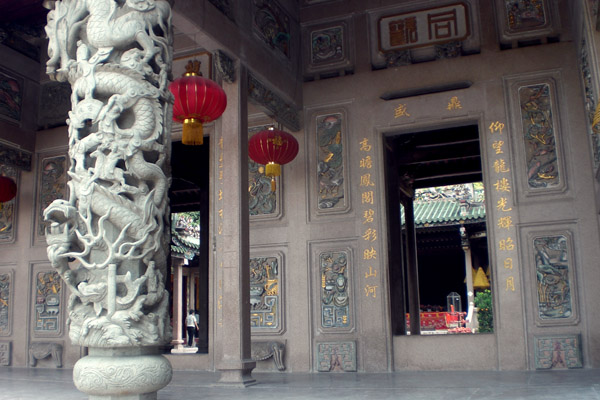
At the foot of Fenghuang Mountain, Fuyong, there is a small temple to the Dragon King. The Wens of Baishixia renovated the temple in 2003. Nearby, the outer row of factories in the Dragon King Temple Industrial Park have been given a faux traditional facade. Above, squatters inhabit small, concrete buildings at the foot of the stepped lychee orchard. Impressions.

Images from Old Loucun (旧楼村), a large swathe of crumbling tile homes, traditional brick homes, narrow roads and alleys, and mid 80s 2 and 3-storey homes. Handshakes on horizon.
Thursday last, I walked Old Hubei Village with Chen Ting, an architectural graduate student with an interest in the landscape of Shenzhen’s state-owned industries. A walk around the train station and then through the Dongmen pedestrian street brought us across the Dongmen pedestrian overpass to the complex neighborhood where Hubei Villages Old and New abut the Luohu Culture Park, crumbling 80s factories, and 90s high-rises and one of the oldest Shenzhen food-streets eased into dusk. Impressions below:
 Shenzhen Noted