和平县阳明镇新塘村: field-tripping


新塘村:new tang village, sunrise

the attitudes of young shenzhers, especially the children of the city’s upper classes, confound their elders, who really don’t know what to do about a generation that hasn’t experienced material poverty. almost thirty years into the shenzhen experiment, a certain material standard of living has become the norm among these children. they expect to have new clothes, pocket money for snacks, and the latest technological gadgets. indeed, if newspaper reports are to be believed, they are a wasteful and lazy group, who take long showers, play online games, and shirk homework responsibilities; in the language of american pop sociology, shenzhen’s young people think they’re entitled not only to what they have, but also to whatever they want.

to counteract their children’s sense of entitlement, wealthy shenzheners tell stories about impoverished childhoods and hungry farmers. these stories are as unsuccessful as those my parents told me: when i was a child, we walked four miles to school; eat all your food because there are starving children in africa. on the one hand, i think these stories fail because children don’t have the experience to imagine beyond their immediate lives. on the other hand, i think these stories fail because children know (even as i knew) that our parents aren’t going to radically restructure their lives to help either starving africans or farmers. instead, these stories aim to change the behavior of children, not to ameliorate social inequality.

nevertheless, adults still try and children still play along. on the 26th and 27th of october, our middle school went on a field trip to greater tang village, yangming township in heping county, in heyuan city (河源市和平县阳明镇大塘村) which is considered an impoverished area (贫困区). according to the heping township officials who hosted us, the official definition of “impoverished” earns less than the national average income but still has enough to eat. usually, families can afford school fees up through middle school, but often have difficulty meeting high school costs, let alone university expenses. according to a people’s daily report the 1,000 odd villagers that make up greater tang village (an administrative territory which is composed of 15 “natural” villages) demonstrate the fact that even if the richest villages are in guangdong province, their are villages that haven’t started getting rich, let alone keep up with the coastal villages. in chinese the expression for these poor cousins is “后无追兵” or “no following soldiers”.

the purpose of the trip was two-fold. our school wanted to give our students a new perspective on the privileges they enjoy as wealthy shenzheners as compared to impoverished students. our yangming middle school hosts wanted their students to be inspired to study even harder to break out of the cycle of poverty. as we discovered during the two-day fieldtrip, many of the yangming students had older brothers and sisters who had dropped out of middle school or not gone to high school in order to begin laboring in places like shenzhen. indeed, a fifteen year-old ninth grader told me she wouldn’t bother taking the high school entrance exam and go right to work after graduation from middle school next june.

the yangming high schools arranged host families for our students and teachers. two of us were assigned to a home, where we ate, slept and were shown the village. yang ming eigth grader, huang shanshan hosted me and my student nicole. shanshan and her family live in new tang village (新塘村), one of the 15 natural villages in the greater tang administrative village nestled between rocky slopes, rice paddies, chicken coops, and family gardens. xin tang village is a hakka (客家) settlement, where paths and shared walls connect the homes to each other, creating a densely populated space. there is a clear spacial division between the village and cultivated areas. indeed, the relative care given to the rice paddies and gardens was striking in comparison to the village proper, where it seemed people took care of inside their homes, but did not care for common areas, which were given over to garbage and scavanging chickens. people seemed to spend a great deal of time outside on paths, working and chatting.

nicole and i shared the only bed in the house; shanshan and her parents slept upstairs on mats. the house was made from local bricks covered by cement, wooden beams supported the ceiling. the first floor consisted of a main room and a kitchen. the main room was divided into two sections, a sleeping section, where the bed was and a social section, with a table, television, and several chairs, some plastic, two made of bamboo. the wash room was a concrete room built next to their pump. for our evening wash, shanshan heated water in the kitchen and then added pump water to adjust the temperature. the outhouse was a separate brick building with a trench dug into the earth. above the trench was a bamboo plank, where i squatted several times a day to relieve myself.

shanshan and her parents moved me with their generousity. they killed a chicken for us and prepared fresh vegetables, eggs, and homegrown rice. when we left, they gave us fresh eggs, homegrown peanuts, and special deep-fried potato cakes for the trip. yangming township gave us a box of kiwi fruits that were locally grown. indeed, their generousity eased the relationship, enabled it to move beyond a tour of poverty. i had feared that the trip would turn the villagers, especially our hosts, into exhibits in living museum and would turn us into tourists. the school had instructed students to give money to their host families as a token of their appreciation, and much thought had been given to what would be the correct amount: not too much so that the families were embarrassed but not so little that they lost materially by hosting us. although the act of hosting didn’t unmake our material inequality, it nevertheless did ameliorate some of the awkwardness of the visit. it certainly reminded me that each of us has something to give and that all of us have a responsibility to accept what is given graciously.

a native of longgang, shenzhen, nicole is also hakka. she enjoyed the trip because it brought back memories of her childhood before her family moved to downtown shenzhen. she grew up in a village like shanshan’s and used to sleep on the same kind of bed. more importangly, she remembered the beauty of the countryside and wondered about why modernization meant the destruction of beautiful places. specifically, as part of shenzhen’s ongoing expansion, her natal village will soon be razed and an upscale housing development built in its place. also, nicole said that she only understood about 70% of what shanshan and her parents said and preferred to speak with them in mandarin, reminding me again of how many variants of local languages (方言) there actually are. after all, heyuan is only a 3 hour drive away from shenzhen.

the belief that youth can be motivated by direct experience inspires this project. more specifically, adults in both places expressed that more communication (交流) between students from both areas would be beneficial. on the one hand, shenzhen youth might learn humility and social responsibility, while yangming youth might learn their are higher goals than working in a factory or restaurant. consequently, our schools hope to establish a hand-in-hand (手拉手) relationship with the yangming first and second middle schools, enabling students and teachers to visit each other.

i hope that this kind of experience might accomplish what exhortations rarely do–inspire us adults to help our children change the world. i know that this experience manifests one, more traditional (in the socialist sense of the word) meaning of the shenzhen experiment, which not only aimed to open china to the world, but also to improve the material wellbeing of all chinese people. in fact, at 63 our school principal is a child of the revolution and she still approaches education with an eye to socialist goals. as a friend of mine said, if china can improve the living standard of all chinese people, bringing stability to its internal affairs, it will have contributed to world peace. one could say the same for the united states and that we start one friendship at a time. i have posted some fieldtrip memories in my galleries.

玩: Hong Kong Disneyland and Ocean Park

玩(wan)means to play, to goof around, sometimes just to hang out. Wan is allied to 放松(to relax)and opposed to 工作(to work). Children are said to crave wan (贪玩), which is not a good thing, but nevertheless natural. Youngsters who can overcome (克服) their impulse to wan have reached the age of understanding (懂事). In contrast, adults who crave wan are childish (幼稚) and unreliable (不可靠); rumor has it these party animals make lame (赖) spouses.

Most importantly wan connects people to each other; playing, goofing around, and hanging out are not solitary activities, but group events, which often require planning and time in order to bring everybody together. Here, wan becomes an important element of friendship. People think about activities that others might enjoy and invite them along. They also invite others along on activities that they want to do. Be warned, however. Playing together sometimes slips into forms of 陪 (pei), where the pleasure of one person becomes the point of the entire trip. I believe this to be true not only of business outings, but also family vactions. What’s more, there are moments when nobody is having a good time, but everyone thinks everyone else is, and so everyone plays until they exhaust themselves (玩累自己).

This summer, friends invited me to join them in a trip to wan Hong Kong Disneyland and Ocean Park. And I went. There were about 20 of us, from seven different families. In the morning, we all met at the restaurant, took pictures with Mickey and Pluto, and then went to the Magic Kingdom, where we broke up into smaller groups based on the age of the children.

Hong Kong Disneyland is small. Indeed you can walk around it in a day. It does, however, offer four fantasies: shopping (on Main Street, USA), romance and shopping (in Fantasyland), exploration and shopping (in Adventureland), and science fiction and shopping (in Tommorowland). There are also many famous characters walking around for photo-ops.

Given the crowds, we spent our time waiting to get into rides or attractions, and then meeting up with the group for lunch.

I returned to Shenzhen and spent the next few days doing yoga and sleeping, necessary antidotes to too much of a good thing.

开平碉楼: fortified homes

the other day, i went to zili village (自立村), li yuan (立园), and chikan town (赤坎镇) in kaiping city (开平市), one of guangdong’s famous 侨乡 (overseas chinese homeland). as a tourist destination, kaiping is famous for its towers, known as 碉楼, which were fortified structures designed to protect families from local bandits. according to anthropologist zhang guoxiong (张国雄):

“Before the Ming Dynasty, presentday Kaiping lay at the administrative intersection of three
counties, Enping, Xinhui and Xinxing. This situation enabled local bandits (土匪) to flourish
and hide out there. Public security was a mess. Liangjin Mountain in Kaiping was just such a
nest for local bandits, whose activities reached the towns of Chikan and Tangkou. Kaiping’s
predecessor was Kaiping Dun. During the Ming, the character “dun” refered to a military
installation. We can imagine that the central government had dispatched a garrison to Kaiping to
manage the problem of public security. They hoped this would be a place of unhindered traffic,
and that peace would be restored. Kaiping became a county during the first year of the Shunzhi
reign (1643). It was precisely to counter these social problems that the are was called Kaiping
(开平), which meant “restore peace (同敉)”. From this we can see, public
security problems were endemic to the area (loose translation from his book 开平碉楼)”.

these problems continued through the late qing and into the nationalist period. local architecture reflected the need to build for safety from bandits. however, the infusion of money from overseas chinese changed and intensified this kind of protective building. from the mid nineteenth century on, men from kaiping began immigrating to the united states and canada. significantly, because exclusion acts prevented them from bringing their families with them, they sent remittances home, often with the specific intent to build a safe tower, where their families could live. it is estimated that from the mid-nineteenth century over 3,000 towers were built, with intensive construction happening from 1912 until 1937, when nearly half the towers were built (1,490).

in fact, the remittances themselves became the cause of increased piracy. from 1912 until 1930, roughly the same period as the most intensive episode of tower building, there were 71 reported instances of bandit attacks in kaiping, including three attacks on the county seat and kidnapping the county magistrate.

early chinese immigrants to the united states worked for low wages in dehumanizing conditions. indeed, chinese migration satisfied american needs for low wage workers without attempting to give workers the benefits of american citizenship; in chinese, the remitances were called “血汗钱 (blood and sweat money)”. all this to say, kaiping people found themselves quite literally in a global crossfire between local bandits and north american immigration policy; there was no safe place for them and their families, together.

indeed, global politics continued to shape the possibilities of kaiping family life. the cold war brought with it u.s. attempts to undermine asian communist leaders, especially mao zedong. beginning in the early 1950s immigration restraints loosened, culminating with the Immigration and Nationality Act of 1965. these changes allowed for the migration of kaiping family members, most of whom abandoned their towers for chinatowns and suburbs overseas, despite the fact that the communist party had actually succeeded in pacifying local bandits.

today, kaiping’s fortified homes seem disconcerting monuments. to departure. to social unrest. to history’s ironies. to ostensive luxury. the towers, the tiled floors, the defensive infrastructure, including weapons, the intricate wood carvings, the marble tables, the obvious wealth boarded up and hidden behind concrete walls and rusting metal shutters distressed me; a fortress can’t protect a dream.

on jan 31, 2002, the state administration of cultural heritage of the people’s republic of china (the awkward and official translation of 中华人民共和国国家文物局) nominated the kaiping towers for inclusion in UNESCO’s world heritage project. they have also uploaded a website that brings together tourist information, annecdotes, and historic analysis about the towers and the overseas chinese who built them. please visit.

此身此行:fat bird in guangzhou


this body
Originally uploaded by mary ann odonnell.

over the may day long holiday, fat bird went to guangzhou to participate in the guangdong modern dance festival. the festival was divided into roughly three events: performances by established troupes, performances by young chinese artists, and workshops with established dancers. the performances by young chinese artists were short, roughly 5 to 10 minutes in length. fat bird performed “此身此行 (this body, these movements)”, which was developed over the course of the winter workshops. at the festival, this piece unexpectedly won a gold medal. unexpected because only one fat bird member was trained as a dancer. however, it seems that a willingness to put amateurs onstage was one of the defining features of experimentation at this year’s festival, where the technical quality of the dancers often overwhelmed the dance itself.

to the right is a copy of the poster for the performance that i designed. it is a reinterpretation of the photos that dominate official funerals. during the performance a larger version of this image (without writing) hung onstage. fat bird members yang qian, yang qie, and hou junmou walked across stage and bowed to this photo, while dancer liu hongming performed a series of intentionally discordant movements. yang jie created the music mash “此地此时 (this place, this time)” for the piece. as promised, “此身此行 (this body, these movements)” is now online.

There are also good people in Henan

On May 4, after two days in Guangzhou, I went to Zhengzhou, the provincial capital of Henan. Unlike in Xi’an, where I was introduced to how unlike the rest of China Shenzhen is, in Henan I unexpectedly encountered claims to how traditional Shenzhen might be. Admittedly, the route to Shenzheners’ Chineseness was twisted and ironic. Nevertheless, as my host in Henan said, “Chinese people are all more or less the same (大同小异).” Not a sentiment that my Shenzhen friends usually admit feeling. They do, however, admit that one always returns to one’s roots (落叶回根). What’s at stake then is how those roots get defined and who gets to set the terms. So, a brief story about the traditional Chinese value of hospitality, which begins with a defense of the basic goodness of Henan people, who have a reputation throughout China for being less than honest. Indeed, jokes about Henan people’s lack of education, shiftiness, and general unreliability circulate on cell phones and turn up in movies and mini-series. So prevelant is the Henan stereotype that my first conversation with most of the people I met in Henan was a variation on the following theme:

“You speak Chinese really well.”

“Really?” asked as modestly as possible.

“There are also good people in Henan.”

I laugh and agree that there are good people everywhere.

The pride of being from the birthplace of China’s oldest dynasties only came out in later conversations. Many of the prototypical images that Westerners hold of ancient China are, in fact, photographs taken in Henan, which was the cradle of advances in agricultural technology, copper and ceramic production, and architecture over several millennia. Luoyang and Kaifeng, China’s oldest imperial capitals are both located near Zhengzhou. So are some of the more interesting Buddhist sites from the Tang and Song dynasties. (For that matter, many of China’s most popular historical mini-series are set in Henan, where Wu Zetian established herself as the incarnation of the Bodhisattva of Compassion.) The gravitational center of the various silk roads, which stretched from Nara to Rome, was in Henan. Indeed, the Henan Provincial Museum is second only to Beijing in terms of the quality, quantity, and diversity of early imperial artifacts.

Although Henan now has the largest population in China (roughly 100 million or so), it does not boast large cities. Zhengzhou, the provincial capital has a population of only 3 million, give or take. Kaifeng, once the largest city in the world, now has a population of less than one million. (This is not only because Kaifeng lies in the Yellow River floodplain, but also because the Yellow River flows roughly thirteen meters above the city. In Xinxiang the river hangs twenty meters above the city. In the rest of the flood plain, the Yellow River flows five meters above land. Should the dykes break, as they did when Chiang Kai Shek blew them up to prevent the advance of Japanese troupes during WWII, tens of millions might die. For several millennia now, local governments have maintained a system of dykes. At the same time, sedimentation has raised the river bed. Consequently, officials and commoners alike have been afraid to invest in Kaifeng.) In contrast, all of Guangdong’s major cities have populations over eight million, while Hong Kong, Shenzhen, Dongguan, Guangzhou, Zhongshan, Foshan, Zhuhai, and Macau encircle the Pearl River Delta. Thus, unlike Xi’an or other Chinese cities, urban culture in Henan is not so sharply distinguished from peasant culture. Most Henan residents live in tightly knit villages, which may have 20 to 30,000 inhabitants. Yet a friend pointed out that this population distribution means that if Henan’s urbanites seem provincial, then Henan’s peasants seem unexpectedly sophisticated. My host was a village entrepreneur, who had moved his factory from the rural area to Zhengzhou’s growing industrial suburbs. His approach to history was less reverential, than practical, a point of view that clearly disconcerted our guide at the museum.

Museum Guide (MG), looking pointedly at me: This seeder was invented 3,000 years ago, long before Europe had begun to centralize agriculture.

Village Entrepreneur (VE): We still use that in my village.

MAO: I thought agriculture was centralized under Mao.

VE: Yes, but the plots are too small for mechanical tools. So we even have to harvest wheat with a hand-scythe.

The MG continued to talk about advances in agricultural technology as if the VE hadn’t spoken. Important for imagining this dialogue is to remember that the MG spoke in standard Mandarin, while the VE spoke with a heavy Henan accent. This linguistic difference clearly marked the MG as urban and the VE as rural, or sophisticated versus provicial. Indeed, with his wife and close associates, he spoke in his hometown dialect. Yet the VE seemed unimpressed by the MG, who had to work and ultimately failed to establish her cultural authority. A little later, the MG directed us to a stunning display of ceramics, including Junci (钧瓷), a style that began over 1,500 years ago during the Tang Dynasty. The VE interjected that during the Cultural Revolution, villagers stumbled upon artifacts like that all the time, but immediately smashed them, destroying the four olds (四旧).

The MG glared.

And so it went. Site-seeing with a peasant-entrepreneur, I also learned that the Yellow River, national symbol of China was “heartless 无情” because when it flooded people died; that commercialization had ruined most of Henan’s famous monasteries, although it was still worth learning Shaolin style gongfu; and that any of the four olds that had been smashed in his village during the Cultural Revolution would provide a lot of seed money for a factory or new house.

More striking than either the village entrepreneur’s gritty practicality or skeptical pride, however, was his generosity. When he was too busy or unable to take me site seeing, he arranged for his driver to 陪 (péi) me. The driver took me to various landmarks, bought my tickets, made sure I have a guide at every site, and when I was hungry escorted me to restaurants, where he ordered local specialties for me to sample. Though out the day, the village entrepreneur called to confirm that I was enjoying myself and to ask if I needed anything else.

My friends in Shenzhen were unsurprised by such generosity. In fact, they found it to be typical Chinese culture.

“Chinese peasants,” a friend explained, “are still the most warm-hearted and welcoming. If they normally eat on 10 RMB a day, when a guest comes, they’ll spend 100, skimping by on 2 or 3 RMB a day to make up the difference.”

“Isn’t that exhausting?” I asked.

“Of course.”

There was a pause as each of us waited to figure out where the other was heading. A fine line often separates hospitality from questions of face; being exhausted so that one’s friends might be comfortable can be understood as either good or bad, depending on context. Clearly, I did not want to imply any criticism of my host. I finally asked if my friend shared the village entrepreneur’s strong sense of hospitality.

“Of course,” she answered immediately, “even though I’ve lived in Shenzhen for almost twenty years, I’m still a traditional Chinese woman at heart.”

“So there are good people in Henan,” I teased. Before I left, she had one of the many to warn me about Henan people’s shady ethics.

She waved off my teasing. “It’s like this,” she joked, “they’ve just had more time than other places to perfect making fake goods. They even produced fake junci ceramics during the Tang.”

“Ah,” I said, dropping the issue.

Below are pictures of me with my hosts in Henan. We are standing at the site where Chiang Kai Shek blew up the Yellow River Dyke (left). My driver enjoys lunch (right).

I will take up the practice and ethics of 陪 (péi) more systematically in a later entry. In the meantime, please visit some Henan sites and check out Kaifeng’s many and diverse lions.

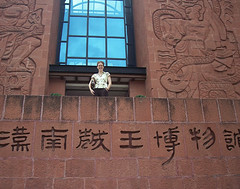
Visiting the Nanyue King Mausoleum

The other day I went to the American Consulate in Guangzhou and, before returning to Shenzhen, I visited the Western Han Nanyue King Museum. Like my visit to Xi’an, this visit helped clarified some of the contradictions that animate the construction of Shenzhen by indexing both national trends and regional specificity.

Located on Jiefang Bei Road in Guangzhou, the Museum of Zhao Mei, second king of the Nanyue State of the Western Han Dynasty (206 B.C.-24 A.D.) is the oldest and largest Han mausoleum in Lingnan. The simple act of walking through the museum suggests the way architecture not only sutures one era to another, but does so by highlighting the radical differences between eras.

The site was discovered in 1983 when developers began leveling Elephant Mountain in order to build needed housing. At the time, Guangzhou and the other 13 coastal cities were still a year away from reforming and opening the local political-economy. This is important because the housing built at the time, housing which now surrounds the museum was built under the Maoist work unit system. Consequently, Stalin inspired apartment buildings surround the museum’s modernist silhouette.

The museum complex consists of two main buildings—the exhibition hall and Zhao Mei’s mausoleum. Architect, Lu Yanzhi won the Liang Sicheng prize for its striking modernism. Green grass and sculpted topiary set off the buildings’ red stone base and glass pyramids. Walking from the exhibition hall toward the mausoleum chamber, however, my eyes kept moving from the set scene toward the spill of Stalinesque housing and Maoist factories. Two kinds of cognitive dissonance kept my eyes darting from the museum complex to the surrounding environment. First was the obvious difference in upkeep between the museum’s well-tended garden and the neighborhood, which seemed to be crumbling. Second was the City’s glorification of ancient history and the implicit denial of the importance of both Mao and Stalin to Guangzhou. After all, in order to build the museum, a building project was put on hold. Yet the surrounding neighborhoods will be razed as soon as it is economically feasible to do so.

I suspect several factors contribute to the social production of these differences. One might be historical age. 25 years really isn’t all that much in comparison to 2,200. Another might be rarity. There is only one mausoleum and many, many crumbling monuments to Stalin. There’s also a hint of elitism—tourists and political leaders agree that dead kings continue to matter more than living commoners, even as the museum implicitly sutures contemporary Chinese society to past empires without actually acknowledging the Cultural Revolution.

All these contradictory impulses animate Shenzhen, of course, but they seem so much more obvious in Guangzhou, where a longer urban history makes it both easier and harder to erase the recent past in favor of imperial glory. On the one hand, there actually are significant archeaological sites in Guangzhou which make imperial claims seem viable. There are several interesting sites in Shenzhen, but they’re either far away from the beaten path so unvisited except by foreigners or rennovated beyond recognition; Shenzhen’s imperial claims (except for Diwang and that’s imperialist of a different kind) feel contrived. On the other hand, Shenzhen has more or less successfully razed traces of the Maoist past. A few Mao heads remain on older village walls, but Mao-era buildings, especially of the industrial urban kind didn’t fit into Baoan County’s plan, so there wasn’t much past to deny, unlike in Guangzhou. But again, precisely because Guangzhou has this deep history and the odd archaeological site, the city might gets tied up in debates that Shenzhen easily sidesteps with the claim, “There was no history here,” moving right along with the task of building a modern international city. All this to say, that even if erasing history seems pretty straight-forward–raze a building here, don’t mention the factory that used to be over there–it doesn’t follow that its easy to rewrite the past simply because garbage accumulates despite our best intentions. The stubborn fact of unwanted (or once-wanted-now-denied) buildings and highways and stores now vexes Shenzhen leaders intent on handling the municipality’s urban villages, ironic remnants of Shenzhen’s earlier boom, which doesn’t count as “history” and so, by definition, needs to go.

The social differences staged by the museum and its immediate environ are lived on the steps to the museum entrance, where recent migrants sell artifacts to tourists. The day I visited, three young men from Gansu tried to tempt me into purchasing animal skins. (I’m not sure if they were real or not, but suspect the latter simply because in Shenzhen all the folks who traffic in wild animals have gone underground and one needs a personal introduction to eat alligator and badger.) When I asked who bought their skins in this heat, they laughed and said, “People like you.” They helpfully offered to take my picture for the memories; I took theirs’ for the same reason. Come tour theWestern Han Nanyue King Mausoleum
.

bethesda presbyterian church

i am travelling in the u.s. this month and have finally settled enough to take the odd picture. i am posting them to fieldnotes because they contextualize where i am and how i see when not in shenzhen; just as images from other chinese cities bring shenzhen into sharper focus, i suspect images from my american life will bring the photographer into focus. these images were taken at a church located about four miles from my parernts’ house in north carolina, a place that strikes me as built of trees and sunlight (when i’m looking up), and somewhat menacing (when walking through the beautifully situated burbs). please visit bethesda. i’ll post more images from north carolina over the next few weeks.

shenzhen’s place in the heart

Over the national day holiday, I went to Yan’an and Xian. Yan’an, of course, resonates throughout Party history, while Xian “makes you proud to be Chinese”, as a friend said before I left. Both are located in Shaanxi Province, center of the central plains heartland, which for millennia has defined belonging to various Chinese polities (or so it seems in retrospect.) It was my first visit; after ten years in Shenzhen, I finally complied with my friends’ exhortations to make a pilgrimage to “authentic” China.

Now, I have been to Beijing, even lived for a while in the capitol, but that brief stint was not enough to convince my friends that I have understood the cultural verities that define their homeland. All this to say that Shenzhen isn’t considered part of China, not ancient China, certainly not mythic China, not really even modern China, which is typified by Shanghai’s cosmopolitan facades. Instead, Shenzhen exists as a strange aberration—a necessary concession to global forces, but not really Chinese. Or at least this is what I have gathered from conversations about the limits to my research project. According to friends, it is possible to study the political-economy of reform and opening in Shenzhen, but not to learn anything meaningful about China’s culture.

On our way to Yan’an, we stopped at the Yellow Emperor’s grave and lit incense. The grave is located in a lovely area, with old, old pine trees and birdsong. Chinese Emperors have always understood the importance of burial fengshui, I was told, and this theme would repeat itself in Xi’an and its outskirts, where terracotta soldiers and bronze horses protect the first Qin Emperor’s grave. But first to Yan’an, where we stayed in a three-star hotel.

In the mythic landscape of Mao Zedong’s rise to power, Yan’an symbolizes many things—how the peasants gave refuge to communists fleeing Nationalist persecution; how the communists persevered for years before liberating China; the establishment of Mao Zedong Thought as a Chinese supplement to Marxist-Leninism. We visited a Song dynasty pagoda, which throughout the Cultural Revolution represented the Yan’an years and thus remained undamaged by Red Guard fury. We also went to Yan’an years museum and followed the progress of WWII from the point of view ill-equipped peasant soldiers holed up in caves.

Beyond these myths, however, Yan’an has represented rural poverty and the collective will to build a socialist utopia. Stereotypically, Yan’an peasants lived in caves with few amenities. They were malnourished, uneducated, and determined to give their children a better life. Yet, red tourism has brought wealth to some in the area, while others continue to live in relative poverty. Busloads of tourists come for a day, rarely longer, to look at where Mao, Zhou Enlai, and Zhude lived and planned the revolution, but we walk past crumbling courtyards and dingy residences. Today, those peasants in search of a better life, I am told, are better off working in Shenzhen factories, where at least they can earn a wage, rather than place their hope in agriculture. When I ask why no one wants to be a peasant, my friend gestures to the decrepit and unsanitary housing, asking rhetorically, “Would you want to live here?” And of course the answer is no.

From Yan’an back to Xi’an by way of the Hukou waterfall, an important national symbol. I’m sure on a warmer, less windy, certainly drier day, I would have appreciated watching the Yellow River surge from the central plains toward the eastern coast. However, on that particular day, I cowered in the lobby of the large hotel that has been built right next to the waterfall and even so, I left with a head cold. My friends, however, were undeterred and photographed themselves standing right at river’s edge, smiling through the spray of icy water. It was, as they reminded me, the first and possibly last time they would come. I agreed it was a rare opportunity, but except for a perfunctory walk past the falls, remained inside.

In Xian, the college classmate of a Shenzhen friend had agreed to show me the city, and over the next three days, humbled me with her generosity. He Lei picked me up at the hotel every morning at 9 a.m. and then brought me to the most famous sites, purchasing all tickets and picking up the tab at every meal. When I tried, rather lamely to pay, she scowled and promptly ripped the bill out of my hand. Xian born and raised, she wanted me to love the city as much as she does. Indeed, the grandeur of the terracotta soldiers and refined beauty of Huaqing hot springs provided a backdrop for her enthusiasm. When I reported back to my friend, she nodded knowingly.

“People back home still care about people. They’re not selfish like in Shenzhen.”

“So why did you come?”

“I don’t know anymore, either. At the time, I wanted to try something new. To see more of the world.”

“And now?”

“Now? Now I live in Shenzhen and dream about retiring back in Xian.”

He Lei pointed to another aspect of that hard truth, which is less extreme than that governing daily life in Yan’an.

“Most Xian people live in substandard housing. They don’t earn very much money. So they have to leave. But nobody wants to. Xian makes you proud to be Chinese.”

That then, perhaps, constitutes the fragile but all-too-vexed thread that sutures Shenzhen to the central plains. People not only want to improve their material standard of living, but also to preserve where they came from because they define themselves through the love they feel for their hometown. So they come to Shenzhen, this place that is “not authentic China” in order to get back.

Even on those days it didn’t rain, the sky remained overcast, and that grey infuses all the pictures I took while in Shaanxi. For a sense of a place considered by many to be one of Shenzhen’s most radical antitheses, please visit: http://pics.livejournal.com/maryannodonnell/gallery/0000e49d.

dogwood journal

photos i took in beijing over the may day vacation have been published in the fifth edition of the dogwood journal (http://www.dogwoodjournal.com/Archive/Issue5/MaryODonnell.cfm). you can visit the most recent edition of dogwood at http://www.dogwoodjournal.com/index.cfm.