This slideshow requires JavaScript.


The two hour trip from Dali to Fengyu Market Town (凤羽镇) eases senses overstimulated by tourist crowds, let alone Shenzhen’s urban crush. Nestled within extensive rice paddies and surrounded by mountains, Fengyu stands in provocative contrast with Shenzhen’s industrial parks and reclaimed housing estates. The town’s crumbling architecture evokes past elegance and stately lifestyles, while elderly women dressed in traditional Bai costumes maintain local religious traditions, setting up small altars at the entrance to the town. Here, at the periphery of urban China’s periphery, I slip into forms of rural nostalgia — once upon a time, a stately, elegant society of noble warriors, rural scholars and happy peasants resisted both Tibetan and Han incursions.
And yet. Where Shenzhen streets bustle with young migrant workers, Fengyu’s main street and side alleys shimmer silently. Whatever remains of the Nanzhao and Dali Kingdoms, today, young Bai must choose between agricultural labor and life elsewhere, in Shenzhen, for example, where one of my favorite restaurants serves Yunnan delicacies that are flown in daily to tempted jaded palates. A walk through Fengyu, below:

Am in Dali, Yunnan, which for years was a favorite spot for backpackers, Chinese and foreign. The out of the way city boasts mountains for trekking, fresh weather, ethnic minorities with links to Tibet, and inexpensive crafts and food. Almost 30 years of backpackers have shaped the development of tourism in the area and many of the shops sell hippy clothes, while the cafes serve better bread and muesli than are available in Shenzhen.
Nevertheless, consistent low-end tourism has brought the area enough capital to inspire dreams of attracting higher-end tourists. Yesterday, for example, I took the Cangshan Mountain Cable Car and then walked through the mountains to Xima Pool. The trip is over 5.8 meters long with a rise of almost 2 meters. Built with French technology, the cable car symbolizes the initiative to transform Yunnan into a world class tourist destination. In fact, the Kunming Airport, which opened June 28, 2012 exemplifies the scale of ambition — according to an architect friend, it is large enough to handle 30-40 million people a year, which is larger than Shanghai’s airport.
I’m not sure how much infrastructure debt Yunnan has incurred, but Cangshan has not been diminished.
Impressions, below.
Eating lunch at a Taiwanese style buffet this afternoon, I experienced a bit of pop culture dissonance, when something vaguely “favorite instrumental love song from a Disney Film” followed Eminem and Rihanna’s “Love the Way You Lie” on the music piped-in music. I’m not sure how these two songs ended up back-to-back, without commentary, either canned or live — my immediate neighbors, for example, wore sanitation jumpsuits and repeatedly asked each other if they had had enough to eat, seemingly oblivious to the music radio faux pas — but I’m thinking maybe the manager had purchased a shanzhai mix of “top love songs, 2010” to enhance the buffet’s image as “cool” and “not neidi“. It may also have been a moment of pastiche prophecy. Not a few alternative rockstars have transitioned from producing troubled hits to belting Disney classics, and I see no reason why either Eminem or Rihanna shouldn’t follow in the footsteps of Elton John and Melissa Etheridge.
I started actively listening to the music when I realized that I was humming along to the chorus of “Love the Way You Lie”. The melody hooked me not only because I like Rihanna’s voice, which is especially poignant in contrast to the desperate anger of Eminem’s lyrics, but also because I know too much (or not enough) about their lives and the way that themes of violence and redemption, suffering and atonement, yearning and self-justification weave through and between their public and private performances. Indeed, whatever their actual relationship to and experience of brutality, Eminem and Rihanna seem apt symbols for the US American confusion of pain with love; we work really, really hard, to sell the story that some killings are justified, and some beings exist to be shot — Oscar Wilde in prison, as if murder were the expression of bravery, while the rest of us cowards go on about wounding each other in social acceptable ways:
Yet each man kills the thing he loves,
By each let this be heard,
Some do it with a bitter look,
Some with a flattering word,
The coward does it with a kiss,
The brave man with a sword!
And Oscar Wilde has nothing on the US American romance with death, destruction, mayhem, and murder. Consider alien invasion movies, where the aliens exist to be killed, and in process reveal the courage and fears of white (or whitened) humanity. Or westerns, where those black hatted fellers “get what’s coming to them”. I have joked that the formula for a US American soap opera is boy + girl + murder, and happy endings simply mean that the murder has brought the two characters together, while unhappy endings are more “hard core” because one of the lovers is the victim, while the other survives to achieve some kind of vengeance. And yet. When we stop to think about it, the extent to which US Americans confuse levels of hurt with intensities of love is distressing.
In thinking through the Aurora Massacre, Patrick S. O’Donnell at Religious Left Law refers to Erich Fromm’s idea of the “pathology of normalcy“, which refers to the ways that culture shapes human interaction, or a socially patterned defect. Importantly, on Fromm’s reading members of the same culture not only share the same defect, but also share behavioral patterns that enable us to live with a defect without becoming ill.
It is as if each culture provided the remedy against the outbreak of manifest neurotic symptoms which would result from the defect produced by it.
In this sense, Eminem and Rihanna might be thought of as symbolizing the American normal, enjoying a violent buzz but not actually killing anyone. In fact, because we know that love hurts, we expect some form of abuse or pain, but within limits. Not surprisingly, in our current fascination with BDSM, US Americans learn to ride the violence and pain to gendered forms of ecstasy.
Fromm also notes that for a minority the cultural pattern does not work. This “not working” has two forms — the expression of the pathology as individual neurosis and the recognition of the pathology as what it is, an unhealthy pattern of interaction. Here’s the point: a neurotic expression of normal All-American love would be if Eminem set Rihanna on fire and watched her burn to death. Neurotic on Fromm’s thesis because the underlying logic of burning a lover to death is the same as that of “normal Americans”; the more extreme one’s love, the more violently it will be expressed. And yes, we all know and derive various levels of pleasure from the formulation total love = total annihilation.
And there’s the rub. At Aurora, James Holmes crossed the fuzzy line separating normal from neurotic, the line in which its okay to play and sing and read about killing others, just not okay to actually kill.
More hopefully, however, there is a second maladaptation to the pathology of normalcy. In this maladaptation, an individual recognizes the pathology of normal life for what it is — a problematic pattern of interaction. We recognize, for example, that abuse within relationships is not an expression of love and thus our job is to learn to change hurtful patterns of behavior. We realize the need to nurture ourselves and others in non-violent relationships. We understand that this is precisely where we need help because changing deeply rooted patterns of interaction, patterns that are reinforced through popular culture and the lived expectations of friends and family, as well as our own conflicted desire requires courage and faith and the willingness to risk normal life for a healthier, happier life. A life, we might say, in which killing the buddha is not a made-for-telesion movie, but a koan.
His Holiness the Dalai Lama reminds us:
Before we can generate compassion and love, it is important to have a clear understanding of what we understand compassion and love to be. In simple terms, compassion and love can be defined as positive thoughts and feelings that give rise to such essential things in life as hope, courage, determination, and inner strength. In the Buddhist tradition, compassion and love are seen as two aspects of the same thing: Compassion is the wish for another being to be free from suffering; love is wanting them to have happiness.
May the survivors of Aurora find healing. May we in the United States find the courage to look seriously at the normalcy of violence in our relationships. And, if we cannot yet love James Holmes, may we find the strength of heart not to wish him ill.

Impressions from a roadside wedding in Qingshui, Taiwan, the groom’s hometown. Over 80 tables, overflowing with lobster, shark, and other delicacies, happy wine for happy times, and repeated exhortations to have many children.

The sun today dazzles and dried up all the rain! Cicadas chirping, vibrant green on green topiary, architectural twists and turns, I walked from Gongyi Park along Gongyi Road back to home at Liming with a stop at the Wu Wei Tsao Tang (无为草堂) for tea and sesame pastry. Wow. The tea had a clean but fragrant, slightly sweet aftertaste and the pastry (well, the three of them) had a flakey, phyllo like crust with white sesame seeds and an almost liquid black sesame filling.

埔里 (Puli) is a small mountain town, about an hour outside Taichung. I wandered the streets, snacking and looking at the mountains. If you go, rent wheels and go deeper into the clouds.

鹿港 (Lugang) is one of the oldest port cities in Taiwan. The winding network of alleys, streets, and boulevards knits together Ming and Qing Dynasty pirates, southern Chinese merchant families, and the influx of Nationalist troops and their families. Over 200 shrines and temples punctuate these pathways, and two of the oldest temples on the island — Matzu (1725) and Longshan (1786) — are in wonderful condition because well cared for. With industrialization and GMT rule, the importance of Lugang to the island economy has lessened, with inland Taichung gaining importance as Taipei shifted cosmographic ordering on Taiwan. Consequently, the city’s layout gives an impressive sense of the urban form of South Chinese port cities during the roughly 500 years that piracy threatened trade ships, their crews and cargo. Just recently, however, Lugang has been reintroduced to world as one of Taiwan’s top tourist destinations and the site of many traditional festivals, including Double 5th (dragon boats) and Mid-autumn (mooncakes). Worth a visit. Impressions, below:

I continue to visit neighborhoods around Taichung. One, Liming New Village was built over fifty years ago on the then outskirts of Taichung. It was complete in and of itself, with a post office and schools, police station, library, and sports center. The other, an expensive, Japanese inspired gated community was built about twenty years ago at Da Keng, on the slopes of the Taichung’s most accessible mountain. Liming is in decline because the young people have left for jobs in Taipei, or to live in more upscale, “modern” communities. The Da Keng community never took off due to banking difficulties.
Also, I have been watching a Taiwanese soap opera with my friend’s mother. My sense of the plot line: episode 1: boy meets girl; episode 2: boy and girl fall in love; episode 3-39: their mothers fight; episode 40: some kind of reunion before the birth or the first grandchild when fighting resumes.
How do the neighborhoods connect up with the soap opera plot? An older neighborhood that looks like Liming keeps getting referenced as where the poor but honest live, while the wealthy and corrupt inhabit ornate homes like the second neighborhood. However, a friend explained that Taiwan’s middle class lives somewhere in between these two extremes, where the question is not how to make more money, but rather to reveal one’s taste by purchasing the highest quality goods (or house, in this case) without becoming consumed by work. Neighborhood impressions, below:
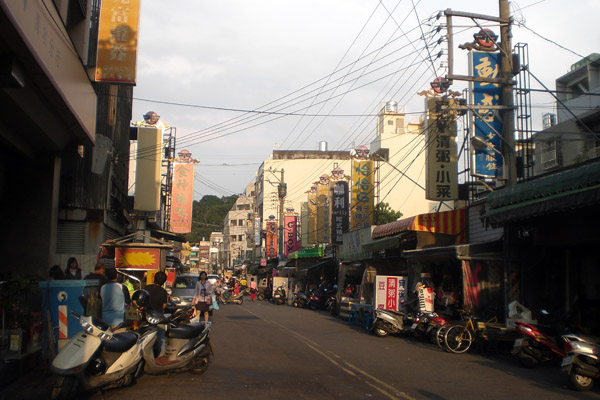
Last night went to the night market at Chingshui, a small market under the administration of Taichung City. Once again I was reminded that history is in the making. In 1935, an earthquake flattened the town, and reconstruction gave rise to a mishmash of western and eastern modernisms, which have been further defined through later developments. Feral cats led us through winding alleyspast Japanese era housing, 60s minimalist facades on low-level row houses, and late 90s mansions. Older women burned incense at Daoist shrines and buddhist temples. We ended our tour eating savory rice ball soup, fermented tofu with garlic and pickles, oyster pancakes. Joy.
 Shenzhen Noted