This slideshow requires JavaScript.

Bao Tong (鲍彤) was Zhao Ziyang’s secretary. Zhao Ziyang, of course, was the Secretary General of the CCP who fell from power because he supported a non-violent resolution to the Tian’anmen protests. Yesterday, Bao Tong chimed in on the Bo Xilai scandal and how it relates to the upcoming 18th National People’s Conference — and yes, whether or not Gu Kailai killed Niel Haywood is a matter of secondary importance, rather than being a question of life or death for the Party. For Bao Tong and like minded CCP politicos, the question is still one of the absolute authority of the Party.
Here’s the rub: Bo Xilai has become a negative example of abuses of Party authority and power. However, like Deng Xiaoping before him, Bo Xilai is the direct heir of Marxin, Lenin, Mao and Stalin. If the Party removes Bo Xilai, they have rejected the justification for absolute power. If they continue with Bo Xilai, then they must deal with the fact that Bo Xilai has been discredited. Bao Tong thus provocatively and accurately raises the question: If Bo Xilai (or someone like him) is the heir to the revolution, what’s the Party to do? Translation of Bao Tong’s op-ed piece, below.
Bo Xilai has already become history. The reason he has entered the annals of history isn’t because of his wife, Gu Kailai was convicted, but because he pursued the “Sing Red, Attack Black [mafia] (唱红打黑)” campaign.
Some have slandered Bo Xilai by saying he isn’t a filial descendent of the Party. This is unfair. He really was immoral and lawless, but wasn’t Mao Zedong? Lenin openly defined revolution as “only dependent on the direct action of the masses and not dependent on any law”, and is thus the even more immoral and lawless ancestor. Under Lenin’s strategy and leadership, the Bolsheviks brazenly dispersed the elected All Russian Constituent Assembly, starting the age of Red Terrorism. Mao Zedong delighted in bragging about his lack of conscious and lawlessness. He didn’t believe this was a source of shame, but rather a source of honor. All Chinese people are familiar with this history. Bo Xilai was merely the direct heir to this tradition. There is no possible discussion about Mao Zedong and Stalin’s personal morality. Thus, if we are to fairly evaluate Bo Xilai, we cannot say that he was the unworthy son of the Party, but must say he was the Party’s worthy son, its skillful and finest son, most worthy in the extreme.
If we are speaking of Party nature (党性), who is more truly of the Party than Bo Xilai. Singing red is to walk with the Party, and attacking black is to struggle against those enemies that the Party has identified. This is the highest essence of revolution and strongest discipline. Bo Xilai had a strong body. During his youth, he was bewitched by Mao Zedong into entering a life or death struggle with his father, Bo Yibo, who Mao had called a traitor. Who else has demonstrated this level of innocent and pure revolutionary spirit and loyalty to the Party?
It must be pointed out that by calling the Chongqing Model “Sing Red, Attack Black”, Bo Xilai had completely digested the marrow of the Party’s authoritative government. Standing in the position of a Party leader, to sing red is to respect only the Party, and to attack Black is to suppress anyone else (异己).
For the masses, singing red is the obligatory way to serve the Party, and attacking black is the willingness to fight on the Party’s behalf. Without exaggeration, we can say that the existence of a political campaign called “Sing Red, Attack Black” signals that the Party’s monolithic control of government has ended. [Within the State Party system] Anything that does not belong to the system is beside the point. Even if it is important, it cannot be a life or death conflict. For example, the difference between Mao Zedong and Deng Xiaoping’s respective policies or that between Stalin and Hitler’s policies is no doubt one of better or worse, but these differences were differences within the context of serving the absolute political power of the Party.
Consequently, when cutting up a cake, there is always the question of who gets the bigger slice. On the the issues of public housing and hukou, Bo Xilai was not rigid, in fact he was extremely flexible. This is one of the reasons he won the hearts of the people. However, he he could only tentatively hold his deep seeded “follow me and flourish, oppose me and perish” attitude (“顺我者昌逆我者亡”这条命根子). He blatantly raised his “Sing Red, Attack Black” banner, brandishing his sword, declaring his strength and prosperity, without giving any quarter. What was this? This was nothing other than the Bo Xilai Model, or we could call it Bo-ism. It was also Maoism for the 21st century. Bo Xilai didn’t invent “follow me and flourish, oppose me and perish”. However, in order to call corruption a miracle and to paint cruel and inhuman philosophy as miraculous revolutionary truth, Bo Xilai needed extreme sincerity in order to succeed as he did.
Some argue that “Red is true! Black is crime!” Is this true? When were the “nine types of black” established in the legal domain? “The whole country is red” campaign was obviously an unprecedented catastrophe. Governance depends upon clear legal ideas, and does not require romanticism or catchy slogans, and does not permit illegal gutting and rewriting the law.
The especially pernicious aspect of singing red was that it called an ass a horse, sedating the people and deifying leadership. In Bo Xilai’s Sing Red campaign a “power grab” was mystified as “the great victory of democratic revolution”. The ongoing impoverishment and alienation was mystified as “the great victory of socialism”. The widening gap between rich and poor was mystified as “Socialism with Chinese characteristics”. Human rights abuses were mystified as “stability”. And immorality and lawlessness was mystified as “the greatest glory”. Of course, with respect to Bo Xilai himself, he was the new savior of the world.
The especially pernicious aspect of attacking black was using law to solve problems that could not be solved through legal means. It made people crazy to attack wherever the Party pointed: attack rightists, attack anti-rvolutionaries, attack liberalization, attack vulgar values, attack those protest, attack those with power, attack lawyers, attack those with the courage not to submit to the Party’s leaders, attack the enemy in Bo Xilai’s eye; charge with out fear of death, attack! All that was necessary was to raise children who daily sang red and attacked the black, and everyone would be in crazy sedation. The highest power would then naturally pass from generation to generation, flourishing for 1,000 years, the establishment of an imperial house. This was the perfect strategy concealed in Bo Xilai’s four characters “Sing Red, Attack Black”.
Even if this campaign had entered high levels of Party debate, nevertheless early on some clear sighted people saw it was unfeasible. Those who sang red were “Party parrots (党八股)”. Lin Biao advocated reading Mao everyday, but Minister of Propaganda Lu Ding disagreed. Lu Ding contradicted Lin Biao with the colloquialism “even delicious Yunnan ham if eaten everyday will cause indigestion”. Clearly, Lin Biao didn’t have Lu Ding’s experience in propaganda. Attacking black everyday was the same as doing the Cultural Revolution everyday. Likewise, how could Bo Xilai be more knowledgeable than the General Secretary in determining the importance of harmony to social stability? Unsurprisingly, when Bo Xilai first appeared on the list of potential candidates for the Standing Committee, how hard it was for people of understanding to stand like pillars in flowing water. They didn’t make a pilgrimage, they didn’t chant sutras, and they didn’t cheer! (With all the drama for becoming General Secretary, the situation is extremely complicated. Those who had risen by attacking black and made their living singing red were probably a small minority.)
The 18th National People’s Congresses faces a choice: either tie itself to Bo Xilai or cut him loose. If they are unwilling to open the 18th NPC under Bo Xilai’s shadow, then it is time to quietly begin ending the “Sing Red, Attack Black” campaign. Of course, if they are willing to openly and properly join Bo Xilai in singing red and attacking black, this is even more commendable, more deserving of everyone’s welcome and support.


Netizens have joked that using a blow dryer or tanning may now infringe on national property rights.
Just recently, Heilongjiang Province promulgated laws governing the analysis of atmospheric resources and conservation (黑龙江省气候资源探测与保护条例). The key and controversial point, of course, is the decision that atmospheric resources, including wind energy, solar energy, precipitation, and ambient air are natural resources and as such belong to the country.
What does that mean?
According to Minister of Meteorology, Zheng Guoguang (郑国光) the laws do not mean that air has been privatized — “impossible!” he said — but rather that the research and development of energy resources will be centralized. The legislation seems to me a rather straight forward decision to institute state monopolies on the production and allocation of sustainable energy. It also anticipates state appropriation of sustainable energy technologies that are developed outside the context of national research and development, but within national borders.
Other countries have also begun to dispute the question of “wind rights”. Denmark, for example, compensates neighboring landowners for loss of property value due to the erection of wind turbines. More interestingly, the Danish government has adjudicated on disputes that (depending on placement) new wind turbines “take wind” from extant turbines.
Ron Rebenitschhas considered water laws (first in time, first in right) and oil right laws (compensatory unitization) as models for developing wind laws. In the former, the first user to develop a qualified use of water (i.e., irrigation) from a flowing stream develops certain rights to divert a defined quantity of water from the stream if it is available. Later users of water from that stream can still divert water from that stream, but only in quantities that do not affect the earlier users’ ability to divert the allocated quantity of water.
In contrast, when an oil well is drilled, the oil flows to the well from all directions, without regard for ownership of mineral rights. Thus adjacent mineral rights holders could theoretically have their oil drain to the nearby well, without recompense. Under unitization, the production of an oil field is then allocated proportionally to the surrounding mineral rights owners, in accordance with pre-determined impact.
Like the Danish and US American discussion, China’s nascent foray into wind rights discussion do not take international borders and sustained regional inequalities into account. Consider, for example, the Law of the Colorado River.
This thicket of deals, trade-offs, set-asides, subsidies and politically sanctioned thievery is nearly impenetrable to even the most seasonedand cynical observer. But from the Mexican side of the border,the law is devastatingly simple: The US retains 95 percent ofthe Colorado River’s water and Mexico gets what’s left over. Most years this is about 1.5 million acre feet, roughly the same amountthat Sonoran desert farmers were using to irrigate their beanand onion fields in 1922.
Likewise, in the Middle East, long-term sustainable economic development depends on access to clean and dependable supplies of freshwater. In turn, this access continues to depend upon region wide management agreements (Gleick, Yolles, and Hatami). More recently, US American Intelligence has predicted increasing risks of water conflicts worldwide. As in the Middle East, shared water resources are increasingly used to threaten neighboring states, while the over-pumping of groundwater supplies threatens the agricultural production, which accounts for 70% of freshwater usage.
All this to make a simple point.
In China, the rhetoric of a centralized state frames the discussion of sustainable resources, while in the Middle East and United States, we can speak of “water security” and thereby transform drinking water into weapons of war. Thus, the development of sustainable energy sources is as potentially fraught as the development of other resources (oil and now water) because we are proposing to use the same, unsustainable models of production, distribution, and allocation.

The aftermath of vacation: unpacking suitcase, downloading last of pictures, writing a to do list that starts tomorrow. Also thinking that I love a local story of how Guanyin transformed herself into an old Bai woman, who carried a rock by roping it to her head and then used it to stop an invading army. Yes!

Half an hour outside Weishan, Lotus East Village (莲花东村) stands apart from the surrounding villages, both historically and culturally. Unlike mountain villages, like those around Lushi, which cultivated Yunnan Red (滇红茶), Lotus East once supplied the horses and guards for the caravans that moved tea and other goods along the Tea and Horse Route (茶马道). Although small, the village was powerful and relatively wealthy. In fact, during the Nationalist era, the clan heads – brothers Ma Shiji, Ma Shiqi, and Ma Shixiang – were aligned with Long Yun, the former Party Secretary of Yunnan Province.
Culturally, the residents were and remain Muslims, who elegantly synthesized elements of Han and Bai traditions within the context of Islam. The couplet that graces the entrance to the village mosque exemplifies the hybrid cultures of Southwestern China. In Mandarin, the word for “mosque” is literally “clear truth temple (清真寺)”. The author has taken those two characters and used them as the opening characters of a Mandarin style couplet:
清升浊沉万教终归一统
真诚不二宇宙同赞阿拉
The pure rises, the polluted sinks, ultimately 10,000 teachings return to one
Truth and piety are not different, the entire universe praises Allah
Today, the Mosque and former homestead of the Ma brothers are open to the public, as is a small museum that introduces horse caravan culture (马帮文化 – literally “horse gang culture”) and the cross cultural breadth of China’s southwestern trade in tea, horses, and other luxury items. Impressions, below:

Another commercial center on the Tea and Horse Route, Weishan (巍山) is located about 75 minutes from Dali. Weishan was the first capital of the Nanzhao, but was soon replaced by Dali, which has a more temperate climate because located on the banks of Lake Erhai (洱海).
One of the main Weishan tourist sites is Weibaoshan (巍宝山), which literally means “Treasure Mountain Wei”. The mountain has been designated a national park and walking paths that thread from and between Daoist temples have been laid. Contemporary Daoists have occupied many of these temples and it is possible to stay the night there for a donation. However, the architectural treasure is the Long Spring Retreat (长春洞) which was constructed between 1779 and 1799 and is dedicated to the Jade Emperor, the Lord of the Underworld.
Sites like Weibaoshan vex me. I studied Chinese language and history in order to experience places like Long Spring Retreat, as if the poetry and philosophy of classical China still animated everyday life. However, 17 years in Shenzhen have taught me that even if the contemporary cultural mix includes Daoism, nevertheless capitalist forms and modern desires more obviously structure human relationships and desires in China.
And yet, if not for capitalist forms, I could not have visited Long Spring because I not only needed to purchase a ticket to enter the park, but also get myself from Shenzhen to Dali, Dali to Weishan, and then from Weishan to the mountain. Alas, none of those plane rides and car trips manifest the Daoist virtue of regulating my life by according to natural rhythms. Instead, they more properly manifest the US American virtue of satisfying individual desires through post-industrial convenience.
The point seems to be remembering to take time to reflect on our place in the world, not only as individuals, but also as a species. What does it mean to be human? What does Long Spring Retreat teach that we cannot learn through Shenzhen’s rush to reproduce and exceed the material wealth of North America?
Impressions below.

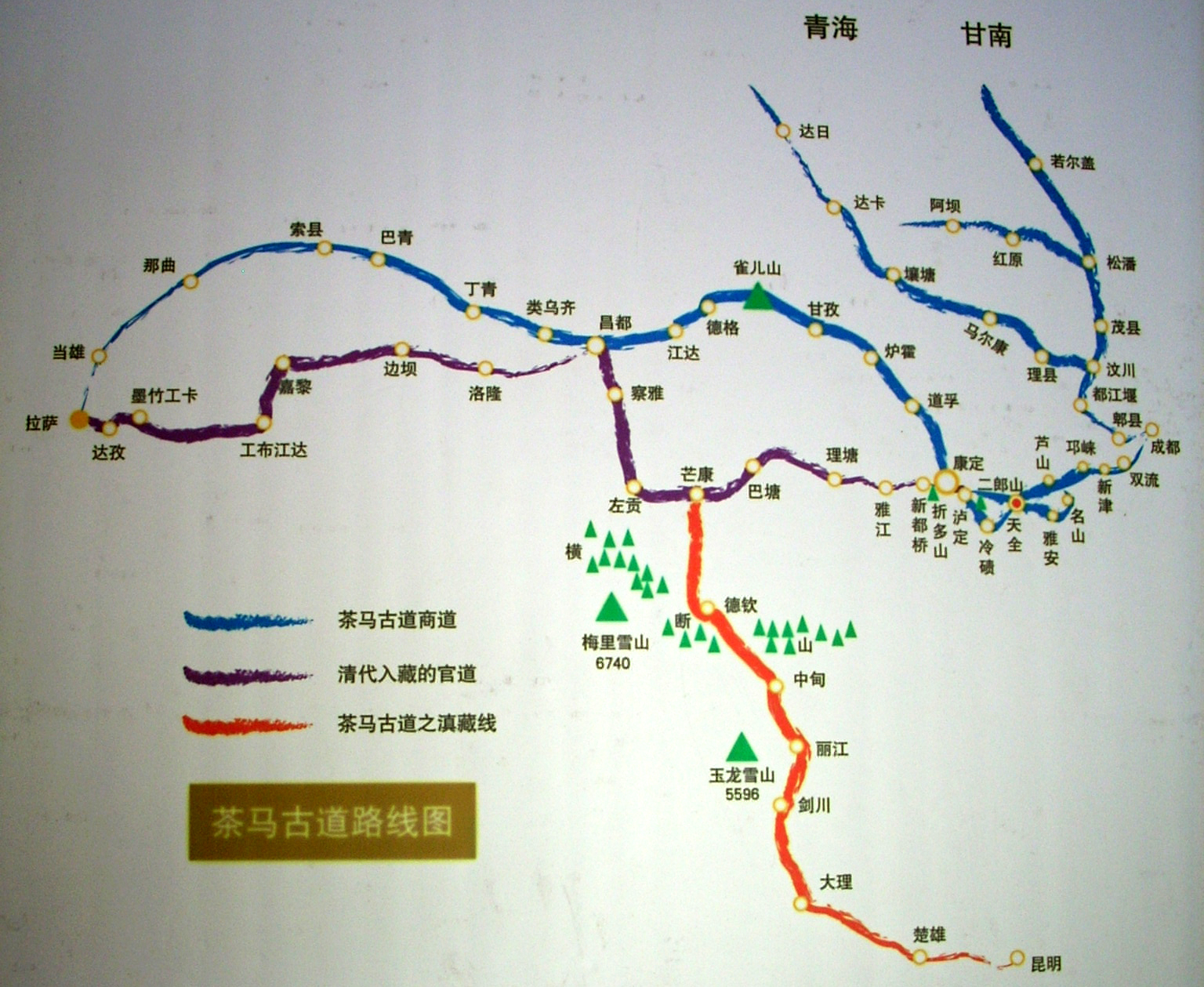
Although less famous than the Silk Road, the Tea and Horse Route (map) had three branches: the commercial route (Lhasa to Chengdu), the official route into Tibet (Lhasa to Kangding, where it reconnected with the commercial route), and the Yunnan-Tibet route (Mangkang to Kunming), which threaded through the Lincang mountains until it met up with the official route in Kangding. A small commercial center on the Yunnan-Tibet route, Lushi was located at the nexus trails that threaded through the Lincang Mountain Range.
Local farmers continue to live in villages along those ancient trails and still use pack mules to bring supplies from the town to surrounding villages. Mrs. Zhang discovered us wandering on one of the partially cemented trails that led to the river and invited us into her family compound for tea.
Mr. Zhang’s grandfather built the first building in the in the 1930s. Each subsequent generation added to the complex, and today the compound has three main buildings and a separate section for farm stock, a kitchen, and solar panels for heating water. With the family responsibility system, the Zhangs obtained several mu (666 2/3 sq meters) of land, where they have planted feed corn, walnuts, and vegetables. Their daughter has moved with her husband to Kunming and their son has opened a small shop in Lushi. One of the three buildings is for him and his girlfriend upon their marriage. The Zhangs earn between 10-20,000 rmb ($US 1,750 – 3,500) a year, which has been almost completely invested in building the house and their children’s education.
We chatted about their lives and in turn, they asked about ours. After half an hour, we took our leave and headed back toward Lushi. I remarked on the difference between walking in Lushi and Shenzhen, where I have been stopped by guards when trying to climb Jingshan Mountai in Shekou, let alone invited in for tea. My friend replied that the more commercialized a village or town, the less hospitable the residents.
This experience has me thinking about the potential and paradoxes of hospitality. In Lushi, if a door was open, we could walk into the compound and expect to be welcomed. The previous day, for example, Old Mr. Zhang (same surname as the village Zhangs) sat with us for 40 minutes, chatting about local history. We offered to continue the conversation by sending photos to the qq accounts of younger family members, who are online. At the same time however, when deflected through tourism, hospitality slips from a social practice into a commercial strategy. During this trip to Dali and its hinterland, we have stayed at hotels where our hosts are friendly, helpful, and pleasant and yet we do not feel obliged to grow the relationship.
Today I am wondering about hospitality in globalizing times. Social hospitality remains an important means of transforming strangers into acquaintances, even as commercial hospitality has expanded with the growth of tourism. The difficulty, of course, is that many of us travel hoping to encounter social hospitality and end up frustrated by differing expectations about the obligations of commercial hospitality. So just what do hosts and guests owe each other when the bill can be paid in full and yet we now live in a global village?

We drove about eight hours from Dali to Lushi (鲁史), a market town (镇) in the Lincang Mountains (临沧山). The last 80 kilometers covered a narrow road, which twisted through dramatic slopes and was, in places, covered in thick mud and rocks from a rainstorm the night before. The trip and the unreliability of the roads created a sense of distance from my everyday life; lack of access to internet reinforced this sense that I was far from the modern world. Moreover, I found it difficult to understand local Mandarin, let alone the local language.
And yet.
The layout and size of the old city area remind us that Lushi was once a vibrant center of mountain life. Peasants packed mules with tea, walnuts, and palm leaves and then set out on narrow trails to sell their goods in seasonal markets in Fengqing (凤庆), Nanjian (南涧), and Weishan (巍山). Old Mr. Zhang told us that during WWII, national forces from Guangdong and Hunan stationed at Lushi. In the not so distant past, Lushi was more prosperous than Fengqing, which only rose to local prominence as a county seat during the Mao era.
Moreover, this was not a trip that placed me beyond the reach of gaokao results (all 42 members of the graduating class of 2012 found places at university), Olympic broadcasts, and packaged snacks. We stayed at a clean motel and ate regional specialities, including jizong mushrooms in spicy oil (油鸡枞) and broad beans stir fried with local pickles. There were telephones and high heels, motorcycles and cigarettes, angry bird balloons and electronic toys scattered through out the crumbling buildings and old stone walkways.
The restructuring of the relationship between Chinese cities and their hinterlands that began during Maoist collectivization and intensified with post Mao industrialization not only favored coastal cites, but also disenfranchised rural China. Today, Lushi is a painful contemporary to Shenzhen precisely because the mountain town has been so obviously positioned at the underdeveloped edge of the modern world and not because that’s what it once was.
Impressions of a rainy day in Lushi, below:
 Shenzhen Noted