schools at the edge

These past few days, I have visited elementary schools in the Xishuangbanna Dai Autonomous Prefecture.

The prefecture capital, Jinghong is undergoing a small (by coastal standards) boom: in 2003, Jinghong had an estimated population of 370,000 and roughly ten years later, school officials estimated a population of over 1.2 million people, suggesting that the same processes of internal migration and rural urbanization that we have seen along the coast; China’s population is not growing so much as it is redistributing (results of the 2011 Census). Indeed, the goals of China’s socialist new village campaign sound explicitly urban — “to develop production, enrich life, civilize the countryside, clean up the villages, and use democratic governance (生产发展、生活宽裕、乡风文明、村容整洁、管理民主的社会主义新农村)”.

Extraction and tourist capitalism have fueled the boom. On the one hand, the primary source of production revenue has been the expansion of rubber tree farming. However, the region also produces pu’er tea, mahogany, and has ancient jade mines. In addition, because Banna (as it is colloquially known) borders Burma, Thailand, and Laos, the prefecture also serves as an entrepôt for Burmese jade, Thai agricultural products, and Laotian hard woods. On the other hand, internal tourism to experience stylized representations of minority cultures continues to grow. Indeed, much of the building development in Jinghong involves adding stereotypical Dai flourishes to concrete buildings, which are structural heirs to Maoist dormitory and mass architecture.

The boom is a reform twist on Maoist efforts to integrate minority communities into the larger Chinese state. The situation of Yunnan ethnic minorities varies, reflecting indigenous pre-Mao state building (the Bai Kingdom at Dali, for example, in contrast to the rain forest tribes of Mengla, Banna), integration into the ancient tea trade, and the building of modern roads and transportation systems. During the Mao era, for example, it took several days to make the trip from Jinghong to the provincial capital, Kunming. Today the trip is a 40-minute plane trip and ethnic Han people hold most political positions and control access to economic opportunities. Indeed, the situation of ethnic minorities in Yunnan resembles that of villagers in Han cities like Shenzhen; whatever opportunities locals have it is tied to traditional land rights as they have been re-interpretted by the state.

However, unlike in Han settlements, where (crudely speaking) rural urbanization has meant making access to some aspects of elite Han culture accessible to peasants, while strengthening class differences, in Yunnan, rural urbanization has had a double thrust — cultural homogenization while asserting Han superiority. In other words, through new village programs, Banna minorities are both sinified and regulated to the lowest rank within Han hierarchies. Of course, many of the Banna born Han are themselves relatively impoverished, but nevertheless better placed than ethnics to capitalize on extraction and tourist opportunities. Thus, what seems to have emerged in Yunnan generally, but Banna specifically, is a situation similar to other colonial situations — on US American indian reservations and throughout the Brazilian Amazon, for example.

The Banna schools that I visited teach the national curriculum to ethnic children. The schools are not destitute, but the problems they face are similar to those faced in peripheral societies elsewhere.

  1. There are not enough students to for large scale investment in education. Consequently, in Banna there are three kinds of elementary schools — education spots (for settlements that only have resources to educate grades 1-2), early elementary schools (combined schools to educate grades 1-4), and complete elementary schools (combined schools that teach the full primary curriculum).
  2. In order for higher level education, most students must leave their home settlements at a young age, some as young as 8 years old to board at an early elementary school. However, any education beyond elementary school entails moving to a county seat; for high school, Jinghong offers the best opportunity to succeed on the gaokao. Not unexpectedly, in Yunnan, Han children, whose parents use a version of Mandarin, are most likely to achieve relative high scores, which are not so high when compared to the results achieved in coastal city schools.
  3. The low birth rate means that even when a complete elementary school exists, there are not enough children to have a class. Consequently, many students end up waiting 2 years to begin their education.

The children were wonderful. The teachers generous. The officials (mostly Han, but some ethnic representatives) determined to improve the situation. However, unless, the values motivating the integration of Banna minorities into the Han state change, I am not sure that the results will differ from other national efforts to integrate minorities elsewhere — cultural loss, relative impoverishment, and the destruction of rain forest. It bears repeating: Underdevelopment and concomitant forms of inequality are the result of human actions, which arise when we confuse profit with the common good.

Impressions from Banna schools, below:

This slideshow requires JavaScript.

trees for sale

Three indications that trees in Banna are up for sale. What’s more, the terms of trade are transforming the landscape.

  1. Since the 1990s, local farmers have been actively razing rain forrest to plant rubber trees. According to a local friend, it takes about 400 trees to support one family in modern style. Also, rubber trees need a lot of water and this has already changed the water table. Less obviously, this evening at dinner, another friend explained that because families can now live off their rubber tree holdings, they’ve stopped traditional cultivation. Entrepreneurial farmers are claiming this fallow land by moving in and planting other crops.
  2. On the road from Jinghong to Mengla, I learned about mahogany — it’s a hard wood, Chinese literati have filled their homes with mahogany furniture for centuries, and there is so little left in Yunnan that Chinese entrepreneurs are harvesting mahogany in neighboring Laos.
  3. This afternoon, I visited the sky tree park, and walked one of the highest treetop rope corridors in the world. High end eco-tourism in a small bit of rain forrest that has been cut off from remaining bits of rain forrest. Indeed, one of my companions mentioned that these rain forrest islands are too small and so the Central and Local governments are investing in building connections between these islands so that the animals have enough room to roam and reproduce.

Impressions of a day in the trees, Mengla, Xishuangbanna, Yunnan, just northwest of the Laotion border.

This slideshow requires JavaScript.

mountain retreat

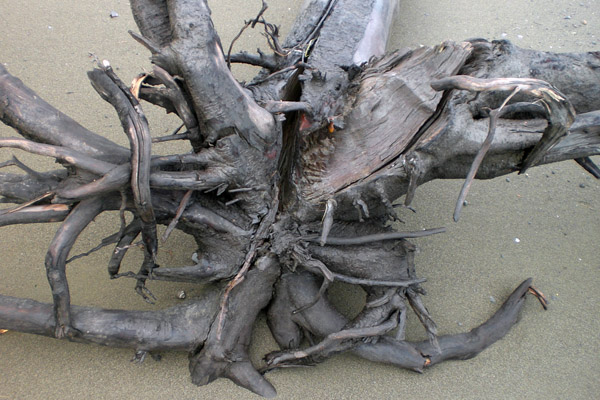
Enlightenment is where we find it. Today, the mountain village of Zhanglang, Menghai County, Xishuangbanna, Yunnan. Impressions, below.

This slideshow requires JavaScript.

inscribed dongguan

Unlike Shenzhen, which has managed to disassociate itself from its rural past, Dongguan continues to be considered a market town, population and exports, notwithstanding — provincial in all condescending senses of the word. Unfortunately for folks in Dongguan, urbanizing strategies to overcome the stigma of cultural boorishness are often the problem. The Lamwa (联华国际) development, 星河传说 (Milky Way Legend), for example, is located in Dongcheng District, Dongguan Municipality’s aspiring middle class district, where English inscriptions, including a Cambridge education kindergarten are all part of local efforts to rebrand the city. It feels, however, like 1990s Shenzhen, before millennial skyscrapers and creative industries replaced industrial parks, creating Shenzhen urbanity and the concomitant nostalgia for urban villages. Impressions of Milky Way Legend’s high culture pretensions, below:

This slideshow requires JavaScript.

architectural thinking — from the nanjing sun yat-sen memorial to luohu train station

One of the highlights of the XLarch Masterplanning the Future Conference was Wang Yun (王昀)’s keynote speech that periodized the development of Chinese style architecture, arguing for an internationalist approach to architecture, rather than an ideologically charged use of architectural symbols.

As an architectural style, Chinese classicism was invented by western trained architects who upon returning to Nationalist China received commissions to build “Chinese style (中华风格)” buildings during the decade of 1927-1937. These buildings had large, Chinese style roofs, windows and decorative details, and sometimes included stylized gardens. The Nationalist capital, Nanjing was the location of some of the most important examples of this style as well because commissions not only represented individual client preferences, but also the determination of government leaders to create a recognizable Chinese public architecture.

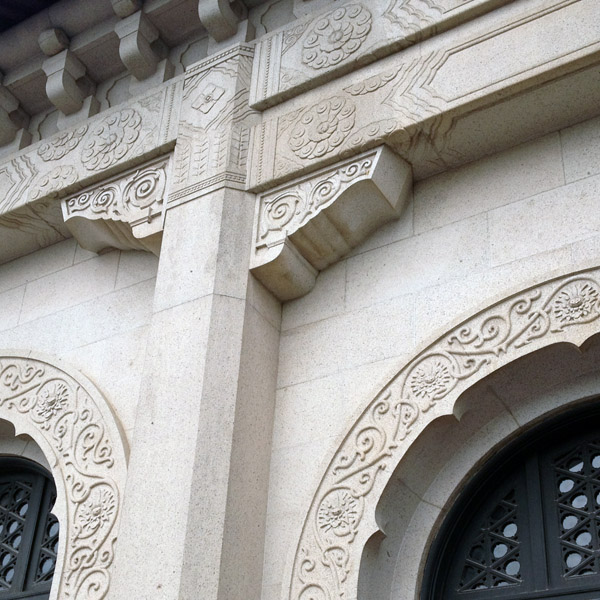
One of the most important examples of Chinese classicism is the Nanjing Sun Yat-sen Memorial, which was designed by one of China’s first starchitects, Lv Yanzhi (吕彦直). Lv also also designed the Guangzhou Sun Yat-Sen Memorial before his untimely death in 1929. The Nanjing Memorial reinterprets traditional themes through choice of material (reinforced concrete and mosaic tiles) and through the secularization of traditional symbols (animals become geometric shapes, for example). In addition, the Memorial layout abstracts and represents Nationalist China as the difficult realization of Dr. Sun Yat-sen’s three principles of the people (三民主义) — nationalism, democracy, and public welfare. To reach the Memorial proper, for example, there are 392 steps going upward, each step representing one million Chinese, and together representing the population of nationalist China. These steps are broken by eight flat platforms, which represent the fragmentation of China by warlords and civil war. However, when one looks back on the stairs, all one sees is a flat surface, an optical illusion that promises national unification.

The Nanjing Sun Yat-Sen Memorial provides a lexicon for understanding Chinese Classicism during the Nationalist era, including the reference to the Lincoln Memorial (1920) by way of the seated figure of Dr. Sun (1926-29). Not unsurprisingly, perhaps, the Lincoln statue also dominates a neo-classical building, albeit through references to Greek architecture. Indeed, both the Sun Yat-sen and Lincoln Memorials use the respective classicism of their countries to assert timeless governance, even as they commemorate leaders who governed countries divided by civil war.  I show the following images of the Nanjing Memorial with the caveat that they are not architectural — an architectural photo has amazing resolution, geometric composition, and absolutely no people, unless, of course, the figure contributes to architectural exegesis. My snaps, however, aim to emphasize just how popular this site is and thus how it continues to shape the visceral experience of being in “China” through a particular architectural style.

This slideshow requires JavaScript.

How does the Nanjing Memorial relate to Shenzhen?

This architectural lexicon has been picked up, tweaked and redeployed throughout Shenzhen, but as a private rather than public source of architectural symbols. The Luohu Train Station is the only exemplar of public Chinese Classicism that has been built in Shenzhen in the Reform Era. The other large example of post Reform classicism is the Hongfa Temple in Fairy Park, which is arguably political in its adamant denial of any political message. Certainly, in its assertion of the reintroduction of official religion to civic life, Fahong was as ideologically charged as the train station, which signaled China’s opening to capitalist countries. However, with the exception of these two buildings, Chinese Classicism in Shenzhen is limited to decoration in urban villages, where many handshakes have tiled roofs, restaurants, and the odd sculpture, such as Nvwa Holding up the Sky in Shekou, which is a socialist realist rendering of a mythic theme.

All this is interesting because given the explicit modernism of Shenzhen’s public architecture, the rediscovery or explicit use of Chinese tradition and roots are often used in neoliberal arguments for alternative forms of architecture and historic preservation. Chiwan comes to mind as do struggles for some form of preservation in urban villages. These efforts contextualize the design and construction of key civic architecture, including the Civic Center and central axis, which has the ideological expression of Reform and Opening (here, here, and here). Importantly, both the relentless modernization of Reform era public buildings and the alternative movement to construct a classical past for Shenzhen ignore Maoism, which nevertheless continues to inform the built environment.

masterplanning the future. or not.

I have an ambivalent relationship to academic conferences. On the one hand, I find them physically exhausting because structured to produce the largest amount of intellectual work in the most efficient way. Sadly, intellectual efficiency, like all forms of efficiency is a statistical concept that can only be represented through quantification. The success of an academic conference tends to be measured in numbers of participants, sessions, and published proceedings — measurements which effectively transform intellectuals into academic line workers and make conferences just another station in what might be described as toolpath control over knowledge production. Thus, I experience diminishing returns in a conference’s progression; early on, I am able to listen more actively and participate more fully simply because I’m rested and able to engage a diversity of theoretical positions and claims. In contrast, as the conference unfolds, I become physically tired and often find myself aware that my only contribution is the effort to engage a presenter’s work; I try to listen and understand.

On the other hand, I attend academic conferences because I yearn for intellectual conversations with people I do not meet in the general unfolding of my life. I have colleagues and friends in Shenzhen with whom I debate and discuss various issues. But in order to be inspired and challenged, or simply unsettled and honed, I need both the stability of familiar conversations and the jolt of unexpected encounters. Consequently, I continue to see old friends and opponents, while making new at conferences, which are by and large international and place me in proximity to scholars working both in and beyond Chinese borders. Thus, the conference format, especially when funded by academic and public institutions, offers opportunities to nurture and grow intellectually — precisely through intellectual companionship — both during and in the off time between stations sessions.

In other words, both the strengths and limits to Fordist knowledge production are relentlessly human; international conferences provide opportunities to be surprised and inspired outside the paths of everyday life, however, tired bodies can only do so much, even and especially when we are going through the privileged motions of academic conferencing.

On Oct 18-19, I had the pleasure of participating in the Masterplanning the Future Conference, which was organized and hosted by the Department of Architecture at the recently established Xi’an Jiaotong Liverpool University in the Suzhou Industrial Park. Organizers, Austin Williams and Theodoros Dounas’ attempted to address the inherent problems of academic conferences through a schedule, which started late enough in the morning and ended early enough in the evening to allow for conversations about and around the the question of high-speed development(s). Moreover, the conference structure attempted to open discussion to the widest possible audience, including a local audience for these ideas. On day one, for example, the public sessions raised general issues, their lay representations, and potential representatives, while on day two, the academic sessions provided more detailed analysis and examples of these issues. Finally, the conference itself was small enough to allow for participants to leave with a sense of the whole, satisfied that if someone were to ask me, “So, what was the conference about?” I could confidently answer, “English language efforts to come to terms with how China has shaped post Cold War thinking about and experience of urbanization. With a few divergences.”

That said, my interpretation of the point and purpose of the Conference differs importantly from the full title of the conference which was Masterplanning the Future: Modernism — East, West & Across the World. The aim to generalize at this scale meant that during sessions we inevitably stereotyped both ourselves and our interlocutors. All too often, the conversation reduced to statements that began with “The West this” or “China that”, rather than staying focused on more specific examples or standpoints that might allow for the negotiation of similarity and difference as shifting aspects of human experience, rather than as identifiable characteristics of mass populations. In this sense, the underlying assumptions of the academic sessions did not differ significantly from that of the public sessions, or even from a more general representation of China and The West at the university itself.

And there’s the rub: this tendency to stereotype distresses me not only because it seems intellectually dodgy, but also because it invariably reduces international relations and cross cultural understanding to semiotic match-making, in all senses of the term. Romancing the factory, so to speak. After all, the conference did take place in an industrial park, with an eye to global knowledge production and consumption.

Outside the XJTLU conference centered where we convened, for example, was a sculpture of a Tang lady and an English gentlemen playing polo (image below).

Both ride culturally appropriate horses and wear culturally appropriate costumes. Both the Tang Lady and English Gentlemen are stylized representations of a recognizable elite, which in turn represent English and Chinese cultures, while glossing internal hierarchy and inequality within the United Kingdom and People’s Republic of China; Tang Ladies and English Gentlemen may represent the current elite of each of these countries, but in no way do they represent the lives of contemporary workers. Moreover, while I’m willing to entertain the idea that contemporary Sino-British relations are simply a game played by elites from the PRC and UK, nevertheless, the gendering of this statue is itself so stereotypically neo-colonial that I don’t know where to begin my critique.

(But really, if we insist on representing international relations through figures of hetero-normative couples, might we not consider a male Chinese zither player and a female British mandolin player, aiming for musical harmony rather than competitive sportsmanship as a unifying metaphor of international intercourse?)

All this to say: I think that these stereotypical elites and their games continue to echo throughout cross cultural conversation because leisure is one of the predicates of meaningful conversation. Here I mean leisure in all senses of the word — as unstructured time, as non-productive time, as pleasurably engaged time and the resultant inspirations, solidarities, and new beginnings. We know that we need to play together in order to create more meaningful relationships and concomitant social orderings; children do it everyday and, unlike us adults, they do it well, creating community out of mud pies and whatever else is at hand. However, unless we restructure the inequalities built into contemporary chains of production and consumption, including cross cultural production and consumption of knowledge, we will remain nostalgic for forms of elite leisure that we cannot have experienced, even as we mistake this deluded nostalgia with the necessary realization of leisure in society.

Sigh.

2012 guangzhou triennial

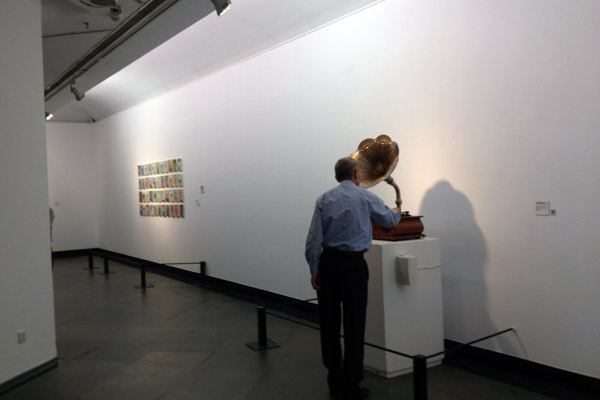
Yesterday, I visited The Unseen, the GZ Triennial exhibition and spent a pleasant 1/2 day engaging the works of 61 artists from China and the world, including Korea, Russia, India, and Indonesia, a diversity of representation much larger than the usual “global” expositions.

Curators JIANG Jiehong and Jonathan WATKINS have selected works in which what is seen directs the viewer’s attention to what is not. Sometimes the unseen referent is concrete, like the crank that twists a rope in XIAO Yu’s piece of twisting rope, Popularity 1. Sometimes the absent referent is more ephemeral, like the possible corpses buried beneath KAN Xuan’s Millet Mounds (大谷子堆). Sometimes, the unseen is a clever joke – Tim Johnson’s never seen flying saucers, for example. Nevertheless, as a viewer engages more works, the accumulation of unseen referents blurs the artificial division between concrete and ephemeral references, directing the viewer’s imagination instead to the illusive yet invisible worlds in which objects can come to signify relentless social pressure, cultural continuity, and comic book fantasy. So yes, it’s worth making the trip to the Guangdong Museum of Art (广州市二沙岛烟雨路38号广东美术馆) to see what else is there.

The Unseen will run until December 16. Impressions, below.

This slideshow requires JavaScript.

the contempt factor

The other day, while showing a group of visitors the Goodbye, Urban Villages (再见,城中村) exhibition, one asked, “Well what will they do about it?” meaning what will the residents do to prevent the forced evictions?

He, from Western Europe, was grappling with the question of democracy (or not) in China. She, from Hong Kong answered saying, “They don’t do anything because they can’t. That’s what it’s like here.”

Our visitors seemed to have settled on a variant of the local intellectual script, A Hong Kong Resident Explains Shenzhen to a Westerner, so I found relief speaking with someone from Beijing.

He commented, “The artists in Shenzhen seem really pure.” I laughed and answered, “That’s because there’s no market for art in Shenzhen; it has to be a hobby (爱好) [literally something done from love].” He smiled, “All we have in Beijing are markets because everything’s for sale.”

As a group, we then moved on to the Kojève exhibition, which is a bit too pure art for my taste, but nevertheless provided enough common ground that the conversation turned to light and pleasant topics.

In retrospect, I have realized that what irritated me about the visitors’ response to Goodbye, Urban Villages was that it had been a variation on a constant theme — contempt for Shenzhen and by extension for those of us who live here.

Intellectual Westerners, who dabble in romance languages, but have never heard of Shenzhen will ask me, “Will you live here, forever?” the unsubtle emphasis underscoring the fact that migrants and their displaced families will not stop the united forces of government and state-owned real estate developers from razing the handshake homesteads, low end eateries, and improvised bicycle repair shops that flourish on the sidewalk. I understand that elsewhere these might appear as insurmountable contradictions, but… and here I pause rather than answer a question that has set me up either to defend what I clearly oppose or to agree with the unspoken contempt in the question. Instead, I point out that no one lives forever.

Likewise, young Hong Kong students who do not cross the border except to purchase books and older aunties who come for sauna and massage will ask me, “How can you live there, is it safe?” and then advise me to move to Hong Kong. Yet others lecture me on the truth about Shenzhen — it is dirty and corrupt and teeming with mafia types who cannot be arrested because they’re in cahoots with governments — this they have learned in Hong Kong newspapers and from their Hong Kong relatives. I understand that many of their foreign friends may have just recently heard of Shenzhen, but… and here I pause rather than answer a question that has set me up either to play the innocent foreigner abroad or to instruct Hong Kong Chinese on what it means to be Mainland Chinese. Instead, I point out that I am still alive.

And there’s the rub: These pauses are difficult to cultivate. On bad days, find myself skeptical of good intentions so poorly phrased that the tone of my response may range from biting to sarcastic, amplifying the contempt with my own. On good days, I treat these questions as possible moments of mutual enlightenment, taking this speech at face value: they do not know and want to learn. Most days, however, I turn pedantic and finish my sentences, trying to make my interlocutor see — not just the political mess and entrenched despair, but also to observe the efforts some are making, and the care that some have brought to what is a vast and tumultuous and often unimaginable transformation.

anthropologizing

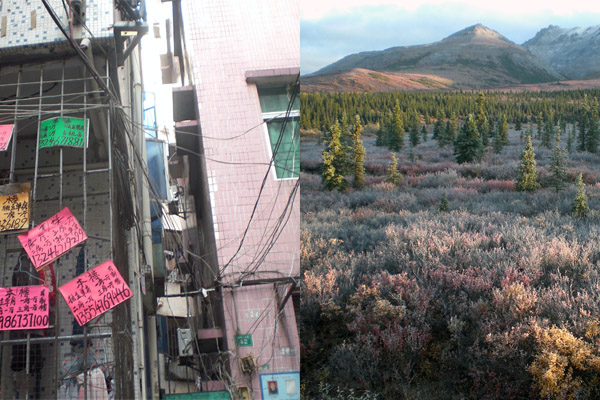
So, a juxtaposition of Baishizhou and Denali, which may be achieved through visual flattening, but as lived required movement through time and space — from Shekou to Hong Kong international by way of Shenzhen Bay checkpoint to SeaTac and then on to Anchorage and passage on the Alaskan Railroad.

I look at snapshots taken here and there, searching for commonalities, for what we might call human universals, which Donald Brown has defined as “those features of culture, society, language, behavior, and mind that, so far as the record has been examined, are found among all peoples known to ethnography and history.”

There is, of course, the eye of the beholder — mine — which seems drawn (here, at least) to pink, but all this does is raise the question of whether or not what I experience in each of these places is what other people also experience. In Chinese poetics, this common — unquestionably and recognizably human — response would be called yijing (意境), which literally means “idea scape” and denotes the moment of union between interior and exterior states of being.  意, for example, is composed of characters meaning “sound (音) and heart (心)”, while 境 is composed of characters for “earth as soil or land (土)” and “final or complete (竟)”, which here functions as a sound marker for jìng.

What are the respective yijing‘s of Baishizhou and Denali? And can we confidently generalize our responses to say, “Just so and how could it be otherwise?”

These questions matter because both Baishizhou and Denali are the focus of conservation efforts, albeit of a different ilk. Both discussions assume a common response to a particular environment. Moreover, in both discussions, one’s response to the environment is taken as an expression of one’s humanity and there, of course, is where the debate rages.

At Baishizhou, the current discussion of how to raze and rebuild an urban village focuses on the experience of mass urbanization and the need for access to housing, food, and transit networks. The debate has two assumes. First, the debate assumes that inequality is a defining feature of human life and that the purpose of social life is to ascertain that level and take measures to insure that people do not live in inhuman conditions. In turn, the content of the debate is over where to draw the line between human, subhuman, and inhuman living conditions. Second, the debate also assumes that urban living is a desirable form of life because it results in access to cultural goods, such as medical care and education by way of intentionally crafted environments, such as hospitals, schools, restaurants, and entertainment districts. As debated, these two assumptions are hierarchically ranked into the Maslovian categories of “basic needs” and “higher needs”. Thus, as one debates, one is not simply drawing lines between this life and that, but also and more importantly, revealing one’s humanity as a function of social responsibility.

Likewise, at Denali a general assumption and its implementation shape debate, but here over the nature and value of wilderness. On the one hand, the debate assumes that the experience of wilderness reveals and cultivates the wild, untamed spirituality that makes us human and that the purpose of social life is to maintain and create spaces where people can realize this spirituality. In turn, one’s love of wilderness functions in this debate as a marker of one’s spirituality. On the other hand, the debate also assumes that wilderness occurs in the absence of human settlements, such that in order to build human settlements one must transform wilderness. As debated, these two assumptions are also ranked hierarchically in terms of what is essentially human (nature) and acceptable transformations of wilderness (culture). Thus, as one debates, one is not simply drawing lines between this life and that, but also and more importantly, revealing one’s humanity as a function of wild spirituality.

It is possible to note the Chineseness of the Baishizhou debate (all that Confucianism going down), just as it is easy to remark on how much Emerson and Muir continue to shape American understandings of our place in the world. And therein lies the challenge of cross-cultural debates about what it means to be human in a world where Baishizhou and Denali cross paths, so to speak. The question is not so much either / or — which is a more accurate definition of what it means to be human: social being or wild spirituality, but rather the question seems to be: what might the Baishizhou debate teach us about the cultural place of wilderness, and what might Denali remind us about the limits to human settlements?

coastal walk, anchorage

This slideshow requires JavaScript.