rumors of excess: the shenzhen universiade

I’ve been talking to people about how much Shenzhen spent on the Universiade and the rumors are flying.

According to a report from the Expenditures Department, Shenzhen Municipality budgeted 17.39 亿元 (272 million USD according to my online currency converter), or roughly 36.4% of the 2010 expenditure budget. In 2011, there were two adjustments to the budget, bringing the official total spent on the universiade to 29.15 亿元 (457 million USD). So yes, I’m trying to imagine the “difficulties” that the center overcame to insure the smooth opening of the Universiade (克服各种困难,助力大运顺利召开), after which there were no more universiade expenditures. So how much is roughly 457 million USD? One answer is, Shenzhen spent 92% of the first quarter total trade between China and Cambodia (498 million USD) on a collegiate sporting event.

But it’s unclear what this money was actually spent on and whether or not, for example, they include infrastructure upgrades or just money spent on flower arrangements and strategically placed sculptures. Continue reading

nasa flicks, again

Several years ago, I posted a link to the nasa animation of land reclamation in houhai, one of my obsessions. I repost because the flick rewards – in that i can’t stop watching – repeat viewings. I’m also hoping that at some point the movie will be updated to include the past ten years. Also of note, G Burak and Karen C Seto (2008) have analyzed the environmental effects of urbanization, using Shenzhen as their case study. All scary, but unfortunately not unique. Shenzhen is merely a useful baseline for evaluating urbanization as a geological process because thirty years ago the area had not been industrialized. To see how New York has remade the world, for example, we close our eyes and imagine Mannahatta.

imported greenspace, clear skies, and sun

clear skies have returned and shenzhen shimmers, entices actually. when the horizon opens, walking settles the heart and has me thinking that we need sustainable worlds for no other reason than the joy they bring; smog discourages in all senses of the word.

yesterday, i wandered through some of the universiade greenspace/ coverage to prevent visitors from seeing nearby construction sites and noticed, once again, the extent to which the city and developers have taken to importing foliage to create beautiful spaces. the (malaysian, i believe – if you know please tell me) trees grow here. and yet. bringing this foliage requires uprooting other landscapes, burning fossil fuels, and (in houhai) filling in coastal waters with imported soil. moreover, these high end landscapes do not flourish without extensive care, so that this beauty remains entangled not only in unnecessary, but also unsustainable inequalities.

shenzhen is not the only city importing foliage in order to make a more perfect world. certainly los angeles and las vegas have set the global standard for transplanting eden. and perhaps that’s the point. in our rush to build a perfect world, we fail to realize we’re already there.

This slideshow requires JavaScript.

What is a boomtown?

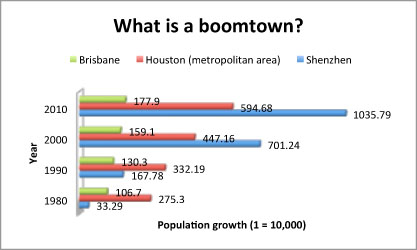
Many readers are no doubt aware that Shenzhen’s sister cities are all (more or less) boomtowns. Two of the most famous are Brisbane, Australia and Houston, Texas. Both Brisbane and Houston, like Shenzhen have seen major demographic changes over the past thirty years, both have also profited from restructuring to the global economy.

To get a sense of the scale of Shenzhen’s population boom, I created the following chart, which compares census statistics from Brisbane, Houston and Shenzhen from 1980 through 2010.

What this simple chart clarifies is the extent to which we (westerners) need to reconceptualize “booms” in order to think about the kinds of demographic, social, and political change that is happening not only in Shenzhen, but throughout China. In a smaller nutshell than even an excell chart, what we see is that Shenzhen blew past Brisbane in 10 years and then past Houston in under 20. Final tally: Brisbane – 1,779,000; Houston (metropolitan area) – 5,946,800, and; Shenzhen – 10,357,900 (plus undocumented inhabitants), begging the question: how do we, who share the planet and this worldwide political economic system talk about and across disparate experiences of urbanization without giving over to either Chinese exceptionalism (as in, that’s just China) or ethnocentrism (as in, why is China acting like us?)

And yes, for practical purposes I’m still using 1 = 10,000 to count.

exhibitionism

Yesterday, I went to the OCAT Contemporary Art Space opening, 小运动:当代艺术中的自我实践(Little Movements: Self Practice in Contemporary Art). I saw many friends and we chatted about what we are doing. Yes, this is the point: the Little Movements exhibition formally presents videos, writings, and photos of artists talking about being artists. And at this level, I like the idea of examining how we make art through day to day encounters. So, if you are interested in this history, the exhibition is well worth the trip. If, however, you want to know what young Chinese artists are doing, visit He Xiangning, the Art Space’s mother organization to checkout the Fresh Eyes exhibit.

Shenzhen population statistics, 1979 – 2011

Playing with excel, I made the following chart based on Shenzhen’s published population statistics (here, here, and here). Note the population unit is 10,000. Thus, in 2011, the total population with Shenzhen hukou was 2,594,000 and without Shenzhen hukou was 9,017,000, making the official population 11,611,000. More importantly, roughly 70% of Shenzhen’s official population comes from someplace else and this is a reduction in the hukou to longterm residence ration. These figures do not include estimates for the illegal floating population, which is estimated to be about 2 million. Thus, until I hear otherwise, I’m attributing the sudden rise in official population figures over the past two years to recent attempts to normalize Shenzhen’s hukou structure.

* Update (Feb 17, 2012): The Shenzhen bus propaganda is putting Shenzhen’s official population at 14.5 million. Seems that the hukou and residence permit inclusion policies continue because the SEZ’s official population grew roughly 3 million in 2011.

Shenzhen Bay Park

The rough edges of the Shenzhen Bay Western Area Landfill Zone, or Houhai (Backwaters) are being smoothed into upscale coastal parks. In fact, the construction is so fresh, seashells and oyster shells still surface in the sod. Yesterday, I walked to the Shenzhen Bay Park, which extends from the western edge of Mangrove Park and used to be a small harbor called Dongjiaotou, where goods and building materials were shipped to and from Baoan County and earlier incarnations of Shekou. Importantly, this upgraded coastline functions like so many parks in Shenzhen; the pleasantness of the park literally covers and symbolically blurs what it took to get here; and in this visceral sense, urban planning and landscaping are ideological practices. Impressions of Shenzhen Bay Park, below. Photos of Dongjiaotou Harbor Area and bluer skies from 2003.

This slideshow requires JavaScript.

Thoughts on certain questions since Maoism was overturned…

The “Resolution on Certain Questions in the History of Our Party since the Founding of the People’s Republic of China《关于建国以来党的若干历史问题的决议》” was a key document in the political re-evaluation of Maoism and subsequent reforms. On Aug. 27, 2011 in Beijing, a group of influential scholars, political scientists, lawyers, and journalists convened to talk about questions still facing the Party. And yes, I found out about the Beijing meeting as I find out about most political and social events in China – text messages and weibo. Below, I have translated a selection of quotable quotes from a circulating collection of quotations from the meeting. The key message remains – ask not what you can do for the economy, but what the economy should be doing for all of us… 

It is not easy to deny the influence of Reform and Opening, it is possible to broaden democracy within the Party and to have a constitutional government under Party rule – Ma Licheng (马立诚) Continue reading

constructing the semi-public sphere – ocat renovations

i have noticed that many of the shenzhen spaces that i enjoy might be defined as semi-public. small scale spaces designed with particular publics in mind, these spaces repurpose the clunky mass architecture of most of shenzhen into interesting nooks for conversation and debate, without falling into the normative excesses of so many private homes. indeed, recently, ocat loft has extended its conversion of industrial manufacturing zones into creative cultural spaces.  the newer area will be the site of the 2011 shenzhen-hong kong biannale.

importantly, cultural consumption and the gentrification of working class spaces have predicated the creation of this semi-public sphere, where individualized desires blunt the the progressive edge of public debate. and yet, if no one shops in these stores, hangs in the coffee houses, and attends gallery openings, the area will collapse and conversations displaced. such are the paradoxes of contemporary urbanization, images below.

This slideshow requires JavaScript.

Education and the production of educated masses

This is a speculative post from yesterday’s walk through Shenzhen University. What struck me in the rubble and organization of public spaces was how much was dedicated to creating mass audiences. Not just not enough for people to be present to observe and thereby constitute political hierarchies, but also that knowledge mediates the rituals of inclusion. Moreover, collectively watching sporting events seems to (1) create massive masses and (2) reminds us that we learn more through the body than we do through eyes and ears when they are pinned uncomfortably in plastic seats. And yes, all these bikes collectively used and then forgotten over summer vacation. For the over 40 crowd like moi, these images tell how extensively China’s political-economy has been restructured from cities of cyclists on their way to work units to cities of recreational biking and cars.  Impressions of technologies for creating educated masses, below:

This slideshow requires JavaScript.