outside my door

I went out this morning to buy fresh bread (still warm!) at my favorite bakery. The stairwell in our building is not only spotless, but also smells of disinfectant. In the compound, our resident Party Center (党群中心) had an announcement about sanitation safety on loop. One of the security guards took my temperature as I left and as I returned.

Things that I’ve heard from friends in other parts of the city: streets are empty, but in Baishizhou, more storefronts have been cordoned off; the country may be on lockdown, but it is partial. Urban renewal proceeds. Also, students have been sent reading materials and some have already begun online classes.

Something I’ve heard from a friend whose hometown is near Wuhan: everyone must stay indoors. One person per household can leave once every five days to purchase food and necessities.

the gates have been shut

Yesterday, on my way out for grocery shopping, I had to open the gate to leave the housing estate. This was somewhat strange because usually the gate is left open to pedestrians, but I didn’t think too much about it, especially because as I walked down the street I noticed that small groceries had opened, including my favorite bakery. On the face of it, things were getting back to normal. However, when I arrived back home, I entered the gate to discover several police officers and red-vested individuals, who I presume were some kind of volunteer. They were busy conferring with each other and the estate security guards. They didn’t say what they were up to, but several hours later a friend posted a map of confirmed cases of 2019-nCoV in the neighborhood. There were no cases in our estate, but four in nearby estates. Another friend then posted an app for checking the location of confirmed cases throughout the city.

Here’s the point: this morning cat litter was delivered to our gate, but not our door. For the moment it seems, only residents can come into and leave the estate. I’m not sure if this means the security guards will start taking our temperature or not. I’ll go out today to find out.

the wuhan 8: whistle blowers with chinese characteristics

One of the major complaints that I am hearing in Shenzhen is the lack of transparency about information about the new coronavirus; most of the information we are hearing isn’t coming from official sources. Indeed, the first announcement of the Wuhan coronavirus came from eight unnamed, unofficial sources, which announced that a new virus had been discovered. The Wuhan police “handled them according to law” for spreading rumors and reminded the public that “the net isn’t outside the law.”

武汉市announcement

Continue reading

coronavirus @sz

Although we are beginning to receive word that return (from cities north of Wuhan on the Beijing-Guangzhou-Shenzhen-Hong Kong) have been cancelled, nevertheless yesterday, the CPC Central Committee of Shenzhen announced that the city was not being locked down. Instead, these posts emphasized the measures that the city was taken to maintain the public’s health. Measures include mandating wearing breathing masks in public spaces and having your temperature taken when entering buildings and crossing borders in and out of the city. Nevertheless, the buses and subway are still running, supermarkets are still open, and as I write I can hear garbage being collected and processed. Continue reading

year of the rat, 2020

The threat of Wuhan coronavirus, notwithstanding, chez Shenzhen it’s been a strangely low-key beginning to the year of the rat or mouse or any other kind of rodentia that floats your boat. Squirrels and hamsters, moles and chinchillas with their long, long whiskers–any and all can appear on a happy new years card, although most are ordinary brown or white mice, and some are wearing breathing masks. Most public spaces have emptied out, events have been cancelled, and we’re at home eating dried persimmons, roasted chestnuts, and dumplings. Someone mentions that the night before they (and who are they?) locked down Wuhan, four million people departed the city. Some must have had advanced knowledge of the shutdown, but others must have been traveling for the New Year. After all, Wuhan is one of the four most important railway transit hubs in China; anyone on the Beijing-Guangzhou-Shenzhen-Hong Kong high speed train went through Wuhan on their way north. We’ll see how (and when) they make their way back.


where have all the people gone?

Yesterday I walked Baishizhou, remembering the bustle of our rushed departure. Bikes and motorbikes, cars and moving vans clogged the hot streets, and we squeezed through and around pedestrians on their way home or to work or to shop or out for a snack. Yesterday, even the once crowded food alley has been mostly abandoned; a few shops are still open at the intersections between the alley and main roads, but the overwhelming feeling is one of departure and a viscous waiting.

This slideshow requires JavaScript.

and yes, urban villages are now heritage sites in shenzhen

So, I wrote Heart of Shenzhen: The Movement to Preserve ‘Ancient’ Hubei Village. It was published in The New Companion to Urban Design, an (embarrassingly expensive) anthology, edited by Anastasia Loukaitou-Sideris & Tridib Banerjee. The paper tracks the rise of public intellectuals in Shenzhen as well as growing identification with the city’s cultural geographies.

handshake 302@xiasha, update

So, it’s been a while since I’ve written. There are reasons and non reasons for my digital silence, but one of the more relevant to my life as a blogger has been Handshake’s move from Baishizhou to Xiasha. Even as the evictions in Baishizhou proceed, we have started a new project “Marquee (走马灯),” which explores the relationship between technology and daily life. We are curious about your first mobile phone experience, your favorite wearable device, and the products that embarrass you. Continue reading

clearance sale

WechatIMG916

Huang Yihong came to Baishizhou with a plan—to explore the materiality of different objects and experiment using them to create different objects. As an aesthetic concept, materiality is a response to both formalism’s emphasis on visual aspects of art and structuralism’s interest in context and communication. Materiality is time and situation based: it acknowledges that the human experience takes physical form. This kind of artistic exploration requires curiosity, patience, and a systematic method of exploring objects, their physicality, and their social context. Imagine, for example, everything that might possibly be done with the green netting that is ubiquitous on Chinese construction sites. The netting keeps dust in place on recently demolished sites and hangs protectively around buildings under construction. Now consider: given this context, what does it mean when an artist wraps an old brick in green netting?

Continue reading

what’s love got to do with it?

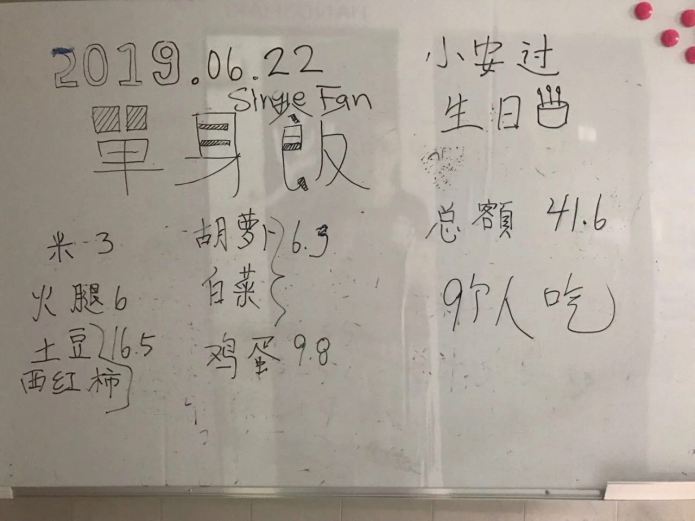
On June 22, 2019, Handshake 302’s visiting artist, Xiao An celebrated her 28th birthday by preparing a Singleton Lunch. To prepare for the meal, she shopped the nearby street market like a professional, prepared “Whole Tomato Rice,” in the rice pot, and served up eggs, potatoes, and batchoy—all in two hours. In fact, this was the first time that the food at a Singleton Lunch was ready before the guests arrived. How did the meal come together so smoothly?

“I’ve spent a lot of time in the field,” Xiao’an said as she efficiently pulled everything together.

This slideshow requires JavaScript.

For this conversation, Xiao’an chose the topic “A Single Woman’s Fear and Love.” Four women and one man joined Xiao’an and Mary Ann, sharing stories about how it feels to be an unmarried married woman in contemporary Shenzhen. As the conversation developed, we realized that other issues, such as hometown and generation played important roles in what participants feared and how they felt about love.

Everyone at the table had made unconventional decisions in order to create a better life for themselves. Yet, this decision to come to Shenzhen and pursue professional dreams extracts a greater cost from women than from men. After all, a traditional man is expected to meet challenges and provide for his wife and family. In contrast, many young women do not work for themselves, but work for their natal families and then, once married, they work for their new family. So we shared this story: standing up our dreams when they came into conflict with social expectations.

This contradiction between our individual dreams and social expectations meant that our most common fear was that we would loose love if we became too much ourselves. If we didn’t act like a Hakka daughter and sister and help our brothers purchase a house and get married, would our parents still love us? If we didn’t get married and have a child before we turn 30 years, would our village still accept us or would they call us “a chicken who can’t lay eggs?” If we were still unmarried at 40, would there be a place for us in society, or would people be wondering, “what’s wrong with you that no man wants you?”

Consequently, most of us experienced love in relationships where our dreams were recognized and valued. When parents accepted a daughter’s choice to earn money for herself, this was experienced as love. When a friend encouraged us to ignore cruel gossip, this was experienced as love. And when we accepted our dreams and our decisions, this too was experienced as love. In other words, the “love” we sought wasn’t a passionate affair, but shared values and dreams, where our partners saw us as individuals and not a social role.

At the end of the meal, it was clear that we had all suffered when our individual desires came into conflict with traditional expectations. We all wanted our families to understand and accept our decisions. Consequently, it also became clear that we all shared a common wish for Shenzhen; we want the city to be a place where everyone—regardless of gender, hometown, or generation—can develop themself as an individual and find life-giving forms of love.

Continue reading