Pictures of the Shanghai Hotel, one of the earliest and most important landmarks on Shennan Road taken in 2005 and 2010, respectively. Other than the skies, of note: In 2005, the bus stop was being expanded and the six story Rainbow Department Store was tucked away behind the Grand Skylight Hotel. By 2010, the new Rainbow Department Store dwarfs all other buildings. This is all part of the upgrading of Huaqiangbei.
Monthly Archives: April 2015
public intellectuals we be
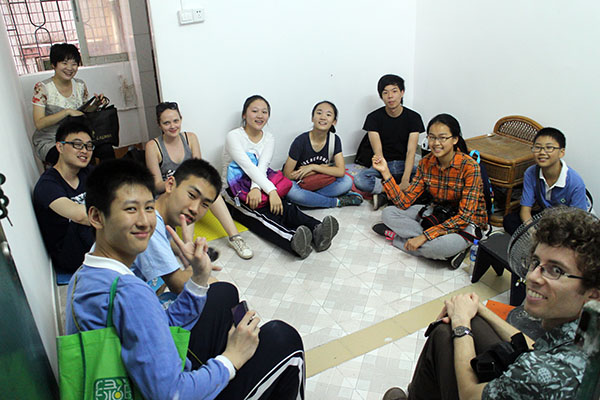
Last Friday evening, Yang Qian, Chen Hongjuan (Melon), and I participated in a public talk on “Designing Escapist Experiences”. The event was the first in a four-part series on experience design that is co-produced by the OCT A3+ space and the Baptist University of Hong Kong, Master’s of Visual Arts in Experience Design. As with many talks in currently salon obsessed Shenzhen, the talk quickly exceeded its proscribed limits, this time steering into discussions of whether or not art was by definition “escapist” or if it constituted an opportunity to re-imagine the world, with particular reference to the every changing utopian project of the PRC. Also as with many of these discussions, commerce came in, guns blazing: was it really so horrible to pay for the delights of Disney princesses or to imagine oneself as middle class if only for a few moments? Indeed, it is an exciting time to be in Shenzhen where public debate–especially minjian debate–is enjoyed and well-attended. Young and old, well educated Shenzheners and recently arrived professionals, everyone wants to learn and is eager to share “true thoughts” with receptive interlocutors. After two hours of intense conversation, we took a group photo and went home, refreshed and somewhat hopeful in the lingering delights of conversation.
Crossing the Border Between Shenzhen and Hong Kong, 1951
great photos of the luohu border crossing, when it was just being established!
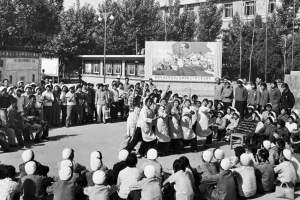
Dancing for the Nation’s Birthday at Our Factory, 1971
The past IS a different country.
handshake with the future
Handshake 302’s latest project is moving along. This past weekend we met with middle school students (on Saturday) and Guangdong Xin’an Polytechnic students (on Sunday) to think about how their experiences and acquired knowledge about Baishizhou might be put to the interesting work of making art. Continue reading
shenzhen speed as simultaneity
Shenzhen Speed has been taken up as a metaphor to describe the pace of life in the city, including the velocity at which buses race through the city. According to friends, Shenzhen buses cover more ground in less time than do buses in their hometowns, where apparently they meander from stop to stop and can take hours to cross an entire city. In contrast, in Shenzhen, crosstown buses make several loops in a day. However, as metaphor “Shenzhen Speed” may distort more than it illuminates the history of the city. Continue reading
chai jing’s “under the dome”: investigating china’s air pollution
If you haven’t seen Chai Jing’s documentary on China’s air pollution problems, here’s the first ten minutes with subtitles. To view subtitles start the video and then click the icon to the right of the clock in lower right hand corner of the screen.
Compelled to learn more? The full documentary can be viewed on youtube. There is also a written English summary online at Unworthy.
the power of faxing protocols
Finding out what is happening within the Shenzhen government is difficult not only because of censorship restrictions, but also because of protocols regulating the circulation of “documents (文件)”. Specifically, no documents are are sent virtually. Instead, documents are faxed from Beijing or Guangzhou to a centralized distribution center in the Shenzhen government that receives the faxed documents, makes copies, and then delivers them to relevant ministries and bureaus. This protocol follows for lower-ranking governments as well, so Shenzhen faxes to its constituent Districts which in turn fax to their Street Offices. There are, of course, different levels of government faxes. Some are simply copies of directives or activities, while others are actually official policy and require stamps (such as the copy of a Sichuan document, above). Continue reading
celebrating yuan geng’s 98th birthday in shekou
Yuan Geng continues to inspire hope for social reform in Shekou. Yesterday, the recently established Shekou Community Welfare Fund mounted the exhibition “Me and Yuan Geng” to celebrate the 98th birthday of China Merchants-Shekou’s first CEO. The Shekou Community Welfare Fund is the 14th such fund registered in Shenzhen, but it is the only one started by community members through donations, rather than through a government bureau. This matters because Shenzhen Municipality has called for the establishment of 100 funds, and we hope for more and more community–rather than government sponsored community–funds to emerge over the next year or two. Continue reading
changing expectations among shenzhen workers
I just had conversation with a friend who is the CEO of a Shenzhen based fashion firm. She said that Shenzhen (and ultimately) Chinese manufacturers were facing two problems:
- Low level manufacturing was being relocated to countries like Vietnam, where wages were lower, and;
- Workers born in the 80s and 90s generation have higher quality of life expectations than do workers born in the 60s and 70s.
Her point, of course, was that the workers from the 60s and 70s not only built Shenzhen, but are also currently factory owners and the most active in society. Therefore they are not necessarily willing to offer workers from the 80s and 90s improved working conditions, including regular time off, air conditioned dormitories, and fewer roommates. She concluded that to be successful, Shenzhen producers needed to offer higher value, niche manufacturing that incorporated both industrial and social design into new business models.
This conversation chimes in on ongoing discussions I’m hearing about dormitories in Shenzhen. It is also reflected in Re/Code”s recently published article, “A Rare Glimpse Inside Foxconn’s Factory Gates” which shows the Taiwanese multi-national’s efforts to re-brand its Shenzhen campus, as a place where workers are well treated and therefore happy.