Sunday afternoon in Baishizhou – sunlight, children playing, and fresh markets.
This slideshow requires JavaScript.
Sunday afternoon in Baishizhou – sunlight, children playing, and fresh markets.

Most discussions of Shenzhen emphasize that as an immigrant city, Shenzhen is a Mandarin speaking outpost of national culture in the midst of Guangdong Province. However, this description glosses over the historical division of Baoan County into Cantonese and Hakka cultural areas, and how urban development focused on the SEZ (rather than the entire Municipality).
The establishment of Baoan and Longgang Districts in 1992 institutionalized these historic divisions, with a Cantonese cultural-linguistic area (Baoan District) and a Hakka cultural-linguistic area (Longgang District). At the same time, the traditional SEZ (bounded by the second line) formed the core of Mandarin national culture in the city.
Thinking about Shenzhen as a tri-cultural city enables understanding of how cultural homogenization does and does not take place. Today, I’m thinking specifically about the creation of a recognizably “rural” local identity versus an “urbane” Shenzhen identity. In the area surrounding the Universiade Village, for example, these various trends are most visible in ongoing construction and demolition projects.
Construction wise, the planned Universiade Village boasts beautiful, glass stadiums and swimming areas, which reflect urbane aesthetics. Indeed, the nearby 5-star hotels and upscale residential areas lump Shenzheners (the Mandarin nationals) with cutting edge international taste and consumption. This aesthetics contradicts that of the mid-90s generation of handshake buildings that constitute much of the Longcheng Street residential area. Architecturally, it all seems a straight-forward contradiction between rural and urbane Shenzhen, which in turn is often misread as a contradiction between Cantonese and Mandarin spheres.
In fact, walking through a small Hakka Village, like Dawei indicates how recent handshake buildings as an architectural sign of the rural are in Shenzhen. In Dawei, the handshake buildings have been built into and on top of a traditional, small Hakka compound (similar to the one in Sungang). In other words, handshake buildings create a common “rural” or “Baoan local” identity for (once culturally and linguistically distinct) Cantonese and Hakka villages only in contradistinction to a Mandarin identity.
Visual evidence in slideshow, below.
each time i visit shangshui (admittedly not all that often), i am caught off guard (again) by how much i like it precisely because the area forms an eddy of difference within hong kong. yesterday, for example, i trundled across the border to shangshui to meet with friends robin and venus who had directed me to meet them at an old style cafe, 广成冰室 in 石湖墟, a short walk from the shangshui metro. the cafe itself teemed with people eating set lunches of macaroni and beef soup, an egg sandwich, and milk coffee or tea. there were also red bean ices, pineapple rolls, and various other foods that had a definite greasy chopstick appeal. indeed, i´m thinking that in the american context, this kind of old style cafe might be more accurately translated as ¨hong kong style diner¨.
when i visit shangshui, i appreciate the low-riding buildings and narrow streets, and sidewalks occupied by fruit vendors. i enjoy the slower jostle of people window-shopping and the mom and pop scale of business. that said, i´m not sure how much shangshui´s appeal lies in it´s being relatively isolated from the glass and steel and tall looming buildings of central and admiralty. in other words, i´m not sure how much of shangshui´s appeal to me is in what it is not, rather than what it is. thus, my pleasure seemed derived from how shangshui contradicted stereotypical notions of what hong kong is.
the distinctly ¨non-urban¨ feeling i had in shangshui also made me aware of how different shangshui is from shenzhen´s urban villages, which are shenzhen´s ¨non urban¨ spaces. admittedly, ¨non urban¨ is not the same as ¨rural¨, nevertheless, shangshui, like shenzhen´s urban villages had me thinking countryside and not metropolis. and this is a difference that seems important. in shangshui, i felt the non urban to signify relative impoverishment – a form of ruralization, if not in actuality, at least ideologically. in contrast, in shenzhen, even though the urban villages actualize relative impoverishment, they also enable a transformation of rural identities and economies into something more recognizably ¨urban¨ and so the feeling is one rural urbanization.
the eddies of difference that shangshui and shenzhen´s urban villages actualize are valuable because they remind us that not only are there many ways of being human, but also that lived difference is created through human interaction. moreover, these eddies also constitute a warning; our urban environment testifies to the extent to which we unequally value rural and urban lives, despite our need for clean water and air and sources of food.
Many have told me that the Yi Jing is always relevant, even in Shenzhen; it’s just a question of knowing how to interpret what is already there. Consequently, I have been wondering how I might use the Yi Jing as a way of understanding Shenzhen.
According to Yuasa Yasuo (2008) divination in the Yi Jing designates the act of knowing the dao or the way. One comes to the Yi Jing when one makes a decision that will determine one’s future, but in order for the divination to be accurate, one must come to with an ethical purpose and clear intention. So defined, divination as understanding is both teleological and practical. On the one hand, the Yi Jing counsels that we interpret any event in terms of both its origin and its telos, which is often unknown, but assumed to comply with the inner logic of the events that will have led to its arising. On the other hand, the Yi Jing provides strategies for harmonizing one’s particular intention with nature and society such that negative consequences of contradiction and imbalance might be ameliorated. Together, divine understanding and action constitute the dao, an ethical unfolding of natural processes, agrarian seasons, social mores, and human intention. Thus, the Yi Jing is a book about time, its possibilities and complications; it not only anticipated Shenzhen by two thousand years, but also provides a moral ecology for narrating both the city’s history and what this history might mean beyond the righteousness of facts.
In other words, interpreting the Shenzhen built environment would be an act of divining the new world order that Shenzheners are trying to realize by constructing the city. What then are we to divine from the self-fashioning of Shenzhen’s urban villages? What are the longings that have been built into an environment that prevents them from being realized? Continue reading
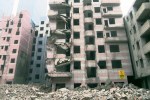
Shenzhen’s urban villages confound easy categorization precisely because they are sites where Mainland Chinese distinctions between “farmers (农民)” and “city people (市民)” have been constantly negotiated and renegotiated for over thirty years.
In the 80s and early 90s, the question facing the Shenzhen government was: how to transfer collective land to urban work units (to establish urban patterns of property ownership) while providing villagers with a livelihood. The resolution to that problem took the form of “handshake buildings (握手楼)” and village level manufacturing and commerce. These villages were called “new villages (新村)” – as in “Guimiao New Village and Xiangnan New Village, for example. However, the economic success of both the new villages and the pace of Shenzhen’s growth has meant that new villages have constantly bumped up against more intensive forms of urban expansion. Consequently, since the mid-90s, the question facing Shenzhen’s government has been: how to integrate the new villages into the city. Suddenly, the government was pursuing a policy of “[urban] village renovation (旧村改新)”. Of course, the so-called “old villages” were in fact the “new villages” of the past decade. More tellingly, the “new villages” were now called “urban villages (城中村)”, an expression which might conjure images of a massive city surrounding and absorbing a small yet resistant village.
The project to renovate Gangxia [New] Village began in 1998 with a plan to construct the Shenzhen central axis along and through Gangxia. However, it was not until 2008 that the government began negotiating with residents of Gangxia Heyuan (岗厦河园片) to transfer land from villagers to city developers. By that time, Gangxia Heyuan had 580 buildings (mostly handshake buildings) and an estimated population of 70,000 people. Obviously, most of the 70,000 inhabitants were migrant workers and not Gangxia Villagers with landrights and property holdings. Nevertheless, the government had to begin a complicated process of negotiated the terms under which Gangxia Heyuan would be transferred from Gangxia [New Village / Juweihui – and there’s a whole ‘nother story told in another post] to Shenzhen City by way of Futian District.
The crux of the matter was, of course, how to define an equitable transfer because once Gangxia Heyuan became a part of the Central Axis it would cease being an “urban village” and become an “urban center”, with all the symbolic and economic capital implied. Consequently, city reps, the development company, and the Gangxia Heyuan villagers needed to work out the amount of ratio of replacement housing to actual housing and the compensation per meter of housing to which each villager was entitled. In the end, the ratio was established at 1:082 for first floor holdings and 1:088 for second story and above. Compensation was fixed at 12,800 per meter of housing space and 23,800 per meter of commercial space.
Inquiring minds want to know: just how much richer did some villagers become anyway? Well, it depended on how much housing one owned and where it was. A villager who owned one of the 580 buildings, which might have 6-800 square meters would be entitled to anywhere from 475-600 square meters of new housing and 7.5 million to 10.2 million rmb if they only owned residential space and much, much more if commercial. In total, there are figures as high as 9 billion rmb in compensation flying through the rumor mill.
Here’s the rub. All this money seems like a lot until we go back and start factoring in the 70,000 migrant workers and several thousand Gangxia villagers who had unequal access to handshake buildings less than 20 years ago. Thus, because Gangxia New Village included unequal redistributions of handshake buildings and landuse rights, some villagers are now much much richer than others. Rumor has it that one such villager had 6,000 square meters of space, while several others had 3,000 square meters. All told (in hushed voices, of course) Gangxia is rumored to have over 20 billionaires and at least 10 residents with over 10 million in property holdings.
And it doesn’t stop there. None of this takes into account how much the real estate developers are going to earn off the wheeling and dealing that re-building Gangxia into Central Axis luxury condos, high-end commercial areas, and business centers. There are a few non-villagers who will become even richer than the few Gangxia billionaires.
So yes, urban village renovation is not only creating new landscapes, but also accelerating the pace of economic polarization in Shenzhen.
If we include Maoist attempts to ameliorate differences between rural and urban settlements, we’re looking at over sixty years of concerted negotiation of Chinese identity as a debate about rural (tradition) versus urban (modernity). Such that its possible to think of the past 100-odd years of Chinese modernization as a process of rural urbanization and concomitant forms of inequality, legislated, negotiated, and otherwise.
For the curious, the Chinese web has facts, figures, and rumors: here, here, and here.

Baishizhou has the distinction of being Shenzhen’s “city that isn’t a city, village that isn’t a village (城不城,村不村).”
The first stop (bus or subway) after Windows of the World themepark, Baishizhou has come to refer to a 7.5 sq km sprawl of handshake buildings that was originally part of the “Shahe Overseas Farm (沙河华侨农场)”. This highly congested and irregularly built area is also the first stop for many new migrants to Shenzhen because of its central location, convenience, and lowest of the low priced housing.
Inquiring minds ask, “How did (one of) Shenzhen’s most beautifully landscaped high end residential, tourist and arts area (OCT) end up next to what is acknowledged to be one of the city’s largest slums?” Continue reading
luohu seethes contradictions, especially in the area surrounding the train station and railroad tracks, which connect shenzhen to hong kong (in the south) and guangzhou by way of buji and dongguan (in the north). in fact, the area immediately surrounding the railway station is frequently (and distastefully) referred to as “chaotic (乱).”
this part of the city was originally part of caiwuwei (蔡屋围), location of the previous administrative headquarters of bao’an county (once it was moved from nantou in 1953). consequently, it was one of the first areas occupied by national work units that built shenzhen. in fact, this area is one of the few in shenzhen where there are work unit residential compounds.
although shenzhen’s explosion has repeatedly transformed caiwuwei, the area’s historic importance has meant that past buildings and dreams accumulate in the shadows of upgraded versions.
i have uploaded a five minute walk through two blocks of caiwuwei. it begins in the alley next to the the ministry of shipping compound (航运大院), scuttles through the driveway entrance to the chengshi tiandi plaza, crosses bao’an south road and moves through the newer section of the mix-c mall to park lane manor.
the point of this walk is not simply to draw attention to the contradictions that structure everyday life in shenzhen, but also to emphasize that critical irony is built into the physical environment. benjamin reminds us that when innovations appear in modern life they do so by calling attention to the past. and not merely any past. but collective dreams and fantasies for completion and wholeness that have not yet been satisfied.
pay attention. the the mix-c’s name in chinese is 万象城 – “city of every phenomenon”, evoking the dao de jing, where “the way gives rise to one, the one to two, the two to three, the three to every phenomenon (道生一,一生二,二生三,三生万物). ask yourself. if the way is not capitalism (with or without chinese characteristics), what is it?
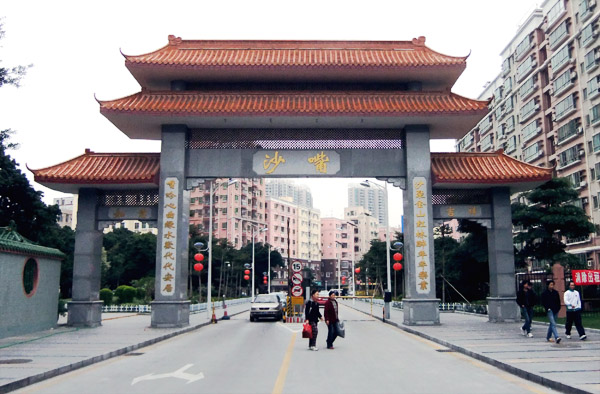
Entry gate to Shazui
Shenzhen villages are places of unexpected encounters with tradition, living and reworked. Indeed, these encounters are reason enough to meander through the villages. Just to the left of the entry gate to Shazui, for example, is a temple to Hongsheng (沙嘴洪圣宫), which is kept by an older Shazui couple. I asked about Hongsheng and they invited me to sit and chat.
Historically, Shazui villagers made their living fishing in the northern section of the South China Sea, beyond the mouth of the Pearl River Delta. Hongsheng, as his name “Flood Victory” suggests is a god who protects fishermen of the South Seas. Hongsheng is also sometimes thought to be 祝融 (Zhurong the god of fire) and THE god of the South Seas, suggesting that Hongsheng is either a local manifestation of a more general god, or was a specific god that was absorbed into a larger tradition.
From a decidely brief net surf, I have gathered that Hongsheng is very local. Most of the temples I came across were located in Hong Kong and this temple is the only one that I (thus far) know about in Shenzhen. Indeed, the Ou Family Association from Hong Kong (沙嘴[香港]欧氏宗亲会) had provided the computor printout with information about Hongsheng, which again suggests how local this god is. I’m wondering if this is because Hongsheng protects ocean fishermen? That said, throughout Nantou, most temples are dedicated to Tianhou (天后) with the largest temple at Chiwan.
So a post that begs more questions than it answers. Why Hongsheng and not Tianhou? Why only in Shazui? How important is the Hong Kong connection to the temple’s maintenance? And why is the temple located at the gate? Questions, questions. More to follow as I stumble across answers…
lately, i’ve noticed a flagrent translation violation on the 362 busline, where bus stops for urban villages (城中村) such as 新洲村 or 水围村 are announced in chinese as “villages” but in english as xinzhou estates and shuiwei estates, respectively. i’m not sure why the village vanishing act in english, when the 村 are clearly present in mandarin. perhaps the more interesting question is how those villages got to keep their designation, when others did not. (list of 362 bus stops, including the undesignated, like 石厦, which is a village but goes by “shixia” full stop, and the villages old (村) and new (新村). i’ll keep my ears tuned to the translations of 村 and 新村 on other bilingual lines. if anyone has noticed similar cross-language happenings in shenzhen or other chinese cities, i’d be interested to hear both what’s been translated (or not) as well as explanations as to why the (bait and) switch…
This weekend a group of Swiss writers visited as part of the food-scape / 食事风景 project. Representing the four Swiss languages, the writers were: Vanni Bianconi (Italian), Arno Camenisch (Romanch), Odile Cornuz (French), Peter Weber (German), and Martin Zeller (German). Margrit Manz organized the project. Three film-makers also came: Xia Tian from Tianjin by way of Basel, Janos Tedeschi, and Milo.
The importance of food in creating and nourishing human relationships is a truism in both anthropological theory and Chinese culture. We don’t just eat with intimates, we also create intimacy by sharing food. Moreover, when a group lacks common topics of conversation, talking about food easily segues into childhood memories, strangest food I ever tasted bravado, journeys through cultural landscapes, and perils of world domination by American fast food chains.
Saturday afternoon, day one, started awkwardly but ended with the sensual pleasures of a Hunan restaurant,where I was most struck by how good food facilitated conversations that had previously been stilted and dry. Pre-food, we approached conversation intellectually, each of us rehearsing arguments and theses we had clearly developed in other contexts. However, the flavors, the baijiu, the chewing, the swallowing, and the communal digesting of Hunan food gave us a world in common. We talked about tastes, what was special about Hunan food, the different types of chili peppers in China. We enjoyed Peter and Vanni’s enthusiasm for new dishes and suddenly the distance between people dissolved into laughter, stories, and arranging another workshop, which would be held after visiting Dongmen and City Hall the next day.
Sunday morning, day two, Winnie Wong joined us for morning tea at the revolving restaurant at the top of the National Commerce Building (国贸). This building is a particular favorite of mine because the inexpensive morning tea (48 per person on weekdays, 58 on weekends) is not only tasty, but also an easy opening to talk about Shenzhen history (the National Commerce Building was the first skyscraper built in reform China) and view Shenzhen (at 49 stories the building is tall enough for great views but low enough to be able to see and identify other buildings). Again, food, its presentation, and the dim sum fun of selecting baskets of dumplings, braised chicken claws, and cow stomach created commonality, so that presence in the present could anchor conversations that might otherwise have drifted into the tenuous connections of abstract thoughts.
We then visited the street markets of the remains of old Hubei Village (湖贝村), an urban village that occupies downtown land as yet to expensive to appropriated. Rows of and two-story traditional houses create narrow lanes, which are wide enough for a person to walk through open onto wider main lanes, which are wide enough to accommodate small carts, bicycles, motor scooters, and tables of fresh meat, vegetables, seafood, fried breads, imported fruits, tofu products, and displays of preserved eggs. Most of Shenzhen’s migrant workers live with their families in inner city villages like Hubei Village and these street markets both reproduce the feel of local markets elsewhere and provide convenient access to food. More importantly, the street markets create food-scapes, where migrants can inhabit Shenzhen by making neighborhoods out of grocery shopping, haggling over prices, sharing recipes, or simply walking around and noticing what’s available.
These three very different food-scapes provided the backdrop to our short visit to experience the monumentality of the central axis, where Martin bought pastries for our afternoon workshop, which itself was a food-scape of another kind. Martin arranged the pastries in the center of the table, I added the box of Swiss chocolates that Xia Tian had given me as a meeting gift, and the hostel workers served cups of hot coffee and tea. The group was now ready to talk about art. And we did. The conversation touched upon individualism, Chinese familialism, the materiality of language, and the performance of written works. Odile and Janos provided an impromtu reading of my translation of Yang Qian’s “Neither Type Nor Category”, and then Peter read his poems in German and Yang Qian their Chinese translations.
I left the table thinking about the importance of shared intimacy through eating to nourishing mutual understanding. Indeed, eating together made spaces in which conversation was meaningful and viscerally pleasurable, allowing real cultural differences to explored, rather than skipped over. During the food-scape exchange, for example, two of the most obvious moments of cultural ignorance appeared as lack of knowledge about Shenzhen (among Western artists) and indifference to Dada (among Chinese students).
On the one hand, over the past thirty years, Shenzhen has touched the lives of every single Mainland person. To have lived through Reform and Opening is to have seen its possibilities tried out, tinkered with, and transformed in Shenzhen. Indeed, migrating to Shenzhen, especially before 1997, defined a particular kind of courage and ambition that all Chinese people recognize. Thus, in the context of the contemporary PRC, ignorance about Shenzhen is unimaginable because it would mean having missed an entire historical era.
On the other hand, modern art movements like Dada have impacted and made possible all kinds of Western lives, ranging from aesthetic experimentation to philosophical interrogation of the limits to objective truth. Many of us, including myself, have created lives out of these possibilities. Thus, in the context of Western individualism, indifference to Dada is puzzling because to learn about Dada is to deepen one’s understanding of the self.
Definite food for thought.

 Shenzhen Noted