The Fishing Village that Became a World Symbol: 渔民村

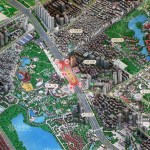
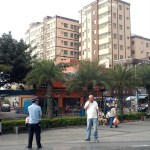
So, I have been catching up on the Shenzhen documentary, 沧海桑田:深圳村庄30年. After setting the historic stage with rural poverty and economic immigration / cold war defection (episode 1) and then national policy (episode 2), the documentary turns to specific villages both to illustrate general trends in SEZ history and to introduce the players. So today, 渔民村 (Yumin Village – episode 3), at the heart of the earliest reforms.

Yumin Village has an important place in both national Chinese and local Shenzhen symbolic geography for three reasons, but most importantly for revealing the prejudices built into the landscape, locally, nationally, and internationally. Continue reading

沧海桑田:The transformation of Shenzhen Villages

For those wondering, is there a documentary on Shenzhen villages out there? The answer is yes and its 15 hours long! CCTV and SZTV produced 沧海桑田:深圳村庄30年,  a 30-episode television documentary to commemorate the SEZ’s 30th anniversary.

Not unexpectedly, the documentary’s ultimate happy end is urbane Shenzhen. Nevertheless, each of the 30 episodes does raise issues worth talking about and also gives current Party takes on these issues, which is always useful information. In fact, that take may be the point; the commemoration of the SEZ’s 30th Anniversary included a more inclusive and nuanced understanding of pre-reform Baoan society and history, reminding us that the villages no longer exist as such. What remains are ideological and economic struggles over the properties held by [former village] stock-holding corporations that have not yet been fully integrated into the Municipality’s urban apparatus.

That said, however, there is also the question of what a truly integrated Shenzhen society might look like. And consequently it is interesting and hopeful to think that the economic questions may also force re-evalution of who belongs in the city.

So, how are those ideological battles being waged in the contemporary SEZ?

Continue reading

Impressions of the differences between Nantou and neighboring villages

Guankou and Yijia Villages are located just outside the Nantou Old Town Arch and revamped walking museumon by way othe Shennan Road – Nanxin Road pedestrian overpass. The villages abut each other along the old, narrow road, which used to run parallel to Yuehai Bay and connected Nantou to Shekou. Guankou and Yijia are slated for renovation at some point in the future. In the meantime, they are “just places where poor people live” as someone said to me, indicating disapproval of my photo-walk through the two neighborhoods.

Guankou and Yijia interest me because the village architecture is actually older than much found in the Nantou Old Town walking museum. Many Nantou residents built handshake buildings before the area was designated for historic preservation. Consequently, what remains in Nantou are handshake and factory buildings from the early 1990s, as well as particular buildings that had been designated historic landmarks. In contrast, the old centers of Guankou and Yijia were untouched during the 1990s village building spree and littered (and I use the word deliberately) with all sorts of old and interesting buildings.

This slideshow requires JavaScript.

Now, inquiring minds may wonder: why is Nantou, the imperial capital of the area with a 1,000 year history gutted of historical architecture (except in the renovating) and Guankou and Yijia not? Continue reading

渔农村: border lives

Connecting the Shenzhen Metro and the Hong Kong KCR, the recently opened Futian Checkpoint has provided incentive for building higher end real estate for those who live in, on and from the Shenzhen-Hong Kong border. The area teems with residential and leisure developments that target variations of Shen Kong lives.

Yunongcun (渔农村) is one of the closest urban villages to the checkpoint; simply exit, turn right, and walk 500 meters or so. The walk from the checkpoint to the village area reveals layers of history, both in the making and the discarding. One sees, for example, a soon to be razed 90s food street and mid 90’s housing, and then buildings from roughly ten years later, including a large spa and even newer shopping mall, as well as the Shenzhen river, which is guarded and sealed off from pedestrians.

This slideshow requires JavaScript.

What one does not see on this walk is Yunongcun’s important place in Shenzhen’s village renovation movement (旧村改新). Over five years ago on May 22, 2006, the Shenzhen government began the movement with a nod to Shekou’s “first explosion (circa 1979),” by detonating “the first explosion” of the village renovation movement and bringing down fifteen illegal buildings all at once. Villagers had put up these buildings as part of their negotiation for a better settlement package. A kind of holdout, but at a much larger scale than the individual family because the area only became prime real estate with the completion of the checkpoint. Continue reading

意maging baishizhou

Three pictures of the northeastern corner of Baishizhou along Shennan Road. The map and detail are from a map in the Window of the World subway station, the third is a photo of the actual corner, taken from the plaza in front of 沙河世纪假日广场 (Shahe Century Holiday Plaza), the large landmark in the two maps. The contrast between the map and the territory interests me because it the ongoing (re)imagineering of Baishizhou in particular and Shenzhen more generally.

Baishizhou, as mentioned in earlier posts, is one of Shenzhen’s more “chaotic (乱)” urban villages. However, it occupies prime real estate – directly across from Window of the World and on the Line 1 Subway. Consequently, upgrading Baishizhou is an ongoing project and has included major real estate development. Tellingly, most information about Shahe Century Holiday Plaza real estate (herehere, and here, for example) emphasizes the subway convenience, views of Window of the World, and modern amenities, downplaying and often ignoring the Plaza’s neighbor, Baishizhou.

Continue reading

Xiasha “Old village renovation”

In point of fact, the phrase “village renovation (旧村改造)” is a misnomer. What many Shenzhen villages are renovating is not the old village, but a village that was “new” in the mid-1990s. Images from Xiasha’s recently completed renovations suggest possible tradition-socialist-early reform-contemporary mashups or postmodern post-villages, so to speak.

This slideshow requires JavaScript.

qinghu – end of the line [du jour]

Walked around the qinghu station, which for the moment, is the last station on the longhua line. in its underdevelopment, the area reminds us that Shenzhen’s “villages in the city (城中村)” began as “new villages (新村)”, as locals took advantage of their land, proximity to Hong Kong, and cheap labor to jump into global chains of production. Nevertheless, with the subway, bourgeois taste has begun to restructure the landscape and upscale housing developments now push Longhua factories and dormitories further inland. Pictures below.

This slideshow requires JavaScript.

大望: Culture Highland

Yesterday, I visited the Dawang Culture Highland (大望文化高地). This is the second year that Dawang has been part of the Cultural Industries Fair; like Dafen, Dawang is using art and international art markets to urbanize. Unlike Dafen, however, Dawang is located at the foot of Wutong Mountain and is promoting a more natural and original art experience.

Dawang refers both to a particular village and the cluster of villages that nestle against the foot of Wutong Mountain and so development in the area tends to be village by village, leading to both unexpected convergences and contradictions. Importantly, the spatial layout of the area suggests interesting (if familiar) transitions between rural and urbane Shenzhen as well as the integration of neidi migrants and artists into the city. On the one hand, Maizai, for example, is the village closest to mountain footpaths and has developed a cobblestone pedestrian street for Shenzhen urbanites looking for weekend relaxation and local Hakka cuisine. Other villages specialize in selling lychee honey. There is limited, small scale production and commerce. On the other hand, transportation to the area is inconvenient, which means that land is cheap. Consequently, both artists and squatters have nestled into the edges of Dawang lychee orchards.

This layout highlights the important social function of urban villages in incubating new kinds of Shenzheners: locals as a new kind of renter class, artists as the up and coming middle class, and squatters as the lowest of the city’s urban proletariat. Importantly, the area’s distance from the city center means that its one marketable asset is precisely the feature it wants to destroy – its rural and undeveloped nature (in all senses of the world).

Dawang and its Culture Highland are featured in That’s PRD’s introduction to new artspaces in Guangzhou and Shenzhen. Pictures of the lay of the land, below.

This slideshow requires JavaScript.

cui bono? state power, urban village rights, and the vanishing of affordable housing

Recent events in Dachong draw our attention to how news coverage and debate about Shenzhen urban renovation projects focus on conflicts between the real estate developers and urban villages, effectively rendering invisible the growing lack of affordable housing for Shenzhen’s migrant workers.

Shenzhen’s mandatory urban renovation plans benefit developers and the government because villages must negotiate a transfer of land use rights. This means that even though compensation packages enrich villagers, long-term, successful project developers and the municipal government end up making more. In this sense, villager complaints that they have been underpaid have a certain legitimacy.  However, in return for their landuse rights, villagers receive compensation packages that include standardized reimbursement for extant housing, moving costs, and compensation for loss of livelihood. Villagers with multiple holdings and savvy negotiating skills become very rich; published reports indicate that as a result of development, Dachong villagers have joined the ranks of millionaires and several are now billionaires.

Huarun (China Resources)  has been negotiating with Dachong since March 2009. Indeed, banners calling for early decisions to sign transfer contracts were draped throughout Dachong and construction walls have been painted with slogans that sing the benefits of urban village  renovation. A sample — Scientific urban planning, collective transformation; Harmonious renovation, civilized relocation. New Dachong, New Life, New Development.

Nevertheless, as of April 15, there were still ten holdouts. The Dachong Stock Holding Corporation wrote an open letter to those holdouts, asking them to sign contracts immediately. A translation of the letter: Continue reading

threats against land transfer holdouts in buji?

In Shenzhen, village renovation and urban renewal involve transferring land use rights from villages and housing rights from homeowners to developers, which have won project bids from the government. Importantly, the developers must negotiate compensation packages both with village corporations (if transferring collectively held property) and with individual homeowners. Compensation packages include monetary compensation for housing and land, compensation for moving expenses, and compensation for livelihood losses. Here’s the point – even though compensation for housing type and land use is standardized, compensation for moving expenses and livelihood losses are negotiated, opening a space for differential treatment and corruption. Continue reading