The experience of walking Shenzhen is significantly different from visiting, Beijing or Shanghai, Xi’an or Guangzhou, where the meaning of the past has already been codified, renovated, and can be consumed on a nostalgic tour. In school we learn that Beijing’s history is Ming-Qing imperial, Shanghai’s history is East-West colonial hybrid, Xi’an’s history is ancient, while Guangzhou’s history is South China sea commerce and migration. We then go to the respective tourist destination to have our knowledge confirmed and perhaps enriched by and through an appropriate activity. We walk Beijing’s hutong and the Forbidden City, drink coffee or cocktails in a stylish restaurant in Shanghai’s shikumen and the Bund, admire Xi’an’s beilin and terracotta soldiers, and wander the small shops of Guangzhou’s West Gate. Indeed, each of these tourist destinations succeeds as such precisely because the site metonymically represents the respective city’s place in China’s “5,000 years” of civilization. We leave thinking we have a deeper understanding of where we have been. Maybe we do. Most likely we don’t. But there is something reassuring in having our stereotypes confirmed, and those stereotypes are what I mean by capital h history.
Now, there are historically significant sites in Shenzhen — Old Nantou, Dapeng Fortress, the Chiwan Tianhou Temple, Dongmen, and Yumin Village. However, municipal efforts to promote Old Nantou and Dongmen, notwithstanding, none of these historical sites has captured the imagination of either residents or visitors. I suspect this is in part because each of these places represents a portion of Chinese history that is already preserved elsewhere. Old Nantou and the Chiwan Tianhou Temple, for example, represent ancient efforts to develop the Chinese salt trade and settle the Pearl River Delta, but there are finer examples of that era to be imagined and seen in Guangzhou, while ancient Chinese history is more elegantly preserved in Xi’an and Jiangnan. Even the Tianhou sea cult is more closely identified with Tianjin and Xiamen than it is with South China temples and shrines. Likewise, Dapeng Fortress is an outpost of Ming-Qing military imperialism, but of a failed variety, rather than successful garrisons to be explored throughout the north.
Dongmen and Yumin Village are perhaps more representative of Shenzhen’s importance as the epicenter of early reform. However, both are historically compromised. Although Dongmin is identified with so-called Shen Kong commerce, for example, there really are more upscale malls throughout both Shenzhen and Hong Kong where one might purchase global products. And what about Yumin Village? Deng Xiaoping visited Yumin Village in 1984, inspecting one of the three-story private homes that local villagers had just built. He declared that Shenzhen speed was a good thing and that the rest of the country should follow. The 1995 exhibition to commemorate the 15th anniversary of the establishment of the Shenzhen SEZ included an installation that reproduced the interior of one of those homes, which at the time, was more luxurious than the homes of urban cadres in Beijing and Shanghai. Here’s the rub: although Yumin Village has been integrated into the Shenzhen municipal apparatus as a Luohu neighborhood, nevertheless the actual buildings that Deng saw and even the home he inspected were razed over ten years ago. There is a history board there, but nothing from 1984 remains and Yumin Village continues to function as a border urban village, with low rents for migrants who work nearby, spas and massage parlors for visiting Hong Kong people, and places where villagers play mah jong and gather to drink tea and gossip.
The absence of an agreed upon master narrative means that walking Shenzhen allows individuals to judge what does and does not represent capital h history in the SEZ. Now Shenzhen does boast upscale skyscrapers that represent achievements within this process — Guomao, Diwang, and the Civic Center all come to mind and are worth a visit. Those wanting to see the “real” capital h historic Shenzhen, I suggest visiting either an industrial park or an urban village. Early 80s work unit housing in Luohu and Shekou are also great examples of how industrial urbanization transformed the area. Personally, however, I believe that if Shenzhen has a place in China’s 5,000 years narrative it is as an epicenter of rural urbanization, including transformation of the local environment, proletarianization of rural migrants to SEZ factories, and the forms of urbanization that returned workers have promoted or their remittances enabled. However, even after over 30 years of reforming and opening Baoan villages, the city is only just starting to come to terms with this legacy and most villages, even the most famous such as Baishizhou are scheduled to be razed. All this to say that as yet, the meaning of Shenzhen’s cultural and historical inheritance is still up for grabs because we are only just starting to come to terms with the urban legacy of Reform and Opening. This means that as yet the city has no capital h history and no corresponding historical sites that one can visit and say, “Yes, I’ve been to Shenzhen and I know where I’ve been.”
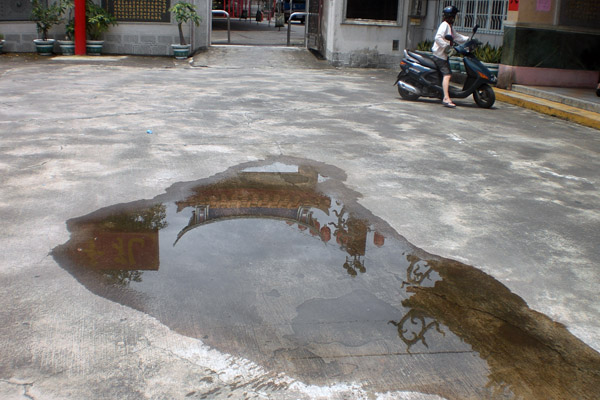
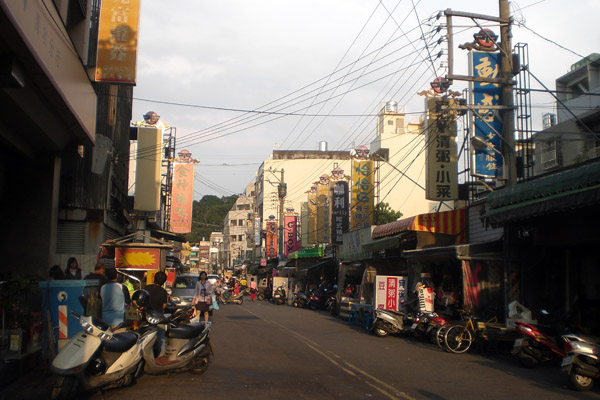
Walk anyway. The Shenzhen you experience will be only loosely tethered to stereotypes about China and you might make something else of it. Below, impressions of a recent walk in Fuyong.
This slideshow requires JavaScript.




 Shenzhen Noted