the cultural work of tests


grafitti-3

Originally uploaded by maryannodonnell

the gaokao is over and shenzhen feels more relaxed. it’s as if the entire city has sighed and thoughts turned to summer. of course, the zhongkao still hovers darkly, but for the rest of us, life is good.

this gaokao season, i’ve been thinking about the cultural significance of tests and testing because so many students have asked me about the SATs and TOEFL. these students are particularly interested in perfect marks and, in order to achieve those scores, are willing not only to spend weeks of their summer locked away in cram schools, but also to retake the tests 5, 6, and yes 7 times. inquiring minds want to know: why is a perfect score so important? Continue reading

what exactly is an urban village anyway?

Shenzhen’s urban villages confound easy categorization precisely because they are sites where Mainland Chinese distinctions between “farmers (农民)” and “city people (市民)” have been constantly negotiated and renegotiated for over thirty years.

In the 80s and early 90s, the question facing the Shenzhen government was: how to transfer collective land to urban work units (to establish urban patterns of property ownership) while providing villagers with a livelihood. The resolution to that problem took the form of “handshake buildings (握手楼)” and village level manufacturing and commerce. These villages were called “new villages (新村)” – as in “Guimiao New Village and Xiangnan New Village, for example. However, the economic success of both the new villages and the pace of Shenzhen’s growth has meant that new villages have constantly bumped up against more intensive forms of urban expansion. Consequently, since the mid-90s, the question facing Shenzhen’s government has been: how to integrate the new villages into the city. Suddenly, the government was pursuing a policy of “[urban] village renovation (旧村改新)”. Of course, the so-called “old villages” were in fact the “new villages” of the past decade. More tellingly, the “new villages” were now called “urban villages (城中村)”, an expression which might conjure images of a massive city surrounding and absorbing a small yet resistant village.

The project to renovate Gangxia [New] Village began in 1998 with a plan to construct the Shenzhen central axis along and through Gangxia. However, it was not until 2008 that the government began negotiating with residents of Gangxia Heyuan (岗厦河园片) to transfer land from villagers to city developers. By that time, Gangxia Heyuan had 580 buildings (mostly handshake buildings) and an estimated population of 70,000 people. Obviously, most of the 70,000 inhabitants were migrant workers and not Gangxia Villagers with landrights and property holdings. Nevertheless, the government had to begin a complicated process of negotiated the terms under which Gangxia Heyuan would be transferred from Gangxia [New Village / Juweihui – and there’s a whole ‘nother story told in another post] to Shenzhen City by way of Futian District.

The crux of the matter was, of course, how to define an equitable transfer because once Gangxia Heyuan became a part of the Central Axis it would cease being an “urban village” and become an “urban center”, with all the symbolic and economic capital implied. Consequently, city reps, the development company, and the Gangxia Heyuan villagers needed to work out the amount of ratio of replacement housing to actual housing and the compensation per meter of housing to which each villager was entitled. In the end, the ratio was established at 1:082 for first floor holdings and 1:088 for second story and above. Compensation was fixed at 12,800 per meter of housing space and 23,800 per meter of commercial space.

Inquiring minds want to know: just how much richer did some villagers become anyway? Well, it depended on how much housing one owned and where it was. A villager who owned one of the 580 buildings, which might have 6-800 square meters would be entitled to anywhere from 475-600 square meters of new housing and 7.5 million to 10.2 million rmb if they only owned residential space and much, much more if commercial. In total, there are figures as high as 9 billion rmb in compensation flying through the rumor mill.

Here’s the rub. All this money seems like a lot until we go back and start factoring in the 70,000 migrant workers and several thousand Gangxia villagers who had unequal access to handshake buildings less than 20 years ago. Thus, because Gangxia New Village included unequal redistributions of handshake buildings and landuse rights, some villagers are now much much richer than others. Rumor has it that one such villager had 6,000 square meters of space, while several others had 3,000 square meters. All told (in hushed voices, of course) Gangxia is rumored to have over 20 billionaires and at least 10 residents with over 10 million in property holdings.

And it doesn’t stop there. None of this takes into account how much the real estate developers are going to earn off the wheeling and dealing that re-building Gangxia into Central Axis luxury condos, high-end commercial areas, and business centers. There are a few non-villagers who will become even richer than the few Gangxia billionaires.

So yes, urban village renovation is not only creating new landscapes, but also accelerating the pace of economic polarization in Shenzhen.

If we include Maoist attempts to ameliorate differences between rural and urban settlements, we’re looking at over sixty years of concerted negotiation of Chinese identity as a debate about rural (tradition) versus urban (modernity). Such that its possible to think of the past 100-odd years of Chinese modernization as a process of rural urbanization and concomitant forms of inequality, legislated, negotiated, and otherwise.

For the curious, the Chinese web has facts, figures, and rumors: here, here, and here.

population updates (of a sort)

third day back in shenzhen and i chanced upon one of my favorite conversations: speculation about shenzhen’s actual population and how these figures are generated.

based on conversations with real estate developers and housing agents, as well as published reports and blog postings, i’ve been guestimating shenzhen’s population at around 14 million. recent articles also place shenzhen’s population at 14 million, with 2 million residents with hukou and 12 million without.

according to yesterday’s cabbie, he heard a china mobile advertisement that claimed they had an audience of 16 million. to his way of thinking, this meant that shenzhen had a population of at least 16 million. he then mused that it was likely that shenzhen had “more” than 16 million. he figured: (a) anyone without hukou registration wouldn’t come to the door to respond to the census; (b) only people working at tax-paing work units can be properly counted; (c) many people have more than one child, and the extra (超生) children may be registered in other cities; (d) censors can’t actually make it to every single residence in shenzhen, so they have to depend on what people say, which means there’s error built into the system even before they begin counting; and thus (e) for the sake of a more reliable estimate, they should pad their figures by “several (几)” million.

two points: first, we don’t know how many people live in shenzhen and the rate at which people are coming to live in the city. should urban planners be aiming for 30 million by 2020 (based on the idea that the population has been doubling every decade)? second, where can we go for reliable information? is estimated audience size more or less reliable than published accounts?

reliable population data matters because it is thet basis for decisions about how many roads to build, how much water and electricity to supply, where to build schools and hospitals. in other words, a working definition of urban quality of life is at stake in this data. perhaps more importantly, there seems to be little consensus on how one might usefully guestimate all the people living outside tax-paying channels. this is an acute problem in shenzhen (and much of guangdong, more generally), where a significant majority of the population is self-employed. consequently, even as it is difficult to make informed decisions about the scale of public services in shenzhen, urban planning is made even more difficult by the fact that there has been little accounting of / for those outside the system, which leads to questions about public policy and welfare.

all this to say, urban planning questions are questions about who has rights to the city and the level of responsibility a city government has to provide a minimum quality of life for all residents; questions, that is, of what it means to be a citizen. so yes, the production of reliable population data is a question of citizenship and urban justice because equitable planning is the political expression of our commitment to each other.

go figure.

p.s. for a sense of how shenzhen’s population is represented on the english language web, i popped over to wikipedia. shenzhen was not listed in the article on chinese population and demographics. this information was based on the 2005 census, which estimated shanghai’s population at a mere 10 million! in the list of most populous cities worldwide (2009 data), shanghai had burgeoned to almost 14 million, while beijing came in at slightly over 10 million. shenzhen was again conspicuously absent from the list. nevertheless, in the article about shenzhen (once again in wikipedia), according to shenzhen’s official population (including people without hukou, but apparently not including the homeless and squatters, who have occupied shenzhen’s edges, including the areas under bridges) is listed at 14 million.

what’s the point of college?

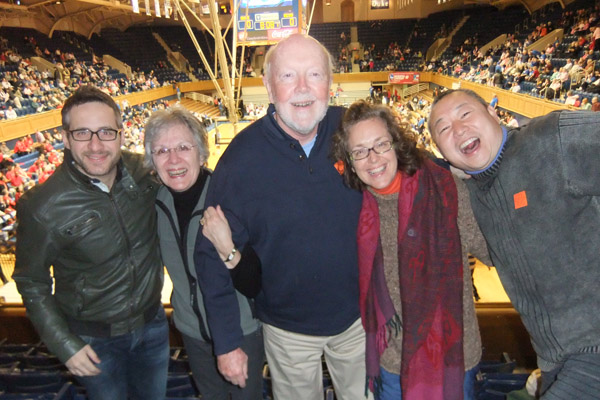
last night, went to cameron indoor stadium to watch the lady blue devils defeat the nc state wolfpack. well, we watched the first half and then returned home. mascot basketball at halftime was a bit much, even for my father who was thrilled to be there because (rumor has it) cameron is a shrine of sorts. certainly, yang qian found the pageantry fun. in contrast, nico (by way of italy) was somewhat nonplussed: how is such a display possible? he seemed to wonder and this was only a women’s game?! yes, those were students camping outside the stadium to purchase tickets for men’s home games, which do sellout. every time. i mentioned that in “utopian verses” wang anyi described her sense of alienation and acute loneliness when attending a university of iowa football game. nico nodded wisely, but remained silent.

watching a duke basketball game with two non-americans made me viscerally aware of the distance between the cultural meaning of “preparing for college” in the u.s. and china. Continue reading

coastal thinking

this past weekend, i was in seattle visiting friends and revisiting my past. yes, the older i become, the greater the twists and turns of who i thought i was and who they thought i was and the distances between all that thinking. mahsheed reminded us that scientists (of the empirically experimental sort) contend that memory is 70% recreated and 30% actual content. however, little is known about how and why that particular ratio or how and why some information is shunted onto one side of the equation or even how recreated memory is plotted… yes, this is the basis of my anthropological musings.  i’ll see your “hmm” and raise you three.

hmmmmm.

caveat given, i’ll move onto thoughts inspired while walking in seward park.

moss on fern green

walking in seward park (as it was when i walked along the salmon river, oregon a year ago), the ferns, red cedars, and douglas furs viscerally reminded me that i was in a coastal ecosystem. mud cold water seeped into my shoes, pulsing bark tempted me to raise my eyes, and a great blue herron stilled my circumnavigation of washington lake.

in contrast, while walking in shenzhen, i find it difficult to remember that we inhabit an estuary. i walk through smog and landscaped greenspace, note new buildings and speculate about economic boomings of one sort or another. i frequently read about mudflat wetland protection, the deep bay oyster industry, marine pollution and mangroves. all this to say, shenzhen’s ecological status strikes me as an abstraction, a category of thinking rather than an experience immanent in the environment itself. thus, my mind invokes “estuarine ecology” as a critical standard by which to hypothesize what might have been and imagine what could be. 

the difference is where lived – right brain or on a path at dawn. now, what to make of it?

shenzhen smog 2010.1.28

view from my window

several hours ago, a heavy smog descended on shenzhen. this smog irritates my throat and eyes, but i can’t identify a smell. at the time, several colleagues mentioned that it smelled like someone was burning something.

the ongoing diminishing of shenzhen’s air-quality has been a persistent theme in this blog. i can honestly say today is the worst day i’ve seen here. nevertheless, at work, most talked about the smog as if it were excessive, but “normal” as in “within expectations”. as i walked home, children were playing in huanggang park, people were chatting, and the traffic moved as usual.

does anyone else know what has / is happening? i tried surfing in chinese but haven’t seen anything. i did, however, come across a blog entry that classified shenzhen’s air quality as “relatively bad” and suggested that people limit their outdoor activities!

i also managed to come up with a timeline of worsening smog (灰霾) conditions in shenzhen:

2009 there were 115 smog days, apparently 39 fewer days than the 154 recorded in 2008.

2007 there were 158 smog days in shenzhen, but the city nevertheless got a “good” air quality rating;

2003 there were 131 smog days and the same article stated that the smog days have been increasing since the 1990s as there were only 8 hazy days in the 70s, and 58 in the 80s.

all this and suddenly the nytimes discovers that shenzhen is one of the top 31 places to visit in 2010. on the list, shenzhen is #20 and apparently getting “greener”! that said, the same article also managed to mention the nanshan kempinski without mentioning the houhai land reclamation area, so clearly the author’s focus was more the affordable luxuries of dongmen and the recent proliferation “legit” massage parlors than it was on environmental transformation. nor did the article mention that shenzhen is the capital of chinese theme parks. presumably shenzhen’s self promotion as a “chic” tourist city of “splendor and happiness” is finding a wider audience!

shenzhen university misty afternoon


lychee

Originally uploaded by maryannodonnell

had one of those delicious afternoons when the beauty despite blossomed. more snaps of shenzhen university trees, here.

Book Club Blues

On December 26, Mao’s birthday, our book club gathered to discuss a recent translation of Wang Shaoguang’s The Failure of Charisma: The Cultural Revolution in Wuhan (1995 Hong Kong University Press; translated in 2009: 王绍光 超凡领袖的挫败–文化大革命在武汉 the 80’s.). We were of several generations – the late 1950’s, 60’s, a couple from the 70’s, and a few from the 80’s.Liu Jingwen, member of the 80’s cohort led and organized the discussion.

What was striking about the conversation was the extent to which generational experience continued to dominate the conversation not just because 50’s and 60’s participants could claim personal experience of the Cultural Revolution, but also because of the relative value of political ideology amongst the different cohorts. Crudely speaking, the older the participant, the stronger was the conviction that collective politics is a pressing matter. Likewise, the younger the participant, the more likely s/he was to express surprise/ interest in/ confusion about the  older generation’s valuation of politics.

How and why the Cultural Revolution continues to matter in Shenzhen are pressing questions because Shenzhen was (arguable) the last of the great social experiments from the first thirty years of the People’s Republic. Deng Xiaoping mobilized intellectuals, cadres, and the engineering corps to leave their cities and “cut open a road of blood (杀出一条血路)” or “feel your way across the river (莫这石头渡河),” depending on the relative militarism of one’s ideological commitments – and yes, Deng was militaristic, but it was also a society saturated by martial metaphors. [Deng Xiaoping’s road of blood inevitably makes me wonder, ‘whose blood’ and ‘how much is needed’?]

Importantly, both the road of blood and the river crossed convey the idea of movement – road to where? Crossing which river? Of course in Shenzhen circa 1978, these questions have concrete answers – roads to Hong Kong at Wenjindu and Luohu and a ferry to Hong Kong at Shekou, respectively. But the also entailed hope and an orientation to the future – a new kind of modernity and xiaokang for every Chinese citizen. In other words, the values that infused the establishment of Shenzhen were the values espoused by many during the Cultural Revolution. This connection is even clearer when we take into account the extent to which freedom and proceedural justice were fundamental to the establishment and prominance of Shekou during the 1980s.

What came out of our conversation was how much history has been disappeared not only in terms of relative knowledge, but also in terms of the scope of the debate. Throughout the discussion,  I was struck by the similarity of the debate to American debates about Vietnam. Most of us don’t know enough to do more than debate the relative value of soundbites, rather than analyze and evaluate events and consequences. Moreover, instead of figuring out shared principals on which to base our analyses and evaluations, we end up comparing levels of personal experience – an important part of historical recovery and recognition of ignored lives, but insufficient to the task of building bridges if (and when) experience (or its lack) become the terms for inclusion in the discussion.

I came to two conclusions after three hours of debate: (1) we need an education that will enable us to transform ourselves and future generations into people who can contribute intelligently AND compassionately to social debate and action and (2) we need to get beyond complacent acceptance of business as usual, let alone celebrating Shenzhen’s successful establishment of hypercapitalism. As we left the coffee shop, one of the 50’s participants said to me, “And we still haven’t done anything in Shenzhen (深圳还没动手!)” Perpetual revolution, indeed.

Another Walk in Shenzhen

Poet Steven Schroeder and I have collaborated to create A Walk in Shenzhen II. The original Walk took place four years ago, 2005.

shenzhen bay 27 dec 2009

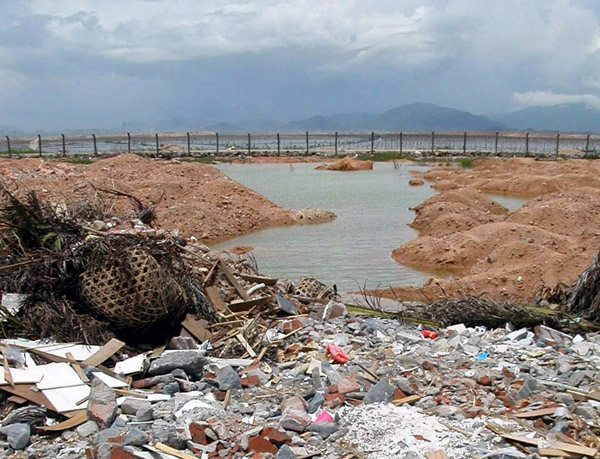
today i walked from the poly center at coastal city to circumambulate the construction site of the shenzhen bay sports center. i have started the walk with a that was then moment in 2003, which is today the point where haide 3rd road opens into houhai landfill in front of the kempinski hotel (now open for business). i started the walk from that same position today. the differences between the first and second pictures is only 6 years – but in terms of the production of real estate and growing air pollution problem it feels a lifetime; certainly another world. visit gallery to take the walk.