taxi talk

A few days ago, during rush hour, I was in a cab heading east on Binhai Road. We had just darted onto the expressway, when traffic slowed. And slowed. Until we were inching our way forward in a simmering mass of cars, many of which were trying to push their way forward by straddling lanes. Which in turn, slowed us further.

The cabbie had his radio dial turned to the morning traffic report. I was craning my neck, trying to figure out just why the snail’s pace. We inched. We sweltered.

He said, “Probably another accident.”

I grunted. He took a swig from his water bottle. We oozed forward another three inches.

At the Mangrove Park bus station, we saw the accident. Two cars were parked at the  divider between the expressway and the station offramp, effictively closing down two lanes – the offramp and the southern most lane. This caused major congestion because there were drivers who, in order to arrive at Mangrove faster, had straddled their way over four lanes to the lane furthest north, and then needed to force their way back to the exit lane to get to the bus station. Yes, because those two cars had blocked the offramp, those who weren’t already in the exit lane were having difficulty getting back, creating more back up and generalized highway irritation. The cars’ drivers were talking on cellphones, glaring at each other.

We had past the accident and were moving a bit faster when the traffic report announced that there was a serious traffic jam at the Mangrove Park bus station because the traffic police had yet to arrive, make the accident report, and have the cars removed. In Shenzhen, cars in accidents are not moved from where the accident takes place until after the accident report is made, otherwise, neither can make insurance claims. According to the report, the cars had been at the offramp for over two hours, which meant that the traffic police had not yet shown up.

“That explains it,” I said, although we still hadn’t picked up all that much speed.”Where do you think they are?”

The cabbi nodded thoughtfully and then made five key points about the nature of corruption in Shenzhen:

  1. High-ranking Shenzhen leaders all have two jobs (兼 – jian is one of those fabulous words that refers to the way that Chinese bureaucracies are knit together).  Clearly, it’s difficult to do both well.  The Municipal Party Secretary, Liu Yupu (刘玉浦) for example, is also one of the Guangdong Provincial Party vice secretaries. According to the cabbie, the Secretary was just biding his time until he was promoted.  “As long as he doesn’t make any mistakes, he’ll be fine.” On that note, Liu Yupu replaced Li Hongzhong (李鸿忠), who after five years in Shenzhen is now the governor of Hubei 兼/jian vice Party Secretary of Hubei Province.
  2. The Shenzhen government is too polite. Back in the cabbie’s home county, the county boss doesn’t back down from anything he’s said, even when he’s wrong. Then, if someone goes against the county boss, well the court does what the court needs to do (该怎么判断,就怎么判断!). In contrast, the Shenzhen government allows the people to talk back. For example, he noted the ongoing 操 contraversy in the Futian court, which was itself a hot topic on the traffic report that day.
  3. The Shenzhen government only pays attention to big events, like preparing for the Universiade in 2011. It doesn’t pay attention to the everyday lives of the people.  The Shenzhen government is, he said, a show for outsiders. And, he added growing increasingly vehement, now they want us to promote Shenzhen to visitors. He then gestured contemptuously at the traffic outside and asked rhetorically, “How in good conscious can I promote THAT?!”
  4. The police take bribes. So if there’s no benefit to coming to the scene of an accident, they won’t come. Just like this morning, he mused, they’re probably having dim sum at a 5-star hotel.
  5. Shenzhen people are themselves morally bankrupt. Everyone with a driver’s liscence knows the traffic laws and everyone has passed the test. In fact, he muttered, they probably could quote all the relevant laws. However, once they’re on the street, they don’t have the breeding and temperment (教养 and 素质) to do what they should.

His discourse lasted about thirty minutes, or the time it took us to crawl from the Mangrove Station offramp to another accident at the entry to Xiasha New Village. Like most populist worldviews, his was a fascinating mix of fact and fiction, liberalism and conservatism. It was also much more entertaining that the traffic report.

More Shenzhen Hukou (debate about) Reforms

This academic year (2008-2009), for the first time, Shenzhen law allowed for students without Shenzhen hukou to have the same rights to compulsary education (义务教育) as students with Shenzhen hukou. Of the roughly 600,000 school children in Shenzhen, 340,000 do not have Shenzhen hukou. It was estimated that the reforms would cost the government 400 million rmb.

At the press conference announcing the decision, Vice Mayor Yan Xiaopei (闫小培) said that there were two bright spots to the new policy that would make compulary education in Shenzhen more equitable. First, was that education for non-Shenzhen students would be free, just as it is for Shenzhen students. Second, in addition to providing free education, the city would also begin issuing free textbooks. In addition, public and private schools would be obligated to follow the same standard for payment of additional fees.

Of course, these reforms are welcome. However, they point to two ongoing education problems in Shenzhen: 1. The lack of good high schools for the number of students in the city, which means that those who don’t test into a top school and have college ambitions leave the city for high school even if they have Shenzhen hukou and 2. the link between taking the college entrance exam (高考) and hukou.

This April at the Shenzhen two Conferences (the National People’s Congress and the Chinese Political Consultative Conference), Shenzhen began debate about dissolving the law that requires high school 3 students to return to their hometowns to take the college entrance exam.  A few quotes from the debate:

到目前为止,对于政协委员和居民的呼声,深圳市政府方面显得很冷静。对于“取消高考资格户籍限制”的建议,深圳市教育局副局长坦承:“这是一个非常好的理 想。”但唐海海随即表示,高考资格之所以有户籍限制,有多方面的原因。深圳社会科学院社会发展研究所所长、深圳市决策咨询委员会委员杨立勋认为,在目前配 套政策没出来之前,放开高考户籍限制会出问题。深圳市人口办有关负责人也表示:深圳是特大城市中户籍准入最开放的城市,深圳的人口压力已经很大了,如果完 全放开,可能会带来很多问题。

(from xinhua net): To date, the Shenzhen government remains cool in the face of  the desires of the Consultative Conference and Shenzhen citizens. With respect to the suggestion to “dissolve hukou limits on the college entrance exam”, Shenzhen Vice Minister of Education, Tang Haihai (唐海海) said, “This is a wonderful ideal.” However, the Vice Minister then pointed out that there are many reasons why participation in the college entrance exam is limitted by hukou. According to Yang Lixun, Head Social Development Research Department of the Shenzhen Academy of Social Sciences and Member of the Shenzhen Policy Consultant Commity, until an entire set of related policies are in place, disolving hukou restrictions on participating in the gaokao will only lead to problems. A person in the municipal population office pointed out: Shenzhen hukou policy is the most liberal of all the especially large cities, and population pressure in the city is already very great, if [hukou restrictions] are completely dissolved, it is possible that many problems will follow.

In the meantime, the “Sunny Internet” program for middle and high school students who will take the high school and college entrance exams, respectively, enters its fourth year. All of Shenzhen’s schools are required to put basic information online, for free, in the interest of fairness. Required information includes: the kind of school (public, public-private hybrid, run privately owned by the state) its ranking (provincial first level…), target students, recruiting field (the whole city, a particular district), costs, address, and where to go for more information. For those desiring the latest information on both tests, visit the Shenzhen Tests Website (深圳招考网).

exotic dubai


dubai

Originally uploaded by maryannodonnell

the dubai-shenzhen connection reaches new levels of irony on the houhai land reclamation area, where “exotic dubai” is now an architectural style to be bought and sold in a soon-to-be-completed trés upscale residential area.

“exotic” is one interpretation of 风情 , which when refering to gender usually refers to the spiritual aspect of a woman’s sex appeal e.g. 多指女性.风情是女人的韵味,与性感有联系,两者的不同之处是:风情来自於“神”而性感来自於 “形” . likewise, when refering to place 风情 usually connotes whatever it is that makes minority groups “attractive”. this new marketing strategy not only begs the question: what other city has turned a bay into a desert in less than 10 years? but also has inquiring minds wondering: are they building artificial seas in dubai?

on that note, does anyone know if “shenzhen” is now or has ever been used as an adjective to describe real estate elsewhere?

comephophia VS 食物恐惧症


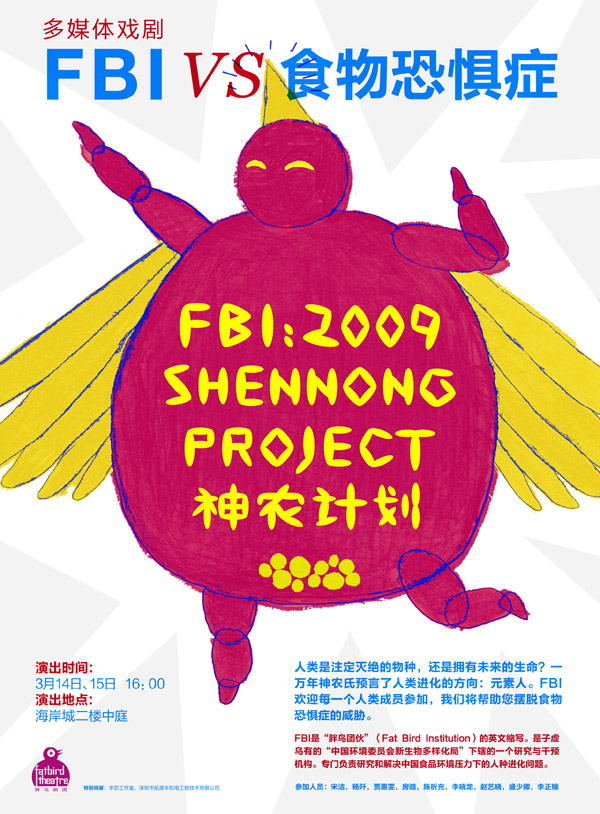
It seems that Three Deer scandal remains a sensitive topic. Even as representatives in the People’s Congress are arguing over whether or not stars who advertised for the company, in Shenzhen Fat Bird has adapted FBI: 2009 Shennong Plan to fit more snuggly into the rhetoric of Coastal City’s plan du month – “知性女性聪明消费 (The Intelligent Woman Shops Smart)” advertising focus.

So, as of last night, the advertising and and title of the play have changed. The play is now called “胖鸟VS食物恐惧症 Fat Bird Takes on Comephobia”. “Comephobia – fear of eating” was in the original production an ironic medical condition. This weekend, comephobia will be staged as a real social problem. The other major change to the piece is the staging of ritual. In Hong Kong, the piece also spoofed Falun Gong. In Shenzhen, the rituals have all been “upgraded” to modern dance.

Strange indeed which venues fear what. In Hong Kong, there was pressure to make sure everyone understood that “FBI” was an ironic naming of the theatre troupe. In Shenzhen, we must make sure that everyone realizes the troupe is making a joke about a problem that while real, isn’t so serious that it can’t be mentioned at all. FBI still hopes it will be able to sing its theme song to the tune of the Olympic theme song. However, that decision has not yet been imposed.

Time of the show has also changed from 3 to 4. The venue, 2nd Fl, Coastal City Mall, above Jusco.

FBI in Shenzhen!

On Mar 14 and 15 at 3 p.m, Fat Bird will perform “FBI: 2009 Shennong Plan” in the second floor public space of Coastal City. The space is located just above Jusco. After both performances, there will be an open discussion with with the audience about food safety and regulation.

This performance continues and elaborates Fat Bird’s efforts to use theater as a vehicle for encouraging public debate. Fat Bird began as a street theatre troupe which made strategic invasions into public space. In contrast, the Coastal City performance marks Shenzhen’s acceptance of Fat Bird into mainstream venues.

Come, enjoy, debate, and support Fat Bird! One bird, so much good.

Slow Shenzhen

Wed afternoon I heard a Taiwanese friend describe development in Shenzhen as “slow”!? Not slowing, but slow. My friend referred to the cultivation of talented people (人才). She pointed to how poorly Shenzhen students do on the college entrance exam to prove her point. 30 years into reform and a real city would have produced top scholars. She added that people who migrate to Shenzhen are go-getters (loose translation of 勤奋), but not cultured.

Bracketing a discussion of the way the gaokao quota system works and Guandong students’ limited options, my friend’s impression of education in Shenzhen is interesting because many of the students I work with will study abroad at top universities. This semester, for example, one of my students has been accepted to Cornell early decision and another accepted to Cambridge. I also know that top American universities now include Shenzhen schools on their Asian campus visits. Indeed, rumor has it that many of the best Shenzhen students use their high school senior year to prepare to study abroad, rather than cramming for the college entrance exam.

In other words, as soon as possible, Shenzhen students opt out of the Chinese system and their parents fund a major flow of talented young people abroad. All this to say, Shenzhen’s middle class and nouveau riche may be merely hardworking, but clearly they have elite aspirations for their children. I don’t know how relatively fast or slow this reorientation of the educational system has been, but I do know that the numbers of Shenzhen students studying abroad has grown steadily and will continue to grow in the foreseeable future. Moreover, I know many to be bright, creative, and capable of enriching wherever it is they ultimately decide to contribute their talents. Seen in this light, Shenzhen may be raising global, rather than national intellectuals. Lucky world.

Who should have rights to the City?

Questions of civic identity haunt Shenzhen like the tag lines of a never-ending soap opera: When will people who live in Shenzhen feel that the city is their hometown (老家)? Is it possible to feel like a Shenzhener without a Shenzhen hukou? When will residents with Shenzhen hukou (户口) say, “I’m a Shenzhener (full stop)” and not, “I’m a Shanghai person (uncertain fade out)”? Will residents who claim Shenzhen identity ever admit that they are from Guangdong and not transplants in a non-Cantonese city? And if Shenzhen gives long-term residents with hukou in another city a residence permit that includes all hukou rights will this administrative restructuring generate a corresponding rise in civic identity?

30 years ago, most Chinese had hukou in the place where they were born and raised. Consequently, their administrative status reiterated their emotional identification with their hometowns. A Beijiner both held a Beijing hukou and self-identified as someone from Beijing.

Today, uncounted millions of Chinese people have migrated from their hometowns to live and work elsewhere, unmaking the easy correspondence between one’s hukou and one’s hometown that had defined Maoist society.This situation is particularly acute in Shenzhen, where the majority of residents are classified as 非深圳户籍的深圳人 (Shenzheners without Shenzhen hukou). Statistics from 2005 put Shenzhen’s population at 5.97 million of which 1.65 million had Shenzhen hukou and over 4 million had temporary residences (暫住证). In addition, the City identified over 4 million temporary residents who had lived in Shenzhen for under a year, bringing the actual population to roughly 10 million.

Here’s the rub: the traditional correspondence between hukou and hometown has had concrete effects on efforts to create post-hukou civic identities. In many cities, for example, those who are “really (have both hukou and hometown status)” from the city blame those who aren’t for urban problems. This logic hinges on the assumption that “real” residents care about the quality of life in a city, while “sojourners” don’t. In addition, under the current hukou system, a Chinese citizen only has rights to city  welfare (including public education for child) in the city or town of their hukou residency, rather than in where they live.

The question of whether or not rights to the city should be based on hukou status is more pressing in Shenzhen than in any other Chinese city because most residents aren’t from here. Moreover, the City’s growth and success is attributed not to residents, but to immigrants. In other words, Shenzheners without Shenzhen hukou are the majority of Shenzhen residents.

In August 2008, Shenzhen promulgated the Shenzhen Residency Permit Temporary Application Process (深圳市居住证暂行办法), a reform of the hukou system, allowing anyone age 16 or over, who has lived in the city for more than 30 days to apply for a residence permit (居住证) that carries the same rights as a Shenzhen hukou.

The Shenzhen reform is notable for several reasons. First, it makes inhabitation, rather than birthplace the criteria for urban welfare. Second, it is open to all Chinese citizens, regardless of whether or not they hold a rural or urban hukou. Third, it assumes that people immigrate to rather than temporarily sojourn in Shenzhen. Fourth, it implicitly challenges traditional assumptions that hometown identification is natural, instead foregrounding the idea that civic identity is a voluntary practice.

Nevertheless, the larger question of who actually claims Shenzhen as their hometown continues to hinge on the question: does administratively designating a city necessarily produce a community that identifies with those borders? It’s possible that what is being produced in Shenzhen is not hometown identification, but rather a weak hometown identification with strong national ties. In other words, any Chinese person should have rights to Shenzhen regardless of hometown identity, making citizenship the only precondition for claiming rights to urban welfare.

This legislation has me hopeful. Not because I think it will be unproblematically implemented and thereby unmake the inequality that has structured Shenzhen hukou. Nor because a stop-gap status between no hukou and hukou status is enough to unmake the inequality that is the national hukou system. But rather, this legislation has me hopeful because it clearly states that living in Shenzhen entitles one to rights to the city.

Tianmian: East West South North

About a year ago, I had the privilege of participating in Vexed Urbanism: A Symposium on Design and the Social at The New School. I contributed Tianmian: East West South North an image poem that mapped four of Shenzhen’s formative ideologies along east-west and north-south axes.  In this piece, I aim to show – quite literally – how landscape is never simply place, but also and always a symbolically organized world, a cosmos. Thus, Tianmianillustrates how it is possible to read not only Shenzhen’s history, but also the values that have informed the city’s construction in the lay of the land, the placement of a building, and movements in and out of an urban village.

East West South North

Shekou 30th anniversary

This year marks the 30th anniversary of the China Merchants (招商局) Shekou Industrial Zone (possibly park). Shekou was established one year before Shenzhen, which celebrates the city’s thirtieth next year or the following year, depending on whether one counts from the year Guangdong approved the decision to establish Shenzhen (1979), or the Central government (1980). The SEZ border with the rest of the country wasn’t fully in place until 1986… Anyway, all sorts of commemorative events have already begun, including randomly posted pictures of Old Shenzhen, here, here and here, which are worth checking out to get a sense of the scale of change.

(Although the first set are actually from the 25th anniversary. I really do have to write about the ongoing and seemingly compulsive revisions of Shenzhen history. In a city that is constantly referred to as having no history, the historic compulsion is not only alive and well, it also shows up in advertising as “11 years of experience” as if 11 years was a long time, and of course, it is, but only in the context of thirty years, which are considered nothing in the history of 5,000 years of civilization… contradictions, contradictions…)

One of the more famous pictures from the early years is of Deng Xiaoping writing the characters for Seaworld (海上世界), here. His daughter stands to his right and, looking over his shoulder is Yuan Geng, the man who initiated many of the reforms that are today considered central to reform and opening, including: the first industrial park open to foreign investment, directly hiring and firing employees (rather than using centralized work assignments), and introducing market driven management principles (time is money, efficiency is life.

This picture is interesting for what it tells us about the political culture in which Shekou came into being as well as the kind of political and social change that Shekou once symbolized.

1. 1984 was the first time that Deng Xiaoping came to Shenzhen. He visited many places, but the two symbolically most important were Guomao (in Luohu, near the train station) and the Minghua cruise ship in Shekou. He inscribed characters for both the Shenzhen and Shekou governments. Shenzhen received the famous lines: 深圳的发展和经验证明,我们建立经济特区的政策是正确的 (the development and experience of shenzhen proves that the policy to establish an economic special zone was correct, picture of Deng Xiaoping writing inscription.) In contrast, Shekou received four characters: 海上世界 (seaworld).

2. The actual content of the inscriptions points to the differences between the early eighties Shenzhen and Shekou models of reform. Shenzhen was explicitly linked with politics. This is confirmed by the importance of Guomao, which was built as both a shopping center and an office building to house representatives from Chinese provinces, cities, and ministries. In contrast, Shekou was explicitly linked re-orienting everyday life from models of third world mutual support and mass production to capitalist trade and individualized consumption as a brief history of the Minghua and the four characters “Seaworld” shows.

The Minghua was a French cruise ship christened by DeGalle (1962). The Chinese bought it to transport engineering support to Tanzania in 1973 to build railroad in support of villigization—a form of African socialism based on the Chinese model. In 1979, then used as part of relinking Sino-Japanese relations. In 1983, the Minghua was moved to Shekou and refurnished as a floating restaurant and nightclub, where it anchored a westernized club scene.

3. When Deng Xiaoping inscribed the characters for Seaworld, he not only signaled his support of the Shekou model, he made the kinds of reforms that were taking place in Shekou a model for national development. Chinese leaders inscribe (题词) calligraphy to support organizations and policies. As of 1984, reform and opening did not only refer to administrative reorganization (as signaled by the Shenzhen inscription), but also to social and cultural reform. This is important because before 6.4 individual desires and political reform had not yet been brutally separated, so that in pursuing their dreams, young people in Shenzhen also represented a new kind of Chinese future.

4. The fascinating and ongoing politics of the smiling face. Smiling continues to be, like inscribing phrases and words, a way that Chinese leaders publicly express political support. This picture of happy leaders was a metonym for reform society: following this path will lead to a happy future. It ties into traditional paternalism, in which strict fathers only smiled when their children truly did something well.

historic preservation

i have been reading about ideas and efforts to renovate shenzhen, and have discovered an intense interest in historic preservation. there are several obvious examples–the chiwan tianhou temple (museum), the renovated dongmen commercial area (west of dongmen road), nantou old city, the hakka compounds in longgang, pengcheng garrison–and several more recent “discoveries”–any of the early 1980s light industry parks, remnants of older villages, a ming dynasty temple in baoan, older ancestral halls, dongmen commerce before historic renovation (east of dongmen road), 4 and 5 star hotels from the late 80s and early 90s, including the eastern pearl luxury cruise ship landlocked behind a golf practice range in seaworld. in various ways and with various degrees of success, all of these areas have been integrated into the new shenzhen.

of course, at stake is the question: what counts as history? the current effort to renovate inner city villages acknowledges that shenzhen’s only living cradles of pre-urban history are the villages, but on the other hand, what makes shenzhen “special” has been its urbanization. this contradiction means that even when village histories are chronicled and preserved, they do not resonate with shenzhen’s migrant communities. nor have i heard (note: what follows is highly anecdotal) that historic preservation in one village means anything to folks from other villages, except to encourage them to write their own histories. these histories re-write village history in terms of urbanization and what shenzhen has done for them.

so one telos, with history becoming the search for one origin. perhaps this is where the difficulty lies in writing shenzhen history. there isn’t one origin, nor one telos for that matter. even bracketing multiple development trajectories at any one time, there is still the fact that shenzhen’s official goals for urbanization have changed with every urban plan. this means that the editorial choice for one origin becomes deng xiaoping’s decision to establish sezs, and the telos becomes whatever has been built to date. so writing shenzhen’s history becomes tracking the history of changing teloses…and this is invisible. we lurch from one state of being to another, but can’t remember what was here before, or are compelled to forget what was here, even yesterday… we are busy explaining the link between deng xiaoping and shenzhen today.

the difficulty of trying to make shenzhen’s multiple teloses visible became clear to me several weeks ago. i met with a friend to show him several years of pictures of houhai and he said, “i thought the change would be more obvious. i can’t tell which pictures were taken first.” image quality told part of the story–i’ve used better cameras over time, so the better the resolution, the more recent the picture. its true. houhai has changed, but the way its changed–reclaim land, build tall buildings–hasn’t. so signs of change include building style, height, materials, distance from original coastline, which is marked by the oldest buildings, green space (as shenzhen has become richer, landscaping has increasing relied on imported, rather than local plants). but who has this kind of knowledge, which might form the basis of some kind of historic recognition? this knowledge is excruciatingly site specific. and people like my friend who haven’t repeatedly walked the coastline, don’t see the change. they see, instead, more of the same and when i visit places in shenzhen, i often find myself relying on knowledge of other places to read the extent of urbanization…

i am tempted to compare this feeling of eternally recreated present to the scene in the matrix, where the keanu reeves character (who’s name i’ve confused with nemo the fish) figures out he’s in a computer program because of a glitch; the same woman in the same dress walks by the same building twice, and only that experience, that moment of awareness reveals change. so history writing becomes looking for these glitches that otherwise go unnoticed.