greek with chinese characteristics – yuanling 1

this weekend, i walked yuanling (园岭), one of the first industrial and residential areas to be developed when shenzhen was officially special.

printing factories still operate in the shrinking industrial area park, however, those that have not been razed for upscale housing development have been and/or are being upgraded to storefront for warehouse like stores for ornate furniture and luxury bathrooms.

it sobers me to think that only ten years ago, this area was a vibrant industrial park, the realization of a particular understanding of modernization, when production and manufacturing were the at the core of shenzhen’s economic development strategy. suddenly and abruptly, individualized consumption has been enshrined as economic productivity in the (literal) wreckage of those past ambitions.

when i first came, shenzhen speed was defined in terms of accelerating 100 years of western modernization into a few decades. but all this instant upgrading has me wondering just how fast is an economic cycle anyway? and what comes next? restructuring and economic depression? pics of upgrades, here.

5 minutes in luohu (蔡屋围)


1 alley

Originally uploaded by maryannodonnell

luohu seethes contradictions, especially in the area surrounding the train station and railroad tracks, which connect shenzhen to hong kong (in the south) and guangzhou by way of buji and dongguan (in the north). in fact, the area immediately surrounding the railway station is frequently (and distastefully) referred to as “chaotic (乱).”

this part of the city was originally part of caiwuwei (蔡屋围), location of the previous administrative headquarters of bao’an county (once it was moved from nantou in 1953). consequently, it was one of the first areas occupied by national work units that built shenzhen. in fact, this area is one of the few in shenzhen where there are work unit residential compounds.

although shenzhen’s explosion has repeatedly transformed caiwuwei, the area’s historic importance has meant that past buildings and dreams accumulate in the shadows of upgraded versions.

i have uploaded a five minute walk through two blocks of caiwuwei. it begins in the alley next to the the ministry of shipping compound (航运大院), scuttles through the driveway entrance to the chengshi tiandi plaza, crosses bao’an south road and moves through the newer section of the mix-c mall to park lane manor.

the point of this walk is not simply to draw attention to the contradictions that structure everyday life in shenzhen, but also to emphasize that critical irony is built into the physical environment. benjamin reminds us that when innovations appear in modern life they do so by calling attention to the past. and not merely any past. but collective dreams and fantasies for completion and wholeness that have not yet been satisfied.

pay attention. the the mix-c’s name in chinese is 万象城 – “city of every phenomenon”, evoking the dao de jing, where “the way gives rise to one, the one to two, the two to three, the three to every phenomenon (道生一,一生二,二生三,三生万物). ask yourself. if the way is not capitalism (with or without chinese characteristics), what is it?

do not remove sketch


do not remove sketch

Originally uploaded by maryannodonnell

’nuff said.

for a wonderful gallery of shenzhen grafitti, visit the western bank of the shahe river bridge at binhai road. the old new coastline has been filled in, roads laid, and the river securely cemented in place. all is in place to continue extending the park. before that happens, visit.

to get to the gallery, it’s best to go to hongshulin park and walk west until you reach the shahe river: if you follow the water, you’ll even get a nice view (on a clear day) of the western corridor bridge and one of our many connections to hong kong. you’ll also have a view of the edges of land reclamation and the remnant wooden boats that anchor at docks strapped together out of styrofoam, bamboo, and plastic string. the eastern bank of shahe is at the furthest edge of the baywalk park that hongshulin is growing into.

(yes, just last week i realized that xiasha is renovating with an eye to integrating into this extensive park and wanke has donated strange log cabin / guard stands to hongshulin.)

if you walk from the west (as i did), begin at coastal city. walk past the kapenski, shuffle across the binhai on ramp and follow the wall that says “western district land reclamation area”. at different points, you can jump onto the landfill. keep your eyes open for granite posts. these were once the safety chain links along the former coastline and proposed extension to baywalk park. pay attention to the names of the buildings – not just “coastal city”, but also “river’s edge” and “bayview”. many of these residences and shopping areas were undertaken before the coastline was redrawn. be sure to notice the motley crew of puppies that guard another patch of squatter gardens and chicken coop. bring water. the walk takes about 90 minutes and the sun is hot.

shit


shit

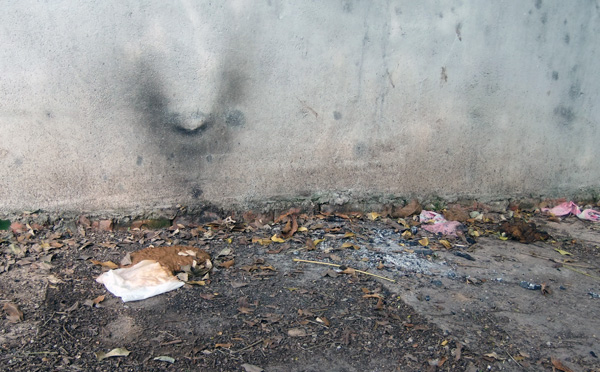
As I have wandered the edges of Shenzhen and as those edges have shrunk to the narrow spaces between the city’s elegant tree-lined boulevards and some kind of wall, I have noticed how easy it is to stumble into impromptu latrines.

Lines that redefine the territory: The road, a sidewalk, and a dirt footpath, which followed the river behind the row of bushes and trees that shaded the sidewalk. This particular latrine is located at the Sungang Bridge over the Buji River.

Once upon a time, maybe as many as ten years ago, this walk was part of Shenzhen’s official greenspace. Indeed, old tile walkways still connect the river path to the sidewalk. Consequently, I also stumbled upon chipped bits of walking path and several benches that provided a view of the Buji River.

The speed at which Shenzhen changes is the city’s identity. A popular saying has it that “To see thirty years of Chinese history, visit Shenzhen; to see one hundred years of Chinese history, visit Shanghai; to see 1,000 years of Chinese history, visit Beijing; to see 2,000 years of Chinese history, visit Xi’an (想看三十年的中国,到深圳;想看一百年的中国,去上海;想看一千年的中国,去北京;想看两千年的中国,去西安).”

A friend recently mentioned a twist on this theme, “Shenzhen took ten years to construct a new city; twenty years to construct an old city; and thirty years to construct a garbage city (深圳以十年建立一座新城市;以二十年建立一座旧城市;以三十年建立一座垃圾城市).”

Sigh.

shenzheners search for happiness…

happy endings?

The Shenzhen Civilization Office (文明办) is currently sponsoring the “Search for the Happy Person in My Life Video Contest (寻找身边快了幸福的人DV大赛)”.

At first, I was simply curious about how to interpret their posters – a canoe, floating on a dock, seperated from an idealized Shenzhen skyline by a vast expance of water. Am I supposed to understand the happy ones as those who have left the city or those who are heading toward the city? The image of Shenzhen rising fully formed from white fluffy clouds strikes me as oddly oz-like, and this has me wondering if perhaps those who don’t live in actually existing Shenzhen are the happy ones?

To assauge my curiosity, I googled 文明办 and, in addition to a national level office of civilization, I also discovered a provincial office. However, Shenzhen’s office was not online. A few more clicks and I found out that

中央文明办全名叫中央精神文明建设指导委员会办公室,是中央精神文明建设指导委员会的办事机构。而中央精神文明建设指导委员会最主要的职责就是督促检查各 地、各部门贯彻落实党的十四届六中全会精神和中央关于精神文明建设的一系列方针、政策的情况,协调解决精神文明建设主要是思想道德和文化建设方面的有关问 题。总结推广交流先进经验。深入调查研究,为中央决策提供建议。

(The full name of the Central Civilization Office is the Central Spiritual Civilization Establishment Oversight Committee Office, and is the managing agency of the Central government’s establishment of spiritual civilization. The main directive of the Central Spiritualization Establishment Oversight Committee is to  promote and supervise each region and bureau to implement the spiritual policies of the 14th meeting of the sixth plenary session and related questions of cultural construction.  In brief, to popularize and exchange avante guard experience. To conduct reseaerch into the process and provide suggestions for central policy making.)

Which begs the question: how do videos of happy people satisfy the Office’s mission?

A friend once told me that if you want to know what Chinese leaders think Chinese society lacks, all you have to do is find out what they’re currently promoting. For example, a “harmonious society” lacks harmony. By extension, a city searching for happy people would then lack happy people. Hmm…

Nevertheless, it seems wonderful to open the question of happiness to social debate. And to frame happiness as a question of spirituality? Again, yes! I’m all for making happiness part of national profiles and a condition for evaluating good government. However, instead of talking about what the conditions of happiness are and how we might extend them to more people, the videos by and large talk about how individuals are happy in their very private lives. Thus, in the videos I’ve seen, the definitions of happiness are so stereotypical (going to school, falling in love) and so individualized (family life, working hard) that its hard to see this competition as anything but more sugar-coating a decided lack of harmony chez Shenzhen.

And that’s the painfully irony: Shenzhen did begin in the dream of happiness or xiaokang, as it was once called.

More videos online at the official website.

unexpected encounters with tradition…

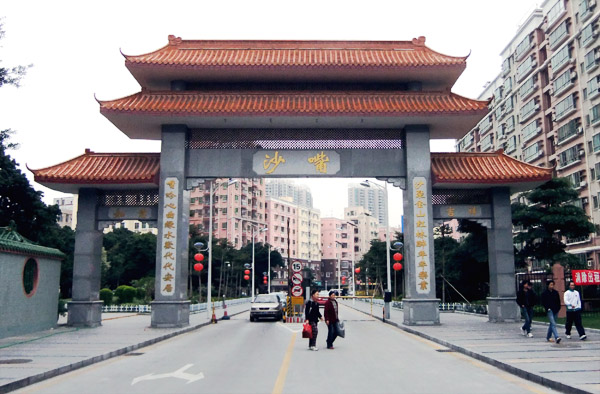
Entry gate to Shazui

Shenzhen villages are places of unexpected encounters with tradition, living and reworked. Indeed, these encounters are reason enough to meander through the villages. Just to the left of the entry gate to Shazui, for example, is a temple to Hongsheng (沙嘴洪圣宫), which is kept by an older Shazui couple. I asked about Hongsheng and they invited me to sit and chat.

Historically, Shazui villagers made their living fishing in the northern section of the South China Sea, beyond the mouth of the Pearl River Delta. Hongsheng, as his name “Flood Victory” suggests is a god who protects fishermen of the South Seas. Hongsheng is also sometimes thought to be 祝融 (Zhurong the god of fire) and THE god of the South Seas, suggesting that Hongsheng is either a local manifestation of a more general god, or was a specific god that was absorbed into a larger tradition.

From a decidely brief net surf, I have gathered that Hongsheng is very local. Most of the temples I came across were located in Hong Kong and this temple is the only one that I (thus far) know about in Shenzhen. Indeed, the Ou Family Association from Hong Kong (沙嘴[香港]欧氏宗亲会) had provided the computor printout with information about Hongsheng, which again suggests how local this god is. I’m wondering if this is because Hongsheng protects ocean fishermen? That said, throughout Nantou, most temples are dedicated to Tianhou (天后) with the largest temple at Chiwan.

So a post that begs more questions than it answers. Why Hongsheng and not Tianhou? Why only in Shazui? How important is the Hong Kong connection to the temple’s maintenance?  And why is the temple located at the gate? Questions, questions. More to follow as I stumble across answers…

thinking food: images from the houhai overpass, 2002-2010

this post is a brief contextualiztion of  china lab’s  landgrab city exhibition for the shenzhen-hong kong biennale 2009. the exhibit draws attention to the the ways that cities are imagined without reference to the countryside and food production. it also usefully brings china into international conversations about urbanization.

The countryside is a vital but frequently overlooked category in the contemporary discourse around spatial policy, and its role with respect to the future of urbanism is more often than not neglected. Landgrab City is an attempt to visually represent the broader spatial identity of the 21st century metropolis; it proposes a new spatial definition of the city and thereby a more complex understanding of urbanism, one that no longer considers city limits as the boundary of its remit, but instead looks beyond – even across international borders – to the spatial, social, economic and political implications of the planet’s rapid urbanization.

i support efforts to think about food – its production, distribution, unequal consumption – are all critical to how shenzhen is imagined, experienced, and reproduced. nevertheless, this exhibition disturbs me because it discusses shenzhen as if the city were one wealthy enclave, rather than an amalgamation of enclaves -rich, poor, and destitute, which abut and constantly disrupt one another.

shenzhen has sold itself and reform in precisely the terms that china lab uses to describe the city’s “reality”. unfortunately, by taking shenzhen’s self-promotion as fact, rather than promotional fantasy, china lab overlooks  how rural migrants inhabit and  transform shenzhen. this silence distresses me because the spatial, social, economic, and political consequences of shenzhen’s modernization are not implied; they are facts of life for many migrants.

so a very simple point:

In reality, of course, these agricultural territories are not actually clustered around Shenzhen, as in the installation, but scattered across China and contiguous regions.

counter point: a five minute walk from the land grab project, agrarian squatters have persistantly grabbed, evacuated, and reoccupied  a portion of the houhai land reclamation area to grow food, which they eat and sell. the differences between overpass then and now are now are instructive because they illustrate both the persistance of shenzhen’s rural poor as well as their increasing destitution.

the map below locates the land grab project with respect to several generations of agricultural squatters at the houhai overpass.  pictures of the squatters and their gardens, here.

the houhai overpass is located at the intersection of houhai and binhai roads. in the map, the squatter areas are located in the southeast quadrant of the intersection, coastal city in the southwest, and the land grab in the northwest. these areas are roughly a five minute walk from each other. in the map, the blue areas used to be underwater; the brown areas were not.

translated space

lately, i’ve noticed a flagrent translation violation on the 362 busline, where bus stops for urban villages (城中村) such as 新洲村 or 水围村  are announced in chinese as “villages” but in english as xinzhou estates and shuiwei estates, respectively. i’m not sure why the village vanishing act in english, when the 村 are clearly present in mandarin. perhaps the more interesting question is how those villages got to keep their designation, when others did not. (list of 362 bus stops, including the undesignated, like 石厦, which is a village but goes by “shixia” full stop, and the villages old (村) and new (新村).  i’ll keep my ears tuned to the translations of 村 and 新村 on other bilingual lines.  if anyone has noticed similar cross-language happenings in shenzhen or other chinese cities, i’d be interested to hear both what’s been translated (or not) as well as explanations as to why the (bait and) switch…

一个朋友一条路: Who can you trust in Shenzhen?

Friendship is an important topic of conversation in Shenzhen, where people want friends (many) because friends help one do things that can’t be done alone. Yesterday, I heard two stories about making friends, both from young women who are laboring (打工) in Shenzhen. Significantly, both stories were about what work had taught them about how to make friends.

The first came from A Han, who is 18 and working in Xiao Chen’s teashop. At first, A Han didn’t like the teashop because it was boring (闷). Her job was brewing tea and chatting with people while they tasted the tea. Moreover, because people who drank tea tended to be old (not even “older”, just “old”!), they weren’t interested in fashionable topics. In contrast, A Meng described herself as lively, out-going, and up-to-date. Nevertheless, as she has learned to brew well so that the qualities of each tea can be tasted and to make conversations interesting, she has made many friends. And all these friendships are the real benefit of selling tea.

“In order to sell tea,” she explained, “you have to quiet your heart (静心) and take your time with people. We don’t force people to buy any tea, but help them satisfy their taste. In the process, we become friends.”

The second story came from A Meng, 21-year old woman who had been on her own since graduating from middle school at age 14.

When I asked her why she had left home so young, A Meng explained, “I knew I was ready to be independent. So I went to Tianjin with a relative.”

A Meng sketched the seven year sojourn that had taught her about independence. When she was fourteen, her relative brought her to Tianjin and then vanished (人不见了 – as inconclusive in Mandarin as English vanishing acts). She found a job in a factory that included room and board. After a year in the  factory, she went home for Chinese New Year and then headed out again, this time to Wuhan, where she studied to give facials and massages in a salon(作美容). After she finished her course in Wuhan, she came to Shenzhen and has been working in mid-level salons. I met her in the salon owned by the wife of the second son of a village head.

A Meng deeply valued independence and her conversation kept returning to it – independence and responsibility. She compared her level of independence to her cousin (one month younger), who has never left home and therefore even at 21 can’t make a decision without her mother’s help. Moreover, A Meng went on to say, only people who are independent can take responsibility for family and friends. Indeed, the more independent she has become, the more capable she has shown herself to be and this, in turn, has helped her make many friends.

I have been mulling the question of why friendship matters in Shenzhen. Why, in other words, do stories about work end up being lessons about how to make friends? I am beginning to think that friendship matters in Shenzhen because Chinese society in general, but business more specifically because there is a low tolerance for collaborative relations with strangers. Instead, people work to transform relations with strangers into person realtions. Continue reading

chiwan 2009


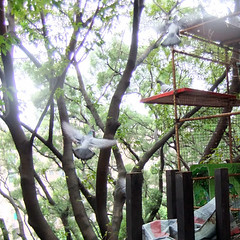
pigeons

Originally uploaded by maryannodonnell

today was the 15th of the 10 month of the lunar calendar, so i did what all good girls do – went temple hopping. chiwan is one of the natural harbors that constitute the port of shenzhen. before reform, chiwan could only be reached by way of a boat launched from shekou, heading north up the pearl river. today, chiwan is easily accessible by the 226 or 355, but still retains something of a backwater feel. indeed, chiwan has the scruffy feel of a potentially hip artist colony, except for the lack of artists and the vanishing coastline.

that said, chiwan is fun because it also boasts some of the oldest sites in shenzhen – the tianhou temple (technically the oldest in the area. zheng he reputedly stopped here, and emperors from the ming and qing gifted stele to commemorate upgrades and rennovations (!) to the temple). chiwan is also site of the grave of the last song emperor – a child who was drown with and by a loyal follower so he would not be dishonored by the yuan. the little emperor’s tomb is maintained by the zhao family.

hop, hop.