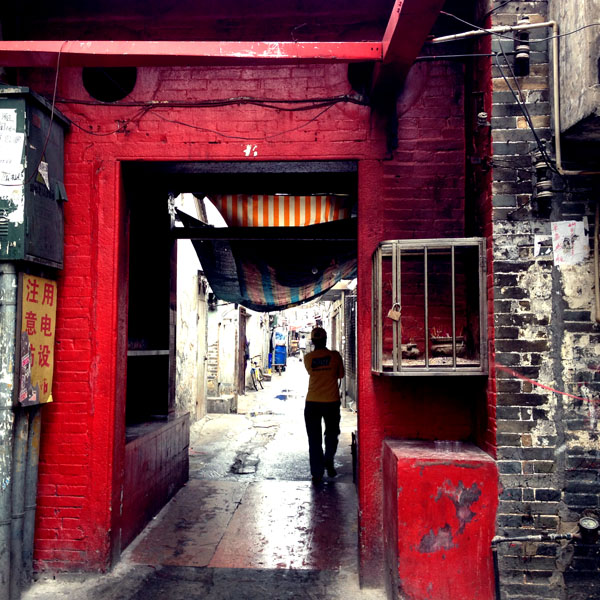
gaoling: shenzhen’s eastern periphery

Episode 13 of The Great Transformation, takes us to Gaoling Village (高岭村), which is located on Qiniang Mountain at Shenzhen’s eastern most edge on the Dapeng Peninsula.

The story of Overseas Chinese Chen Jiageng (陈嘉庚) opens the episode, connecting the history of Shenzhen’s eastern periphery to early modern Chinese nationalism. An ethnic Hakka, Chen Jiageng raised funds among to construct the Jimei School in his hometown Jimei Xiamen. For his nationalist efforts, Mao Zedong referred to Chen Jiageng as being “the banner of Overseas Chinese, the glory of the race (华侨旗帜,民族光辉)”.

Settled over 400 years ago by Hakka migrants, the layout of Gaoling reflected the founders need for safety and arable land. The village houses were located deep in the mountains, while village fields were located at the foot of the mountain. Every morning, villagers went down the mountain to work their fields and every evening, they returned to the relative safety of their homes.

The architecture of Gaoling reflected the agonistic relations between Hakka and local (本地 boon day [H], bendi [M], pundi [C]) peoples during the 19th Century. In fact, between 1855 and 1867, relations disintegrated into open conflict during the Punti-Hakka Clan Wars. During the early 20th Century, the village housed anti-Japanese troops, who were led by Hong Kong born Liu Peidai.

As in Xiamen, Gaoling villagers who lived overseas donated funds to build a school in their hometown. Over the course of the village’s history, Gaoling villagers immigrated to Singapore, Holland, the United States, and Canada, and many more lived in Hong Kong. Importantly, the Overseas Chinese funded improvements to their hometown, including modernizing the water system. The Euro-Chinese style of the school architecturally reflected these migrations and returns.

沓饼节: the second annual pounded biscuit festival

Yesterday, Bao’an District organized the second annual pounded biscuit festival (沓饼节). Pounded biscuits are a traditional local sweet that are especially popular at Chinese New Year’s. It so happens that a Shenzhen brand, 合成号 has been making said biscuits since 1901. The company celebrated its 100th anniversary in 2011, and to kick off its next century, in 2012, it became the sponsor of Shenzhen’s latest festival.

Local historian, Mr. Liao Honglei (廖虹雷) invited me to join the celebration. Mr. Liao curated the event and has been active promoting local Chinese culture. He is particularly attentive to cultural differences between Cantonese, Hakka, and Chaozhou settlements. Shenzhen inhabitants from outside Guangdong, refer to Cantonese as “baihua (白话)”, or local language. In contrast, Mr. Liao makes a point of calling each of these cultural strands by their official names, Guangfu (广府 literally provincial capital of Guangdong), Hakka, and Chaozhou in order to draw attention to Bao’an’s heterogeneous roots.

Also present was special guest, Professor Wu Bing’an (乌丙安), an 86-year old specialist in Chinese folklore. Professor Wu began his discussion by explaining why he opposes calling Chinese New Year “Spring Festival”. On his analysis, festival (节 jie) refers to a date on the calendar. In contrast, year (年 nian) refers to a period of time. Thus, jie mark the passage of time within a given nian. Professor Wu said that in order to leave one year and enter the next, Chinese people need sound and color. After praising the reintroduction of noisy, pounding to make New Year’s biscuits, he mentioned that firecrackers were the traditional “sound” for sending off and greeting the new year. Professor Wu also complained that too many safety restrictions had made Chinese New Year too quiet.

Impressions of the pounded biscuit festival, below.

This slideshow requires JavaScript.

border theory

End of last semester, I attended the review for MArch 1 studio: Inbetweeners taught by Joshua Bolchover, The Department of Architecture, The University of Hong Kong. Six teams offered analysis and plans for the Shenzhen-Hong Kong border. I have found it useful to think through and against the students’ work because when juxtaposed, our respective points of departure highlight critical issues that need to be thought if we are to create a genuine cross-border society. So, thoughts:

1) From the perspective of Hong Kong, the SZ-HK border is peripheral to the city proper or downtown. In contrast, the border was the reason that Shenzhen was established. Two areas in particular — Luohu/Wenjingdu and Huanggang — have been exceptionally important to Shenzhen’s ongoing self-construction and yet remain, on the Hong Kong side relatively marginal to the larger society. Luohu and Wenjingdu were of course the points where respectively people and goods passed during the Mao era and early Reform. In fact, Dongmen refers to the area that used to be Old Shenzhen Market and was the commercial area that thrived once the border reopened as both Chinese and Hong Kong residents went there to purchase goods and services unavailable or unavailable that cheaply back home. Huanggang, of course, is an extension of the new central axis and with the construction of the Lok Ma Chau Loop will become even more important to Shenzhen’s construction of its border-crossing cosmopolitan identity.

2) The disproportional population growth in Shenzhen and Hong Kong complicated by residential densities in the region. Over the past thirty years, Hong Kong has had one of the world’s lowest birthrates, growing from a population of roughly 5 million in 1980 to a little over 7 million in 2010. During that same period, Shenzhen’s official population exploded from 300,000 to over 10 million in 2010. However, I have heard that the Shenzhen’s administrative population (管理人口) is over 17 million, while Hong Kong’s population continues to hover at 7 million. Moreover, even though Hong Kong has one of the highest residential densities in the world (6,420 people per square km), Shenzhen has surpassed it (7,500 people per square km), and continues to grow. How to feed, shelter, and provide for the well-being of this population, which is also concentrated along the border fundamentally shapes and will continue to shape both how we imagine the integration of these two cities as well as the social and environmental forms that integration will take.

3) All this begs the question of the appropriate scale of planning and designing for a cross-border society in the absence of a vision of what that society is and/or might be. Does the border area refer to those who live there? Those who cross through? Or those who benefit from the way the border sustains the international division of labor? We all know that borders are social artifacts, built and maintained for particular ends. And that’s the rub: in order to design and plan a better border, we need a vision of how the border might benefit both Shenzhen and Hong Kong, or maybe a vision of how Shen Kong might be differently lived. A story perhaps of membranes and sutures, rather than borders and exclusions.

Impressions from the review, below:

This slideshow requires JavaScript.

…and the juggernaut rolls on

By the year 2017, Shenzhen plans to have built 95 shopping malls, totaling 17.8 million square meters. Moreover, the raze and raise juggernaut seems unstoppable, even in the face of growing support for historic preservation and public recognition of the social, cultural, and historic value of village settlements.

In October this year, the Municipality announced that  China Resources (华润) will raze Hubei Village and raise another high-end mall despite the fact that Hubei was built during the Ming Dynasty between 1465 – 1487, boasting a settlement history of almost 550 years.

The “three horizontal and eight vertical roads (三纵八横)” layout of Hubei exemplifies Guangfu (广府) or Cantonese style. The village also includes an ancestral hall that was rebuilt in 1804, a village gate, well, and over 200 houses. In addition, the ancestral hall used granite, a building material rarely seen in the area.

Hubei Village was part of the original Shenzhen Market (深圳墟), which has already been extensively razed. Indeed, Hubei Village is the largest and most concentrated of historical architecture in the area. Moreover, the village also serves as cheap housing for those who work in the surrounding hotels, spas, restaurants, and malls.

The recent and loudly protested decision to raze Caiwuwei and build the KK 100 is the immediate context for ongoing calls for some kind of preservation effort.

Impressions from a recent walk in Hubei, below:

This slideshow requires JavaScript.

shenzhen security holds second annual open house

As part of its ongoing efforts to create transparent government, today the Shenzhen Security Bureau is hosting its second annual Police Station Open House (警察开放日活动). In each of the Districts, one Police Station has opened its doors to the public and is offering various scenarios and performances that provide insight into the working and capacity of the municipal police force.

The events illuminate the contours of officially recognized crime in Shenzhen.

At the Shenzhen Police Academy (on Qiaocheng East Road), detectives will be answering questions about intellectual property rights, patrol cops will answer questions about not paying salaries, white-collar crimes will teach methods for preventing property related theft, and traffic will hold Q&A sessions about traffic regulations.

At Meilin (梅林办证大厅停车场出入境管理处办的会场),officers will answer questions about policies on entering the SEZ, including questions about employment and education opportunities for people without Shenzhen hukou. At the Luohu Grand Theatre Plaza, functionaries from the Population Management Department will answer questions about Shenzhen hukou policy.

The Fire Department will hold a large event in Europe Plaza, the large retail complex on Shahe East Road, including an exhibition of pictures, presents, and fire prevention demonstrations. The Anti-Drugs Office will open its doors (罗湖区金稻田路1128号戒毒所行政楼二楼) to allow for tours of the medical facilities, library, labor retraining, and psychological treatment facilities.

Several Subdistricts will also hold similar open houses, including photo opportunities for students, demonstrations of calligraphy and painting skills, and interaction with police dogs. As with the municipal level events, District and Subdistrict events will be held at easy to reach public sites.

Tian’an Subdistrict, Futian will hold events at Building 9, Tian’an Digital City ( 福田分局天安派出所会场福田区天安数码城9栋 ); Dongmen, Luohu will hold its events at the Dongmen Cultural Plaza (东门文化广场); Gaoxin, Nanshan will hold events at Langshan Road (南山区朗山路2号 ); and Fuyong, Bao’an will hold events in Shajing (宝安区沙井街道新沙路492号).

dec 2012: more hukou rumors

According to a knowledgeable friend, Shenzhen’s latest census results indicate that the city’s population has breached 17 million. However, the number of residents with hukou remains between 2 and 3 million. In other words, although the population continues to grow and despite liberalizing hukou regulations, nevertheless, the hukou population has remained relatively static.

What’s going on?

Another at the table said that although the regulations had been liberalized, nevertheless, applications had bottle-necked at different ministries and offices. The common denominator seems to be that its not enough to have fulfilled the requirements, but one must somehow exceed those requirements, offering something that will enhance Shenzhen’s statistical profile.

This rumor echoed similar rumors that I have heard about education. Although Shenzhen schools are required to admit waidi (outside) students in their cachment area, nevertheless, schools often refuse to admit these students unless they are incredibly talented and likely to produce results. Importantly, people emphasize that its not possible simply to buy one’s way into a school because teachers’ salaries and school rankings are at stake — no one wants to waste their time on students who will drag down class and school averages.

The general point seems to be that simply having money isn’t enough to buy one’s way into Shenzhen; one must also add cultural value to get in with the in crowd.

local historian, liao honglei

How we evaluate the meaning of Shenzhen’s emergence and increasing prominence, both nationally and internationally, often hinges on when we entered the SEZ maelstrom of frenzied development and nouveau riche ambition.

Local historian Liao Honglei (廖虹雷) concludes a post on the thirtieth anniversary of Shenzhen’s founding with the following words:

It’s been thirty years. I remember what thirty years in Shenzhen have given me, I also can’t forget what the thirty years before Reform and Opening left me. What has been the greatest gift of these sixty years? “Life” — two completely different lives. The first thirty years constituted a difficult, pure, honest, and bitter but not painful life; the second thirty years constituted a nervous, struggling, deep pocket, wealthy, and sweet but not optimistic life. (30年了,我记得深圳30年给我什么,也不忘改革开放前30年给我留下什么。60年给我最大的礼物是什么?“就是生活”,两种截然不同的生活。前30年是一种艰苦、清纯、扑实,苦而不痛的生活;后30年是一种紧张、拚搏、殷实、宽裕,甜而不乐观的生活。)

As a local historian, Liao Honglei is sensitive to the disparagement in phrases such as “Shenzhen was just a small fishing village” because he knows that before the SEZ, Baoan Shenzhen was not simply a “one college graduate town” or “border town with only 300,000 residents”. He remembers the first experiments with cross border culture — in the 1980s, Shenzhen made famous al fresco dining (大排档) and night markets (灯光夜市), which were local graftings of Hong Kong’s Temple Street and Western Vegetable Streets (庙街 and 西洋菜街). As well as when and how Shenzhen adopted Hong Kong protocols for the institution of joint ventures, stock issuances, and futures trading. And, of course, the language that came with this change — illegal booth owners (走鬼), settle a matter (搞掂), did you get it wrong (有没有搞错呀), bye bye (拜拜), and bury (pay for) the check (埋(买)单).

Liao Honglei’s blog, 廖虹雷博客 is a wonderful resource for anyone interested in Shenzhen’s history. On the one hand, the gritty details of lived experience permeate each post, taking into account how profoundly the establishment of Shenzhen transformed Baoan lives. On the other hand, he calls for the active inclusion of pre-1980 Baoan culture and material history as the basis of any kind of Shenzhen identity. Liao Honglei is a rare Shenzhener: an organic intellectual who advocates the recognition of Baoan as one of the SEZ’s true and necessary roots. Moreover, he actually knows this history, rather than has generalized a Lingnan type past onto the territory. Thus, on his reading, Shenzhen is not just an immigrant town, but also and more importantly, a hybrid mix that has a responsibility to acknowledge and to nurture its diverse origins.

top ten concepts of shenzhen

On November 28, I participated in a symposium to celebrate the English language edition of Top Ten Concepts of Shenzhen (深圳十大观念 for Chinese i-pad version).

The production, organization and publication of the Top Ten have been very Shenzhen, so to speak. The Publishing House of Shenzhen Press Group (深圳报业集团出版社) created an online website, where people could vote for the slogans and campaigns that they though best represent the city’s history. These slogans and campaigns were then re-presented (re-issued?) as concepts that epitomize Shenzhen’s values and way of thinking. Thus, in his preface, Guangdong Provincial Committee Standing Member and Shenzhen Party Secretary, Wang Rong, “[T]he top 10 concepts are the concrete manifestation of the era’s zeitgeist and a vivid imprint of the reform and opening-up program.”

The ideological slippage from political slogans and campaigns to civic values and zeitgeist interests me because it points to Shenzhen’s simultaneously fraught and co-dependent relationship with Beijing. On the one hand, experimentation in Shekou and early Shenzhen legitimated ongoing policy debates in the Chinese capital. On the other hand, the Shenzhen model, specifically and the Guangdong model more generally continue to be at slight odds with the rest of the country. Specifically, Shenzhen continues to advocate a managerial approach to governance, promoting not simply business, but also entrepreneurship and a vibrant grassroots economy.

Two of the slogans did, in fact, challenge prevailing political currents and concomitant power structure. Yuan Geng provided the two most obvious examples — “Time is money, efficiency is life” (1981) and “Empty talk endangers the nation, practical work brings prosperity” (1992). The first was a clear challenge to the Maoist planned economy. The second not only expressed Shekou’s ongoing support of Reform policies, but also the industrial zone’s continued advocacy of talented young people with alternative ideas. The Top Ten discussion of “Empty talk” introduces the history of the Shekou Storm. At the time, Yuan Geng emphasized that while Beijing officials blathered on about ideology, Shekou youth were building the future. The decision to erect the “Empty talk” billboard in the aftermath of the June 4th Incident was especially telling because Shekou actively hired transferred hukou of intellectuals who had been sidelined for their support of students.

Nevertheless, thirty years later, those same slogans uncannily echo neo-liberal values throughout the world. “Time is money” quickly looses its oppositional potential when we remember that in Shenzhen, workers’ wages have not kept up with the price of housing; many white-collar workers are also unable to purchase homes. Likewise, “Empty talk” no longer seems  an effort to protect those with alternative ideas as it does the instruction to “suck it up”. It is therefore unsurprising that concepts 3-10 express the municipality’s ongoing efforts to promote neo-liberal neo-confucianism. More to the point, these concepts clearly resonate with Wang Yang’s call to deepen and extend neo-liberalism not only in Guangdong, but also throughout the rest of China.

I’m thinking that it is thus best to read the Top Ten as a list of double-edged swords. As political campaigns and slogans, the concepts reflect contemporaneous power games. “Shenzhen embraces the world”, for example, was a blatant attempt to justify outrageous spending on the 2011 Universiade, while “You’re a Shenzhener once you come” is the self-serving motto of the Shenzhen Volunteer Association; what exactly does it mean that everyone is a Shenzhener when less than 1/5 of the population has a Shenzhen hukou? However, when understood as exemplars of civic values and a city’s zeitgeist, the concepts illuminate cracks within the power structure and spaces for alternative practices, both in business and everyday life. Indeed, it would be wonderful if these slogans/values might in turn reshape Shenzhen’s neo-liberal juggernaut, creating spaces for legitimate political opposition and open debate on whither the next thirty years of reform.

The top ten concepts are: Time is money, efficiency is life; Empty talk endangers the nation, practical work brings prosperity; Dare to become the world’s first; Reform and innovation are the root and soul of Shenzhen; Let Shenzhen be respected for its enthusiasm for reading; Innovation encouraged and failure tolerated; Fulfilling the cultural rights of citizens; The fragrance of the rose lingers on the hand that gives; Shenzhen embraces the world; and You’re a Shenzhener once you come here.

China Daily and Shenzhen Daily coverage of the symposium online.

egalitarian architecture

One of the more interesting architectural continuities between Maoist Tangtou and Handshake Baishizhou is the ideology of egalitarianism (平均主义).

When Tangtou villagers first came to Baishizhou in 1959, they gave up their rural status and became members of the Shahe Farm (沙河农场). As members of the Farm, their hukou status was “non-rural (非农)”. This meant that they had rights to socialist welfare benefits, including housing, a salary, a rice allocation, and education for their children. In turn, they gave up their land rights. All this, even though they continued to do agricultural labor. Thus, as a architectural typology, Tangtou’s flat houses were not rural buildings — traditional or modern — but rather socialist dormitories.

According to the Maoist planned economy, non-rural members of socialist work units were entitled to dormitory housing, or “one houselhold, one room (一户一间)”. Within these dormitories, all facilities were the same — the same size sleeping and communal areas, the same number of windows, and the same access to the collective canteen and outhouses, differences in family size, notwithstanding. This type of dormitory construction was the architectural manifestation of a larger egalitarian ideology.

Of course, architectural egalitarianism was relative to regions as well as local resources. For example, the dormitories that Tangtou villagers built in Baishizhou were one story structures made of cement admixtures, wooden beams, and Hakka technology. After the canteen system broke down, families constructed small stoves outside their front doors, but continued to share nearby outhouses and wells. In contrast, dormitories in cities ranged from buildings of stacked, one-room efficiencies with a bathroom at the end of the hallway to buildings of multiple room apartments. In the colder northern cities, the decision to turn on and off central heating for everyone in a dormitory was an extension of this theory as was the decision not to provide central heating to dormitories south of the Yangtze River.

The construction of urban villages in Shenzhen has been an extension of architectural egalitarianism in the post Mao era. All handshakes were built on plats of 10 X 10 meters. To insure equal access to sunlight, there is a mandatory distance of 3 meters on the east-west axis between buildings and a distance of 8 meters on the north south axis. This mandated layout is the basic grid of an urban village. Moreover, when juxtaposed against older settlements, including rural dormitories like Tangtou or village settlements at Hubei, for example, the layout of a handshake settlement extends and often further rationalizes the egalitarianism of the previous layout.

This form of development has brought with it two urban planning conundrums:

  1. The 10 X 10 grid, with its mandatory distances of 3 and 8 meters between buildings pre-empts the efforts to put in adequate roads. 3 meters is small enough that handshakes have grown closer together — albeit without touching — on the east-west axis. At the same time, 8 meters is only wide enough to accommodate one traffic lane, which often gets jammed during deliveries or when too many motorcycles dart through.
  2. Public space and access to main roads is at a premium within the settlements. At Tangtou, for example, the large basketball court in front of the 59 dormitories is the one large space, where children and older people can meet outside. At night this area becomes a night market with more business than those areas in the Baishizhou alleys. Likewise, the roads that connect Baishizhou to Shennan Road are also the most profitable because they have storefronts in areas with large numbers of pedestrians.

The ongoing ruralization of Tangtou (and other urban villages  neighborhoods) has had paradoxical ideological effects. On the one hand, thinking of Tangtou as rural empowered Tangtou residents to make handshake land grabs. On the other hand, thinking of Tangtou as rural continues to justify the exclusion of Tangtou residents from discussions of future development, differing to the expertise of “urban” intellectuals and authorities. Moreover, the urban planning problems presented by Tangtou are considered effects of “rural” and “traditional” thinking. However, Tangtou is as “rural” and as “traditional” as Greenwich Village, NYC. The current built environment of Mao-era dormitories and post Mao handshakes is itself a product of non-rural socialism, first as the Shahe Farm and then as the Shenzhen Special Economic Zone.

And there’s the rub: what does it mean that “rural” and “traditional” Tangtou Baishizhou has come to represent all that is good and problematic about Shenzhen’s “urban villages”?  More generally, what are we to make of Maoist egalitarianism — both its continued appeal to the broad masses of Chinese people and its problematic manifestations — when we confuse it with a Chinese past that never happened?

WoWorldly desires

Window of the World opened in 1984, on the auspicious day of 6.18 (June 18). Yesterday, I visited WoW with Constant Dullaart, one of the residents in this years OCT Art Residency. The featured image for this post is a snap of us in front of Niagara Falls.

This is the first time I’ve visited WoW since 1997, and was impressed by two of the new installations — a plane ride trip through the United States (installed 2004) and a toy train ride through mountainous Europe (June this year). The plane ride uses IMAX technology and moving seats to give the impression of flying coast to coast on a double wing plane. At each landmark, white Americans wave to visitors, yelling, “Welcome to the United States”; in watery areas, visitors are lightly spritzed with water. The toy train is less high-tech, but more popular with young children. According to one of the friendly staff members, these rides are part of plans to shift WoW entertainment from viewing miniature landscapes to interactive rides and activities; I’m thinking WoW goes Epcott.

I was struck not only by the yearning for elsewhere manifest in the WoW installations, but also by the continuing nostalgia for a particular kind of elite life. Tourism as an activity of early 20th century elites continues to shape built forms of this yearning. (Or perhaps we experience nostalgia in search of an object?) This neo-liberal appropriation of colonial forms of pleasure was also been reproduced at Shekou’s Seaworld, circa 1984, where the plaza houses western consumption in quaint buildings and the landlocked Shining Pearl.

Seaworld was one of the first efforts to materialize Chinese yearnings for the better (relentlessly global) life. Nevertheless, by the early 1990s, when WoW was built and developers put up European style estates (with appropriate tributes to Versailles excess), Shenzhen grappled to implement neo-liberal economic policies without neo-liberal political changes. The political-economy of both early Shekou and 1990s Shenzhen were reminiscent of early 20th century capitalism, when all sorts of material wealth began to appear, but only a few people were positioned to enjoy it. Or more to the point, perhaps, only a few elites had both the leisure and resources to enjoy it, including romantic alpine train rides and virtual plane rides on double wing planes a la the Wright brothers.

The fantasy life infusing representations of the early 20th century high life — the fashionable world — were a fixture of 1990s Shenzhen architecture. Seaworld and WoW, for example, were conceived and built in the post Tian’anmen era, when “European-style” housing estates were also popular, including OCTs upscale Portofino. In fact, throughout Shenzhen, but especially along Shennan Center Road, the mini-fascades that wrap WoW and Seaworld dreams have been enlarged in themed real estate developments, where many of Shenzhen’s solidly middling middle class still live and to which many migrants aspire.

Yesterday morning while waiting for Constant, I stood at the subway exit that is located beneath the Jiang Zemin inscribed glass pyramid and watched ticket scalpers approach tourists. The tourists spoke accented Mandarin, and had organized themselves into small groups of carefully dressed visitors. They examined the pamphlets, considered their options, and then opened their umbrellas to embark a rainy day of exploration. Those I later saw again within the park seemed to be enjoying themselves; I certainly enjoyed the toy train and virtual plane rides.

In recent years, of course, Shenzhen’s vision of the world has gone SciFi glassy — steeled if you will — against the imaginary onslaught of encounters with alien lives. However, that kind of elite consumption does not resonate with the same visceral pleasure of early 20th century elites enjoying both their traditional privileges and the mass produced delights of a new era. I’m trying to figure out why. Guess du jour: we want elite agency, but we want it as pleasure,in the play of tourism and leisurely meals, for example, rather than as the high stress, overwhelmed and overwhelming agency that seems to characterize elite life on the ninety-first story of a 21st century glass tower.

Postcards from my Alpine excursion, below:

This slideshow requires JavaScript.