So, Huaqiangbei is the heart of Shenzhen’s maker culture. However, China Merchants Shekou has upped the production ante, establishing “net valley (网谷)”, a company slash investment strategy to produce and deploy the latest in digital gadgetry. Friday morning, we visited their showroom in order to learn about techno-possibilities and brainstorm events for the May cultural industries fair. The point of all this investment is to stimulate creativity (创新). And yet. I kept thinking how the form of contact–a tour and a meeting–made it all seem ordinary, despite the fact that we held our meeting in a room that went from being a library to a bird’s eye view of mountain tops. If my impressions of banal sci-fi seem familiar, it’s because much of this technology was first exhibited at the Shenzhen New Media Exhibition.
Tag Archives: shekou
fishermen’s wharf, shekou
First day of 2015, I walked Fishermen’s Wharf, Shekou where they’re still selling fish. The oysters cultivated on the Hong Kong side of Shenzhen Bay are sold in Dongguan and Guangzhou. Impressions, below.
self governing trade zone, thoughts from
Speculation about what the 自贸区 (self governing trade zone) continues to shape all sorts of conversations. On Monday I participated in a public planning forum for the OCT, where comparisons between China Merchants in Shekou and Overseas Chinese Town in its eponymous neighborhood, the OCT illuminated contours of Shenzhen’s history. Four ideas of note popped up.
First, that China Merchants (in Shekou) and OCT (in the OCT) have been the two state owned enterprises most responsible for creating the Shenzhen image. During the post 1992 era, many of the images of reform (in terms of built environment) were of the OCT and its neighborhoods, tourist industry, and theme parks. Continue reading
shekou redux
For those following the shifts in Guangdong structure, you noticed that yesterday Shekou, along with Qianhai, Nansha, and a bit of Zhuhai was designated a self-governing trade zone (自贸区). Inquiring minds want to know: what does that mean? Speculation abounds and adjustments are coming, but there seem to be two key points. Continue reading

innovate with china…
…was the slogan of this year’s Shenzhen Maker Faire. I attended on Sunday, and then Monday afternoon joined researchers from the Institute For the Future on a tour of BGI (Beijing Genomics Institute) or “China Great Gene (华大基因)” as the name translates from the Chinese.
What did I see and learn?
That children love playing with gadgets. That most of the “products” were in fact toys. And that the most popular booths had the greatest room for serious play. In other words, the successful objects themselves structured a particular–and somehow “first”–experience. Hence, the wow moments that attracted children and adults alike.
That BGI has concentrated a massive amount of capital and resources in order to further the production of data. Moreover, as the cost of mapping genomes has dropped from $US 3B to around $US 3,000 in a little over twenty years, the data has proliferated to the point where the challenge facing researchers is technologies for storing and analyzing the data. I’m not sure what this volume of data means in terms of life experiences, but it does strike me that our imaginations constantly seek material form. And I learned the expression human augmentation, as if we are not enough.
That the Shekou Relaunch campaign has brought in interesting cultural programs to the area. In addition, these programs have been popular and attracted residents from all over the city to Shekou. So notable that–again–we’re looking at the design of experience. And all this hinges on the promulgation of culture and creativity as both the means and ends of socio-economic development.

garden city
Spring in Shenzhen brings memories of dustier grasses and bluer skies. 18 years ago, I lived next to a construction site, and the low cost local ornamentals and creepers flourished in moderation. We breathed construction dust and navigated street floods (or “accumulated water” as I have learned to say in Mandarin). But the skies, if organic and digitalized memory serve, we’re blue and vast and clear.
Yesterday I ate brunch on the Intercontinental patio and had an afternoon tea-becomes-dinner meeting at 1 Haiguan Rd. Once upon a developmental time, both were located near Shenzhen Bay. When built in 1982, the Intercontinental perched near coastal oyster beds and provided visitors and investors in the OCT and Shahe Industrial Parks with simple accommodations. That same year, there was no restaurant at the top of “Microwave Hill” as the site of 1 Haiguan Rd is known. Instead, it was the site of the first local (difang) broadcast tower in post Mao China. The tower broke through tree cover to send and receive signals from Hong Kong, which was just across the water. It symbolized a new communication independence from Beijing, but not too much independence; the simple two-story border guard tower still stands.
The original Intercontinental has been razed and in its place a 5-star Spaish-themed hotel stands. Outside is a galleon, while inside the male staff wear bull fighter costumes and the restaurant hostesses sashay in modified flamenco dresses. The patio area has imported flora, a black marble pool with multi-color goldfish, and a break in the lush green buffer that opens to a virtual beach area. The coastline, of course, is now pushed back, placed on the southern edge of the Binhe Expressway and the narrow Shenzhen Bay Park, which stretches along the reconstituted coastline. 1 Haiguan Rd is the physical realization of another chapter in the same history, albeit land reclamation-in-progress to accommodate a larger port area and a yacht marina. The interior of the border tower has been fitted with stage lights that create the nostalgic centerpiece of an elaborate and fragrant garden.
I enjoyed both outings. I was with generous and creative friends, with whom I often collaborate. All have helped with 302, and all are interested in contributing to the cultural life of the city. Moreover, they are truly willing to share what they have. It is a joy to be with them.
And yet.
Our friend dropped us off at our late 80s compound of boxy concrete low rises, crumbling compound floor, local plants, and ordinary pavilion with tacky pseudo-imperial glazed tiles. The combined cost of yesterday’s two meals was more than my monthly rent. Sometimes, my increasing sense of distance from ever-growing areas of the city provokes anxiety. Sometimes it hooks into my sadness about the forms of social segregation that are being built into the city. Last night, the contrast made me nostalgic for a dustier, more industrial Shenzhen, when large tracts of undeveloped land were still accessible for exploration and amenable to common dreams.
Photos taken at 1 Haiguan Rd, where the changing Shekou coastline is visible from the third floor gardens.
shekou relaunch
So the Biennale has been extended two weeks. Good news and great press for the curators, the SZ Center for Design, and China Merchants. And that–generating a Shekou Buzz–has been the point of all this productivity, or as the current campaign is called “Shekou Relaunch”.
This afternoon, I attended one of the final scheduled events, a forum on how to renovate the Dacheng Flour Mill, which has been designated the site of the future Shekou a Industrial Culture Center. The program included repurposing the buildings and designing more public space, a visual culture center, a theater, and an office building. The responses hinged on determining the purpose of the renovated buildings; just what does China Merchants hope to accomplish through these renovations? Just what is being launched again? And why?
Indeed, there is both something primal about the campaign; we are setting off, again (再出发), and yet something equally unsettling; again? How many times do we need to remake society? Or is it just the persistent dissatisfaction of capitalism and vague anxiety that we may never get it right?
I actually believe that creative activity makes people happy, but not redundant assembly line production. I have experienced happiness in creative activity that nourishes my connections with others. I am particularly enjoying 302 because it brings together research interests, social commitments and friendships. I also really, really like working with my hands. This seems to me the goal of social transformation; improving the quality of life of family, friends and neighbors, and not just achieving higher economic indicators.
Today, I’m thinking that to the extent that traditional socialist industrial culture aimed to improve the lives of worker, it offers inspiration for possible renovations and building. However, without a discussion about what’s being relaunched and why, another round of pretty and smart and interesting construction seems to me to be beside the point.
venue a walkway
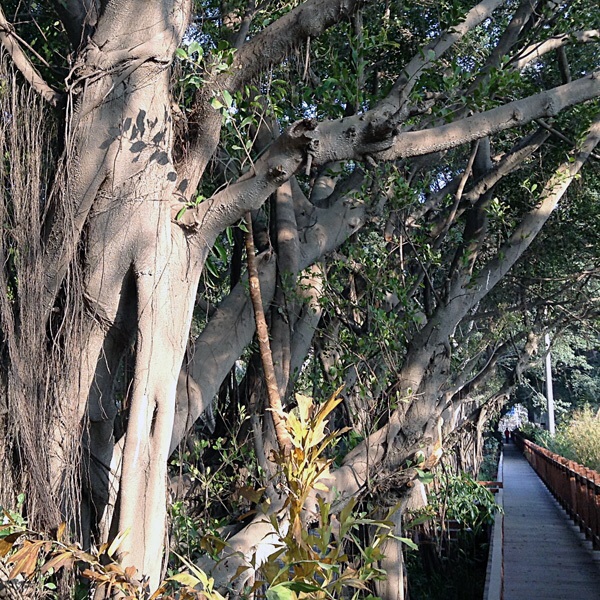
One of my favorite details at the Value Factory is the approach. Impressions below.

a new year, a renovated seaworld
January 1, 2014. Shekou is preparing for the 30th anniversary of Deng’s 1984 visit to Shenzhen and Zhuhai, January 24-29. At the time, the tour was also an explicit celebration of Shekou, a different model of reforming and opening the Maoist apparatus. Images below are of renovations as of December 31, 2013. Yes, there is a light show. Yes, the transformers flash and when you ride the stationary bikes they blast a Beyond song that was popular in the mid-1980s. And yes, the Ming Wah is now in the water even as the coastline extends beyond Nuwa. Impressions of the upgrade, below:
2013 szhk biennale of urbanism/architecture, thoughts on
This year’s Biennale occupies two spaces, the The Value Factory (venue A) and The Border Warehouse (Venue B), which are connected by a shuttle bus. Metonyms for Shekou history, the two sites index the industrial zone’s early manufacturing and connections to Hong Kong.
Team Ole Bouman curated The Value Factory with an eye to making it a catalyst for urban change. They cleaned up and slightly modified six areas of original factory complex — the entrance, the machine shop, two silos, the warehouse and the grounds themselves. This clean-up allows the site to be repurposed for new kinds of production. The grounds have been transformed into a garden, for example, and the silos opened for viewing, while the machine shop houses exhibitions as well as spaces for creative encounter, such as workshops, performances, and lectures.
Team Li Xiangning/ Jeffery Johnson conceptualized the Warehouse as a space to reassert the importance of knowledge and research to urban design. The exhibition includes a vast catalogue of investigations into borders and intances of boundary crossing, including a timeline, case studies, videos, installations, and national and regional pavillions. The sponsor, China Merchants has also curated an exhibition of Shekou history, which is displayed in the warehouse.
China Merchants Shekou (which built the ferry terminal and float glass factory) sponsored the fifth edition of the Biennale as part of its Shekou Relaunch campaign, in turn an element of the larger project to rebrand Shenzhen as a creative industry hub. This underplayed, but vital fact predicates visitors’ experience of the Biennale as a cultural enterprise. Creative activity in the Factory produces the knowledge archived in the Warehouse, which in turn provides tools for new creative activity in the Factory… Consequently, although some exhibits critically engage the inequalities that comprise capitalist production, nevertheless the Biennale as a whole ultimately celebrates accumulation as the highest social value.
In this context, my perception of Pierre Bourdieu’s critical analysis of The Forms of Capital abruptly shifts. Instead of a blueprint for socialist intervention, I see a conceptual toolkit for transforming the SEZ into a nexus of cultural industry:
“[C]apital can present itself in three fundamental guises: as economic capital, which is immediately and directly convertible into money and may be institutionalized in the forms of property rights; as cultural capital, which is convertible, on certain conditions, into economic capital and may be institutionalized in the forms of educational qualifications; and as social capital, made up of social obligations (‘connections’), which is convertible, in certain conditions, into economic capital and may be institutionalized in the forms of a title of nobility.”
Thought du jour: I’m not sure if it is necessary the Biennale Borg as it is easily avoided, but I do wonder about my continued participation in these events. To redeploy the theme of this edition: just when do we cross the boundary between engagement and complicity? Or is it more the case that “boundary crossing” is simultaneously both a judgment call and an instance of social speculation?
To get to the Biennale, take the Shekou Subway to Shekou Ferry station and walk about 500 meters. To then move between the spaces, take the shuttle. Or, if in Nanshan, my favorite bus line, the 226 stops at both venues. Jump off at Shekou Ferry Terminal (to visit the Warehouse) or Glass Factory (玻璃厂 to visit the Value Factory). First impressions from The Value Factory in previous post. Impressions from The Border Warehouse, below.
 Shenzhen Noted