the u.p. went global and caught me unawares.

i open this story with a picture of me and my cousin david. this post resonates with a previous entry about tianmian. there i tracked the relationships that placed me in shenzhen in a particular way. here i sketch the geneology that specifies me as american. both entries share an impulse to transform discomfort about the relative privileges i enjoy into ethnographic knowledge. this discomfort, whether voiced or not vexes my work to date. i hope that narrating these awkward moments will illustrate the complexity of documenting shenzhen.
about a week ago, my uncle emailed me to say that my cousin david would be in china and wouldn’t it be great if the two of us could meet up. surprise. my mother is from iron mountain, in the u.p., where i used to spend summer vacations. my siblings and i swam, ran around, hung out with relatives, learned to play smear, argued with relatives, ate fresh vegetables from their gardens, had swordfights with sparklers on the fourth, and still had two more weeks to endure with relatives. i stopped going my sixteenth year because i was given the choice of going to michigan or staying home. so, my uncle’s email abruptly reminded me that not only do i have an extended family, but also that those folks are busy creating and participating in global networks. just like me. gulp.
david looks like my mother in ways that i don’t. surprise again. more importantly, his personal trajectory out of the u.p. makes him like my mother in ways that i am not. my mother and david embody connections between the rural midwest and upwardly mobile suburbanites. when we would go back to the u.p. all those summers, my mother was going home to people she recognized and who recognized her as being fundamentally the same: same small high school, same kinds of wage labor, same catholic church, same teachers, same cold winters, same rural environment. david went to that high school and church, his father and brother work(ed) those jobs, endured those winters… the difference from the u.p. relatives that my mother and david share is that they both got out by working their way up. and today’s story is in the prepositions. out and up: my mother through nursing and david by way of the marines.
in contrast, my siblings and i grew up in upper middle class suburbs, moving from house to more expensive house, with the expectation of a college education and yet bigger houses for our children. that all of us now live in smaller houses than when we were children is another story. at the moment, i’m thinking that when we went to the u.p. all those summers ago, my siblings and i embodied class and cultural differences that we weren’t capable of finessing, although there were times that affection and horseplay overcame the ruptures. it wasn’t simply that we symbolized my parents’ success (my father was also an out and up story from pittsburg), but also and more fundamentally it was that we lived in a world from which our cousins were excluded. we went to michigan; they didn’t come to new jersey. these differences became more painfully obvious with each passing year, until my simblings and i opted out of going back. and so, even if the reunion with david caught me offguard, that it would happen outside the u.p. might have been predicted.
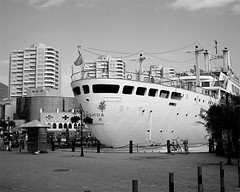
we talked about what we and our immediate families have been up to these past twenty-odd years. most of his family remains in the u.p.; mine is scattered throughout different east coast suburbs. indeed, leaving jersey, especially for new york, is itself a fascinating story of the lived snobberies and upward mobilities of my siblings and friends. and yet… the snobberies and upward mobilities of my family and friends have been reproduced in shekou. local investors, travelling businessmen, and government officials bent on globalizing shenzhen have together reproduced places where middle class american suburbanites easily lunch and dine. david and i had dinner at gypsy’s one of the comfortable, seaworld (海上世界) restaurants that cater to displaced westerners in shekou. i like the food, which is fresh, eclectic, and yet so very, very familar; it tastes like good food from my hometown burb and provides the particular counterpoint to the generalized tastes of macdonald’s and papa john’s, which are also located in the seaworld plaza.
this meeting has started me re-thinking these fieldnotes.
on the question of a shenzhen identity: i am native to the idealized version of global culture that is being built in seaworld. this culture is not broadly u.s. american, but a vision of upper middle class suburban forms of consumption. developers and real estate agents market aspects of this vision to sell new houses (bigger and better, like the houses of my childhood); local officials judge the success of reform on the numbers of white collar workers who can afford to eat at restaurants like gypsy’s.
the different trajectories that brought my cousin and me to seaworld highlight the way that exporting this version of prosperity functions to restructure domestic american class relations in international terms. on the one hand, the seaworld version of prosperity has enabled me to find jobs and live comfortably in shenzhen. on the other hand, it has also provided opportunities for my cousin to move out of and up from the u.p. crudely but nevertheless provocatively seaworld helped ameliorate our previous antagonisms, which we still don’t talk about.
this leads to the question of who is excluded from this world; my relatives in the u.p. remain excluded from this world, although one or two may find a way in. david and my mother remain the embodied bridges between these worlds. at the same time, most of china’s rural poor are also excluded from this world. this is important, seaworld marks not an amelioration of the class differences that separated me from my u.p. relatives, but rather an extension of those differences into a new domain. i am not suggesting that chinese society wasn’t marked by class differences before reform. instead, i am reiterating a point long made by postcolonial marxists: displacing our class differences onto new societies has neither resolved class tensions in the u.s., nor improved class antagonisms in china. instead, class conflicts in both china and the u.s. have been amplified, even as the beneficiaries of this inequality justify their actions in terms of globalized meeting grounds, like seaworld, as places where cultural difference is overcome.
in local newspapers, the class difference manifest in the architecture and various uses of seaworld is glossed as “incentive”, presumably to move out of and up from the rural hinterland. formally, at least, the structure of the incentive reproduces the lived differences between rural and suburban americans. i am not sure whether or not my siblings and i inspired my cousin to join the marines and go to college; my gut reaction is that the comparison although annoying was less important than the physical and social unpleasantness of both manual labor and being denied what is considered valuable, including tasty food, an interesting education, and opportunities to travel. as chinese friends who are on their way out and up remind me: there really are better lives than they used to lead.
finally, i find myself wondering at the understandings, experiences, and practices that compel us individually to move out and up, rather than collectively forward.
shenzhen

 Shenzhen Noted