The gifting chart for “Prosthetic Cosmologies – Sitka” is now online. Please visit and follow the ebb and flow of story-making.
Tag Archives: prosthetic cosmologies
Delta or Estuary? What’s in a Name?
Googling for information about environmental conditions in Shenzhen, I noticed that the distinction between delta and estuary has facilitated a disturbing separation between conversations about economic miracles and ecological disasters in Southern China. When I googled Pearl River Delta, I stumbled upon articles about economic development. In contrast, when I googled Pearl River Estuary, I came upon articles about the seriousness of our situation.
Here’s the rhetorical rub: Ecologically, deltas and estuaries co-evolve. However, through linguistic convention, the words delta and estuary refer to different aspects of this process. The word delta draws our attention to what’s happening on land, while the word estuary reminds us what happens in places where fresh and salt water mix. In other words, how we locate Shenzhen – either in an estuary or on a delta – has already determined whether our conversation will most likely be about environmental or economic issues.
So, by emphasizing the Delta in conversations about South China, what do English speakers leave out? The fact that in an October 19, 2006 press release, the United Nations Environment Programme announced that the Pearl River Estuary was a newly listed dead zone, where nutrients from fertilizer, runoff, sewage, animal waste, and the burning of fossil fuels trigger algal blooms. The most common algal bloom in the Pearl River Estuary is “red tide”, a colloquial way of saying HAB – harmful algal bloom of which the most conspicuous effects are the associated wildlife mortalities among marine and coastal species of fish, birds, marine mammals and other organisms.
What else do we English speakers miss? The ongoing houhai land reclamation and associated siltation, which is damaging coastal Mangrove forests. In the panel Gilded Coast from Prosthetic Cosmologies, I used images from the NASA Scientific Visualization Studio to draw attention to this process. The SVS images were taken in 1988, 1996, and 2001. Taken in December 2008, a recent Earth Snapshot from Chelyis shows how more has changed in the past seven years. The Chelyis image also contextualizes the SVS images within the delta/estuary. Compare the levels of siltation and environmental transformation below:
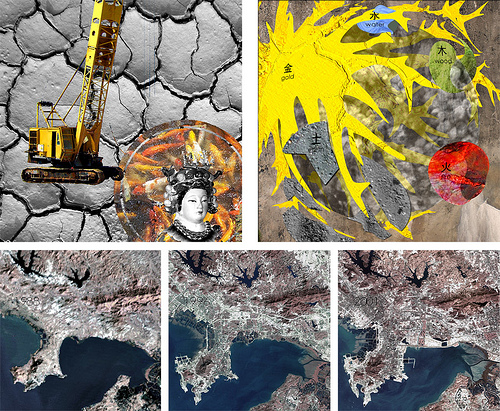
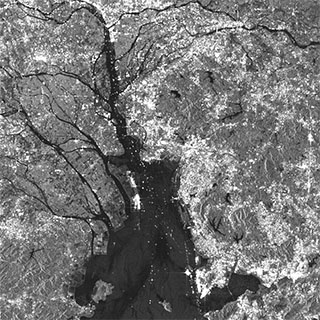
More importantly, the Cheylis explanation identifies both Guangzhou and Hong Kong, but not Shenzhen. This omission is disturbing not only because Shenzhenhas been the most active land reclaimer in the region, but also because it pre-empts inclusion of Shenzhen – as well as Dongguan, Foshan, Zhongshan, and Macau – in conversations about how to both clean-up and enrich the region. (This omission dovetails into dim sum with the Swiss writers, who were shocked by how developed Shenzhen actually is. I keep asking myself: how do westerners miss Shenzhen? And it keeps happening…)
Incidently, the Chinese character 洲 (zhou) further muddies rather than bridges waters between English and Chinese conversations about the environmental consequences of economic development. The two parts of zhou are: the three-dot radical for water and 州 (zhou), a sound component which is composed of the pictograph for river with three dots. According to my dictionary, a 洲 is a continent or an island, so a delta/estuary is actually a three-cornered continent island or 三角洲, while the character is two-thirds full of water. This means googling 珠江三角洲 brings up a different mix of economic and environmental articles than does an English attempt.
Prosthetic Cosmologies gallery up
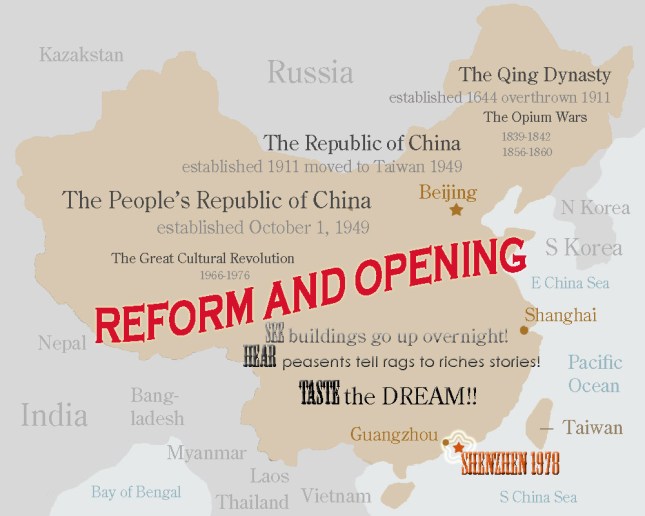 This is the first panel in the image poem “Your Presence is Requested” from Prosthetic Cosmologies. My artist statement follows.
My work aims to make visible the shared processes – cultural, environmental, political, and economic – that define daily life in both the People’s Republic of China and the United States of America. I believe that any person, any organism, any word, indeed, any object, connects us in transformative dependency and as yet unrecognized possibility. I proceed in the faith that respectful seeing reveals the structure of interconnection and new forms of hope. I compose images that testify to the poetic beauty of this complexity.
While at the Sitka Center for Art and Ecology, I added ten panels to an ongoing series of image-poems entitled Prosthetic Cosmologies, which chronicles the globalizing myths that situate Shenzhen across diverse levels of historical experience. The formal structure of each image-poem combines genre conventions from classical Chinese poetry, anthropological theories about the human quest for meaning, and photographic images from Shenzhen and elsewhere. I used my time at Sitka both to reflect on the mythmaking that emerges in delta cultures and to track those myths along the Oregon Coast.
 Shenzhen Noted