Baishizhou update

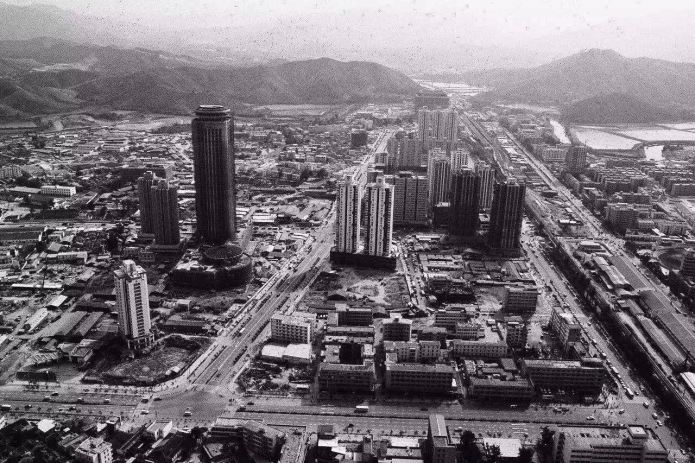
So, rumors before pictures. They say Lvgem 绿景 is bleeding. I’ve been told that the company can’t pay back the interest on its loans, let alone make a dent into the principal. Moreover, its become a problem because they are also unable to pay for the housing for the villagers who will move back 回迁 to Baishizhou, once the first buildings are complete. Nevertheless, on the ground its difficult to see any problems. The buildings are going up, and two developments–Century City and World Garden Milanju–are open for residents.

Continue reading
following deng’s footsteps in shenzhen

Red tourism is a thing in China, especially visiting revolutionary sites — Yan’an’s 400+ sites (which have been ranked); Shanghai’s revolutionary heritage, and; Beijing’s Red Trail. These pilgrimages tend to be excruciatingly pedagogical, but also fun because they usually mean a day off work or school to hang with friends and eat snacks. The ideological point of these tours lies in how before and after experiences structure moral sentiment. The meaning of these tours are more complicated that Mao was there and so was I! Instead, the expected experience includes visceral gratitude: When the elders 前辈 were here, life was hard. I am here, enjoying this (implied easier and better) life because they suffered.

So what does red tourism in Shenzhen look like? It means exploring the sites that Deng Xiaoping visited in 1984 and especially in 1992. And yes, this is more or less the same trek that Xi Jinping made in 2012 during his first tour outside Beijing after becoming General Secretary. Let’s make the trip!

Continue reading

good bye OCAT

By now you probably know that the Overseas Chinese Town Contemporary Art Terminal (OCAT) has closed, marking the end of an era and no doubt (in retrospect we will discover) the beginning of another. Those of us who were here when OCAT opened in 2005, remember it as contemporaneous with the first Shenzhen-Hong Kong Bi-City Biennale of Architecture\Urbanism (UABB). Indeed, three of the first four biennales were held in Overseas Chinese Town, a massive endeavor that was facilitated by OCAT and its influential first director, Huang Zhuan. Circa 2005, OCAT was an important signal, a sign that Shenzhen was thinking about urbanization in relation to a diversity of urbanisms and futures.

Continue reading

guomao: how quickly we forget

The image that many have of Shenzhen is a collection of state-of-the-art buildings because for years, these towers have represented the city and its progress. These buildings, of course, not only represent important state-owned enterprises in the Shenzhen landscape (China Merchants and China Resources, for example), but also provide a particular map to the city: the downtown investment area, Huaqiangbei electronic markets, Overseas Chinese Town, the recently opened Hi-Tech area along Shenzhen Bay, and the Dameisha beach. The latest skyline montage includes architecture from all over the city (labeled to the best of my ability):

Continue reading

of influence and independence, power & game: thoughts on shenzhen 3.0

If memory serves (and it tends to serve some agenda), I first visited Huaqiangbei (formerly the Shangbu Industrial Park) in 1995, when it was still primarily a manufacturing and residential area, but didn’t know what I was looking at. The big ideas in my head had to with workers rights and feminism, and so I was aware of the factories, the state sponsored housing, the few department stores, including the then still operative Friendship store, and the iconic Shanghai Hotel with its surprisingly good Cantonese dim sum. I noticed that neighboring Gangxia and Tianmian were under construction, but glossed this new urban morphology as a “new village.” I didn’t realize that the scale of immigration and construction that happened during the 90s and defined “Shenzhen” for me would be different enough from the 1980s that friends who arrived during the Special Zone’s first decade laughing asserted that Shenzhen was changing so quickly that if they didn’t visit a neighborhood for several years it was easy to get lost; Shenzhen in 1989 and 1999 were two different cities. And that was almost two decades ago.

Continue reading

playgrounds for consumption

In 2009, Sam Green and Carrie Lozano made the short documentary Utopia, Part 3: The World’s Largest Shopping Mall about the South China Mall in Wanjiang, Dongguan. On November 1 and 2, 2013, I visited said mall. This post serves as a partial update. It also a brief response to the ideas of “too big to fail” and “acceptable capitalism” that haunt so many apologies for contemporary neoliberalism.  Continue reading

czc: six months in baishizhou

Here’s the link to CZC–Six Months in Baishizhou, an introduction to Handshake 302 and our projects there. The pamphlet includes a brief cultural history of the relationship between Baishizhou and Overseas Chinese Town.