the 2011 universiade

This year, Shenzhen hosts the 2011 Summer Universiade, which I gather (from the FISU website) is olympics for college students. The 2011 Winter Universiade is being held in Erzurum, Turkey from 27 Jan – 6 Feb, 2011.

As I gear up for a year of college athletics hype, I have two brief comments and a question.

First, the Erzurum and Shenzhen websites are remarkably similar, including countdown, strange anime mascots, and news about the city. So thinking that yes, boosterism fuels this Universiade business as much as joy in youthful athletics.

Second, I had no idea about the Universiade until I left the United States because we have college sports, which are linked to University boosterism; at this level of competition, US Americans cheer for our school rather than our country.

Third, is Erzurum an up and coming Turkish city? In other words, is Erzurum using the Universiade to do what Shenzhen is doing, i.e, using an international collegiate sporting event to assert the city’s international status because the “real” international events (Olympics, World Expo, and Asian Games) went to other cities (Beijing, Shanghai, and Guangzhou, respectively)? And if so, might this mean that the intended audience of the Erzurum Games, like the Shenzhen Games, is actually the local population. “See residents,” the government is saying, “we’re as global as the country’s first-ranking cities.” Please advise.

thoughts on the culture of commerce

information about the shenzhen bay fringe festival is now online. the dates are december 4-12, 2010. there will be events everyday at the nanshan culture center, which is in fact the string of malls that run from baoli in the east through coastal city over houhai road to nanshan book city. and yes, the conflation of “culture” with “commerce” is both strategic and unfortunate. strategic because commerce is the way shenzhen artists step around politically sensitive questions. unfortunate because most shenzhen residents do not see interesting frissions between commerce and culture.

the hopeful aspect of commerce as culture is that what starts out as a strategy to introduce shenzhen residents to a wider variety of cultural forms may pry open an alternative space within the relentless commercialism of the area. the more distressing aspect, of course, is that the commercialism is relentless and, for many, an unquestioned good precisely because of its alliance with culture, especially, education. after all, commercialized shenzhen art remains primarily a means of earning additional gaokao points, even when a student actually enjoys music or painting or the ballet. for adults, art is a hobby.

the shenzhen conflation of commerce and culture is not unlike the american confusion of freedom to purchase with human emancipation. we buy sniper dolls for our daughters and do not question the principles organizing our toy stores (why dolls? why plastic bullets? why do we differentiate between children based on what their parents can and cannot afford?) and yes, this confusion annoys me; on bad days, i end up snapping at mothers who have done nothing more than ask if their daughters can earn alot of money if they go to the right colleges. (i haven’t recently taken out my frustration on americans because i left the country. next trip home i’m sure i’ll be snapping with the best of the turtles. sigh.)

come anyway. be the fissure that cracks open our hearts.

eddies of difference

each time i visit shangshui (admittedly not all that often), i am caught off guard (again) by how much i like it precisely because the area forms an eddy of difference within hong kong. yesterday, for example, i trundled across the border to shangshui to meet with friends robin and venus who had directed me to meet them at an old style cafe, 广成冰室 in 石湖墟, a short walk from the shangshui metro. the cafe itself teemed with people eating set lunches of macaroni and beef soup, an egg sandwich, and milk coffee or tea. there were also red bean ices, pineapple rolls, and various other foods that had a definite greasy chopstick appeal. indeed, i´m thinking that in the american context, this kind of old style cafe might be more accurately translated as ¨hong kong style diner¨.

when i visit shangshui, i appreciate the low-riding buildings and narrow streets, and sidewalks occupied by fruit vendors. i enjoy the slower jostle of people window-shopping and the mom and pop scale of business. that said, i´m not sure how much shangshui´s appeal lies in it´s being relatively isolated from the glass and steel and tall looming buildings of central and admiralty. in other words, i´m not sure how much of shangshui´s appeal to me is in what it is not, rather than what it is. thus, my pleasure seemed derived from how shangshui contradicted stereotypical notions of what hong kong is.

the distinctly ¨non-urban¨ feeling i had in shangshui also made me aware of how different shangshui is from shenzhen´s urban villages, which are shenzhen´s ¨non urban¨ spaces. admittedly, ¨non urban¨ is not the same as ¨rural¨, nevertheless, shangshui, like shenzhen´s urban villages had me thinking countryside and not metropolis. and this is a difference that seems important. in shangshui, i felt the non urban to signify relative impoverishment – a form of ruralization, if not in actuality, at least ideologically. in contrast, in shenzhen, even though the urban villages actualize relative impoverishment, they also enable a transformation of rural identities and economies into something more recognizably ¨urban¨ and so the feeling is one rural urbanization.

the eddies of difference that shangshui and shenzhen´s urban villages actualize are valuable because they remind us that not only are there many ways of being human,  but also that lived difference is created through human interaction.  moreover, these eddies also constitute a warning; our urban environment testifies to the extent to which we unequally value rural and urban lives, despite our need for clean water and air and sources of food.

shenzhener identity, reconsidered

This post about razed Shenzhen childhoods is inspired by an ongoing conversations with Melissa and several other post-80 young women (80后女性).

Melissa came to Shekou in the early 80s, attending elementary and middle school before going abroad. As I have indicated in other posts, Old Shekou and Old Shenzheners were different. Melissa was part of the Old Shekou group, those who came with China Merchants to establish the Shekou Industrial Zone between the years 1978 to 1988 (the year of the Shekou Tempest). In contrast, “Old Shenzheners” were those who came to build Shenzhen in the early 80s, when “Shenzhen” referred to the area from the Dongmen commercial area to the Shanghai hotel (at the western border of Huaqiangbei).

To paraphrase Gregory Bateson, the differences between an Old Shekou family and an Old Shenzhen were differences that have made for different lives. Melissa’s story is that of growing up with the Shekou spirit, which was progressive and liberal. I have written much about Shekou because Old Shekou people hoped to build a new society and it was, if anywhere in was in Shenzhen, Utopian. In contrast, Old Shenzhen (especially through Liang Xiang) has been more explicitly associated with the rise of the city’s explicitly materialist cultural.

Nevertheless, despite the opposing ideological significance of 80s Shekou and Shenzhen, I’ve spoken to several young post 80s women with similar life histories – came with parents to Shenzhen / Shekou in the 1980s, read books in parks, went for walks along the beach, enjoyed the city’s clean environment and small population, and did a lot of studying in high school before leaving for college (either abroad or Beijing/Shanghai/Guangzhou).

Interestingly, all speak of the same 近乡情怯 experience, which seems to have started as an inarticulate feeling toward the end of the 1990s and has grown into an expressed and discussed sentiment in the new millennium. The Shekou / Shenzhen that they remember are very different from the contemporary city. Shekou in particular has become a vexed symbol of past dreams. Today, Shekou is relatively backward, but more importantly has been absorbed into the surging mass of urban Shenzhen. At the same time, the city’s parks are smaller and more exotic (how many imported palm trees does one city need?), the skies are grayer, and the streets are now considered unruly enough that families don’t feel comfortable allowing middle school daughters to wander off by themselves. In other words, these post 80s women, whether they still live in Shenzhen or elsewhere, speak of a growing alienation from the city.

Ironically, their’s is precisely the generation that many once predicted as who would be true “Shenzheners” – people who identified with the city, rather than with their hometowns. People who would have an unproblematic relationship to Shenzhen as their “hometown”. This was in fact the generation for whom the city was built. Continue reading

magic moments

shenzhen buses have televisions, which broadcast pre-recorded programs which coble together news reports of major events (such as the expo in shanghai), as well as produced clips of famous skits (小品), imported western comedies (home video moments of children jumping and cats in baby carriages), strange competitions (in which restaurant staff compete to set a banquet table the most quickly), and top ten music video countdowns (which are often repeated and always interrupted midway to announce bus stops).

i understand these programs to be negotiations of the tension between ongoing propaganda campaigns (it was on a bus that i first heard of the campaign to conserve water in shenzhen, for example) and approved-yet-profitable popular culture (the buses also provide advertising blitzes for movies and pop singers). that is, these bus programs are useful indications of both what the party thinks shenzhen people should be thinking and what actually engages shenzhen people’s minds. consequently, when these programs added clips of magic tricks – card tricks, woman sawed in half tricks, vanishing boat tricks, multiplying cheer leader tricks – to their programming, i began wondering about when and why the manipulation of appearances had become so popular in a city that is explicit in its support for and origin in science.

[side note: shenzhen was an explicit realization of the four modernizations. as such, it has used scientific (科学) to describe what in the u.s. we would call “rational” as in “rational development (科学的发展)” and “rational management (科学的管理)”. “scientific” is also a term of commendation, as in: she does things in a rational/scientific way (她做事很科学).]

so what follows is speculation on why magic in shenzhen, now. Continue reading

what exactly is an urban village anyway?

Shenzhen’s urban villages confound easy categorization precisely because they are sites where Mainland Chinese distinctions between “farmers (农民)” and “city people (市民)” have been constantly negotiated and renegotiated for over thirty years.

In the 80s and early 90s, the question facing the Shenzhen government was: how to transfer collective land to urban work units (to establish urban patterns of property ownership) while providing villagers with a livelihood. The resolution to that problem took the form of “handshake buildings (握手楼)” and village level manufacturing and commerce. These villages were called “new villages (新村)” – as in “Guimiao New Village and Xiangnan New Village, for example. However, the economic success of both the new villages and the pace of Shenzhen’s growth has meant that new villages have constantly bumped up against more intensive forms of urban expansion. Consequently, since the mid-90s, the question facing Shenzhen’s government has been: how to integrate the new villages into the city. Suddenly, the government was pursuing a policy of “[urban] village renovation (旧村改新)”. Of course, the so-called “old villages” were in fact the “new villages” of the past decade. More tellingly, the “new villages” were now called “urban villages (城中村)”, an expression which might conjure images of a massive city surrounding and absorbing a small yet resistant village.

The project to renovate Gangxia [New] Village began in 1998 with a plan to construct the Shenzhen central axis along and through Gangxia. However, it was not until 2008 that the government began negotiating with residents of Gangxia Heyuan (岗厦河园片) to transfer land from villagers to city developers. By that time, Gangxia Heyuan had 580 buildings (mostly handshake buildings) and an estimated population of 70,000 people. Obviously, most of the 70,000 inhabitants were migrant workers and not Gangxia Villagers with landrights and property holdings. Nevertheless, the government had to begin a complicated process of negotiated the terms under which Gangxia Heyuan would be transferred from Gangxia [New Village / Juweihui – and there’s a whole ‘nother story told in another post] to Shenzhen City by way of Futian District.

The crux of the matter was, of course, how to define an equitable transfer because once Gangxia Heyuan became a part of the Central Axis it would cease being an “urban village” and become an “urban center”, with all the symbolic and economic capital implied. Consequently, city reps, the development company, and the Gangxia Heyuan villagers needed to work out the amount of ratio of replacement housing to actual housing and the compensation per meter of housing to which each villager was entitled. In the end, the ratio was established at 1:082 for first floor holdings and 1:088 for second story and above. Compensation was fixed at 12,800 per meter of housing space and 23,800 per meter of commercial space.

Inquiring minds want to know: just how much richer did some villagers become anyway? Well, it depended on how much housing one owned and where it was. A villager who owned one of the 580 buildings, which might have 6-800 square meters would be entitled to anywhere from 475-600 square meters of new housing and 7.5 million to 10.2 million rmb if they only owned residential space and much, much more if commercial. In total, there are figures as high as 9 billion rmb in compensation flying through the rumor mill.

Here’s the rub. All this money seems like a lot until we go back and start factoring in the 70,000 migrant workers and several thousand Gangxia villagers who had unequal access to handshake buildings less than 20 years ago. Thus, because Gangxia New Village included unequal redistributions of handshake buildings and landuse rights, some villagers are now much much richer than others. Rumor has it that one such villager had 6,000 square meters of space, while several others had 3,000 square meters. All told (in hushed voices, of course) Gangxia is rumored to have over 20 billionaires and at least 10 residents with over 10 million in property holdings.

And it doesn’t stop there. None of this takes into account how much the real estate developers are going to earn off the wheeling and dealing that re-building Gangxia into Central Axis luxury condos, high-end commercial areas, and business centers. There are a few non-villagers who will become even richer than the few Gangxia billionaires.

So yes, urban village renovation is not only creating new landscapes, but also accelerating the pace of economic polarization in Shenzhen.

If we include Maoist attempts to ameliorate differences between rural and urban settlements, we’re looking at over sixty years of concerted negotiation of Chinese identity as a debate about rural (tradition) versus urban (modernity). Such that its possible to think of the past 100-odd years of Chinese modernization as a process of rural urbanization and concomitant forms of inequality, legislated, negotiated, and otherwise.

For the curious, the Chinese web has facts, figures, and rumors: here, here, and here.
futures – yuanling 2


jijian kindergarten

Originally uploaded by maryannodonnell

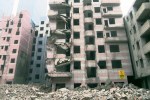
even as yuanling’s factories are upgraded to retail storefronts, the old neighborhoods – especially the old courtyard residential areas – are being razed to make way for highrise developments.

watching the chickens feed in the courtyard of new yuanling village remind us (1) that shenzhen was imagined and built in a very different social economy and (2) that value is not simply a matter of upgrades, but nevertheless remains tied to how we imagine the future.

new yuanling village is not an actual village, but an example of the first generation of work unit courtyard residences in shenzhen. in the early 80s, homes here appear in some of the first corruption scandals as early cadres scrambled for homes, which they used as investments and rewards (in turn).

housing in yuanling is still some of the most expensive in the city because with each home comes one elementary and one middle school seat (学位). this is important because yuanling schools are ranked first provincial (省一级), a ranking that suggests students from yuanling do well in the national college entrance exam (高考).

although much of the old housing is rented out, those school seats are coveted and circulate not only with the sale of the house, but part of rental negotiations. not unexpectedly, many have bought in yuanling, but live elsewhere, simply so their children can go to school there.

in addition, the area has been approved for redevelopment, which means that within the next two years, all this will be razed and new housing built. homeowners in yuanling will be compensated with replacement housing (based on square footage conversions, but i’m not sure what precisely the terms are.)

housing and education are two of the great goods in shenzhen. indeed, many women will not marry unless they have a home; many parents spend time, energy, and money trying to provide for their child’s education. consequently, it is useful to think about what new yuanling village signified to early shenzhen residents because housing and education are sites where we actively and vigorously create the future.

yuanling looks battered and worn, but the shenzhen dreams of a house and providing for one’s only child still resonate. moreover, the importance of this future to shenzhen identity explains how corruption may have been built into the city. it is hard to imagine how communist cadres may have been reduced to scrambling for moldy bits of concrete and in retrospect, the object of their scrambling appears ridiculous. however, it is more than easy to understand how private hopes and dreams for their families’ future might have gotten entangled in what those cadres saw when they drew up blueprints, laid foundations, and built a post-mao, post cold war future at yuanling.

when i asked if there were any other benefits to buying a house in yuanling, the salesman looked at me somewhat confused – after all, is there anything more important than a new house (even if many years down the road) and a child’s education? – and offered lamely, “you could open a ground floor store.”

i like yuanling in its current incarnation. the streets are narrow, quiet, and clean, the buildings shaded by banyan trees, and the occasional palm tree straggles into the sky above working class residents. pictures, here.

greek with chinese characteristics – yuanling 1

this weekend, i walked yuanling (园岭), one of the first industrial and residential areas to be developed when shenzhen was officially special.

printing factories still operate in the shrinking industrial area park, however, those that have not been razed for upscale housing development have been and/or are being upgraded to storefront for warehouse like stores for ornate furniture and luxury bathrooms.

it sobers me to think that only ten years ago, this area was a vibrant industrial park, the realization of a particular understanding of modernization, when production and manufacturing were the at the core of shenzhen’s economic development strategy. suddenly and abruptly, individualized consumption has been enshrined as economic productivity in the (literal) wreckage of those past ambitions.

when i first came, shenzhen speed was defined in terms of accelerating 100 years of western modernization into a few decades. but all this instant upgrading has me wondering just how fast is an economic cycle anyway? and what comes next? restructuring and economic depression? pics of upgrades, here.

shenzheners search for happiness…

happy endings?

The Shenzhen Civilization Office (文明办) is currently sponsoring the “Search for the Happy Person in My Life Video Contest (寻找身边快了幸福的人DV大赛)”.

At first, I was simply curious about how to interpret their posters – a canoe, floating on a dock, seperated from an idealized Shenzhen skyline by a vast expance of water. Am I supposed to understand the happy ones as those who have left the city or those who are heading toward the city? The image of Shenzhen rising fully formed from white fluffy clouds strikes me as oddly oz-like, and this has me wondering if perhaps those who don’t live in actually existing Shenzhen are the happy ones?

To assauge my curiosity, I googled 文明办 and, in addition to a national level office of civilization, I also discovered a provincial office. However, Shenzhen’s office was not online. A few more clicks and I found out that

中央文明办全名叫中央精神文明建设指导委员会办公室,是中央精神文明建设指导委员会的办事机构。而中央精神文明建设指导委员会最主要的职责就是督促检查各 地、各部门贯彻落实党的十四届六中全会精神和中央关于精神文明建设的一系列方针、政策的情况,协调解决精神文明建设主要是思想道德和文化建设方面的有关问 题。总结推广交流先进经验。深入调查研究,为中央决策提供建议。

(The full name of the Central Civilization Office is the Central Spiritual Civilization Establishment Oversight Committee Office, and is the managing agency of the Central government’s establishment of spiritual civilization. The main directive of the Central Spiritualization Establishment Oversight Committee is to  promote and supervise each region and bureau to implement the spiritual policies of the 14th meeting of the sixth plenary session and related questions of cultural construction.  In brief, to popularize and exchange avante guard experience. To conduct reseaerch into the process and provide suggestions for central policy making.)

Which begs the question: how do videos of happy people satisfy the Office’s mission?

A friend once told me that if you want to know what Chinese leaders think Chinese society lacks, all you have to do is find out what they’re currently promoting. For example, a “harmonious society” lacks harmony. By extension, a city searching for happy people would then lack happy people. Hmm…

Nevertheless, it seems wonderful to open the question of happiness to social debate. And to frame happiness as a question of spirituality? Again, yes! I’m all for making happiness part of national profiles and a condition for evaluating good government. However, instead of talking about what the conditions of happiness are and how we might extend them to more people, the videos by and large talk about how individuals are happy in their very private lives. Thus, in the videos I’ve seen, the definitions of happiness are so stereotypical (going to school, falling in love) and so individualized (family life, working hard) that its hard to see this competition as anything but more sugar-coating a decided lack of harmony chez Shenzhen.

And that’s the painfully irony: Shenzhen did begin in the dream of happiness or xiaokang, as it was once called.

More videos online at the official website.

深大南区:the map is not the territory


the map

Originally uploaded by maryannodonnell

Once upon a time, this territory was ocean. There were oyster farms and fishing boats. And the people who lived here had single story homes that came to represent the poverty that these maps and plans would end.

The effort it takes to force territories into maps pulses through each inch of the houhai land reclamation area. Lines imagined elsewhere are being bulldozed, pounded, and moulded into six-lane highways and ten-lane expressways. Beside these roads climb glass buildings and residential developments with exotic gardens – palm trees, English grass, a goldfish pond, which is drained and cleaned once a month.

This is the territory – unmapped, but not unsung: Beneath the grey sky and rising walls of a high-tech research compound, a woman washes vinyl advertizing sheets for indigent tenting, paths veer in hidden enclaves that serve as public toilets, and a child plays on a piece of flatboard that has been placed protectively on top the mud.

Shenzhen’s poor are poorer than they were 15 years ago, when squatters had enough space and privacy to build small shelters beneath the lychee orchards that have also been imaginatively disappeared.

May the new year bring new possibilities.