临摹:When is a copy not a copy?

This November, I was an assistant for the OCAT international art residency program, through which I met artists Frank Haermans and Thomas Adebahr, the artist collective of Nika Oblak and Primoz Novak, as well as curator Paula Orrell. Together, they put up the show Future Relevance, or as we translated it “明天,谁说了算?”

Interacting with the artists and curators was interesting because it inspired me to think differently about my own forays into creative ethnography and forms of representation that engage different (and frankly) wider audiences. In particular, Thomas Adebahr’s earlier work, The Benjamin Project (shown at Gallery Diet) had me thinking about contemporary art conventions that value some forms of copying and reduce other forms to “labor” albeit “skilled”. The question, of course is: how do we move across and between these social structures to create meaningful dialogue about human creativity? Continue reading

life seasonings…

Yesterday had lunch with friend and his son, a member of generation 90. The conversation turned to memories of life as an early 80’s college student in Beijing, while son politely played games on his phone.

Me: What interests me about your generation is that although today y’all are friends with your classmates, your children might not necessarily be friends because they are from different classes.

Old Zhang: That’s true. The country (国家) paid for us to go to college so once we were in, everybody was the same [economic] class. Now these young people have a hard time of it. I really feel sorry for them. [laughs] For example, falling in love. When we were in college we were all the same, so all you had to do was find someone you liked and then figure out how to open your mouth. But kids today [son looks up from cell phone], they have to match up everything – the right car and clothes and job and house. Love is just like salt, it’s the seasoning you add for flavor, not the dish itself.

[Old Zhang notices son looking up and continues in another vein]

This is why I’m encouraging him to get religious belief. It doesn’t really matter what. The point is that all our beliefs – in a better society, in the four modernizations, we achieved. There’s nothing left to do. Or, we don’t know what to do. That’s why belief is important.

Me: Or salt?

Old Zhang laughs, son goes back to game.

after thoughts…

The biennale opening week has come and gone; I’m still standing.

What have I learned in all the rush?

1. If I don’t take the time to think, I don’t.

2. Serious distance between Chinese and Western values continue to destabilize these large events.

3. It really is about identity creation and maintenance.


Who’s in charge?

As the biennale approaches, many documents have to be translated and I’ve found myself doing on the spot translations by text message. I mentioned to a friend that I had finally figured out that if I gave two possible translations – one more or less literal, the other more or less poetic, my interlocutor was usually satisfied with the translation. However, if I only gave one possible translation, then my interlocutor inevitably came back with questions and challenges to my understanding.

My friend nodded and asked, “Haven’t you heard the popular saying, ‘Leaders love multiple choice questions’ (领导最喜欢选择题)?”

I noted that this strategy also works with recalcitrant eaters as in, “You can eat your cornflakes with milk or without milk” because the child thinks she’s in charge even as she eats the cornflakes.

If possible, my friend’s smirk deepened.

Balancing Act: Notes on Translating for Future Relevance

Future Relevance / 明天,谁说了算? opened today. I translated the exhibition catalogue. Below, I’ve uploaded my thoughts (and translation of said thoughts) on the importance of learning to listen across unsaid assumptions, even when we don’t depend on a translator.

In our native languages, we speak with the expectation that we will be understood and if not, that misunderstandings can be easily fixed. Moreover, we often emphasize speaking as the sign of linguistic competence, rather than listening, reading, or writing, or more generally, an ability to navigate shared histories and cultural assumptions, political exigencies and economic conditions; in short, we take for granted all the unspoken social infrastructure that enables communication. Indeed, we are often so oblivious to the contexts of meaningful dialogue that cross-cultural exchanges often degenerate into fumbling searches for the “right word”.

Take for example a simple comparison of cultural associations with the English word, translation and its Mandarin counterpart, fanyi (翻译). Continue reading

意maging baishizhou

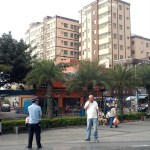
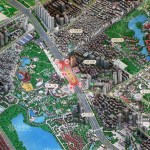
Three pictures of the northeastern corner of Baishizhou along Shennan Road. The map and detail are from a map in the Window of the World subway station, the third is a photo of the actual corner, taken from the plaza in front of 沙河世纪假日广场 (Shahe Century Holiday Plaza), the large landmark in the two maps. The contrast between the map and the territory interests me because it the ongoing (re)imagineering of Baishizhou in particular and Shenzhen more generally.

Baishizhou, as mentioned in earlier posts, is one of Shenzhen’s more “chaotic (乱)” urban villages. However, it occupies prime real estate – directly across from Window of the World and on the Line 1 Subway. Consequently, upgrading Baishizhou is an ongoing project and has included major real estate development. Tellingly, most information about Shahe Century Holiday Plaza real estate (herehere, and here, for example) emphasizes the subway convenience, views of Window of the World, and modern amenities, downplaying and often ignoring the Plaza’s neighbor, Baishizhou.

Continue reading

perfect partnerships

The past few days, I have overheard friends comment that the spouse of a mutual friend isn’t in friend’s league. Admittedly, knocking a friend’s significant other is common enough cross-culturally, so inquiring minds might be wondering why I glommed to these moments of snark. Short answer: because I finally realized something about the social arrangements of family businesses. And yes, the social organization of these relationships seems universally neoliberal, even if (or because?) the evaluations of the roles that different spouses play varies in interesting (and gets read as) cultural difference.

Chinese power couples have an interesting division of social labor; one usually works human relationships and the other usually takes care of business. Continue reading

productivity PK understanding

I have been having disturbing thoughts about compulsive productivity in the arts and academia, and yes, I know, Marx wrote eloquently about alienation, but it bears repeating: when we become cogs in whatever machine we find ourselves, we loose our humanity – our ability to empathize, to feel joy, to surrender to unhappiness, to accept responsibility for the consequences of our actions even though we cannot control how things will turn out. And that’s the rub: I keep thinking that if we gave ourselves time to ripen, our artistic and intellectual activities would bear rich harvest, rather than simply withering away as we scramble to complete the next assignment. Dust to dust, yes, but in good time.

Specifically, I’ve been wondering about how “accountability” is measured – a book every three years (tenure track jobs) or an artwork at the end of a residency (global AIR programs), and then, I recall that the words themselves show up the economic metaphors that strangle compassionate creativity. Account-able. Measure-able. Profit-able. As if our work was to make count-able objects, rather than to create more fully human lives.

Rant over.

how do we judge linguistic competence (in a foreign language)?

Yesterday, I played judge at a foreigners speak Mandarin competition. Contestants were judged on a prepared speech, fluency answering a question, and a performance of some traditional Chinese art. The contestants came from North America, Europe, Korea, and Japan and a variety of ages, ranging from two seven year old twins to folks in their late 40s, possibly early 50s.

What did I learn?

Short answer: Age and home culture matter in questions of linguistic competence in a foreign language. However, a pleasant personality and curiosity about one’s host culture will go a long way to buttressing linguistic incompetence.

Long answer: See short answer, above. Add elaborations, below: Continue reading

conditions of possibility – grassroots discourse at the wutongshan arts festival

The title of this post shouts “academic theorization”, but in fact, the post itself is far less ambitious. I’m simply speculating about what conditions we need to put in place in order to cultivate cross cultural discourse in and about places with vexed histories, like Wutong Mountain, Shenzhen.

Creating models and forums for cross cultural discussions in and about places with vexed histories is difficult. On the one hand, most of us are not familiar with the values and concerns that inform the ethos of another people; indeed, even when we are relatively knowledgable about cross cultural differences, often we do not share our interlocutor’s priorities. On the other hand, cultural groups are not monolithic entities, but rather vexed by class, gender, and regional differences, creating what Bhaktin called “heteroglossia” – a situation in which context (including history and culture and politics and economy and one’s interlocutor) is more important in determining the meaning of an utterance than is the text.

This slideshow requires JavaScript.

With the Wutongshan Arts Festival (梧桐山艺术节 – impressions above), organizers Gigi Leung and Michael Patte (founders of the riptide collective) aimed to generate conversations between village residents, local businesses (including Canyou), and artists who have moved there. The situation was clearly heteroglossic with both foreign and Chinese participants, who represented a range of different class backgrounds as well as different relationships to and with Wutong Mountain as well as Shenzhen. We came together to discuss future development in and of Wutong Mountain. Continue reading