sunny day, lushi

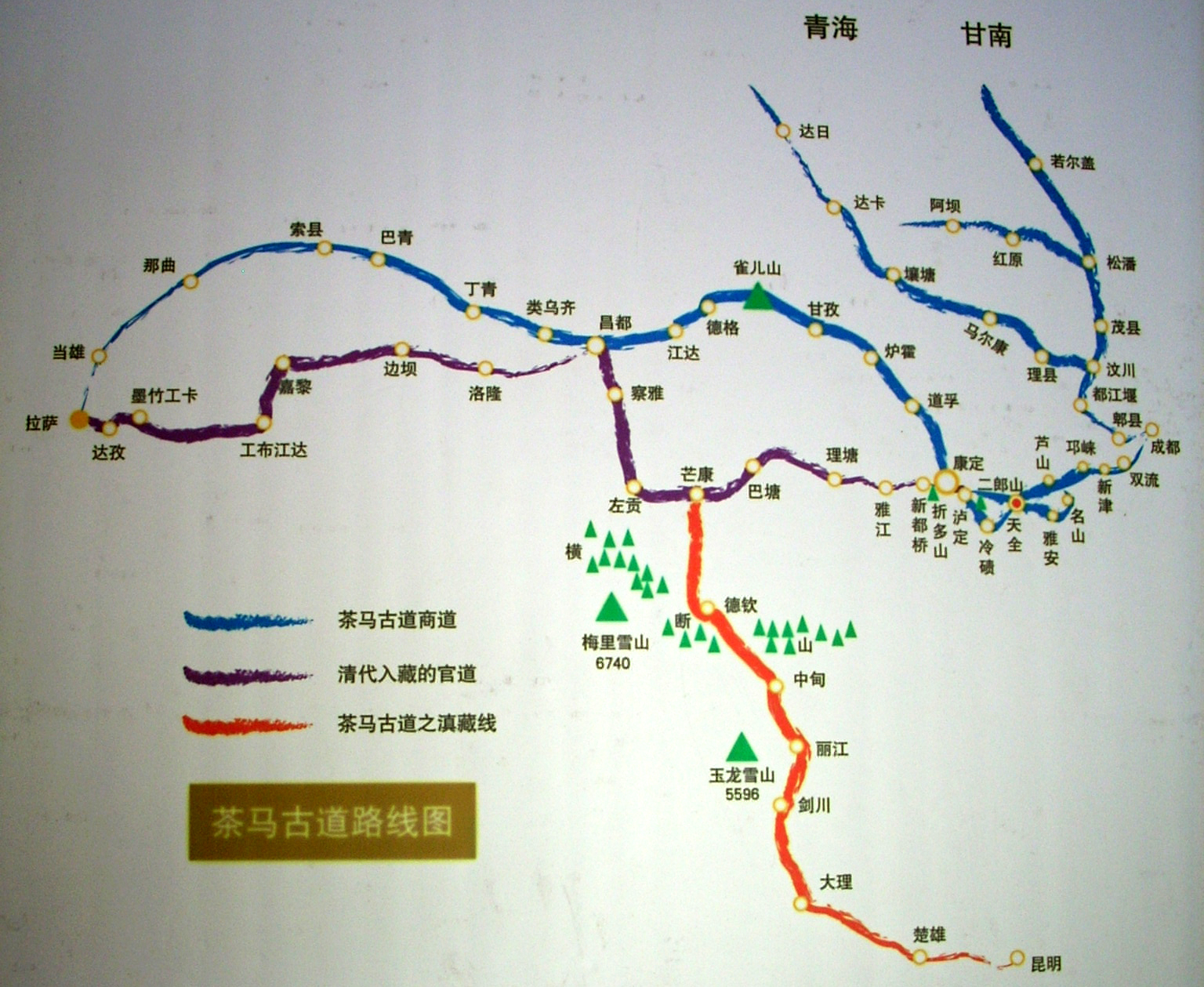
Although less famous than the Silk Road, the Tea and Horse Route (map) had three branches: the commercial route (Lhasa to Chengdu), the official route into Tibet (Lhasa to Kangding, where it reconnected with the commercial route), and the Yunnan-Tibet route (Mangkang to Kunming), which threaded through the Lincang mountains until it met up with the official route in Kangding. A small commercial center on the Yunnan-Tibet route, Lushi was located at the nexus trails that threaded through the Lincang Mountain Range.

Local farmers continue to live in villages along those ancient trails and still use pack mules to bring supplies from the town to surrounding villages. Mrs. Zhang discovered us wandering on one of the partially cemented trails that led to the river and invited us into her family compound for tea.

Mr. Zhang’s grandfather built the first building in the in the 1930s. Each subsequent generation added to the complex, and today the compound has three main buildings and a separate section for farm stock, a kitchen, and solar panels for heating water. With the family responsibility system, the Zhangs obtained several mu (666 2/3 sq meters) of land, where they have planted feed corn, walnuts, and vegetables. Their daughter has moved with her husband to Kunming and their son has opened a small shop in Lushi. One of the three buildings is for him and his girlfriend upon their marriage. The Zhangs earn between 10-20,000 rmb ($US 1,750 – 3,500) a year, which has been almost completely invested in building the house and their children’s education.

We chatted about their lives and in turn, they asked about ours. After half an hour, we took our leave and headed back toward Lushi. I remarked on the difference between walking in Lushi and Shenzhen, where I have been stopped by guards when trying to climb Jingshan Mountai in Shekou, let alone invited in for tea. My friend replied that the more commercialized a village or town, the less hospitable the residents.

This experience has me thinking about the potential and paradoxes of hospitality. In Lushi, if a door was open, we could walk into the compound and expect to be welcomed. The previous day, for example, Old Mr. Zhang (same surname as the village Zhangs) sat with us for 40 minutes, chatting about local history. We offered to continue the conversation by sending photos to the qq accounts of younger family members, who are online. At the same time however, when deflected through tourism, hospitality slips from a social practice into a commercial strategy. During this trip to Dali and its hinterland, we have stayed at hotels where our hosts are friendly, helpful, and pleasant and yet we do not feel obliged to grow the relationship.

Today I am wondering about hospitality in globalizing times. Social hospitality remains an important means of transforming strangers into acquaintances, even as commercial hospitality has expanded with the growth of tourism. The difficulty, of course, is that many of us travel hoping to encounter social hospitality and end up frustrated by differing expectations about the obligations of commercial hospitality. So just what do hosts and guests owe each other when the bill can be paid in full and yet we now live in a global village?

This slideshow requires JavaScript.

rainy day, lushi

We drove about eight hours from Dali to Lushi (鲁史), a market town (镇) in the Lincang Mountains (临沧山). The last 80 kilometers covered a narrow road, which twisted through dramatic slopes and was, in places, covered in thick mud and rocks from a rainstorm the night before. The trip and the unreliability of the roads created a sense of distance from my everyday life; lack of access to internet reinforced this sense that I was far from the modern world. Moreover, I found it difficult to understand local Mandarin, let alone the local language.

And yet.

The layout and size of the old city area remind us that Lushi was once a vibrant center of mountain life. Peasants packed mules with tea, walnuts, and palm leaves and then set out on narrow trails to sell their goods in seasonal markets in Fengqing (凤庆), Nanjian (南涧), and Weishan (巍山). Old Mr. Zhang told us that during WWII, national forces from Guangdong and Hunan stationed at Lushi. In the not so distant past, Lushi was more prosperous than Fengqing, which only rose to local prominence as a county seat during the Mao era.

Moreover, this was not a trip that placed me beyond the reach of gaokao results (all 42 members of the graduating class of 2012 found places at university), Olympic broadcasts, and packaged snacks. We stayed at a clean motel and ate regional specialities, including jizong mushrooms in spicy oil (油鸡枞) and broad beans stir fried with local pickles. There were telephones and high heels, motorcycles and cigarettes, angry bird balloons and electronic toys scattered through out the crumbling buildings and old stone walkways.

The restructuring of the relationship between Chinese cities and their hinterlands that began during Maoist collectivization and intensified with post Mao industrialization not only favored coastal cites, but also disenfranchised rural China. Today, Lushi is a painful contemporary to Shenzhen precisely because the mountain town has been so obviously positioned at the underdeveloped edge of the modern world and not because that’s what it once was.

Impressions of a rainy day in Lushi, below:

This slideshow requires JavaScript.

fengyu: at the periphery of the periphery

The two hour trip from Dali to Fengyu Market Town (凤羽镇) eases senses overstimulated by tourist crowds, let alone Shenzhen’s urban crush. Nestled within extensive rice paddies and surrounded by mountains, Fengyu stands in provocative contrast with Shenzhen’s industrial parks and reclaimed housing estates. The town’s crumbling architecture evokes past elegance and stately lifestyles, while elderly women dressed in traditional Bai costumes maintain local religious traditions, setting up small altars at the entrance to the town. Here, at the periphery of urban China’s periphery, I slip into forms of rural nostalgia — once upon a time, a stately, elegant society of noble warriors, rural scholars and happy peasants resisted both Tibetan and Han incursions.

And yet. Where Shenzhen streets bustle with young migrant workers, Fengyu’s main street and side alleys shimmer silently. Whatever remains of the Nanzhao and Dali Kingdoms, today, young Bai must choose between agricultural labor and life elsewhere, in Shenzhen, for example, where one of my favorite restaurants serves Yunnan delicacies that are flown in daily to tempted jaded palates. A walk through Fengyu, below:

This slideshow requires JavaScript.

what does the athletic body signify?

Upside to Shenzhen’s Olympic propaganda push — less minutes of propaganda per bus ride than leading up to the Universiade. That said, during blurb du jour about the national body, I had an insight. To wit: I’m thinking that Chinese athletes represent state power, while US American athletes represent honed individual desire.

Consider the mise-en-scene: a busload of commuters reading weibo, some sprawled on a seat others dangling from a safety handle, still others huddled over fat children, one who smiled at me. Their expressions were neutral, passively waiting to jump off the bus to their next encounter, although I did see several people scowling at their cellphones and overheard a well-dressed lady in pumps, repeat in frustration, “No, we need the order to be shipped today.” In contrast, on the television screen another Chinese gymnast gracefully flip-flopped on a balance beam, paused, and looked directly into the camera. She wore a bright red and yellow bodysuit, her hair was pulled back in a neat ponytail, and she stood straight, shoulders thrown back in pride. The message was clear: if we commuters who were not exactly slovenly but far from neat and certainly tending to scrawny and flabby, ate healthy, exercised, slept regularly, and visited our doctors, we too could be proud members of the national team.

That’s when I realized that similar US American propaganda would have emphasized the same good behavior but for a different reason; we should eat healthy, exercise, get enough sleep, and have medical check-ups in order to fulfill our personal dreams. Another thought followed: even if the US and China field national teams to achieve different ideological ends — the US has to demonstrate that all that rugged individualism makes us a strong nation, while China has to prove that all that authoritarianism is the pre-condition for individual excellence, nevertheless, structurally all this athletic posturing affirms the status quo. But we knew that. It’s just that suddenly the status quo seems to be a pad de deux Sino-Americana, rather than say, a cold war.

killing the buddha in aurora

Eating lunch at a Taiwanese style buffet this afternoon, I experienced a bit of pop culture dissonance, when something vaguely “favorite instrumental love song from a Disney Film” followed Eminem and Rihanna’s “Love the Way You Lie” on the music piped-in music. I’m not sure how these two songs ended up back-to-back, without commentary, either canned or live — my immediate neighbors, for example, wore sanitation jumpsuits and repeatedly asked each other if they had had enough to eat, seemingly oblivious to the music radio faux pas — but I’m thinking maybe the manager had purchased a shanzhai mix of “top love songs, 2010” to enhance the buffet’s image as “cool” and “not neidi“. It may also have been a moment of pastiche prophecy. Not a few alternative rockstars have transitioned from producing troubled hits to belting Disney classics, and I see no reason why either Eminem or Rihanna shouldn’t follow in the footsteps of Elton John and Melissa Etheridge.

I started actively listening to the music when I realized that I was humming along to the chorus of “Love the Way You Lie”. The melody hooked me not only because I like Rihanna’s voice, which is especially poignant in contrast to the desperate anger of Eminem’s lyrics, but also because I know too much (or not enough) about their lives and the way that themes of violence and redemption, suffering and atonement, yearning and self-justification weave through and between their public and private performances. Indeed, whatever their actual relationship to and experience of brutality, Eminem and Rihanna seem apt symbols for the US American confusion of pain with love; we work really, really hard, to sell the story that some killings are justified, and some beings exist to be shot — Oscar Wilde in prison, as if murder were the expression of bravery, while the rest of us cowards go on about wounding each other in social acceptable ways:

Yet each man kills the thing he loves,
By each let this be heard,
Some do it with a bitter look,
Some with a flattering word,
The coward does it with a kiss,
The brave man with a sword!

And Oscar Wilde has nothing on the US American romance with death, destruction, mayhem, and murder. Consider alien invasion movies, where the aliens exist to be killed, and in process reveal the courage and fears of white (or whitened) humanity. Or westerns, where those black hatted fellers “get what’s coming to them”. I have joked that the formula for a US American soap opera is boy + girl + murder, and happy endings simply mean that the murder has brought the two characters together, while unhappy endings are more “hard core” because one of the lovers is the victim, while the other survives to achieve some kind of vengeance. And yet. When we stop to think about it, the extent to which US Americans confuse levels of hurt with intensities of love is distressing.

In thinking through the Aurora Massacre, Patrick S. O’Donnell at Religious Left Law refers to Erich Fromm’s idea of the “pathology of normalcy“, which refers to the ways that culture shapes human interaction, or a socially patterned defect. Importantly, on Fromm’s reading members of the same culture not only share the same defect, but also share behavioral patterns that enable us to live with a defect without becoming ill.

It is as if each culture provided the remedy against the outbreak of manifest neurotic symptoms which would result from the defect produced by it.

In this sense, Eminem and Rihanna might be thought of as symbolizing the American normal, enjoying a violent buzz but not actually killing anyone. In fact, because we know that love hurts, we expect some form of abuse or pain, but within limits. Not surprisingly, in our current fascination with BDSM, US Americans learn to ride the violence and pain to gendered forms of ecstasy.

Fromm also notes that for a minority the cultural pattern does not work. This “not working” has two forms — the expression of the pathology as individual neurosis and the recognition of the pathology as what it is, an unhealthy pattern of interaction. Here’s the point: a neurotic expression of normal All-American love would be if Eminem set Rihanna on fire and watched her burn to death. Neurotic on Fromm’s thesis because the underlying logic of burning a lover to death is the same as that of “normal Americans”; the more extreme one’s love, the more violently it will be expressed. And yes, we all know and derive various levels of pleasure from the formulation total love = total annihilation.

And there’s the rub. At Aurora, James Holmes crossed the fuzzy line separating normal from neurotic, the line in which its okay to play and sing and read about killing others, just not okay to actually kill.

More hopefully, however, there is a second maladaptation to the pathology of normalcy. In this maladaptation, an individual recognizes the pathology of normal life for what it is — a problematic pattern of interaction. We recognize, for example, that abuse within relationships is not an expression of love and thus our job is to learn to change hurtful patterns of behavior. We realize the need to nurture ourselves and others in non-violent relationships. We understand that this is precisely where we need help because changing deeply rooted patterns of interaction, patterns that are reinforced through popular culture and the lived expectations of friends and family, as well as our own conflicted desire requires courage and faith and the willingness to risk normal life for a healthier, happier life. A life, we might say, in which killing the buddha is not a made-for-telesion movie, but a koan.

His Holiness the Dalai Lama reminds us:

Before we can generate compassion and love, it is important to have a clear understanding of what we understand compassion and love to be. In simple terms, compassion and love can be defined as positive thoughts and feelings that give rise to such essential things in life as hope, courage, determination, and inner strength. In the Buddhist tradition, compassion and love are seen as two aspects of the same thing: Compassion is the wish for another being to be free from suffering; love is wanting them to have happiness. 

May the survivors of Aurora find healing. May we in the United States find the courage to look seriously at the normalcy of violence in our relationships. And, if we cannot yet love James Holmes, may we find the strength of heart not to wish him ill.

entitled: the demise of comrade and ritualization of inequality

The other evening northern friends of a certain age lamented the demise of “comrade (同志)” as a form of address. They weren’t so much distressed by the Cantonese queering of the term, as they were by the fact that Chinese forms of address no longer assumed (or aspired to) equality between comrades. Instead, etiquette now demanded that social fields be charted and hierarchical relations marked. Officials, for example, are called by their bureaucratic position. Not surprising in the case of higher ranking officials — the City Party Secretary and Mayor, for example — but somewhat excessive in the case of neighborhood heads.

Even if they chafe at the ritual acknowledgement of political hierarchy and concomitant social inequality, nevertheless, they also remarked that official status does simplify the question of how to address someone. In contrast, they noted that the real awkwardness lay in deciding how to address someone without either a clear social role or a defined relationship to the self. They addressed professionals by their job (Lawyer Chen, Teacher Dong, Doctor An, Theatre Director Yang, and Engineer Liang come to mind), but often blanched at calling rich acquaintances “boss (老板)” or the more refined “executive (总)”. Friends were addressed by nicknames and fictive kin terms, while new friends could be called “Mr. (先生)” or “Ms. (小姐)”, but workers, including waitstaff and other service workers posed a problem because they could also be hailed as fictive kin or just young people. Moreover, gender and age play an important role, and in conversation my friends often call working men “craft master (师傅)” or “boy (小伙子)” and working women “auntie (阿姨)” or “younger sister (小妹)”.

In anticipation of the 18th National People’s Congress and to give a sense of just how complicated is the system of Chinese bureaucracy and relevant titles, I have translated the fifteen official levels of government from a Baidu entry. Positions are listed in order of ranking within a category. Hence, the General Secretary ranks higher than the President, who in turn ranks higher than the Chair of the Military Commission. When making introductions, most people will qualify a title with the appropriate administrative status, as in City Level Vice Mayor, after which however, they will use the full title “Mayor” unless the actual Mayor is around. These rankings also matter because they map the bureaucratic journey that ambitious functionaries must make. Shenzhen is a sub-provincial level city, for example, and so its Mayor cannot be directly considered for a national post, but must first obtain a provincial or ministerial position. In contrast, a the same position in an independent city, like Beijing or a full provincial ranking, would be a rank higher, placing the office holder in contention for national assignments.

Should your eyes not glaze as you read the list, you’ll get the hang of assigning rank and how using titles has ritualized inequality by reiterating the Chinese bureaucratic system from the General Secretary all the way down to a functionary in a community or village office.

First level, national level (国家一级):General Secretary, President, Chair of the Military Commission, Chair of the National People’s Congress, State Council Premier, Vice General Secretary, Standing Member of the Political Bureau of the CPC Central Committee.

Second and third level, national government (国家二至三级):Member of the Political Bureau of the CPC Central Committee, Alternative Member of the Political Bureau of the CPC Central Committee, Secretary for the Central Disciplinary Commission, Vice Chair of the NPC Standing Committee, Vice Premier of the State Council, State Council Member, President of the Supreme People’s Court, Vice Chair of the CPPCC National Committee.

Third and fourth level, national ministries and provincial government (部级正职、省级正职三至四级): Provincial governor, Vice Secretary for the Central Disciplinary Commission, Standing Member NPC, Secretary of State, all sub-national administrative chiefs and enterprise heads (including Party organizations), leaders of all People’s organizations (including Party organizations) at the provincial, autonomous region, independent city level. These organizations include Party Committees, People’s Congresses, Government, and Chinese People’s Political Consultative Conference. Exceptions can be made to give provincial rank to leaders of sub-provincial organizations;

Fourth and fifth level, vice ministries and sub-provincial government (部级副职、省级副职四至五级): Vice Governor, Members of the Central Disciplinary Commission, all sub-provincial administrative chiefs and enterprise heads (including Party organizations), leaders of all People’s organizations (including Party organizations) at the sub-provincialand sub-autonomous region. These organizations include Party Committees, People’s Congresses, Government, and Chinese People’s Political Consultative Conference. Exceptions can be made to give sub-provincial rank to leaders of Office of the Council or Regional organizations [Shenzhen Municipality];

Fifth through seventh level, Council Heads, Regional Chiefs and Counsels (司级正职、厅级正职、巡视员五至七级);

Sixth through eighth level, Vice Council Heads, Sub-regional Offices and Assistant Counsels (司级副职、厅级副职、助理巡视员六至八级) [Shenzhen Districts];

Seventh through tenth level, Department Heads, County Commissioner and  Investigators (处级正职、县级正职、调研员七至十级);

Eighth through eleventh level, Vice Department Heads, Vice County Commissioners, and Assistant Investigators (处级副职、县级副职、助理调研员八至十一级) [Shenzhen Precincts];

Ninth through twelvth level, Section Heads, Xiang Heads and Chief of Staff (科级正职、乡级正职、主任科员九至十二级);

Ninth through thirteenth level, Vice Section Heads, Vice Xiang Heads, and Vice Chief of Staff (科级副职、乡级副职、副主任科员九至十三级) [Shenzhen Communities/Neighborhoods];

Ninth through fourteenth level, Staff Members (科员:九至十四级);

Tenth through fifteenth level, Office Workers (办事员:十至十五级).

三打两建:ideology in guangdong

Guangdong Party Secretary, Wang Yang has been busy shoring up his position as a reliable, upstanding, and neo-liberal party member.

Since February this year, all of Guangdong has been engaged in “three attacks and two establishments (三打两建)”, a movement that has its own, quite extensive website. The three targets of attack are “illegal monopolization of the market through violence (欺行霸市)”, “manufacturing and selling fake goods (制假售假)”, and “commercial bribery (商业贿赂)”. The two principals to be established are “a system of social trust (社会信用体系)” and “a system of market oversight (市场监管体系)”.

It seems on first glance a call to rationalize highly local systems of production, consumption, and regulation because I have usually seen movement banners in urban villages, rather than in malls, making villagers the target of Guangdong’s current ideological movement. For example, “illegal monopolization of the market through violence” and “commercial bribery” seem to be descriptions of how markets and shops are actually run (with their reputed mafia ties) in villages. Likewise, “manufacturing and selling fake goods” also seems to be located in villages, with low-level investors setting up shanzhai factories in older, under the radar of municipal oversight spaces and then distributing these goods through local outlets. In contrast, the double aim to establish systems of trust and market regulation point to the government’s determination to bring all production, distribution, and consumption under a system of generalized oversight.

Currently, Shenzhen’s villages have all been incorporated into the municipal apparatus and villagers given citizen status. However, to the extent that industrialization in the Pearl River Delta has created rich villages that cultivate loyalty to the collective (or extended family) rather than to the state (as an abstract system), the next step in rural urbanization has become transforming villagers into citizens. Currently, one of the defining characteristics of a citizen in contrast to a villager is that “citizens” position themselves with respect to national laws (shared with strangers), while “villagers” position themselves with respect to traditional values (shared with familiars and intimates).

Point du jour, an important task of Chinese governance has become shifting how the state interpellates rural residents, hailing them as individualized “citizens”, rather than as collectivized “farmers” even when and despite the fact that many villages (such as Xiasha) are investing in symbols of collective identity, and the “urban village” has become a stereotype of Shenzhen cultural identity.

可怜天下父母心: generation 80 and 90 go abroad

I tend to think that middle class Chinese parents have it good. Grandparents take care of young children, elementary school children go to school and can generally be pressured into doing several hours of homework a night, and older children hang out with their parents, not only out of respect, but also because they acknowledge that being with children makes parents happy. In fact, a visit to any park or mall, or even an ordinary bus commute suggests how well behaved Chinese infants are. One or two fuss, but most sit calmly on their grandparents’ laps or play with a water bottle. School age children get themselves to and from campus, attend cram sessions, and organize their homework.

Even after graduating from college, middle class children take care of their parents’ well-being. I know more than one member of Generation 80, for example, who returns home for weekly meals. Working Chinese children also arrange for their parents and parental-in laws to live with or near them in order to attend to parental needs. So common is the assumption of parental care that throughout Shenzhen, hospitals and shopping malls market themselves as places where children can express care for parents — arranging a mother’s dental appointment or family dinner, for example. Certainly, facilitating migrant remittances from Shenzhen to neidi and family network phone plans are huge sections of the financial and service industries. In other words, my experience has shown me the extent to which middle class Chinese children — even members of Generation 80 and 90 —  remain remarkably filial. Or certainly seem so when compared with their age cohorts in the United States.

I realize that mine is a minority position. Commentators in both China and the West have focused on how China’s middle-class parents work exceedingly hard to provide the material conditions for their only child to live well. These parents sacrifice all sorts of ambitions and desires so that their child can go a famous university. They also point out that since promulgation in 1980, China’s one-child policy has produced not a few “little Emperors (小皇帝)”, who in common English are simply “spoilt brats”. Now it may be that when two sets of grandparents and often a nanny orbit the lone descendent, some children become unreasonable. But not all. And certainly not the majority, who study hours as long or longer than their parents work to achieve academic results that will make their elders proud. Indeed, I am still impressed by the number of young Chinese people who make their parents’ dreams (rather than their own) their lodestar.

As I have begun to gather stories about generations 80 and 90 abroad, however, my perspective has shifted. I am beginning to realize the extent to which their parents have made these young people their life’s purpose. It is not simply that middle class parents bask in the glory of their child’s accomplishments, but also and more importantly, that they have crafted lives out of raising this child. These parents often confuse high grades with success and low grades with failure, or interpret independent thinking as “rebellion” and “intransigence”. Nevertheless, once their child successfully matriculates in an overseas high school or college, these parents suffer acute ” empty nest” syndrome, as we call it in the States not only because they realize that they will no longer be able to direct their children’s development, but also because they finally understand, no matter what and how they dream for their child, ultimately they cannot give their child a smooth and carefree life.

Yesterday, I helped a mother read and understand US insurance documents. Her daughter is in California and was in a car accident. The other party has filed for damages, and the daughter’s insurance company has begun to negotiate with the claimant’s lawyer. Ironically, the mother sold her own car so that the daughter could purchase a car, which she explained, “is more necessary in California than Shenzhen.” The daughter whose English is fine, but not strong enough to feel confident about her understanding of documents in legal English sent her mother digital copies, asking for guidance. The mother does not read English and used half a day to find a connection to me to make an appointment. After I explained the content to her, we came up with a plan of action and contacted the daughter, who is no doubt figuring out what needs to be done and doing it. Her mother, however, is in Shenzhen managing the anxiety of helplessness; she deeply wants to help her daughter, but cannot.

All this to say that I am hearing the expression “take pity on the hearts of the world’s parents (可怜天下父母心)” differently, and perhaps more accurately. I used to hear it as spoilt parent moaning about a child’s attempt to establish a bit of independence. Today, I am better able to pity parents, not because their child received poor grades or has a stubborn streak, but rather because they would do anything to make their child’s life smooth and happy. Of course, that is precisely what they cannot do, and so they suffer.

Interesting cultural postscript: in Chinese, empty nests refer to lonely grandparents and the phrase “empty nester” is translated as 孤寡老人. Thus, when their children go and remain abroad, Chinese parents not only become empty nesters in the US sense of “children have moved out”, but also potentially in the Chinese sense of “old person without a grandchild”.

population and hukou update, 2012

The decision to further loosen hukou requirements is once again front page news in Shenzhen (南方都市报). Interestingly, however, the municipal hukou system is only one reform target. Yesterday, the Municipality released its 2012 Reform Targets, which like hukou reform seem to be about rationalizing public administration, and include centralizing the City’s pension, philanthropy, credit, and prison systems. Nevertheless, hukou reform captured the headlines. Why?

Simple answer: Despite the fact that the children of both early migrants and Baoan locals, as well as the children of long-term residents now claim Shenzhen identity, nevertheless, the majority of the population does not have a legal claim to the Municipality, let alone an emotional sense of belonging. Indeed, the City’s statistics noticeably do not mention uncounted members of the floating population.

According to recent statistics, Shenzhen’s official population is now 15.1 million, of whom only 2.3 million have Shenzhen hukou. The Municipality’s other 12.8 million are in various states of limbo, which range from those who have overstayed a temporary residence permit through workers who have enough points to apply for a hukou to graduate students at Shenzhen’s University Town, who will be given hukou along with their diploma.

Nevertheless, even if we don’t know how many inhabitants actually identify themselves as Shenzheners, we do know that the Municipality is vigorously promoting the slogan, “If you come, you’re a Shenzhener”. To give a sense of how the Municipality strains to graft a sense of place onto deterritorialized bodies, I offer a loose translation of a recent bit of musical propaganda, the song, “If you come, you’re a Shenzhener (来了就是深圳人)” sung by Xu Qianya.

If You Come You’re a Shenzhener

(chorus) Wherever you’re from, you’ll hear your hometown language; It’s hard to distinguish between elsewhere and hometown; Wherever you’re from, this city opens its doors to you; If you come, you’re a Shenzhener; The earth has dreams to be harvested; The heart expands; Shennan Road is like a production line; Producing Spring after Spring; Clouds search for green mountains, mountains search for clouds; People seek opportunities, opportunities seek people; Heroes populate this world; You and I have the same heart; repeat chorus

Rap: There’s an immigrant town; Inhabited by youth and their dreams; Our latitute is 22 degrees north; Here a handshake means something; Here smiles last a little longer; Every day is young; The heart expands; Shennan Road is like a production line; Producing Spring after Spring; Clouds search for green mountains, mountains search for clouds; People seek opportunities, opportunities seek people; Heroes populate this world; You and I have the same heart; repeat chorus ad nauseum.

Lyrics:

不论你从哪里来 都能听到乡音,异乡和故乡很难分,不论你从哪里来 这座城敞开门,来了就是深圳人,土壤有梦多收获,胸襟开放多风云,深南路像一条流水线,流过青春又青春,云找青山山找云,人找机缘缘找人,天地间苍茫千万里,你我相知一颗心,不论你从哪里来 都能听到乡音,异乡和故乡很难分, 不论你从哪里来 这座城敞开门,来了就是深圳人

RAP:有一座移民之城,住满着青春和梦,这里刮着北纬22度季候风,这里的握手比较有力,这里的微笑比较持久,这里的每天都年轻,土壤有梦多收获,胸襟开放多风云,深南路像一条流水线,流过青春又青春,云找青山山找云,人找机缘缘找人,天地间苍茫千万里,你我相知一颗心,不论你从哪里来 都能听到乡音,异乡和故乡很难分,不论你从哪里来 这座城敞开门,来了就是深圳人 (Repeat)

mini-series plot recap (by country and episode length)

Television dramas remind us that love is cross-culturally a means of negotiating gender inequality, but that is expressed through culturally specific forms of unhappiness and resolution there of. My trip to Taiwan reminded me, however, that even within Chinese speaking communities, young lovers face different challenges. Below, a list of mini-series plot recaps by country and episode length based on my own television habits. As a general rule of thumb, two episodes of an Asian mini-series is the equivalent in length of one US American made for television movie. Also, in my plot recap, I first note the happy ending and then in parenthesis a sad story version. And yes, please add insight from your experience watching these pervasive and addictive forms of popular culture.

US American = boy meets girl, boy and girl have sex, a murder brings them closer together (or one of them may be the victim) in one made for television movie;

Japanese = boy meets girl, boy and girl fall in love, a suicide brings them closer together (or one or both commit suicide) in 12 episodes;

Korean = boy meets girl, boy and girl fall in love, inherited and usually unsuspected history between their parents brings them closer together (or results in them being separated for years that each stoically endures) in 16 or 20 episodes;

Taiwanese = boy meets girl, boy and girl fall in love, their mothers begin a battle that brings them closer together (or forces one or both of them to choose between their lover and their mother) in 30 to 40 episodes;

Mainland = boy meets girl, boy and girl are attracted to each other, they soon realize that together they can rule the country more justly (or together they can’t seize power because corruption is just too endemic) in 80 episodes.