I’ve learned a new expression, face engineering projects (面子工程), which I understand to mean large scale social mobilization that is just for show and will vanish with the project’s intended audience. Continue reading
Tag Archives: longgang

cultural homogenization in shenzhen. and not.
Most discussions of Shenzhen emphasize that as an immigrant city, Shenzhen is a Mandarin speaking outpost of national culture in the midst of Guangdong Province. However, this description glosses over the historical division of Baoan County into Cantonese and Hakka cultural areas, and how urban development focused on the SEZ (rather than the entire Municipality).
The establishment of Baoan and Longgang Districts in 1992 institutionalized these historic divisions, with a Cantonese cultural-linguistic area (Baoan District) and a Hakka cultural-linguistic area (Longgang District). At the same time, the traditional SEZ (bounded by the second line) formed the core of Mandarin national culture in the city.
Thinking about Shenzhen as a tri-cultural city enables understanding of how cultural homogenization does and does not take place. Today, I’m thinking specifically about the creation of a recognizably “rural” local identity versus an “urbane” Shenzhen identity. In the area surrounding the Universiade Village, for example, these various trends are most visible in ongoing construction and demolition projects.
Construction wise, the planned Universiade Village boasts beautiful, glass stadiums and swimming areas, which reflect urbane aesthetics. Indeed, the nearby 5-star hotels and upscale residential areas lump Shenzheners (the Mandarin nationals) with cutting edge international taste and consumption. This aesthetics contradicts that of the mid-90s generation of handshake buildings that constitute much of the Longcheng Street residential area. Architecturally, it all seems a straight-forward contradiction between rural and urbane Shenzhen, which in turn is often misread as a contradiction between Cantonese and Mandarin spheres.
In fact, walking through a small Hakka Village, like Dawei indicates how recent handshake buildings as an architectural sign of the rural are in Shenzhen. In Dawei, the handshake buildings have been built into and on top of a traditional, small Hakka compound (similar to the one in Sungang). In other words, handshake buildings create a common “rural” or “Baoan local” identity for (once culturally and linguistically distinct) Cantonese and Hakka villages only in contradistinction to a Mandarin identity.
Visual evidence in slideshow, below.
shenzhen administrative structure
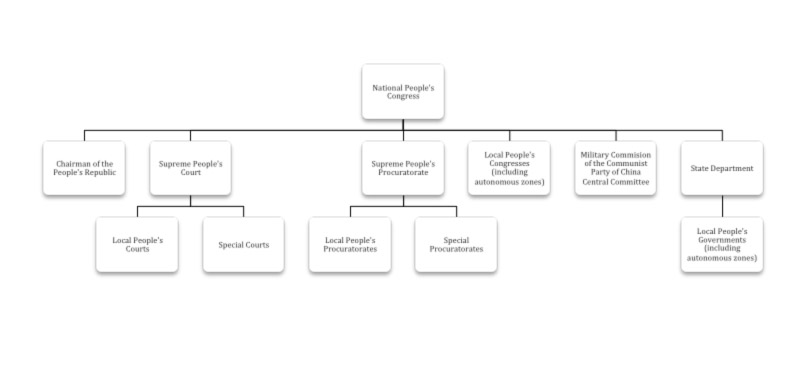
I’ve been making charts to organize my thinking. Below is an organizational chart of Shenzhen, circa 2010.

Also, a simplified version of the organizational relationship between the Central government and local governments. Guangdong is the provincial local; Shenzhen is a sub-provincial city, however, as an SEZ, Shenzhen has all sorts of legal privileges that provinces and direct cities do not.
earthly abstractions
Coming into Shenzhen on the Tianjin-Shenzhen train, I heard a broadcast about the City’s historic importance and sites of touristic interest. Nothing out of the ordinary, until the broadcast introduced the Daya Bay Nature Conservation Park. I tend to think of Daya Bay in terms of nuclear power and French technologies thereof, rather than in terms of conservation. Today, the unexpected juxtaposition of nuclear power and nature preserves has me thinking about paradoxes in urban planning.

my hope for the new year

I have been thinking about the contradictions that shape human lives and how, in turn, those lives are the environment for others – human, animal, vegetable, and mineral.
SZCAT, a part of China’s Animal Lovers Net dedicated to saving feral urban cats announced that on December 26, 2010, a group of animal protectors (as they call themselves) discovered an illegal slaughterhouse and reported it to the Yanshi police as part of a rescue mission in a Hakka area where yes, I ate stewed cat and dog (separate dishes) several years ago.
The Nanfang Daily report on the rescue called it “Stealing Dogs Movement”, emphasizing the human cost of taking the animals. The animal protectors went in to rescue the animals and the local police destroyed several of the shanties that made up the slaughter house. However, as the volunteers were trying to get the animals to safety, many of the residents in the area stopped them because these animals were their livelihood. As a result, the police ended up negotiating a compromise – the volunteers could leave with the animals they already saved, and the rest would be left with their owners, who no longer had a way of processing them.
The results of this negotiation pleased no one. For their part, the migrant workers who make their precarious living by slaughtering and preparing traditional cat and dog dishes took a huge economic hit at the time of the year when they most need to save money for the upcoming Spring Festival. On the other hand, the volunteers felt that inhuman misuse of cats and dogs would continue without any intervention or “respect for law”.
I’m not sure how to think about this situation because I’m sad for all involved. Clearly, migrant workers in Shenzhen resort to all sorts of grayish means to earn a living not only for themselves, but also to support family back in neidi. At the same time, the raising and slaughtering of animals for human consumption is itself the cause of much, unnecessary suffering and inequality; not only do stock animals suffer, but raising cows and pigs and fish and chickens on industrialized ranches and farms damages the environment for other creatures (including humans).
My hope for the New Year is that we find ways of resolving these contradictions in inclusive ways. As long as we frame the debate as a choice between “save the pets” and “save the migrant workers,” we fail to see how all lives – not just the ones we like or agree with or are proud of or believe to be right, but all lives matter and matter beautifully.
Happy, happy 2011. Prosper.
New Districts defined!
brief post on shenzhen´s ongoing redistricting because i know what´s ¨new¨ about shenzhen´s two new districts (新区), guangming and pingshan.
shenzhen´s two new districts are not ¨districts¨ in the strict sense of the word, instead they have all the economic power of shenzhen´s other 6 districts, but none of the political power. unlike yantian, luohu, futian, nanshan, longgang and bao´an districts, guangming and pingshan do not have the four administrative organs that define china´s government — the chinese people’s political consultative committee (政协), a district court (区级法院), a district congress (人大), and a procuratorate (检察院). nevertheless, the new districts do have the power to develop and implement economic plans.
if this sounds familiar it´s because this is how shenzhen began — an administrative unit betwixt and between beijing (politics) and guangzhou (economics). in order for guangming and pingshan to become politically viable districts, shenzhen municipality will have to petition the central government to change the government structure. however, that petition may be beside the point if the point is to develop these areas as quickly as possible, especially as many ¨political¨ decisions get framed as ¨economic policy¨ issues. moreover, in keeping with the plans can´t keep up with change ideology that permeates shenzhen decision-making, it may simply be easier to grant economic independence to an area and worry about political independence when and if the time comes.
redistricting – guangming and pingshan xinqu
i try to keep apace of the changes, but alas, shenzhen redistricts and i find out about it after the fact. guangming new district was carved out of baoan and pingshan was carved out of longgang. thus shenzhen now has 8 districts: within the gate (guannei or the old second line, erxian) nanshan, futian, luohu, and yantian; outside the gate (guanwai) baoan, guangming, longgang and pingshan. see map.
this redistricting seems to be a return of the repressed because during the mao years guangming and pingshan were communes. of course, all shenzhen’s districts were once upon a time communes and so the city’s administrative history might be thought of as tweaking and reshuffling extant divisions upon revisions of a traditional world order. more to the point is that this redistricting speaks
- to shenzhen’s loosely planned uneven development (some places in shenzhen really are noticeably poorer than others, which is interpreted as intended-by-the-governmenet-to-be poorer than others, thus requiring explicit recognition through the establishment of a new administrative district. first case – yantian) and
- to the city’s growth (it really is too big for simple administrative bureaucracy).
a simple point of nomenclature: i don’t understand why guangming and pingshan are “new districts (xinqu)”, rather than districts (qu). it may have something to do with actual rights and responsibilities of the new district government as being distinct from other district governments (in terms of taxation and what not), but i don’t know. or, thinking from the analagy of new villages (xincun versus cun), i hypothesize that new districts are a variation of a past government, with status change and thus the right to transform whole chunks of the political-economy. thus for example, guangming was a zhen within baoan, just as pingshan was a longgang zhen, which were subseequently elevated to neighborhood (jiedao) as part of the 2004 rural urbanization movement. but again and alas, i’m not for sure.
cutting to the chase, i ask: does anyone know the reason for why xinqu rather than a plain and simple qu? please tell.
吉田园:the spectre of modernized death

high density real estate
today, some notes on human death and the spirit of capitalism with chinese characteristics.
last week some shenzhen university architecture grad students and i visited 深圳市吉田永久墓园 (shenzhen lucky fields eternal cemetary) (official translation: jitian permanent cemetary shenzhen) the translation difference is instructive. eternal resonates with my sense of death, but permanent speaks to the anxieties of the living: will the graves be moved? in shenzhen, land appropriation for development has meant that village graves have been moved; many have been reinterred at lucky fields. moreover, razing extant sites for new and improved development is a skill shenzheners have cultivated. so it’s not completely for sure that lucky fields won’t become obsolete.
lucky fields is a large scale cemetary located in buji, about twenty minutes (depending on traffic) from dafen village. like all buji real estate it abuts factories, which for me intensified the feeling of being packaged and slotted. in class, we’re thinking about modernization and the reorganization of traditional spaces, with an eye toward contributing an installation to the shenzhen architectural biennial, which takes place at the end of this year. (i’m beginning to think a cultural career might be made out of these biennials!) so, in addition to reading and discussing related materials, we’ve been going on field trips. going through the lucky fields’ literature, i was struck by the rhetorical similarity to all land related projects in shenzhen, namely the emphasis on planning and management, but also the promise to develop lucky fields as a namebrand (品牌). excerpts:
the shenzhen lucky fields eternal cemetary was established in 1994. it was approved by the guangdong provincial goverment department of civil affairs, and managed by the shenzhen municipal government. lucky fields covers an area of 448 mu and currently employs 30 people. after ten years of effort [paper was written in 2004] lucky fields has gradually transformed from a cementary conceptualized on paper into a new form of cememtary which exhibits modern culture and boasts beautiful scenes. throughout the construction of the cemetary, we have paid attention to planning and management. experience has taught us that planning is the basis of a company’s development and management the key to success. neither can be lacking. accordingly, at lucky fields we ceaselessly work to keep these two…[魂 also “soul” in some translations], it is also a company’s spirit/soul. in the intense competition of today’s market, if a company has a brand, it has a market, which is to have a future. this brand will promote a company’s growth and development at every moment…
(5) branding strategy a brand is a product’s spirit
now what’s fascinating is that as part of the promotion of the lucky fields brand, the company has joined the (apparently) first virtual memorial webside, 无尽的爱纪念网. online, people can post pictures of departed loved ones, write messages, and send condolences. there are also sites for beloved teachers, famous people, blogs, dreams, tradition, and marriages and births.
eelove compliments online marriages and gaming as a way of connecting to the world through electronic webs. it also seems to be important among diasporic chinese, who are unable to visit graves on important days.
interestingly (but not unexpectedly in the era of branding) eelove holds (non-traditional) memorial events (some free, some having fees) to go along with other holidays. but, then again, holidays are when we remember those who have left us. many of us (not just diasporic communities) aren’t living in the neighborhoods where we were born because we pursue jobs and dreams in a global world. we not only live far away from family, but also die and are buried in places that relatives can’t visit regularly, if at all. how do we speak to that alienation?
personally, i have been more moved/disturbed/confounded by the capitalization of death rituals than life rituals (such as marriage or birthdays). at death, the fact that we’re making money off each other just sits there, uncovered by the hopes that accompany life rituals. even if in formal terms the commodification of marriage and death is the same, viscerally i feel that wedding planners aren’t the only ones benefitting from marriages; somehow an expenditure of capital at a wedding seems to thrust the couple into the future. but where do commodified burials–whether actual or virtual–launch us? sentimental values indeed.
take a virtual (!) walk through lucky fields.
和平县阳明镇新塘村: field-tripping

新塘村:new tang village, sunrise
the attitudes of young shenzhers, especially the children of the city’s upper classes, confound their elders, who really don’t know what to do about a generation that hasn’t experienced material poverty. almost thirty years into the shenzhen experiment, a certain material standard of living has become the norm among these children. they expect to have new clothes, pocket money for snacks, and the latest technological gadgets. indeed, if newspaper reports are to be believed, they are a wasteful and lazy group, who take long showers, play online games, and shirk homework responsibilities; in the language of american pop sociology, shenzhen’s young people think they’re entitled not only to what they have, but also to whatever they want.
to counteract their children’s sense of entitlement, wealthy shenzheners tell stories about impoverished childhoods and hungry farmers. these stories are as unsuccessful as those my parents told me: when i was a child, we walked four miles to school; eat all your food because there are starving children in africa. on the one hand, i think these stories fail because children don’t have the experience to imagine beyond their immediate lives. on the other hand, i think these stories fail because children know (even as i knew) that our parents aren’t going to radically restructure their lives to help either starving africans or farmers. instead, these stories aim to change the behavior of children, not to ameliorate social inequality.
nevertheless, adults still try and children still play along. on the 26th and 27th of october, our middle school went on a field trip to greater tang village, yangming township in heping county, in heyuan city (河源市和平县阳明镇大塘村) which is considered an impoverished area (贫困区). according to the heping township officials who hosted us, the official definition of “impoverished” earns less than the national average income but still has enough to eat. usually, families can afford school fees up through middle school, but often have difficulty meeting high school costs, let alone university expenses. according to a people’s daily report the 1,000 odd villagers that make up greater tang village (an administrative territory which is composed of 15 “natural” villages) demonstrate the fact that even if the richest villages are in guangdong province, their are villages that haven’t started getting rich, let alone keep up with the coastal villages. in chinese the expression for these poor cousins is “后无追兵” or “no following soldiers”.
the purpose of the trip was two-fold. our school wanted to give our students a new perspective on the privileges they enjoy as wealthy shenzheners as compared to impoverished students. our yangming middle school hosts wanted their students to be inspired to study even harder to break out of the cycle of poverty. as we discovered during the two-day fieldtrip, many of the yangming students had older brothers and sisters who had dropped out of middle school or not gone to high school in order to begin laboring in places like shenzhen. indeed, a fifteen year-old ninth grader told me she wouldn’t bother taking the high school entrance exam and go right to work after graduation from middle school next june.
the yangming high schools arranged host families for our students and teachers. two of us were assigned to a home, where we ate, slept and were shown the village. yang ming eigth grader, huang shanshan hosted me and my student nicole. shanshan and her family live in new tang village (新塘村), one of the 15 natural villages in the greater tang administrative village nestled between rocky slopes, rice paddies, chicken coops, and family gardens. xin tang village is a hakka (客家) settlement, where paths and shared walls connect the homes to each other, creating a densely populated space. there is a clear spacial division between the village and cultivated areas. indeed, the relative care given to the rice paddies and gardens was striking in comparison to the village proper, where it seemed people took care of inside their homes, but did not care for common areas, which were given over to garbage and scavanging chickens. people seemed to spend a great deal of time outside on paths, working and chatting.
nicole and i shared the only bed in the house; shanshan and her parents slept upstairs on mats. the house was made from local bricks covered by cement, wooden beams supported the ceiling. the first floor consisted of a main room and a kitchen. the main room was divided into two sections, a sleeping section, where the bed was and a social section, with a table, television, and several chairs, some plastic, two made of bamboo. the wash room was a concrete room built next to their pump. for our evening wash, shanshan heated water in the kitchen and then added pump water to adjust the temperature. the outhouse was a separate brick building with a trench dug into the earth. above the trench was a bamboo plank, where i squatted several times a day to relieve myself.
shanshan and her parents moved me with their generousity. they killed a chicken for us and prepared fresh vegetables, eggs, and homegrown rice. when we left, they gave us fresh eggs, homegrown peanuts, and special deep-fried potato cakes for the trip. yangming township gave us a box of kiwi fruits that were locally grown. indeed, their generousity eased the relationship, enabled it to move beyond a tour of poverty. i had feared that the trip would turn the villagers, especially our hosts, into exhibits in living museum and would turn us into tourists. the school had instructed students to give money to their host families as a token of their appreciation, and much thought had been given to what would be the correct amount: not too much so that the families were embarrassed but not so little that they lost materially by hosting us. although the act of hosting didn’t unmake our material inequality, it nevertheless did ameliorate some of the awkwardness of the visit. it certainly reminded me that each of us has something to give and that all of us have a responsibility to accept what is given graciously.
a native of longgang, shenzhen, nicole is also hakka. she enjoyed the trip because it brought back memories of her childhood before her family moved to downtown shenzhen. she grew up in a village like shanshan’s and used to sleep on the same kind of bed. more importangly, she remembered the beauty of the countryside and wondered about why modernization meant the destruction of beautiful places. specifically, as part of shenzhen’s ongoing expansion, her natal village will soon be razed and an upscale housing development built in its place. also, nicole said that she only understood about 70% of what shanshan and her parents said and preferred to speak with them in mandarin, reminding me again of how many variants of local languages (方言) there actually are. after all, heyuan is only a 3 hour drive away from shenzhen.
the belief that youth can be motivated by direct experience inspires this project. more specifically, adults in both places expressed that more communication (交流) between students from both areas would be beneficial. on the one hand, shenzhen youth might learn humility and social responsibility, while yangming youth might learn their are higher goals than working in a factory or restaurant. consequently, our schools hope to establish a hand-in-hand (手拉手) relationship with the yangming first and second middle schools, enabling students and teachers to visit each other.
i hope that this kind of experience might accomplish what exhortations rarely do–inspire us adults to help our children change the world. i know that this experience manifests one, more traditional (in the socialist sense of the word) meaning of the shenzhen experiment, which not only aimed to open china to the world, but also to improve the material wellbeing of all chinese people. in fact, at 63 our school principal is a child of the revolution and she still approaches education with an eye to socialist goals. as a friend of mine said, if china can improve the living standard of all chinese people, bringing stability to its internal affairs, it will have contributed to world peace. one could say the same for the united states and that we start one friendship at a time. i have posted some fieldtrip memories in my galleries.
大芬村: when is a copy not a forgery?

located in buji town, dafen village is (in)famous for the assembly line production of copies of famous works of art, usually western masters. dafen artists pride themselves on making authentic copies, giving attention brush struck, style, and feeling. all for as little as US$ 10.
i have visited dafen village several times this summer and have yet to persuade myself to buy a souvenir painting. not that i need to. i already have a dafen souvenir, which a friend gave me after her hong kong shop went under. (she tried to cash in on the hong kong passion for interior make-overs by selling dafen copies in hong kong.) as it stands, my reluctance to purchase a dafen painting intrigues me. after all, living in shenzhen i regularly buy pirated dvds and cds; i also buy “improved upon” copies at luohu mall at the hong kong-shenzhen border. my l.v. billfold, for example, has giant flower smiley faces, which i haven’t seen on any authentic l.v. i wear knock-offs when i can’t find what i’m looking for in outlets. moreover, i live in a housing development that looks like housing developments all over the city; my apartment is itself a reproducible unit in a mass produced building. and even on superficial reflection, i remember buying posters of great works of art to hang on my college dorm wall.
the only other area of my life as a consumer, where i seem as resolutely committed to originality seems culinary. yet here again, the question is not so much one of whether or not a dish can be reproduced (after all the sign of a top chef is the ability to reproduce the same taste day in and out), but rather one of freshness; i enjoy fresh vegetables, unfrozen meets, and innovative tastes. i want the same on my walls. or so i tell myself as i look at the mass produced spring festival couplet i have hung on my door (年年如意新春乐;岁岁平安合家欢) with glittered chicken.
my reluctance to purchase a copy found its counterpart in the pictures i took while there; i again found myself looking sideways at what was happening. i ended up photographing an unintentional street performance. however, yu haibo of the shenzhen economic daily won at the 2006 world press press photo of the year contest for his photos of dafen village. eastsouthwestnorth provides a translation of 天方乱谭‘s analysis of yu’s photos and how representative they are of china.
those interested in purchasing a dafen oil painting can order directly from various websites (dafen village dot com and dafen dot net). the people’s daily provides a brief history of dafen.
 Shenzhen Noted
.svg)