architectural thinking — from the nanjing sun yat-sen memorial to luohu train station

One of the highlights of the XLarch Masterplanning the Future Conference was Wang Yun (王昀)’s keynote speech that periodized the development of Chinese style architecture, arguing for an internationalist approach to architecture, rather than an ideologically charged use of architectural symbols.

As an architectural style, Chinese classicism was invented by western trained architects who upon returning to Nationalist China received commissions to build “Chinese style (中华风格)” buildings during the decade of 1927-1937. These buildings had large, Chinese style roofs, windows and decorative details, and sometimes included stylized gardens. The Nationalist capital, Nanjing was the location of some of the most important examples of this style as well because commissions not only represented individual client preferences, but also the determination of government leaders to create a recognizable Chinese public architecture.

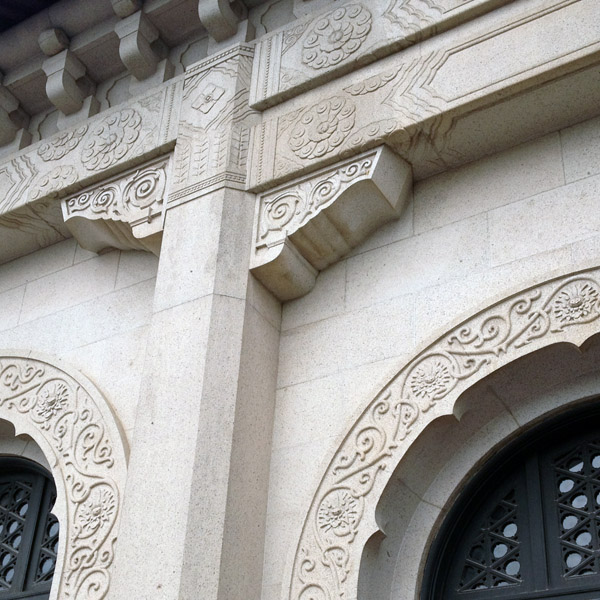
One of the most important examples of Chinese classicism is the Nanjing Sun Yat-sen Memorial, which was designed by one of China’s first starchitects, Lv Yanzhi (吕彦直). Lv also also designed the Guangzhou Sun Yat-Sen Memorial before his untimely death in 1929. The Nanjing Memorial reinterprets traditional themes through choice of material (reinforced concrete and mosaic tiles) and through the secularization of traditional symbols (animals become geometric shapes, for example). In addition, the Memorial layout abstracts and represents Nationalist China as the difficult realization of Dr. Sun Yat-sen’s three principles of the people (三民主义) — nationalism, democracy, and public welfare. To reach the Memorial proper, for example, there are 392 steps going upward, each step representing one million Chinese, and together representing the population of nationalist China. These steps are broken by eight flat platforms, which represent the fragmentation of China by warlords and civil war. However, when one looks back on the stairs, all one sees is a flat surface, an optical illusion that promises national unification.

The Nanjing Sun Yat-Sen Memorial provides a lexicon for understanding Chinese Classicism during the Nationalist era, including the reference to the Lincoln Memorial (1920) by way of the seated figure of Dr. Sun (1926-29). Not unsurprisingly, perhaps, the Lincoln statue also dominates a neo-classical building, albeit through references to Greek architecture. Indeed, both the Sun Yat-sen and Lincoln Memorials use the respective classicism of their countries to assert timeless governance, even as they commemorate leaders who governed countries divided by civil war.  I show the following images of the Nanjing Memorial with the caveat that they are not architectural — an architectural photo has amazing resolution, geometric composition, and absolutely no people, unless, of course, the figure contributes to architectural exegesis. My snaps, however, aim to emphasize just how popular this site is and thus how it continues to shape the visceral experience of being in “China” through a particular architectural style.

This slideshow requires JavaScript.

How does the Nanjing Memorial relate to Shenzhen?

This architectural lexicon has been picked up, tweaked and redeployed throughout Shenzhen, but as a private rather than public source of architectural symbols. The Luohu Train Station is the only exemplar of public Chinese Classicism that has been built in Shenzhen in the Reform Era. The other large example of post Reform classicism is the Hongfa Temple in Fairy Park, which is arguably political in its adamant denial of any political message. Certainly, in its assertion of the reintroduction of official religion to civic life, Fahong was as ideologically charged as the train station, which signaled China’s opening to capitalist countries. However, with the exception of these two buildings, Chinese Classicism in Shenzhen is limited to decoration in urban villages, where many handshakes have tiled roofs, restaurants, and the odd sculpture, such as Nvwa Holding up the Sky in Shekou, which is a socialist realist rendering of a mythic theme.

All this is interesting because given the explicit modernism of Shenzhen’s public architecture, the rediscovery or explicit use of Chinese tradition and roots are often used in neoliberal arguments for alternative forms of architecture and historic preservation. Chiwan comes to mind as do struggles for some form of preservation in urban villages. These efforts contextualize the design and construction of key civic architecture, including the Civic Center and central axis, which has the ideological expression of Reform and Opening (here, here, and here). Importantly, both the relentless modernization of Reform era public buildings and the alternative movement to construct a classical past for Shenzhen ignore Maoism, which nevertheless continues to inform the built environment.

what does the athletic body signify?

Upside to Shenzhen’s Olympic propaganda push — less minutes of propaganda per bus ride than leading up to the Universiade. That said, during blurb du jour about the national body, I had an insight. To wit: I’m thinking that Chinese athletes represent state power, while US American athletes represent honed individual desire.

Consider the mise-en-scene: a busload of commuters reading weibo, some sprawled on a seat others dangling from a safety handle, still others huddled over fat children, one who smiled at me. Their expressions were neutral, passively waiting to jump off the bus to their next encounter, although I did see several people scowling at their cellphones and overheard a well-dressed lady in pumps, repeat in frustration, “No, we need the order to be shipped today.” In contrast, on the television screen another Chinese gymnast gracefully flip-flopped on a balance beam, paused, and looked directly into the camera. She wore a bright red and yellow bodysuit, her hair was pulled back in a neat ponytail, and she stood straight, shoulders thrown back in pride. The message was clear: if we commuters who were not exactly slovenly but far from neat and certainly tending to scrawny and flabby, ate healthy, exercised, slept regularly, and visited our doctors, we too could be proud members of the national team.

That’s when I realized that similar US American propaganda would have emphasized the same good behavior but for a different reason; we should eat healthy, exercise, get enough sleep, and have medical check-ups in order to fulfill our personal dreams. Another thought followed: even if the US and China field national teams to achieve different ideological ends — the US has to demonstrate that all that rugged individualism makes us a strong nation, while China has to prove that all that authoritarianism is the pre-condition for individual excellence, nevertheless, structurally all this athletic posturing affirms the status quo. But we knew that. It’s just that suddenly the status quo seems to be a pad de deux Sino-Americana, rather than say, a cold war.

怀德村:virtue’s rewards

It’s been a while since I’ve summarized an episode from The Transformation of Shenzhen Villages (沧海桑田深圳村庄三十年) and so today, episode 6: The Secret of Huaide Village (怀德的秘密), which puns the village’s name and also means “the secret to cherishing virtue”.

The episode opens by telling viewers that Huaide is a revolutionary village, which contributed over 40 soldiers to the People’s Liberation Army. The connection between good Party leadership, virtuous villagers, and getting rich is then personalized through the story of Pan Baliang, a Huaide villager, who fought in the Korean War, (or the Resist American War as it is known in Chinese). However, during the Cultural Revolution he was jailed because his children were abroad, and was only to be rehabilitated in 1980, when out of gratitude for his fellow villagers continued support, he petitioned the village/ brigade if he could open a factory.

In 1988, Huaide was chosen as the location for Shenzhen’s Baoan International Airport. At the time, the SEZ decided that guannei land should be saved for urban development, rejecting a proposal to build at Baishizhou, which was then considered the suburbs and choosing instead to stimulate the guanwai economy by converting Shenzhen’s largest duck farm into an international airport. The Shenzhen airport expropriated over 1,000 mu of village land and in return Huaide received a compensation package of 3.5 million yuan. The question became: should the sum be divided evenly and distributed to each villager (as many villages had chosen to do) or should the village create a jointly held corporation and invest the money in common cause?

In 1988, guanwai New Baoan County was still rural. This meant that the village was still organized as a collective brigade, which provided the organizational infrastructure for Huaide’s subsequent development as a jointly held corporation. Huaide’s current CEO and current Party Secretary, Pan Shansen earnestly explains that Huaide Party leaders understood that unless they could correctly direct the thinking of the villagers, the village was in danger of making a collective mistake. Collective and Party leaders then went to work on villagers with dissenting opinions in order to make sure that everyone was on board with the next step — using the money for capital investment to build and manage Cuigang Industrial Park. Pan Shansen then expresses his gratitude for the previous Party leaders’ foresight in using the Airport compensation to create a strong, collective economy.

Pan Shansen describes the work of creating “a center where there was previously no center” as arduous and only possible through the cooperation of the people and their government. In addition to creating a large wholesale furniture market, in 1996 Pan Shansen established a venture capital fund that provided interest free loans to young villagers who wanted to start up companies. The fund started with 1/2 million when and grew to 2 million, and loans grew from 20-50,000 per project. In 2005, this venture capital project was expanded through collaboration with Shenzhen’s rural bank, providing low interest loans of up to 300,000 yuan to Huaide Villagers. By 2010, when the documentary was made, in addition to the villages collected holdings, over 40 families had used Village venture capital to create family businesses.

Fiscal conservatism of the defining features of Huaide Village’s success. Huaide Village has its own “constitution” that requires any private investment over 5 million yuan to be approved by the village, they set up a legal aid office for villagers to consult when writing contracts, and since 1992 have not sold any village land rights. Telling, Pan Shansen makes a point of reminding documentary viewers that Huaide Villagers are farmers — to break their ties to the land and the village is tantamount to destroying what makes them who they are, regardless of how they actually make money. Land is at the heart of Huaide’s neo-Confucian CCP virtue and unlike many Shenzhen villages that no longer have collective land, Huaide still owns almost 1/2 of the land they owned before 1980. What’s more, the Village has actively purchased land rights from other Shenzhen villages, leaving its own land for future use.

The rewards of Huaide’s virtue are a neo-Confucian-socialist hybrid capitalist success story, or as it is sometimes said, villagers washed their feet and left the paddies. In addition to its village venture capitalist fund, Huaide invested in social services and local culture. Huade provides medical insurance, education, including college scholarships, and old age activities for its 700 villagers, and in 2010, its Lion Dancing Troupe was the only village level troupe to receive an invitation to perform at the opening ceremony of Belgium’s Chinese Culture Festival. And thus, the moral to this episode tallies with Shenzhen’s ongoing campaign to promote Confucian ethics: good party cadres are at heart neo-Confucians, serving their people, who become collectively rich. In turn, inquiring minds wonder: to what extent has Huaide’s ethical sensibility extended to the organization of workers’ rights in the village’s three industrial parks?

Cultural postscript: the Lion Dance Troupe is talented and fun. Check out a performance, here.

power and authority in a chinese high school

Last night I heard a fifteen year old girl ask the rhetorical question, “Why are some suited to be a leader and others aren’t?” She had been comparing a teacher and a vice principal, both from her school. Apparently, the teacher had treated her badly and the vice principal had treated her well. Her disparaging remark neatly summarized a common understanding of power — people who treat others well deserve to be leaders. Implicit, of course, was the assumption that those who don’t treat others well don’t deserve to be leaders.

The question vexed me. On the one hand, she was correct to note the difference between authority and power as styles of leadership. The vice principal had helped her, which confirmed the legitimacy or the authority of his position. In contrast, the teacher had coerced her to do something she didn’t want to do. Coercion falls pretty unambiguously into the deployment of power category. On the other hand, these were not isolated events. They took place within a fraught social network in which the reason she had sought out her teacher and the vice principal came into play. At this level, both the teacher’s and the vice principal’s actions make sense. Continue reading

Not your cup of tea?

Ten of us were having dinner at a private style restaurant. Unlike mom and pop “family style” diners, which serve standardized fare at similar prices, a private style restaurant caters to the discerning rich, who have a good relationship with the owners. Trust and taste define this good relationship. Guests trust that the owner will provide quality tea, food, and service for a price that includes a “reasonable” profit. In turn, the owner trusts that these guests not only desire, but also can afford high quality teas, expertly brewed, seafood delicacies and soups adorned with beautifully shaped fungi. There is a menu, but it seems to be used for pedagogical purposes, including the health benefits of particular foods and herbs. Consequently, guests don’t order individual dishes, instead a meal’s host discusses a menu with the owner, who then plans the meal. The price of the meal is either set ahead of time (the host setting an upper limit, for example) or, if the guest returns regularly, the owner can plan a meal based on the number of guests. Special requests for imported seafood can be accommodated with 24-hour notice. Private style restaurants set the stage for intimate displays of taste and friendship. Sharing a meal of this quality, for example, enabled my friend both to demonstrate how much he cares for us (because the food is outstanding) and to show off how very good his good life is (because really, the food is that outstanding. And the tea. Wow.)

Bourdieu, of course, has reminded us that elites use aesthetic distinction or good taste to solidify class identity, arguing that cultivated predispositions to certain foods, music, and art enable us to recognize relative social status; we “like” that which is appropriate to our social position and “dislike” that which is not. Continue reading

沧海桑田:The transformation of Shenzhen Villages

For those wondering, is there a documentary on Shenzhen villages out there? The answer is yes and its 15 hours long! CCTV and SZTV produced 沧海桑田:深圳村庄30年,  a 30-episode television documentary to commemorate the SEZ’s 30th anniversary.

Not unexpectedly, the documentary’s ultimate happy end is urbane Shenzhen. Nevertheless, each of the 30 episodes does raise issues worth talking about and also gives current Party takes on these issues, which is always useful information. In fact, that take may be the point; the commemoration of the SEZ’s 30th Anniversary included a more inclusive and nuanced understanding of pre-reform Baoan society and history, reminding us that the villages no longer exist as such. What remains are ideological and economic struggles over the properties held by [former village] stock-holding corporations that have not yet been fully integrated into the Municipality’s urban apparatus.

That said, however, there is also the question of what a truly integrated Shenzhen society might look like. And consequently it is interesting and hopeful to think that the economic questions may also force re-evalution of who belongs in the city.

So, how are those ideological battles being waged in the contemporary SEZ?

Continue reading

architectural patriotism

Today is my last day in NYC. Tomorrow, I head to North Carolina to visit parents and then back to Shenzhen. My immanent departure has me wondering about if I’m going home, or not. I’m wondering because I say “I’m going home” about North Carolina and Shenzhen and not New York, which I go to but I feel more “at home” in New York than in either NC or SZ.

What’s up with that?

In Shenzhen when people express pride in the city’s architecture, I agree that some of the buildings are great. Indeed, I walk the streets photographing those buildings in various stages of construction. And, as mentioned earlier, this attention to Shenzhen details has taught me to care, both for the city in particular, but places in general.

However, being in New York this month has reminded me about the deep structure of architectural patriotism. New York is the one American city that moves me to unthinking patriotism. I see a building and think, “great city”. See another, “oh yeah, best city in the world”. Turn the corner and marvel at sunlight flickering across baroque facades, “is it any wonder we’re the world’s capital?” I ask myself.

My response to New York is visceral. Carnal. Second nature, so to speak. When outside Yew York, I don’t think about it, don’t fantasize about particular streets, don’t plan summer weekends in central park. But when here, each building hails me, each street tempts me, and each neighborhood anticipates my pleasure.

Before I came, I met with a former student, who left Shenzhen to study in New York, where he has learned to miss the street vendors of Yuanling (“who really do have the best street food,” unquote), the heady rush of Shenzhen nightlife, and the infinite possibility that all the construction continues to promise. He loves New York, too. Just like I love Shenzhen. And yet. Pretzels and falafel don’t bring him home, even as 米粉 still does not comfort me when I am most distressed.

More to the point, I’m wondering about the social uses and abuses of my sentiments. These unthinking responses to New York both affirm my identity and limit me. In New York, I have a stronger sense of who I am than I do in either Shenzhen or North Carolina. New York gives me a confidence that I do not feel in either of my physical “homes”; New York also gives me a hopeful certainty that no matter what happens today, tomorrow yeah, I’ll walk down the right street and all will connect.

Nevertheless, this unthinking rightness about my place in the city also confirms my prejudices and ignorance. In New York, I don’t need to see the dignity of Yuanling vendors, the odd differences in Fengshui architecture, and the unexpected (yes, to me) twists of Mandarin (let alone Cantonese-inflected Mandarin) conversations because all that messy otherness exists comfortably beyond my sentimental peregrinations. In Shenzhen, however, I see all this and thus rarely mistake my feeling of ease with a true perception of the world. Indeed, even when I’m feeling wonderfully situated, I’m watchful. Careful. Precise. All this attention because I sense and sometimes approach another river, that unthinkingly flows through my friends just as deeply as New York flows through me.

Yet what my life in Shenzhen has taught me unconditionally is that we are all also sojourners, some of us more obviously than others.  Even if still living in the town of our birth, most of us intuit that this place isn’t “home” because it isn’t what it was. Again, the distance between childhood and contemporary homes is more obvious in Shenzhen than in New York, but even North Carolina is erecting new buildings and neighborhoods that have radically restructured the landscape and in turn, transformed the meaning of “hometown”.

In Buddhist Mandarin “return home (回家)” means to return to one’s true nature. Accordingly, we are all “homesick,” yearning to return to our place of true belonging. And now I’m wondering if home can’t be other than where I am, why does it feel like life is elsewhere?