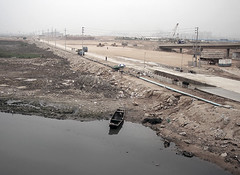
鲤鱼门: more landfill


gateway to the coast that used to be, liyumen

school has been open almost four weeks and my life is finally settling down. this weekend, i was back on the nantou peninsula and instead of walking along houhai, i walked along the yuehai side. (facing guanzhou, right near the western railway station which connects shenzhen to hunan.)

in the early 1990s, liyumen was a beach front resort area, somewhat modeled after the hong kong fishing port of the same name, where good seafood might be eaten relatively cheaply. the shenzhen version included saunas, and massage parlors, and a very large badmitten court. over the past fifteen years,land reclamation has proceeded and liyumen is now a good half mile inland. however, the land has not yet been developed and is instead used to park and repair container trucks, which transfer goods from nanshan factories to chiwan port, just around what remains of nanshan mountain.

so liyumen constitutes a strange kind of timewarp, both as memorial to what used to be a shenzhen resort area and as a transition between industrial nantou and the new highrises that are being planned, please visit.

houhai, lay of new land


new roadwork, houhai

this week shenzhen hosts a conference on sustainable, urban development. yesterday, at the flag raising ceremony we were told the new limit for air-conditioning is 26 degrees centigrade. houhai marches on. now that the roads have been layed, the next step is partitioning the land and putting in infrastructure for new residential and commercial areas. another houhai walk.

houhai land reclamation area, may 27, 2007


western corridor houhai land reclamation district

houhai, again. another encounter with that which became obsolete in less than ten years. another walk through the determined construction of an alternative world. several views of the same stretch of new road.

there’s a chinese proverb 沧海桑田 (the oceans become mulberry fields) that is used to describe largescale transformation. perhaps, 沧海楼盘 could be used to describe shenzhen’s development, or at least the policy of 移山填海 (move mountains, fill in the ocean), but it wouldn’t mean only massive change. something about the necessary scale of transformation to compete economically. something in keeping with another updated proverb i’ve heard: 谈金论股 (discuss money and debate the market)–a puny take on “discuss today and debate the past (谈今论古). or the rewrite of the national anthem:
起来还没有进股市的人们
把你们的资金全部变成神奇的股票
中国人民族到了最疯狂的时刻
每个人都激情发出震颠的吼声
涨停涨停涨停
怀着暴富的梦想
钱进钱进钱进进。 what other new proverbs have you heard?

后海新村: more houhai, again


houhai tianhou

saturday morning, houhai new village, where the houhai tianhou once gazed out on houhai harbor and now sits back from houhai road, among shade trees and handshake buildings, her view blocked by cars and housing developments. those pictures, here.

also, at some point when i wasn’t paying attention, nanyou and chuangye roads became nanshan road. on my 2004 map, the road has the old names, which mark the border between nanyou and shekou neighborhoods. my 2006 map has the new names. i’m looking for a 2005 map to see when the change happened. interesting because it points to the continuing subordination of shekou to nanshan district. once, long ago, shekou was directly under the central government, and was only brought under district control in the early 1990s. but then again, the district system only came into play in the mid-1990s, but that’s not the story i’m telling here. nevertheless, i did wander past the old nanyou building and take a picture of it. again, interesting for its mid-1980s state of the art, both architecturally and in terms of landscape. (nanshan road runs parrallel to houhai road, and before the completion of the binhai expressway was the main road connecting the nantou peninsula to shenzhen by way of shennan road.)


nanyou building, shenzhen state-of-the-art, mid 1980s

second random thought of the houhai village walk. shenzhen is full of buildings from the late 1980s and early 1990s that have never used air-conditioner casings. the casings, attached to the buildings and located next to windows, were designed for small air-conditioners. presumably, once shenzheners could afford air-conditioners, they went for the bigger, better, colder variety. so empty casings and air-conditioners variously attached to the sides of buildings. as part of the beautify nanshan campaign, these randomly placed air-conditioners are now being caged.


never-used air-conditioner casings

only four years ago

Saturday, all day, dreary clouds flattened Shekou grey. Trucks rumbled through landfill dust, which coated pedestrians and fengshui trees, parked cars and potted plants. I walked to the Dongjiaotou Port Area (东角头港区), located on the eastern edge of Shekou, where once upon a time, workers unloaded building materials shipped from Foshan and Shunde. Only 4 years ago, I photographed fishing boats berthed where today the Peninsula residential development rises in the shadow of the western corridor bridge, which will link western Shekou to Hong Kong. Yes, these were the fishing boats that used to supply Shekou’s fresh seafood restaurants (大排挡). And yes, the Peninsula is part of the move to gentrify Shekou. I’m not sure if it’s the weather, the inevitable dust, the scale of the change, or D all of the above that has me feeling bereft, but today, I didn’t want to look. Below, two views of Dongjiaotou, one circa 2003, the other circa 2007. More comparisons, more dust, and a few detours into Old Shekou side streets, here.


fishing boat harbor, dongjiaotou west (facing nanshan), 2003


new road, dongjiaotou west (facing nanshan), 2007

found objects: houhai

this entry unites two of my obsessions: discarded objects and the houhai land reclamation project.


looking from old coastline toward the houhai land reclamation

in shekou, the land reclamation project continues, with new housing developments popping up like mushrooms after a spring rain, so to speak. like any good mushroom, these developments thrive in dark and fetid spaces, only to be washed up and presented as luxuries. the first step in growing a development mushroom is razing whatever came before (in the sense of shenzhen history: this entry presupposes that the rural has already been displaced). what came before is usually narrow, one-story high temporary concrete structures, which functioned as residences and small businesses (more or less from the 1980a), but also more substantial, once-upon-a-time intended for the long haul, housing (late 80s, early 90s).

step two in cultivating mushrooms is picking through the rubble, scavanging whatever might still be of use–plastic can be sold, as can metals. as i stepped through the remains, i found a small clay teapot and picked it up. one of the pickers yelled at me in a henan dialect that i didn’t understand. when i asked if she wanted the teapot, however, she said no, adding in mandarin, “it can’t be sold.” she wasn’t interested in talking with me, lugging her scavagings to a truck, where a man weighed and bought them.

pickers, like this woman, move onto the temporary rubble heaps, setting up campsites that blend into the rubble. indeed, the campsites are difficult to distinguish from the garbage. the tents are made from the same plastic the pickers are scavanging and the kitchens seem burnt piles of stuff. but looking closely (or prying as the case may be), i saw fresh vegetables, packaged foods, and soap, although no source of fresh water. at this site, there were two campsites, and each had a separate stove. lucky pickers have a bicycle to cart findings to collection stations, where they can sell them.

step three, of course, is the arrival of construction crews. images of objects found while others picked, here.

houhai monuments–found objects


temporary nursery, houhai

it’s been over six months since i last walked this particular section of houhai. the road has been laid and now traverses the entire site. they’re even planting trees as part of shenzhen’s ongoing efforts to become a garden city. i snapped away, aware that houhai has yet to disappoint me; something there always fascinates. indeed, houhai has been central to found objects. i found teapot there, brought most of the other objects there, and have retuned to photograph the unmovable objects i have stumbled upon there.

lately, i’ve been thinking about my houhai fascination and suddenly realized that i am drawn to objects and sites that seem monumental, in all sences of that word. large, of course, so large that the scale of transformation slips away from my efforts to conceptualize it. but also, evocative of time and its passage. the monument commemorates some past event, keeping particular memories at play in shared worlds. indeed, the monument holds time in place, so that we might create a shared worlds.

and yet. the objects i photograph only gain their monumentality in digitalized retrospect, although sometimes i actually print an image. but on any ordinary day, the objects come and go, without comment, changing what houhai might mean, begging the question of whether or not houhai participates in a shared world before something “permanent” is constructed. on houhai, only buildings and streets are named. the rest vanishes.

today, in addition to the trees, i’ve uploaded a few houhai monuments, from the past few years.


mound, houhai april, 2006

more houhai

today i started exploring the houhai land reclamation project further west, walking from shekou industrial road #8 toward dongjiaotou port.

at first, i had no specific goal other than getting onto reclaimed land and snapping a few photos. however, at the end of i.r. #8, i was stopped by a soldier, whose youth distressed me. i would say he was no older than 16, but when asked, he claimed to be 18 and meet all the requirements for joining the army and carrying a gun, which rested prominantly on his boney hip. he told me that access to the area was restricted because it was the new national border (边界). suddenly, i needed a reason to be on the reclaimed land. i pointed to the western corridor suspension bridge and said that i wanted to take some pictures of the bridge. he politely asked me to leave. i stared pointedly at the people walking on and off the area and he finally went over to a couple and asked to see their passes.

now determined to get onto the landfill, i walked to i.r. #7, where a brick wall blocked my way. i tried walking around it, but a deep gully prevented me from successfully getting on. however, neither soldiers nor security guards prevented access. at the yucai-schumann art school, which is located right at the boundary between public and filled land, i tried to talk the security guard into letting me walk to the back of their school to take a picture. he refused, but helpfully directed me back to the end of the road, when i said it was impossible to get onto the landfill, he seemed doubtful because, he saw workers (打工的) heading that way every day.

nevertheless, one of the parents from the school started talking with me and offered to take me into his new housing development to go to the top of a building to take pictures. it turns out, the gentleman from hebei works for the oil industry and had just completed overseeing the construction of a refinery in zhuhai. he mentioned that he had taken photographs of the entire construction process, “from nothing to a beautiful refinery.” he agreed that it was important to document this process, otherwise we would forget where we had come from. “where are the pictures now?” i asked. in zhuhai.

i then walked to the street immediately west of i.r. #7 and there was direct access onto the reclaimed area. i stepped onto the landfill and headed toward the bridge, my confidence growing with every step; no one here would stop me. i inhaled the fishy smell of rotting shells and stepped through air thick with flies. as i headed further out, i stumbled upon a shantytown and watched several children playing. i watched the dust a pair of once-red flip flops kicked up as a woman pushed an old bike past me. i looked again toward the bridge, but decided i had accomplished my task. i believe an old man watched me leave.

the tour ends with a view of new coastal real estate.

种菜游击队: veggie guerillas and other food frauds

the rural make-over movement is the most obvious example of shenzhen’s efforts to eliminate the rural within. however, homeless, unemployed migrants also define this border as they relentlessly occupy and re-occupy urban spaces. notwithstanding, efforts to eliminate shanties, shenzhen remains a place where the three without people (三无人员:无户口,无工作,无房子; no household residency in shenzhen, no formal job, no home) live in the underground passages or build shanties in out of the way places, find day jobs (many hang out at intersections in the larger of the new villages, waiting for trucks to come pick them up), get married, have children, and cultivate gardens.

at the houhai land reclamation site, migrants identified in the press as the vegetable planting guerilla forces (种菜游击队) plant gardens of relatively quick growing green vegetables, which are hawked on sidewalks as well as markets throughout the city. recently, these gardeners and their gardens have become the target of a police action not simply because they are unsightly and illegal, but more importantly because the farmers do not have access to clean water. consequently, they plant their vegetable next to the rain and waste water channels that thread through the city, using the sewage system as an ad-hoc irrigation system.

now, a typical shenzhen meal includes one green vegetable dish, sometimes sauteed and other times blanched. this means that government officials and regular shenzheners alike all consider the quality and price of green vegetables to be quality of life issues, on which the legitimacy of the government hangs. however, given the numbers of gardens, legal and illegal, that supply shenzhen homes, markets, and restaurants with vegetables, the police have been unable to guarantee a minimum standard of contamination-free vegetable.

the fact that the police have acknowledged in the press that the veggie guerillas plant, harvest, and hawk faster than they can uproot contributes to an underlying if not always vocalized food anxiety. indeed, shenzheners seem less concerned about digital piracy than they are about food fraud, which includes selling contaminated food. i have heard stories about fake alcohal:

“the other night, i was so drunk i had to go to the hospital. i called my husband and he said, ‘how is it possible that you’re drunk’. and i thought that’s true. i drink white wine (白酒) all the time and i’ve never been drunk. but in the hospital they had to pump my stomach. i could feel my heart pounding and i was dizzy. it had to have been fake alcohal.” the others at the table agreed with both the husband’s assessment (how could she have been drunk? we’ve never seen it) and her analysis (it could have only been fake alcohal).

contaminated ice cream:

“they keep the bins of ice cream hidden in grimy warehouses and then transfer it to official containers. now if this famous namebrand can be faked, any brand can be faked.”

and, if possible, fake eggs:

me: how do they do it?

answer: they put the egglike stuff inside a fake shell.

me: this is cheaper than raising a chicken?

answer: labor is cheap, but keeping an environment sanitary is relatively expensive. so is uncontaminated chicken-feed.

me, still trying to figure out how you can fake an eggshell in a country of where most people either are farmers or have farm experience: have you seen a fake egg?

answer: no, but chinese people are really enterprising. we can fake anything.

me: if you do see one, please buy it for me.

then, there are simply low quality goods, prototypically from henan:

friend: in henan we don’t have the skills to fake high-quality brands, that’s what they do in guangdong and fujian. instead, our goods are the real thing, but they’re lower quality than high-end fakes. so its probably safer to eat a guangdong fake than a henan original.

these stories intertwine with and amplify anxieties about avian flu and sars, all of which are said to be caused by unsafe food practices; for many in shenzhen, eating has become problematic. indigestion looms. this brings the conversation back to shenzhen’s enterprising homeless gardeners. when i ask, the explanation given for unsafe food practices is the same as that of digital piracy: poor people have no other options. by extension this logic has it that once china gets rich, people’s natural goodness will resurface and they won’t need to practice food fraud.

in the meantime, my friends and i continue to discuss the importance of dieting because it’s too easy to put on pounds during business related banqueting (应酬).

Integrating the Pearl River Delta

Sunday afternoon, I walked east along the Houhai coast, from Houhai to Sand River (沙河). This is a strip of land that was formerly designated to be part of the Nanshan District Binhai green zone, which connects up with the Shenzhen Natural Mangrove Reserve in Futian District. My interest in the area grows with the audacity of land reclamation in Shenzhen. This area marks a second rezoning of the coastline. The first was part of the effort to build the Binhai Expressway, which connects Nanshan to Futian and Luohu Districts. This second stage was districted later and remnants of that now-obsolete coastline litter the new construction site.

(The curious can check out the Shenzhen’s overall urban plan (1996-2010) maps, while the even more adventurous can go to the Nanshan District overall urban plan. On those maps, I walked along the strip of coast facing Hong Kong. Offline, if your library has any of the Shenzhen yearbooks from the 1980s, there are interesting comparisons to be made. Published in the early 1990s, the last Baoan County Gazetteer is also fun, but harder to find.)

On my walk, I stumbled upon guardhouses that were never staffed by border guards and the chain-link fence that separates pedestrians from Houhai. The entire area had been filled with earth and pumps were busy squeezing out the last of the ocean. Dump trucks rumbled past and people carrying nets biked out to the new coastline. I learned there was a two-week window to catch newborn crabs before they swam out into what remained of the ocean. These baby crabs would be used to stock fisheries in Baoan District. The crabbers carried the crabs in plastic soda bottles that hung around their necks. Eventually, I arrived at Sand River, I came across one of the construction sites for the Shenzhen Western Corridor Bridge, which set me to thinking about the various infrastructures which integrate Shenzhen and Hong Kong. What follows is a longish outline of Shenzhen history as mapped by Shenzhen-Hong Kong checkpoints. You can skip the discussion and go straight to the Western Corridor land reclamation pictures, or you can indulge my sudden urge to document comprehensively the transformation of Shenzhen.

(I’ve just realized that I only use Mandarin and Shenzhen place names in this blog. I promise to start documenting the different names for the sites. I may even talk about what these differences in talk might mean…)

Anyway, the fourth land connection between Shenzhen and Hong Kong, the Shenzhen Western Corridor Bridge was completed in January 2006. The corridor itself should be finished later this year. It is a 3.8 km long dual-carriageway 3-lane bridge connecting Nanshan District to Hong Kong at Ngau Hom Shek. The construction is being overseen by OPAC, a San Francisco based engineering firm. Trying to figure out the actual cost of the corridor is somewhat difficult. According to the China Daily, the bridge cost $US 111 million to build. On their webpage, OPAC estimated that the cost of the Western Corridor Bridge would be $US 400 million. The Nickel Institute website quotes the Hong Kong Highway Authority as putting the estimated cost at $US 2.7 billion. Perhaps the China Daily quote refers just to the cost of the bridge, the OPAC quote to the cost of the entire corridor, and the Hong Kong Highway Authority quote to related infrastructure in Hong Kong. What can be concluded is that the corridor is expensive and somebody is making a lot of money from it.

And making money seems to be the point. The Western Corridor Bridge is part of a larger effort to transform the Pearl River Delta into one of the most vibrant economic regions in the world. On August 28, 2003, at the Foundation-stone Laying Ceremony for the Hong Kong-Shenzhen Western Corridor in Shenzhen, Hong Kong Chief Executive, Mr Tung Chee Hwa said, “Hong Kong and Shenzhen are a key nexus in land transport to the Mainland…The three existing land boundary crossings between Shenzhen and Hong Kong are nearing the saturation point, such that both administrations have agreed to build the Hong Kong-Shenzhen Western Corridor as the fourth land crossing to accommodate growth. Traffic flows at the three existing boundary crossings have increased greatly over the past five years. The average total daily vehicular traffic at boundary crossings is expected to reach 65,000 vehicles in 2006, far beyond the daily capacity of 42,000 vehicles, which the three existing crossings offer now. Upon its completion, the Western Corridor will provide additional daily traffic capacity of 80,000 vehicles, raising the overall daily traffic capacity to 122,000 vehicles, thereby easing the current congestion. And yet, even four land crossings are considered inadequate to meet the future demand arising from further development. A working group drawn from among officials of the Hong Kong, Guangdong and Macao administrations will convene its first meeting tomorrow to press on with the advance preparations for construction of the Hong Kong-Zhuhai-Macao Bridge…”

The figures for vehicular land crossings do not include statistics for all border checkpoints (in order of numbers of passenger crossings)—Luohu, Huanggang, Shekou, Shenzhen airport, Wenjindu, and Shatoujiao. Official Shenzhen customs figures showed entry and exit passengers at the city’s six checkpoints reached 137 million in 2004. Crossings surge during Chinese holidays, especially Chinese New Years, when an estimated 5-6 million people (over a period of two weeks) cross at Luohu alone. During the holiday season, all checkpoints extend hours and increase staff handling document inspection. Each of these crossings has a distinct, but interconnected history that illuminates different aspects of the Shenzhen-Hong Kong nexus as part of globalization. A crude synopsis of the six sites follows and provides a very, very, very rough outline of Shenzhen’s deep history.

(I try to problematize the idea of history with respect to Shenzhen most entries. However, this is the first time in this site that I’m trying to locate Shenzhen with respect to larger currents. I’ve learned how to think about this history from Giovanni Arrighi in his wonderful book The Long Twentieth Century. Helen Siu and David Faure have turned an anthropological lens on this process in Down to Earth: The Territorial Bond in South China. I’ve picked up some online sources that may be helpful and embedded in the following notes. I assume it’s all as reliable as statistics about Western Corridor Bridge finances are.)

In a certain sense, the Luohu checkpoint has been in existence since the leasing of the Hong Kong New Terriories in 1898, when the Sino-Anglo border moved to the Shenzhen River. Previously, the Qing Dynasty had ceded Hong Kong Island and the area south of the Kowloon Mountains to Great Britain in 1842 (end of the first Opium War) and 1860 (end of the second Opium War), respectively. Luohu (Lo Wu in Cantonese) was the first stop on the Chinese side of the Hong Kong-Guangzhou railway, which was built in 1913 and more effectively integrated south-eastern China into the British Empire. So thinking about Luohu leads to thoughts about British imperialism, the transition to the Cold War, and the postsocialist realignment of international political-economies with a focus on East Asia. Suddenly, Shenzhen is neither hinterland nor no man’s land, but vying for the center of global trade. In a recent defense of building the Hong Kong-Zhuhai-Macao Bridge and associated costs, the Executive Director of the Travel Industry Council of Hong Kong, Joseph Tung, has said that the Luowu checkpoint is one of the busiest land crossings in the world, with more than 90 million people passing through it every year.

The Huanggang Checkpoint opened for 24-hour border crossings Jan. 27, 2003, at which point crossing figures surged from 50,000 to 110,000 per day. Buses to and from the Huanggang Checkpoint, connect Shenzhen to six Hong Kong destinations, including the Hong Kong airport. Since 1995, Huanggang has been the primary conduit between Shenzhen and Hong Kong Disneyland. Until the construction of the Western Corridor Bridge, Huanggang was the newest of the land crossings. It is interesting because it was part of a geographic shift in Shenzhen from “Downtown” referring to Luo Hu to the new “City Business Center” in Futian. The shift began in 1996, when the Shenzhen Municipal Government accepted plans for the new CBD. Michael Gallagher gave a talk about the Shenzhen CBD in 2002. But for a sense of the scale of this transformation and the debate about it, google 深圳CBD and check out all the different sites. Thus, the shift from Luohu to Futian allows for specifying the differences between a Hong Kong centered development in the early 80s to a more diffuse integration of the region, and therefore a more Mainland-centered pattern of economic development.

The most expensive connection between Shenzhen and Hong Kong, the Shekou ferry makes 13 round trip voyages a day, except during Chinese New Year, when the number of trips increases to accommodate the numbers of visitors. An additional 8 daily voyages connect Shekou to the Hong Kong airport. Most frequent passengers on the ferry are Shekou-based foreigners. The Shekou Ferry is interesting for a number of reasons, most related to the role that China Merchants has played (by way of Shekou) in the development of Shenzhen. The role of China Merchants then leads back to Luohu and questions of national development first raised during the later years of the Qing Dynasty. As of 2004, China Merchants has posted its own historical archive online, which highlights the role that commerce and international relations have played in modern Chinese history.

Along with Hong Kong, Guangzhou, Zhuhai, and Macau, the Shenzhen Airport is one of five international airports in the Pearl River Delta. In terms of passengers served, it ranks behind Hong Kong and Guangzhou. The five international airports have been built within a radius of 25 km. illustrating the level of competition and inter-city rivalry that has characterized development in the Pearl River Delta, rather than regional cooperation and planning. Moreover, the redundant infrastructure in the Delta has led to serious environmental problems, according to a report by K. C. Ho and C. S. Man.

Wenjindu is primarily a crossing for goods between Shenzhen and Hong Kong. It was opened in 1950, as part of the new Mainland government’s strategy to bring hard currency into the country. Throughout the Mao-era, agricultural products flowed from the Mainland into Hong Kong, a development strategy that has been more fully exploited since Shenzhen’s establishment. So thinking about Wenjindu allows one to question commonly held understandings about China’s so-called isolation during the Mao era outside of the obvious connections with the former Soviet Union and other socialist and third world countries. In the era of Avian flu, Wenjindu regularly appears in Hong Kong news reports as the site where chickens and other poultry cross the border. With suspicious regularity, indeed with an almost ritualized compulsion, Hong Kong public health officials regularly express astonishment on conditions north of the border.

So a rough outline of Shenzhen’s history with respect to the construction, use, and re-appropriation of Shenzhen-Hong Kong border checkpoint infrastructure. It touches upon British imperialism, the Cold War, the East Asian economic miracle, the rise of China as a global player, international epidemics, and the concomitant transformation of the environment. This is how we make our world, one reclaimed special zone at a time.