shenzhen bay 27 dec 2009

today i walked from the poly center at coastal city to circumambulate the construction site of the shenzhen bay sports center. i have started the walk with a that was then moment in 2003, which is today the point where haide 3rd road opens into houhai landfill in front of the kempinski hotel (now open for business). i started the walk from that same position today. the differences between the first and second pictures is only 6 years – but in terms of the production of real estate and growing air pollution problem it feels a lifetime; certainly another world. visit gallery to take the walk.


exotic dubai


dubai

Originally uploaded by maryannodonnell

the dubai-shenzhen connection reaches new levels of irony on the houhai land reclamation area, where “exotic dubai” is now an architectural style to be bought and sold in a soon-to-be-completed trés upscale residential area.

“exotic” is one interpretation of 风情 , which when refering to gender usually refers to the spiritual aspect of a woman’s sex appeal e.g. 多指女性.风情是女人的韵味,与性感有联系,两者的不同之处是:风情来自於“神”而性感来自於 “形” . likewise, when refering to place 风情 usually connotes whatever it is that makes minority groups “attractive”. this new marketing strategy not only begs the question: what other city has turned a bay into a desert in less than 10 years? but also has inquiring minds wondering: are they building artificial seas in dubai?

on that note, does anyone know if “shenzhen” is now or has ever been used as an adjective to describe real estate elsewhere?

Are we there yet?

Yesterday over coffee, a friend and I talked about how vast the houhai reclamation project actually is. She mentioned that her daughters love to drive on roads in the reclaimed area because their GPS (global positioning system) locates them in the ocean, rather than on land. Apparently, the system misreads their location because the maps that the system is accessing do not represent the new landscape. It’s true. Plans really can’t keep up with change (计划跟不上变化).

Who should have rights to the City?

Questions of civic identity haunt Shenzhen like the tag lines of a never-ending soap opera: When will people who live in Shenzhen feel that the city is their hometown (老家)? Is it possible to feel like a Shenzhener without a Shenzhen hukou? When will residents with Shenzhen hukou (户口) say, “I’m a Shenzhener (full stop)” and not, “I’m a Shanghai person (uncertain fade out)”? Will residents who claim Shenzhen identity ever admit that they are from Guangdong and not transplants in a non-Cantonese city? And if Shenzhen gives long-term residents with hukou in another city a residence permit that includes all hukou rights will this administrative restructuring generate a corresponding rise in civic identity?

30 years ago, most Chinese had hukou in the place where they were born and raised. Consequently, their administrative status reiterated their emotional identification with their hometowns. A Beijiner both held a Beijing hukou and self-identified as someone from Beijing.

Today, uncounted millions of Chinese people have migrated from their hometowns to live and work elsewhere, unmaking the easy correspondence between one’s hukou and one’s hometown that had defined Maoist society.This situation is particularly acute in Shenzhen, where the majority of residents are classified as 非深圳户籍的深圳人 (Shenzheners without Shenzhen hukou). Statistics from 2005 put Shenzhen’s population at 5.97 million of which 1.65 million had Shenzhen hukou and over 4 million had temporary residences (暫住证). In addition, the City identified over 4 million temporary residents who had lived in Shenzhen for under a year, bringing the actual population to roughly 10 million.

Here’s the rub: the traditional correspondence between hukou and hometown has had concrete effects on efforts to create post-hukou civic identities. In many cities, for example, those who are “really (have both hukou and hometown status)” from the city blame those who aren’t for urban problems. This logic hinges on the assumption that “real” residents care about the quality of life in a city, while “sojourners” don’t. In addition, under the current hukou system, a Chinese citizen only has rights to city  welfare (including public education for child) in the city or town of their hukou residency, rather than in where they live.

The question of whether or not rights to the city should be based on hukou status is more pressing in Shenzhen than in any other Chinese city because most residents aren’t from here. Moreover, the City’s growth and success is attributed not to residents, but to immigrants. In other words, Shenzheners without Shenzhen hukou are the majority of Shenzhen residents.

In August 2008, Shenzhen promulgated the Shenzhen Residency Permit Temporary Application Process (深圳市居住证暂行办法), a reform of the hukou system, allowing anyone age 16 or over, who has lived in the city for more than 30 days to apply for a residence permit (居住证) that carries the same rights as a Shenzhen hukou.

The Shenzhen reform is notable for several reasons. First, it makes inhabitation, rather than birthplace the criteria for urban welfare. Second, it is open to all Chinese citizens, regardless of whether or not they hold a rural or urban hukou. Third, it assumes that people immigrate to rather than temporarily sojourn in Shenzhen. Fourth, it implicitly challenges traditional assumptions that hometown identification is natural, instead foregrounding the idea that civic identity is a voluntary practice.

Nevertheless, the larger question of who actually claims Shenzhen as their hometown continues to hinge on the question: does administratively designating a city necessarily produce a community that identifies with those borders? It’s possible that what is being produced in Shenzhen is not hometown identification, but rather a weak hometown identification with strong national ties. In other words, any Chinese person should have rights to Shenzhen regardless of hometown identity, making citizenship the only precondition for claiming rights to urban welfare.

This legislation has me hopeful. Not because I think it will be unproblematically implemented and thereby unmake the inequality that has structured Shenzhen hukou. Nor because a stop-gap status between no hukou and hukou status is enough to unmake the inequality that is the national hukou system. But rather, this legislation has me hopeful because it clearly states that living in Shenzhen entitles one to rights to the city.

Delta or Estuary? What’s in a Name?

Googling for information about environmental conditions in Shenzhen, I noticed that the distinction between delta and estuary has facilitated a disturbing separation between conversations about economic miracles and ecological disasters in Southern China. When I googled Pearl River Delta, I stumbled upon articles about economic development. In contrast, when I googled Pearl River Estuary, I came upon articles about the seriousness of our situation.  

Here’s the rhetorical rub: Ecologically, deltas and estuaries co-evolve. However, through linguistic convention, the words delta and estuary refer to different aspects of this process. The word delta draws our attention to what’s happening on land, while the word estuary reminds us what happens in places where fresh and salt water mix. In other words, how we locate Shenzhen – either in an estuary or on a delta – has already determined whether our conversation will most likely be about environmental or economic issues.

So, by emphasizing the Delta in conversations about South China, what do English speakers leave out? The fact that in an October 19, 2006 press release, the United Nations Environment Programme announced that the Pearl River Estuary was a newly listed dead zone, where nutrients from fertilizer, runoff, sewage, animal waste, and the burning of fossil fuels trigger algal blooms. The most common algal bloom in the Pearl River Estuary is “red tide”, a colloquial way of saying HAB – harmful algal bloom of which the most conspicuous effects are the associated wildlife mortalities among marine and coastal species of fish, birds, marine mammals and other organisms.

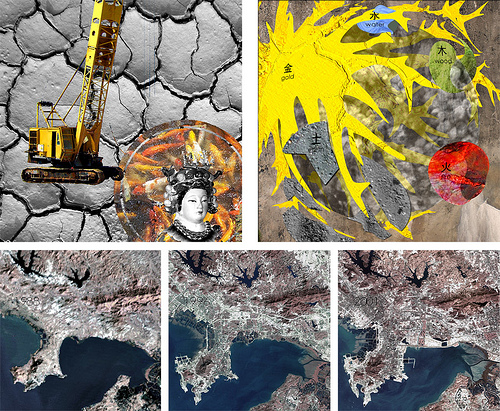
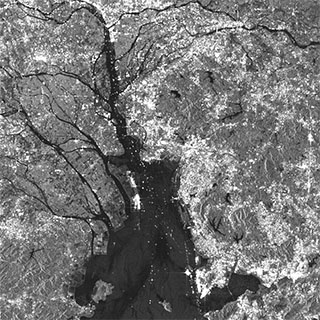
What else do we English speakers miss? The ongoing houhai land reclamation and associated siltation, which is damaging coastal Mangrove forests. In the panel Gilded Coast from Prosthetic Cosmologies, I used images from the NASA Scientific Visualization Studio to draw attention to this process.  The SVS images were taken in 1988, 1996, and 2001. Taken in December 2008, a recent Earth Snapshot from Chelyis shows how more has changed in the past seven years. The Chelyis image also contextualizes the SVS images within the delta/estuary. Compare the levels of siltation and environmental transformation below:

3238295529_9c49de8afe4

20081211-hongkong-thumb4


More importantly, the Cheylis explanation identifies both Guangzhou and Hong Kong, but not Shenzhen. This omission is disturbing not only because Shenzhenhas been the most active land reclaimer in the region, but also because it pre-empts inclusion of Shenzhen – as well as Dongguan, Foshan, Zhongshan, and Macau – in conversations about how to both clean-up and enrich the region. (This omission dovetails into dim sum with the Swiss writers, who were shocked by how developed Shenzhen actually is. I keep asking myself: how do westerners miss Shenzhen? And it keeps happening…)

Incidently, the Chinese character 洲 (zhou) further muddies rather than bridges waters between English and Chinese conversations about the environmental consequences of economic development. The two parts of zhou are: the three-dot radical for water and  州 (zhou), a sound component which is composed of the pictograph for river with three dots. According to my dictionary, a  洲 is a continent or an island, so a delta/estuary is actually a three-cornered continent island or 三角洲, while the character is two-thirds full of water. This means googling 珠江三角洲 brings up a different mix of economic and environmental articles than does an English attempt.

storm clouds


tianmian clouds

these past two weeks, it has rained in shenzhen and the rest of the delta. on friday the 13th (!), the rains flooded baoan district, killed six, and delayed airflights. songgang was the worst hit. that night, storm water also pooled throughout the city and public transportation stopped, causing hundreds to wade home.

in between the downpours, however, the cloud formations have been stunning. pictures from tianmian, dongmen (hubei new village), huaqiangbei, and houhai.

shenzhen garbalogy


coconuts

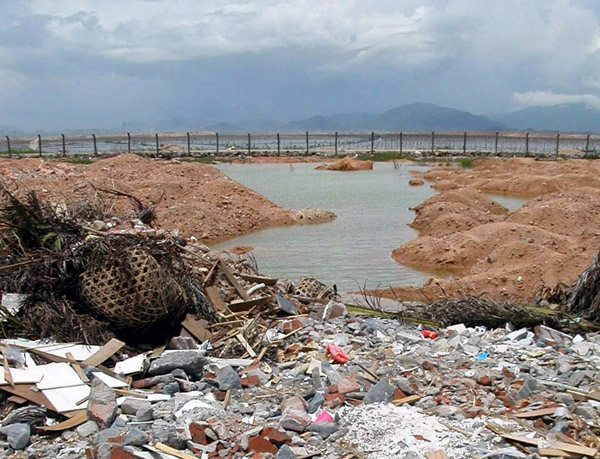
this morning as i walked the edge of houhai i stumbled upon another former settlement, where the squatters’ housing and kitchens had been razed, but then reconstituted in even more transient form–beds have been made inside the water pipes that are now being installed. signs of life: shoes, mosquito coils, and makeshift offerings. when i asked one of the women salvaging plastic wrapping from the site, she said that the settlement had been razed just this week. two more permanent fixtures remained–a pink shrine and a 42 stall traditional outhouse. the outhouse seemed relatively clean; perhaps it has been built in anticipation of the work teams that will soon move onto the site.

this is the second time this month that i have stumbled upon housing arrangements that have been hidden in plain sight on the border between housing built on the reclaimed land and newly reclaimed construction sites. just three weeks ago, while walking near the western corridor bridge, i came across a squatting settlement. the small pup tents were located along a sidewalk that was temporarily out of use due to construction. however, a hill and mounds of dirt in the reclamation site kept the settlement out of sight. i only came across them because i jumped the temporary barrier that had been installed, while a more permanent; it seems easier to go through concrete one was being built.

during a brief and admittedly superficial engagement with the other three anthropological subfields, i took several archaeology courses. i didn’t understand the joy of finding bicuspids, nor did i fantasize about going off to dig up the remains of lost civilizations. i did, however, like the idea of theorizing a life out of garbage, which william rathje initiated in 1973 with the tucson garbage project and popularized in 2001 with the publications of rubbish! the archaeology of garbage.

one of rathje’s points is that there are discrepancies between what we say we do and what are garbage reveals that we do. i’m not terribly interested in catching people lying; it seems unnecessarily stressful to constantly assess the degrees of truthfulness in any statement. nevertheless, i think that garbalogy might be useful when looking at how shenzhen has razed and continues to raze squatter settlements. officials maintain that shenzheners are building one of the most modern cities in china. the promise of modernity includes the promise of material comfort for all residents. however, the garbage that this process generates includes neighborhoods, family homes, and migrant livelihoods.

i like thinking about houhai through garbagology because it makes facts about squatters’ lives immediate and visceral, stubborn. it is difficult to talk one’s way around the image of a child who cut his head playing near his mother’s salvage cart. indeed, that child’s life measures the degree of truth in any statement about how globalization has been beneficial for shenzhen.

of plants and smog

shenzheners are developing an environmental consciousness. indeed, the shenzhen 2030 development strategy calls explicitly for sustainable development. so now we encounter billboards to protect endangered species. the irony, of course, is that these billboards have been raised at the former new houhai coastline. about 10 years ago, the elephant would have been standing on the beach. 20 years ago, said elephant would have been up to its knees in water, possibly even deeper.


save endangered species billboard

moreover, only five years ago, if memory serves as well as i hope, the elephant would have been standing beneath “blue skies and white clouds.” these days, smog is an all too often topic of conversation in shenzhen. most folks blame the cars, and then quickly remark that cars are necessary, both for convenience and building the economy. all of us, however, lament that the environment has deteriorated so obviously, so quickly.

at the same time, shenzhen’s furious pursuit of garden cityhood proceeds. recently exotic plants abut the new roads and construction sites of the houhai land reclamation zone. although beautiful, these plants irritate me. unlike the once ubiquitous and local banyan tree, shenzhen’s palms and bushes and flowering trees don’t provide shade. they also require large teams of gardeners, who water the plants with an irrigation system that stretches along the ever changing coastline. these plants confound me. i wonder where their gardeners live and how much they earn; as far as i know, the blue uniformed gardeners in central park, live in dorms in the park itself, but there aren’t any dorms on the landfill, only temporary construction dorms. the extent of the irrigation system also has me wondering, given the city’s water shortage, who isn’t getting water if imported fonds are. and if perhaps, we’ve reached the final coastline.

this afternoon, on the landfill, i stopped to talk with several people. one, a migrant worker who had just came to shenzhen and lived in one of the nearby shanties, said that it was nice to walk on the coastline where the air was fresher. true enough. i actually breathed in salty air. a second interlocutor, was an old shenzhener, originally from ningbo, who like like me, enjoys photography. he showed me some of the pictures in his very nice camera–flowers, parrots, traditional architecture, and old village rivers.

“unfortunately,” he said, “shenzhen is a new city, so there isn’t much beauty here.” as i understood him, beauty referred to things natural and manmade that had a graceful harmony. he admitted that all shenzhen’s glass buildings were impressive, but not yet beautiful, unlike shanghai, where old sections of the city had been preserved and improved. his comments had me wondering if we wait long enough, shenzhen will become beautiful through age. although with all the upgrading and razing of older sections of the city, this path to beauty may not be the most efficient and shenzhen may as well just stick with its the newest is the most beautiful aesthetic. speculation aside, we agreed that the smog had become a serious problem that would become even more serious, “unless the government takes serious action.” as we separated, me to take more pictures of houhai and him to continue searching for beauty, he exhorted me to visit other cities, especially shanghai, “where the environment is really beautiful.”

i am not sure if shenzhen’s utopian origin sets residents up for disappointment, or if memory creates beauty where it may not have been; i’ve been to shanghai, and i remember smog, in addition to the lovely buildings. i do think that the utopian impulse behind the city’s construction continues to inform longterm planning. the idea of shenzhen as a sustainable city is, if it is nothing else, a call to create a better future. and yet. houhai continues to transform the south china environment and climate at a pace unplanned, and more than likely, with unforeseeable environmental consequences.

pictures of plants and smog here.
海岸城:city on the fill


coastal city, west and east

one of the newest, most expensive, and flashiest of the recent crop of development projects on houhai reclaimed land, coastal city (海岸城) sparkles even in a winter drizzle. i suspect that coastal city will soon enough fade into some post-whatever background, but today as i walked around both the east and west complexes, i wanted this to be important, not just an object of anthropological critique, i wanted all this building to mean something other than wild real estate speculation and irresponsible environmental policy. i wanted it to become a city to fall in love with, even though i can’t bring myself to say i like shenzhen. clearly if not misplaced, my sentiments are vexed.

so pictures.

christmas 2007: garden city…and christmas-lit palms


merry christmas-new years

it’s another christmas. unlike previous years, when the great christmas pumpkin made its appearance, this year, it’s christmas qua new years, which fits. many of my friends think of christmas as american spring festival. i will be tracking the shenzhen christmas make-over, which began the day after thanksgiving. these first pics are from garden city in shekou.


inside garden city, a christmas palm tree

the palm trees and bright city lights (santa goes neon after dark) at garden city seem a high-end moment in a citywide trend to shine. low-end nanshan clubs, for example, also decorate plastic palm trees with christmas lights. these lights, however, flicker all year.


blue


yellow