开平碉楼: fortified homes

the other day, i went to zili village (自立村), li yuan (立园), and chikan town (赤坎镇) in kaiping city (开平市), one of guangdong’s famous 侨乡 (overseas chinese homeland). as a tourist destination, kaiping is famous for its towers, known as 碉楼, which were fortified structures designed to protect families from local bandits. according to anthropologist zhang guoxiong (张国雄):

“Before the Ming Dynasty, presentday Kaiping lay at the administrative intersection of three
counties, Enping, Xinhui and Xinxing. This situation enabled local bandits (土匪) to flourish
and hide out there. Public security was a mess. Liangjin Mountain in Kaiping was just such a
nest for local bandits, whose activities reached the towns of Chikan and Tangkou. Kaiping’s
predecessor was Kaiping Dun. During the Ming, the character “dun” refered to a military
installation. We can imagine that the central government had dispatched a garrison to Kaiping to
manage the problem of public security. They hoped this would be a place of unhindered traffic,
and that peace would be restored. Kaiping became a county during the first year of the Shunzhi
reign (1643). It was precisely to counter these social problems that the are was called Kaiping
(开平), which meant “restore peace (同敉)”. From this we can see, public
security problems were endemic to the area (loose translation from his book 开平碉楼)”.

these problems continued through the late qing and into the nationalist period. local architecture reflected the need to build for safety from bandits. however, the infusion of money from overseas chinese changed and intensified this kind of protective building. from the mid nineteenth century on, men from kaiping began immigrating to the united states and canada. significantly, because exclusion acts prevented them from bringing their families with them, they sent remittances home, often with the specific intent to build a safe tower, where their families could live. it is estimated that from the mid-nineteenth century over 3,000 towers were built, with intensive construction happening from 1912 until 1937, when nearly half the towers were built (1,490).

in fact, the remittances themselves became the cause of increased piracy. from 1912 until 1930, roughly the same period as the most intensive episode of tower building, there were 71 reported instances of bandit attacks in kaiping, including three attacks on the county seat and kidnapping the county magistrate.

early chinese immigrants to the united states worked for low wages in dehumanizing conditions. indeed, chinese migration satisfied american needs for low wage workers without attempting to give workers the benefits of american citizenship; in chinese, the remitances were called “血汗钱 (blood and sweat money)”. all this to say, kaiping people found themselves quite literally in a global crossfire between local bandits and north american immigration policy; there was no safe place for them and their families, together.

indeed, global politics continued to shape the possibilities of kaiping family life. the cold war brought with it u.s. attempts to undermine asian communist leaders, especially mao zedong. beginning in the early 1950s immigration restraints loosened, culminating with the Immigration and Nationality Act of 1965. these changes allowed for the migration of kaiping family members, most of whom abandoned their towers for chinatowns and suburbs overseas, despite the fact that the communist party had actually succeeded in pacifying local bandits.

today, kaiping’s fortified homes seem disconcerting monuments. to departure. to social unrest. to history’s ironies. to ostensive luxury. the towers, the tiled floors, the defensive infrastructure, including weapons, the intricate wood carvings, the marble tables, the obvious wealth boarded up and hidden behind concrete walls and rusting metal shutters distressed me; a fortress can’t protect a dream.

on jan 31, 2002, the state administration of cultural heritage of the people’s republic of china (the awkward and official translation of 中华人民共和国国家文物局) nominated the kaiping towers for inclusion in UNESCO’s world heritage project. they have also uploaded a website that brings together tourist information, annecdotes, and historic analysis about the towers and the overseas chinese who built them. please visit.

华强北:constructing progress

located in futian district, 华强路 (huaqiang road) is the name of the central axis of the area known as huaqiang north. the area itself is bordered by yannan road (east) to huafu road (west), and hongli road (north) to shennan road (south). importantly, the southern border of shennan road with its strip of postmodern glass and steel buildings is often included in the area. with dongmen, huaqiangbei is one of the two most important commercial areas in the city. it has an area of roughly 1.45 square kms and according to futian government online, as of april 25, 2006 boasts over 700 shops, averages 500,000 visiters per day, and generates 26 billion net sales rmb per year. catic, the chinese aviation bureau and major huaqiangbei investor has uploaded a flash picture of the huaqiangbei skyline (looking east) to celebrate the area’s economic vitality. and the commercial interests in huaqiangbei have opened their own webpage.

we have come to a reader be warned moment: telling this history frustrates me because i end up feeling like i understand the general process, but have missed all the details. the problem of course is that i suspect the story is to be found precisely in those lost details. indeed, i don’t know if the details can be known. in part, my doubt springs from the lack of reliable books and information on the web. the early years of shenzhen simply weren’t systematically documented. in 1995, i went to the city’s 15th anniversary exhibition at the shenzhen museum, but it was a celebration of the present, rather than an investigation into the past.

moreover, with all the different governments moving from one building to another (part of the huaqiangbei story below), stuff got misplaced. i once tried to gather pictures and documents from the 80s, but was told either the pictures weren’t taken or the papers lost in a move. the thing is, i don’t believe i was simply being kept at bay to protect state secrets. what got boxed and moved is around here somewhere, but… i understand. i too have lost papers and documents in moves from one office to the next. i also believe my interlocutors when the tell me that in the early 80s there wasn’t time to take pictures; they worked long hours and moved from one job to the next. also, its sometimes hard to remember that over 25 years ago, there weren’t all that many personal cameras in shenzhen, and so people tended to take pictures of people and places that mattered to them.

i doubt the availability of relevant details because (given the lack of documentation) they can only have been carried in the hearts and minds of the people who were actually there. even allowing for the instability of human consciousness, these events are scattered accross the population, rather than located in one neat spot. so, no matter how many people i talk to, i feel i’ve missed something.

i also feel outside the historical loop because the process itself remains counter-intuitive to me, in the way that football does. so even when i do meet up with someone who can tell the story, i’m not always sure what to ask or, more importantly, how to ask it. now, i have chinese friends who can memorize levels of government and rankings as easily as my brother remembers footbal statistics. in fact, not a few have patiently gone through the system with me, two of them several times. but still i need to lay things out and look at organizational charts before i understand what i’ve been told and then i find myself feeling about it the same way i feel about my brother’s statistics. i realize it matters to him, i appreciate the time and effort that went into cultivating that kind of knowledge, i even understand why someone would want to have that kind of knowledge easily available in any conversation. but, political ranking isn’t my game.

all this to say, i realize this history is important. i’m trying to figure out why the space itself fascinates me, but the history doesn’t. it may be that i’m interested in a different kind of history, smaller, more persoanl and intimate. it may also be that at the level of generalities, i’ve heard this story all too many times. i once heard a reknown sinologist say that research was boring because marx had already outlined the process; been here, done that. at the time, i was outraged. how can it be the same? how can people’s lives be boring? but i have come to hear that comment as a comment on the limits of knowledge. we do reduce everything to generalities, and then are surprised when we don’t find anything new. so if i could find another way to approach urban rankings it might fascinate me.

by shenzhen standards, huaqiang north is an old area. and, like most of the city did not start out as either a commercial area or an administrative unit within a district government. indeed, the history of huaqiang north not only anticipates many of the transformations happening in other parts of the city, but also illustrates the neo-liberal vision of progress: through hard work the people have moved from working in factories through owning commercial properties toward wheeling and deeling in international finance. what’s more, this vision is not simply futian district’s plan for the huaqiang north area, but rather a scaled-down version of the overall plan for shenzhen, which has called to transform the economic base manufacturing to higher value-added production in real estate and financial services. the critical point, which is glossed over in the neoliberal account, is that those working and those benefiting aren’t always the same people. economic growth and expansion hasn’t meant that every shenzhen immigrant has worked their way out and up of relative poverty; many factory workers are still factory workers; many factory owners are now stock brokers.

also, like other places in shenzhen, the history of the area has resulted from complex negotiations between different interests, none of which fall into neat categories. a brief history of those interests:

when the central government first elevated baoan county to shenzhen city in 1980, it did not immediately redristrict the lower levels of government. this meant that although shenzhen city now existed, it was placed on top of a rural administrative apparatus. in an ordinary chinese city, administrative levels are: city (市), district(区), street(街道办事处), and neighborhood(居委会). at the time shenzhen replaced baoan county(县), but beneath it were communes (公社), large and small brigades (大小队). the large and small brigades corresponded to administrative and natural villages (行政村、自然村), respectively.

crudely, one of the main purposes of the new city government was to transform rural administrative structures into urban structures. in previous entries, i have focused on the structural position of the new villages within shenzhen, in this entry, i want to look at the new urban structures which replaced the villages. what is interesting is to keep in mind the dissolving and restructuring of economic units within the government. specifically, although shenzhen has been heralded as a place where state-owned industries constitute a small percentage of actual businesses, it remains the case that the most lucrative businesses are linked to the government either directly or indirectly.

the earliest shenzhen plan was approved in 1982. in it, shekou was set up as an independent industrial zone (another fascinating history of 1980 experimentation). in what would become downtown, the plan identified about 50 square kms, stretching from the wenjindu border crossing in the east to huafu road in the west. within this area, land was appropriated by urban work units that were then responsible to develop the area according to the plan. the area that is now know as huaqiangbei was originally part of the shangbu industrial area.

the organizations that came included the former national electronics ministry (电子工业部), the weapons ministry (兵器部), the national bureau of aviation (航空局), and the guangdong provincial bureau of electronics (广东省电子局). each was given the authority to negotiate for a tract of land on which to construct electronics factories. of course, this included putting in the infrastructure necessary to run this factories. nevertheless, the project took off and by 1986, the shenzhen municipal and guangdong provincial governments brought these companies together to form the shenzhen electronics company, which was named saige electronics (赛格电子集团)in 1988.

a bird’s eye of huaqiang north bears traces of this history, where the tracts of factory buildings stretch across the landscape:

first attempt to restructure the area was in 1998, when the municipal government invested 45 million rmb in infrastructure for huaqiang road to build better sidewalks, install better street lighting, a large screen, more electrical wires, and benches for resting under imported palm trees. these investments transformed huaqiang road into a pedestrian friendly strip of large malls. according to the above mentioned futian government online statistics the government’s investment stimulated 1.2 billion rmb commercial investment in the larger area.

visit huaqiangbei.

旧村改新:initial observations

this is another thoughts-in-progress entry. these past few days, i have been trying to organize thoughts about the 旧村改新 (old village make-overs), a recent government initiative to clean-up shenzhen’s new villages (now understood as “old”). this was part of the reason for posting on luohu; i actually took that series of pictures last december, but the juxtaposition of new luohu village, the era of two cities building, the new housing development, and the renovated train station point to issues that come together in the make-over initiative. so if you haven’t yet, you may want to first take a walk about luohu.

the point, of course, is simple: there are many shenzhens and they all abut one another. indeed, it’s as difficult to miss new villages, which have a distinctive layout and architecture, as it is to overlook a high-end housing development. these different urban forms actualize the different development trajectories that shenzhen’s villagers and white-collar migrants have pursued. that is to say, even if we bracket for the moment the question of whether or not shenzhen has deep, imperial history, nevertheless, it has been over 25 years since deng xiaoping began reform and opening just north of hong kong. architecture styles and urban plans actualize different moments in this process, providing a material history of the city. with the village make-over initiative, the government seems determined to remove traces of historic difference, even as cultural officials continue to moan about shenzhen’s lack of history. below is a picture of the arch at the entrance to huanggang new village.

the old village make-over initiative first came to my attention over dinner last year, when friends were discussing the government’s decision to raze 18 mid-rise buildings), right at the huanggang cross-border checkpoint. the topic came up not because those at the table disagreed with the make-over process, but because this was the first time china was simultaneously imploding 18 buildings. the event was know as “china’s first blast (全国第一爆).the buildings belonged to yunong village (渔农村). if memory holds, the conversation focused on the technology involved, the need for a modern area to face hong kong, and the avarious fearlessness of villagers, who continued to errect illegal, rental properties.

this past year, i have watched construction teams lay the foundations for a new yunong with something of a jaded eye. this is not the first time that the municipal government had directed a movement specifically at shenzhen’s urban villages. and in a certain sense, it often feels like a more of the same kind of project.

in 1991, the government initiated the rural urbanization movement (农村城市化运动) with the goal of integrating all villages into the municipal government and giving all shenzhen peasants, citizen status. this was called the double transformation. this movement finally ended in august 2004, when baoan and longgang districts announced that all villages had been redistricted and all villagers had been given a new hukou. shenzhen was thereby the first city in china to have neither villages nor villagers within its borders.

for officials determined to turn their city into a global, international city, the end of rural shenzhen was a major milestone. indeed, in this area shenzhen has been heralded as a national leader. these administrative changes, however, did not irradicate the visceral spatial differences between shenzhen villages and the surrounding city.

in order to deepen the integration of the villages into the fabric of the city, shenzhen officials turned their gaze to the built environment as a sign of rural-urban difference. consequently, the following year, in 2005, the government decided to start the old village make-over initiative. crudely, this entails razing what are known as “handshake buildings” and replacing them with modern residential developments. handshake buildings are so-called because they are so close to each other that neighbors can reach out their windows or across their balconies and shake hands. the initiative includes building plazas and public areas, as well as different kinds of housing developments. i include a picture of a row of handshake buildings, huanggang new village.

compare with an image of the new urban dreams currently under construction in huanggang:

the old village make-over initiative was formally approved on october 28, 2005. it is a special five-year plan to improve the urban villages (城中村), speed up urbanization, promote the unification of infrastructure within and outside the sez, realize the joint planning and harmonious development of urban villages and other areas in the city, and to advance the architecture of a global, modern, and key city, errect a harmonious and efficient shenzhen. the curious can check out the full old village make-over plan online.

nevertheless, the question of make-overs and everyday life only became interesting the other day, when i was in shuiwei and huanggang, two of the futian villages that abut the hong kong border. frankly, i was impressed with the layout of shuiwei’s culture plaza, which boasts a funky (if derivative) outdoor stage, a curious rocks museum (the rocks are mainly from guangxi), and a library. i also had tea at a colorful hong kong style teashop, where the milk tea was strong and rich. suddenly, i wanted to move from tianmian, which is conveniant but not like shuiwei. (the lack of tasty but reasonable restaurants in tianmian is a bone of ongoing contention. after all, one of the defining features of the urban villages has been the quality and price of the restaurants.)

my desire to move to shuiwei points to an underlying fact about new village life; the primary source of income for most villagers is rental property. this has meant that villagers have built as densely and as highly as possible, with little concern for the overall environment. it also has meant a density of cheap beauty and massage parlors, restaurants, places to play mah johng, food markets. indeed, since the mid-1990s, as most of shenzhen’s factories have been pushed outside city limits, the importance of rental property and services to village economies has grown. the main residents of the villages are low income migrants, usually from the countryside.

it seems that the ratio of villagers to migrants in the villages concerns the government. the villages maintain their own militias (民兵) that act as a police force within village borders, shifting social regulation from the state to these quasi-governmental organizations. according to futian government statistics, for example, there were 19,353 villagers registrared in 15 administrative villages (there are 20 natural villages in futian.) those villagers provided housing for 572,143 migrants. a ratio of 1 villager for every 29.5 migrants. (these figures do not include unregistered migrants, some of whom live in illegal housing, but others who live in the underground walkways that connect villages to the city proper.) these migrant laborers are precisely the persons regularly identified in the press and popular opinion as causing social unrest. outside the sez in baoan and longgang districts, the villager to migrant ratio is even higher. thus, this research suggests that the greatest challenge facing the make-over movement is a contradiction between the villagers’ economic interest (as landlords) and the state’s interest in maintaining social discipline.

i conclude with a picture of the home of the shuiwei militia (水围民兵之家).

There are also good people in Henan

On May 4, after two days in Guangzhou, I went to Zhengzhou, the provincial capital of Henan. Unlike in Xi’an, where I was introduced to how unlike the rest of China Shenzhen is, in Henan I unexpectedly encountered claims to how traditional Shenzhen might be. Admittedly, the route to Shenzheners’ Chineseness was twisted and ironic. Nevertheless, as my host in Henan said, “Chinese people are all more or less the same (大同小异).” Not a sentiment that my Shenzhen friends usually admit feeling. They do, however, admit that one always returns to one’s roots (落叶回根). What’s at stake then is how those roots get defined and who gets to set the terms. So, a brief story about the traditional Chinese value of hospitality, which begins with a defense of the basic goodness of Henan people, who have a reputation throughout China for being less than honest. Indeed, jokes about Henan people’s lack of education, shiftiness, and general unreliability circulate on cell phones and turn up in movies and mini-series. So prevelant is the Henan stereotype that my first conversation with most of the people I met in Henan was a variation on the following theme:

“You speak Chinese really well.”

“Really?” asked as modestly as possible.

“There are also good people in Henan.”

I laugh and agree that there are good people everywhere.

The pride of being from the birthplace of China’s oldest dynasties only came out in later conversations. Many of the prototypical images that Westerners hold of ancient China are, in fact, photographs taken in Henan, which was the cradle of advances in agricultural technology, copper and ceramic production, and architecture over several millennia. Luoyang and Kaifeng, China’s oldest imperial capitals are both located near Zhengzhou. So are some of the more interesting Buddhist sites from the Tang and Song dynasties. (For that matter, many of China’s most popular historical mini-series are set in Henan, where Wu Zetian established herself as the incarnation of the Bodhisattva of Compassion.) The gravitational center of the various silk roads, which stretched from Nara to Rome, was in Henan. Indeed, the Henan Provincial Museum is second only to Beijing in terms of the quality, quantity, and diversity of early imperial artifacts.

Although Henan now has the largest population in China (roughly 100 million or so), it does not boast large cities. Zhengzhou, the provincial capital has a population of only 3 million, give or take. Kaifeng, once the largest city in the world, now has a population of less than one million. (This is not only because Kaifeng lies in the Yellow River floodplain, but also because the Yellow River flows roughly thirteen meters above the city. In Xinxiang the river hangs twenty meters above the city. In the rest of the flood plain, the Yellow River flows five meters above land. Should the dykes break, as they did when Chiang Kai Shek blew them up to prevent the advance of Japanese troupes during WWII, tens of millions might die. For several millennia now, local governments have maintained a system of dykes. At the same time, sedimentation has raised the river bed. Consequently, officials and commoners alike have been afraid to invest in Kaifeng.) In contrast, all of Guangdong’s major cities have populations over eight million, while Hong Kong, Shenzhen, Dongguan, Guangzhou, Zhongshan, Foshan, Zhuhai, and Macau encircle the Pearl River Delta. Thus, unlike Xi’an or other Chinese cities, urban culture in Henan is not so sharply distinguished from peasant culture. Most Henan residents live in tightly knit villages, which may have 20 to 30,000 inhabitants. Yet a friend pointed out that this population distribution means that if Henan’s urbanites seem provincial, then Henan’s peasants seem unexpectedly sophisticated. My host was a village entrepreneur, who had moved his factory from the rural area to Zhengzhou’s growing industrial suburbs. His approach to history was less reverential, than practical, a point of view that clearly disconcerted our guide at the museum.

Museum Guide (MG), looking pointedly at me: This seeder was invented 3,000 years ago, long before Europe had begun to centralize agriculture.

Village Entrepreneur (VE): We still use that in my village.

MAO: I thought agriculture was centralized under Mao.

VE: Yes, but the plots are too small for mechanical tools. So we even have to harvest wheat with a hand-scythe.

The MG continued to talk about advances in agricultural technology as if the VE hadn’t spoken. Important for imagining this dialogue is to remember that the MG spoke in standard Mandarin, while the VE spoke with a heavy Henan accent. This linguistic difference clearly marked the MG as urban and the VE as rural, or sophisticated versus provicial. Indeed, with his wife and close associates, he spoke in his hometown dialect. Yet the VE seemed unimpressed by the MG, who had to work and ultimately failed to establish her cultural authority. A little later, the MG directed us to a stunning display of ceramics, including Junci (钧瓷), a style that began over 1,500 years ago during the Tang Dynasty. The VE interjected that during the Cultural Revolution, villagers stumbled upon artifacts like that all the time, but immediately smashed them, destroying the four olds (四旧).

The MG glared.

And so it went. Site-seeing with a peasant-entrepreneur, I also learned that the Yellow River, national symbol of China was “heartless 无情” because when it flooded people died; that commercialization had ruined most of Henan’s famous monasteries, although it was still worth learning Shaolin style gongfu; and that any of the four olds that had been smashed in his village during the Cultural Revolution would provide a lot of seed money for a factory or new house.

More striking than either the village entrepreneur’s gritty practicality or skeptical pride, however, was his generosity. When he was too busy or unable to take me site seeing, he arranged for his driver to 陪 (péi) me. The driver took me to various landmarks, bought my tickets, made sure I have a guide at every site, and when I was hungry escorted me to restaurants, where he ordered local specialties for me to sample. Though out the day, the village entrepreneur called to confirm that I was enjoying myself and to ask if I needed anything else.

My friends in Shenzhen were unsurprised by such generosity. In fact, they found it to be typical Chinese culture.

“Chinese peasants,” a friend explained, “are still the most warm-hearted and welcoming. If they normally eat on 10 RMB a day, when a guest comes, they’ll spend 100, skimping by on 2 or 3 RMB a day to make up the difference.”

“Isn’t that exhausting?” I asked.

“Of course.”

There was a pause as each of us waited to figure out where the other was heading. A fine line often separates hospitality from questions of face; being exhausted so that one’s friends might be comfortable can be understood as either good or bad, depending on context. Clearly, I did not want to imply any criticism of my host. I finally asked if my friend shared the village entrepreneur’s strong sense of hospitality.

“Of course,” she answered immediately, “even though I’ve lived in Shenzhen for almost twenty years, I’m still a traditional Chinese woman at heart.”

“So there are good people in Henan,” I teased. Before I left, she had one of the many to warn me about Henan people’s shady ethics.

She waved off my teasing. “It’s like this,” she joked, “they’ve just had more time than other places to perfect making fake goods. They even produced fake junci ceramics during the Tang.”

“Ah,” I said, dropping the issue.

Below are pictures of me with my hosts in Henan. We are standing at the site where Chiang Kai Shek blew up the Yellow River Dyke (left). My driver enjoys lunch (right).

I will take up the practice and ethics of 陪 (péi) more systematically in a later entry. In the meantime, please visit some Henan sites and check out Kaifeng’s many and diverse lions.

Integrating the Pearl River Delta

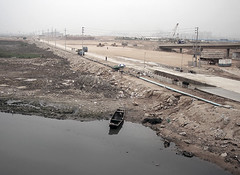
Sunday afternoon, I walked east along the Houhai coast, from Houhai to Sand River (沙河). This is a strip of land that was formerly designated to be part of the Nanshan District Binhai green zone, which connects up with the Shenzhen Natural Mangrove Reserve in Futian District. My interest in the area grows with the audacity of land reclamation in Shenzhen. This area marks a second rezoning of the coastline. The first was part of the effort to build the Binhai Expressway, which connects Nanshan to Futian and Luohu Districts. This second stage was districted later and remnants of that now-obsolete coastline litter the new construction site.

(The curious can check out the Shenzhen’s overall urban plan (1996-2010) maps, while the even more adventurous can go to the Nanshan District overall urban plan. On those maps, I walked along the strip of coast facing Hong Kong. Offline, if your library has any of the Shenzhen yearbooks from the 1980s, there are interesting comparisons to be made. Published in the early 1990s, the last Baoan County Gazetteer is also fun, but harder to find.)

On my walk, I stumbled upon guardhouses that were never staffed by border guards and the chain-link fence that separates pedestrians from Houhai. The entire area had been filled with earth and pumps were busy squeezing out the last of the ocean. Dump trucks rumbled past and people carrying nets biked out to the new coastline. I learned there was a two-week window to catch newborn crabs before they swam out into what remained of the ocean. These baby crabs would be used to stock fisheries in Baoan District. The crabbers carried the crabs in plastic soda bottles that hung around their necks. Eventually, I arrived at Sand River, I came across one of the construction sites for the Shenzhen Western Corridor Bridge, which set me to thinking about the various infrastructures which integrate Shenzhen and Hong Kong. What follows is a longish outline of Shenzhen history as mapped by Shenzhen-Hong Kong checkpoints. You can skip the discussion and go straight to the Western Corridor land reclamation pictures, or you can indulge my sudden urge to document comprehensively the transformation of Shenzhen.

(I’ve just realized that I only use Mandarin and Shenzhen place names in this blog. I promise to start documenting the different names for the sites. I may even talk about what these differences in talk might mean…)

Anyway, the fourth land connection between Shenzhen and Hong Kong, the Shenzhen Western Corridor Bridge was completed in January 2006. The corridor itself should be finished later this year. It is a 3.8 km long dual-carriageway 3-lane bridge connecting Nanshan District to Hong Kong at Ngau Hom Shek. The construction is being overseen by OPAC, a San Francisco based engineering firm. Trying to figure out the actual cost of the corridor is somewhat difficult. According to the China Daily, the bridge cost $US 111 million to build. On their webpage, OPAC estimated that the cost of the Western Corridor Bridge would be $US 400 million. The Nickel Institute website quotes the Hong Kong Highway Authority as putting the estimated cost at $US 2.7 billion. Perhaps the China Daily quote refers just to the cost of the bridge, the OPAC quote to the cost of the entire corridor, and the Hong Kong Highway Authority quote to related infrastructure in Hong Kong. What can be concluded is that the corridor is expensive and somebody is making a lot of money from it.

And making money seems to be the point. The Western Corridor Bridge is part of a larger effort to transform the Pearl River Delta into one of the most vibrant economic regions in the world. On August 28, 2003, at the Foundation-stone Laying Ceremony for the Hong Kong-Shenzhen Western Corridor in Shenzhen, Hong Kong Chief Executive, Mr Tung Chee Hwa said, “Hong Kong and Shenzhen are a key nexus in land transport to the Mainland…The three existing land boundary crossings between Shenzhen and Hong Kong are nearing the saturation point, such that both administrations have agreed to build the Hong Kong-Shenzhen Western Corridor as the fourth land crossing to accommodate growth. Traffic flows at the three existing boundary crossings have increased greatly over the past five years. The average total daily vehicular traffic at boundary crossings is expected to reach 65,000 vehicles in 2006, far beyond the daily capacity of 42,000 vehicles, which the three existing crossings offer now. Upon its completion, the Western Corridor will provide additional daily traffic capacity of 80,000 vehicles, raising the overall daily traffic capacity to 122,000 vehicles, thereby easing the current congestion. And yet, even four land crossings are considered inadequate to meet the future demand arising from further development. A working group drawn from among officials of the Hong Kong, Guangdong and Macao administrations will convene its first meeting tomorrow to press on with the advance preparations for construction of the Hong Kong-Zhuhai-Macao Bridge…”

The figures for vehicular land crossings do not include statistics for all border checkpoints (in order of numbers of passenger crossings)—Luohu, Huanggang, Shekou, Shenzhen airport, Wenjindu, and Shatoujiao. Official Shenzhen customs figures showed entry and exit passengers at the city’s six checkpoints reached 137 million in 2004. Crossings surge during Chinese holidays, especially Chinese New Years, when an estimated 5-6 million people (over a period of two weeks) cross at Luohu alone. During the holiday season, all checkpoints extend hours and increase staff handling document inspection. Each of these crossings has a distinct, but interconnected history that illuminates different aspects of the Shenzhen-Hong Kong nexus as part of globalization. A crude synopsis of the six sites follows and provides a very, very, very rough outline of Shenzhen’s deep history.

(I try to problematize the idea of history with respect to Shenzhen most entries. However, this is the first time in this site that I’m trying to locate Shenzhen with respect to larger currents. I’ve learned how to think about this history from Giovanni Arrighi in his wonderful book The Long Twentieth Century. Helen Siu and David Faure have turned an anthropological lens on this process in Down to Earth: The Territorial Bond in South China. I’ve picked up some online sources that may be helpful and embedded in the following notes. I assume it’s all as reliable as statistics about Western Corridor Bridge finances are.)

In a certain sense, the Luohu checkpoint has been in existence since the leasing of the Hong Kong New Terriories in 1898, when the Sino-Anglo border moved to the Shenzhen River. Previously, the Qing Dynasty had ceded Hong Kong Island and the area south of the Kowloon Mountains to Great Britain in 1842 (end of the first Opium War) and 1860 (end of the second Opium War), respectively. Luohu (Lo Wu in Cantonese) was the first stop on the Chinese side of the Hong Kong-Guangzhou railway, which was built in 1913 and more effectively integrated south-eastern China into the British Empire. So thinking about Luohu leads to thoughts about British imperialism, the transition to the Cold War, and the postsocialist realignment of international political-economies with a focus on East Asia. Suddenly, Shenzhen is neither hinterland nor no man’s land, but vying for the center of global trade. In a recent defense of building the Hong Kong-Zhuhai-Macao Bridge and associated costs, the Executive Director of the Travel Industry Council of Hong Kong, Joseph Tung, has said that the Luowu checkpoint is one of the busiest land crossings in the world, with more than 90 million people passing through it every year.

The Huanggang Checkpoint opened for 24-hour border crossings Jan. 27, 2003, at which point crossing figures surged from 50,000 to 110,000 per day. Buses to and from the Huanggang Checkpoint, connect Shenzhen to six Hong Kong destinations, including the Hong Kong airport. Since 1995, Huanggang has been the primary conduit between Shenzhen and Hong Kong Disneyland. Until the construction of the Western Corridor Bridge, Huanggang was the newest of the land crossings. It is interesting because it was part of a geographic shift in Shenzhen from “Downtown” referring to Luo Hu to the new “City Business Center” in Futian. The shift began in 1996, when the Shenzhen Municipal Government accepted plans for the new CBD. Michael Gallagher gave a talk about the Shenzhen CBD in 2002. But for a sense of the scale of this transformation and the debate about it, google 深圳CBD and check out all the different sites. Thus, the shift from Luohu to Futian allows for specifying the differences between a Hong Kong centered development in the early 80s to a more diffuse integration of the region, and therefore a more Mainland-centered pattern of economic development.

The most expensive connection between Shenzhen and Hong Kong, the Shekou ferry makes 13 round trip voyages a day, except during Chinese New Year, when the number of trips increases to accommodate the numbers of visitors. An additional 8 daily voyages connect Shekou to the Hong Kong airport. Most frequent passengers on the ferry are Shekou-based foreigners. The Shekou Ferry is interesting for a number of reasons, most related to the role that China Merchants has played (by way of Shekou) in the development of Shenzhen. The role of China Merchants then leads back to Luohu and questions of national development first raised during the later years of the Qing Dynasty. As of 2004, China Merchants has posted its own historical archive online, which highlights the role that commerce and international relations have played in modern Chinese history.

Along with Hong Kong, Guangzhou, Zhuhai, and Macau, the Shenzhen Airport is one of five international airports in the Pearl River Delta. In terms of passengers served, it ranks behind Hong Kong and Guangzhou. The five international airports have been built within a radius of 25 km. illustrating the level of competition and inter-city rivalry that has characterized development in the Pearl River Delta, rather than regional cooperation and planning. Moreover, the redundant infrastructure in the Delta has led to serious environmental problems, according to a report by K. C. Ho and C. S. Man.

Wenjindu is primarily a crossing for goods between Shenzhen and Hong Kong. It was opened in 1950, as part of the new Mainland government’s strategy to bring hard currency into the country. Throughout the Mao-era, agricultural products flowed from the Mainland into Hong Kong, a development strategy that has been more fully exploited since Shenzhen’s establishment. So thinking about Wenjindu allows one to question commonly held understandings about China’s so-called isolation during the Mao era outside of the obvious connections with the former Soviet Union and other socialist and third world countries. In the era of Avian flu, Wenjindu regularly appears in Hong Kong news reports as the site where chickens and other poultry cross the border. With suspicious regularity, indeed with an almost ritualized compulsion, Hong Kong public health officials regularly express astonishment on conditions north of the border.

So a rough outline of Shenzhen’s history with respect to the construction, use, and re-appropriation of Shenzhen-Hong Kong border checkpoint infrastructure. It touches upon British imperialism, the Cold War, the East Asian economic miracle, the rise of China as a global player, international epidemics, and the concomitant transformation of the environment. This is how we make our world, one reclaimed special zone at a time.

shekou: symbols of globalization

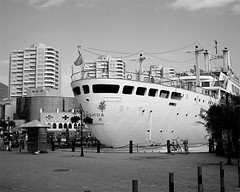
Although my last entry about Bitao Alley focused on one architectural manifestation of globalization in Shekou, the most famous architectural sign of Shekou’s march to a global future is in fact the Minghua luxury liner.

Over twenty years ago, the Shekou People’s Government bought the Minghua from France and docked it in the port. At the time, the Minghua floated and Chinese guests had a sense of embarking on an international cruise. In 1984 Deng Xiaoping boarded the Minghua and, pleased with what he saw, wrote the four characters for seaworld (海上世界), which now grace the ship’s entrance. Throughout the 80s, the Minghua symbolized exotic consumption. Western restaurants and shops sprung up in the area around the ship; this is today’s Seaworld Plaza. However, by the 90s, the Nanshan District, Houhai land reclamation had spread along the coast, landlocking the Minghua. The ship fell into disuse and the newly created land next to it was turned into a golf practice field. At the turn of the millennium, Seaworld Plaza underwent an international facelift and the Minghua was restored as a luxury hotel and restaurant.

For Chinese visitors to Shenzhen, Seaworld Plaza is an important destination. They buy foreign knicknacks at kiosks, take their picture in front of the Minghua, and sometimes enjoy a foreign meal. Next, they walk along the ocean walk to take their picture with Nuwa, who saved humanity by mending heaven. The ocean walk is now also landlocked, but before, Nuwa stretched into heaven, the ocean at her feet. I confess that the mythological turn confuses me, not that I’ve asked anyone involved with the project what it once meant. According to legend, Nuwa first sutured the rent in heaven and then cut off the feet of the great turtle to support the four pillars of the universe. She also stopped the flood that had surged through the rent and finally drove away fierce beasts that had taken advantage of the chaos. Clearly a heroine. But I’m not sure what she’s mending in Shekou. The ocean? Communism? The separation of Hong Kong from the Mainland? Whatever the wound, landfill now stretches way past Nuwa, creating a new coastline and new room for the development of beachfront property.

The Minghua illustrates how spaces of sanctioned consumption have provided legitimacy for the globalization of Shekou. In particular, globalization has arrived as the consumption of Western culture. The beached luxury liner anchors the western restaurants and stores of Seaworld Plaza through the promise of global consumption. Indeed, for many years, Chinese tourists rented binoculers and looked toward Hong Kong across the water.

A friend once warned me against buying beach front real estate in Shekou, where, “Just as soon as they sell the last lot, they start over again, creating a new coast line.” Recently, however, Shekou’s newest coast has been turned into an upscale beach community, that echoes the western style of Seaworld. Unlike earlier homes that were built to entice western businessmen, these homes have been built for Shenzhen’s white collar workers, who now expect and enjoy a material standard of living often higher than that in Europe or the United States.

The irony, of course, is that the factories which have enabled consumption elsewhere in the world are a block away from Seaworld Plaza. There too one finds housing and urban villages that were built in the 1980s, when the Minghua floated. And that’s perhaps the point. These factories were to provide and ultimately did provide the means of Shekou’s globalization. Like the Minghua, these once-necessary buildings fell into disuse and disrepair in the 90s. Unlike the Minghua, however, these buildings were once sites of manufacturing. Today, they are one by one being rennovated to facilitate new forms of consumption as manufacturing gets pushed out of Shenzhen into Dongguan, which has recently appealed to me more and more. Someday soon I’m going on a photo-trip to Dongguan and look forward to reporting back. Until then, I invite you to take a tour through and around Seaworld Plaza, Shekou.

Visiting the Nanyue King Mausoleum

The other day I went to the American Consulate in Guangzhou and, before returning to Shenzhen, I visited the Western Han Nanyue King Museum. Like my visit to Xi’an, this visit helped clarified some of the contradictions that animate the construction of Shenzhen by indexing both national trends and regional specificity.

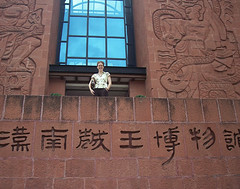
Located on Jiefang Bei Road in Guangzhou, the Museum of Zhao Mei, second king of the Nanyue State of the Western Han Dynasty (206 B.C.-24 A.D.) is the oldest and largest Han mausoleum in Lingnan. The simple act of walking through the museum suggests the way architecture not only sutures one era to another, but does so by highlighting the radical differences between eras.

The site was discovered in 1983 when developers began leveling Elephant Mountain in order to build needed housing. At the time, Guangzhou and the other 13 coastal cities were still a year away from reforming and opening the local political-economy. This is important because the housing built at the time, housing which now surrounds the museum was built under the Maoist work unit system. Consequently, Stalin inspired apartment buildings surround the museum’s modernist silhouette.

The museum complex consists of two main buildings—the exhibition hall and Zhao Mei’s mausoleum. Architect, Lu Yanzhi won the Liang Sicheng prize for its striking modernism. Green grass and sculpted topiary set off the buildings’ red stone base and glass pyramids. Walking from the exhibition hall toward the mausoleum chamber, however, my eyes kept moving from the set scene toward the spill of Stalinesque housing and Maoist factories. Two kinds of cognitive dissonance kept my eyes darting from the museum complex to the surrounding environment. First was the obvious difference in upkeep between the museum’s well-tended garden and the neighborhood, which seemed to be crumbling. Second was the City’s glorification of ancient history and the implicit denial of the importance of both Mao and Stalin to Guangzhou. After all, in order to build the museum, a building project was put on hold. Yet the surrounding neighborhoods will be razed as soon as it is economically feasible to do so.

I suspect several factors contribute to the social production of these differences. One might be historical age. 25 years really isn’t all that much in comparison to 2,200. Another might be rarity. There is only one mausoleum and many, many crumbling monuments to Stalin. There’s also a hint of elitism—tourists and political leaders agree that dead kings continue to matter more than living commoners, even as the museum implicitly sutures contemporary Chinese society to past empires without actually acknowledging the Cultural Revolution.

All these contradictory impulses animate Shenzhen, of course, but they seem so much more obvious in Guangzhou, where a longer urban history makes it both easier and harder to erase the recent past in favor of imperial glory. On the one hand, there actually are significant archeaological sites in Guangzhou which make imperial claims seem viable. There are several interesting sites in Shenzhen, but they’re either far away from the beaten path so unvisited except by foreigners or rennovated beyond recognition; Shenzhen’s imperial claims (except for Diwang and that’s imperialist of a different kind) feel contrived. On the other hand, Shenzhen has more or less successfully razed traces of the Maoist past. A few Mao heads remain on older village walls, but Mao-era buildings, especially of the industrial urban kind didn’t fit into Baoan County’s plan, so there wasn’t much past to deny, unlike in Guangzhou. But again, precisely because Guangzhou has this deep history and the odd archaeological site, the city might gets tied up in debates that Shenzhen easily sidesteps with the claim, “There was no history here,” moving right along with the task of building a modern international city. All this to say, that even if erasing history seems pretty straight-forward–raze a building here, don’t mention the factory that used to be over there–it doesn’t follow that its easy to rewrite the past simply because garbage accumulates despite our best intentions. The stubborn fact of unwanted (or once-wanted-now-denied) buildings and highways and stores now vexes Shenzhen leaders intent on handling the municipality’s urban villages, ironic remnants of Shenzhen’s earlier boom, which doesn’t count as “history” and so, by definition, needs to go.

The social differences staged by the museum and its immediate environ are lived on the steps to the museum entrance, where recent migrants sell artifacts to tourists. The day I visited, three young men from Gansu tried to tempt me into purchasing animal skins. (I’m not sure if they were real or not, but suspect the latter simply because in Shenzhen all the folks who traffic in wild animals have gone underground and one needs a personal introduction to eat alligator and badger.) When I asked who bought their skins in this heat, they laughed and said, “People like you.” They helpfully offered to take my picture for the memories; I took theirs’ for the same reason. Come tour theWestern Han Nanyue King Mausoleum
.

bitao alley—the morning after


i love you
Originally uploaded by mary ann odonnell.

The school I work for is currently going international. Consequently, I’ve been going to an international school in Shekou to meet with administrators and teachers in order to figure out what to do. The school is located right next to the infamous Bitao Alley, where sex and money get mixed up in soul-chilling ways. Bitao Alley is lined by bars that cater to the many single Western men, who live and work in Shekou. At night, music blares and there’s a sense that people are trying to forget where they are, or rather trying to get someplace else through each other. Most of the Chinese women have come from poorer areas in China’s underdeveloped rural areas and are looking for boyfriends or husbands, while the Western men seem determined to pretend they aren’t in China and haven’t bothered to learn even enough Chinese to give a taxi driver their address. So it’s never clear who’s using who, and a desperate insecurity infuses the relationships that litter Bitao. One morning I was in a Seaworld coffee shop eating brunch, when I overheard the following conversation:

He: “You’re a liar…”
She: “We just met for coffee.”
He: “A liar. You lie about everything.”
She: “You don’t understand.”
He: “You told me you were staying at home. And then you went out for coffee.”
She: “My friend called…”
He, throwing hot coffee at her: “Liar.”

She wiped the coffee up and started read a newspaper, while he continued yelling at her. I turned around to ask her if she need help and she said no. I then asked him to tone it down, but by then, most of the other English speakers had left the coffee shop. Distressed, I also paid and left the two of them there.

The political-economic background to this scene is common to most ports, where the sudden influx of capital usually means the arrival of single men, who are overpaid relative to the local economy and hookup with local women as a strategy for negotiating their very real loneliness and cultural incompetence. Bitao Alley is located in center of Shekou, which was the first area in Shenzhen opened to foreign capital. Even before Shenzhen had been established, the Shekou Industrial Zone was open for business. Until municipal restructuring in the early 1990s, Shekou was independent from the municipal government. So important was Shekou to Deng’s image of Reform and Opening that in 1984 during the meetings to discuss opening the fourteen coastal cities, Yuan Kang, Shekou’s head officer, rather than Liang Xiang, the city’s mayor, represented Shenzhen in the discussions.

Like Overseas Chinese Town, Shekou has been administered by a governmental ministry for economic ends. China Merchants was a branch of the government responsible for overseas trade. This model represents an expansion of a similar pattern in downtown Shenzhen, where different ministries and provincial governments were allotted land to pursue economic projects. Overseas Chinese Town and Shekou, however, are much larger and unlike Overseas Chinese Town, Shekou’s initial political independence continues to shape local politics and investment patterns. Indeed, China Merchants, the Ministry that ran Shekou is now one of the largest enterprises in the country, with interests ranging from financial services, shipping, and real estate to manufacturing and new technologies. For a sense of the scope and range of the company’s investments, visit China Merchants Group, where Shekou is only one of many projects.

Importantly, Shekou is also the headquarters for Chinese oil exploration in the South China Sea, where sovereignty debates continue to vex development. Seven countries have diverse claims to the region: Brunei, China, Indonesia, Malaysia, Philippines, Taiwan, and Vietnam. Not unexpectedly, representatives from the Seven Sisters oil companies (Exxon, Shell, BP, Mobil, Chevron, Gulf, Texaco) are based in Shekou. For a dated but relevant synopsis and map of the claims and disputes please visit the Department of Energy’s briefSouth China Sea Tables and Maps. I’ve heard, but not confirmed that the foreign companies shoulder all exploration expenses and then when oil is discovered split profits with the Chinese government. I’m sure there are more complicated negotiations that go into dividing up tracts, especially given the international sovereignty debates. You can also check out China Merchants petro-businesses on their website.

What is interesting about all this, is that for many Chinese, Bitao Alley both actualizes and provides a working metaphor for all that is wrong with the way that Shenzhen has reformed and opened. So pervasive is this sense, that in everyday conversation, the expression “开放”, which means to open, also means to be sexually liberated tending toward the promiscuous. In contrast, “改革”, which means to reform has retained its political meaning. On the one hand, it is considered inevitable that bars, which traffic in sex came to mediate the relationships between relatively wealthy white businessmen and relatively poor Chinese women. After all, as a popular expression has it, “men go bad once they have money, while women are only bad when they’re poor (男人有钱就坏,女人没有钱才坏)”. In Shenzhen, not just white men, but men in general—men from the Mainland, Hong Kong, Taiwan, Korean, Japan, and Singapore—have taken advantage of relative privilege to indulge in relationships that they might not have been able to pursue at home. On the other hand, the white man-Chinese woman relationship often stands for the feminization of China with respect to the West. Suddenly the problem seems not one of gender inequality, but racial/national inequality in which local women’s issues get subordinated to national goals.

Speakers who invoke the white man-Chinese woman metaphor to illustrate what’s wrong with globalization rarely question the fact that throughout Shenzhen women work in jobs that pay less and carry fewer benefits than do “masculine” jobs. Instead, what is lamented is the imperiled status of China’s masculinity. China’s men, it seems, aren’t manly enough. If they were, the argument proceeds, then Chinese women wouldn’t have to work in Bitao Alley bars. The corollary—that a wealthy Chinese man could import or go abroad to use white sex workers—remains unmentioned. Nevertheless, a desire for China to fuck the world seems to hum beneath the surface of such conversations. At the level of popular culture, this desire takes the form of scantily clothed Russian dancers performing in Las Vegas-style numbers at Shenzhen’s popular resort, Window to the World, while some Chinese men do go to Thailand on less than savory tours. This topic has received both popular and scholarly attention. In China Pop, Jianying Zha reports on this phenomenon, while Xueping Zhong provides a more theoretical version of this story in Masculinity Besieged? In the spirit of fair disclosure, I should also mention that I provided my husband with the material to write an award-winning skit about what it means to be a white woman in China. The translation of “Neither Type Nor Category” was published in TheatreForum, Issue 27, Summer/Fall 2005.

For a sense of the gendered despair that radical inequality between nations produces, you could do worse than visit Bitao Alley.

Back in Shenzhen

After two and a half months in North Carolina, I’ve finally returned to Shenzhen. My first photo opportunity was, not unexpectedly at Shenzhen University, where I first came in 1995. At the time, University lands abutted the bay, and oyster fishing families lived on the strip of land between the University wall and coast. I remember walking along the path and looking out toward the horizon where dump trucks hauled earth to build what is now the Binhai Expressway. Later, I learned that the entire western coast was being transformed through the Houhai land reclamation project.

Today, I came upon Shenzhen University’s new South Gate, which connects the University to Houhai Road. Carved into the land, the gate formalizes this space, makes it part of a larger pattern, when before it had been a wild border, unkempt, untended, with tendrils of purple flowers bursting open. As I walked, I remembered this space ten years ago when fish gasped the last drops of water left. Five years ago, I crawled through a hole in the temporary fence that separated the Houhai Road construction site from the campus, clay oozing into my shoes. I also remembered walking past the frame of a demolished building and thinking I should get a camera and take a picture—document the transformation, not simply being a kind of anthropological imperative, but an attempt to inhabit this space.

Lately however I’ve been wondering about my fascination with Houhai. Indeed, Houhai has been one of my favorite haunts. I visit regularly to see what has changed and what I still am able to re-member as another housing development or shopping mall rises. Yet, I don’t spend any time systematically investigating the actual construction of Houhai. I haven’t tracked down the engineers who planned the project and don’t intend dig through the various urban plans to track the discrepancies between planned and actual land use. I’m not sure if I even want to theorize about the meaning of globalization or environmental reconstruction from what I’ve seen of Houhai.

Instead, I seem compelled to pick my way through the mud and take pictures of cranes and transported dirt, the remnants of squatter housing and the lush vegetation that flourishes whenever dust is allowed to settle. I am obsessed with how the Houhai land reclamation project continues to encroach on my cognitive maps of the world and my place in it. And perhaps there’s rub. I don’t know how much of myself I can hold onto as memories that were once constituted through another landscape have already been razed. Two new pictures from the transforming border between Shenzhen University and Houhai are up at: http://pics.livejournal.com/maryannodonnell/gallery/00010qpw. The picture in the corner is for reference; I took it over three years ago from more or less the same place.

You can also visit houhai ghosts, a previous entry that shows these changes even more clearly: http://pics.livejournal.com/maryannodonnell/gallery/00002c4h.

shennan rd, part 2

Walking further east on Shennan Road, from the old city hall building toward the train station, what becomes clear is the extent to which we might describe urbanization in Shenzhen as a process of “the city surrounds the countryside”. This phrase, a reworking of the Maoist revolutionary maxim that “the countryside surrounds the city” points to the geographic shift that has enabled the transition from rural revolution to urban reform. Under Mao, revolution was understood as starting in rural areas and spreading to urban areas. Although the revolutionaries aimed to modernize China, they nevertheless first occupied rural areas and then liberated urban areas. Thus, the Maoist slogan referred to a military strategy. In contrast, under Deng, reform was understood to entail freeing up urban processes in order to allow the economy to develop naturally. Consequently, the Shenzhen inversion of Maoism makes explicit the shift from political to economic concerns, even as it maintains the occupation of land as central to historic process. All too crudely, we might say that for Mao, the occupation of territory was conceptualized as a political process that was to bring about economic change. In contrast, under Deng, the occupation of territory was understood as an economic project, which had political consequences.

What is interesting to think about in terms of Shenzhen’s rural urbanization, is how the rural and the backward (in need of modernization) constantly change as new areas are developed. Thus, areas that ten, fifteen years ago were considered modern are today looking worse for wear. These now constitute the relative rural, which needs to be updated. The process of ruralizing the urban with respect to newer, taller, more modern urban spaces creates a particular kind of urban geography, one of poorer eddies, or (quite literally because they stand in the shadows of taller buildings) dark holes that are surrounded by shiny new buildings. The relative poverty of these pockets is of a different kind than the kind of isolation that has taken place in Shenzhen’s new villages, which are actually well off. Instead, these pockets are the manifestation of a necessary dialectic in which progress is measured by overcoming what already exists—there is a necessary surpassing of these older areas.

I think I’ll write more about the creation of ghettos and its particular manifestation in Shenzhen in another entry. Today, I want to call attention to the ongoing contradictions, but also the shiny brightness of Shenzhen construction during the 1990s. These images can be seen at: http://pics.livejournal.com/maryannodonnell/gallery/0000prqq