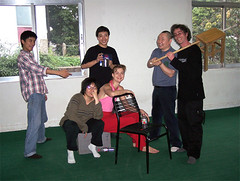
Fat Bird Rehearsal, August 25, 2006


first rehearsal dinner, waiting for godot

fat bird took the summer off, but reconvened to begin rehearsals for “waiting for godot”. it marks a move from the workshop format that we had been pursuing the past two years. however, it continues the fat bird tradition of adapting our performances to participants’ strengths; this time, we are taking our direction from judi moriarty. we hope to stage godot in mid november.

judi decided to work with fat bird in order to deepen her understanding of chinese people and culture. she believes that this happens through collaborative effort, specifically through the development of trust between all members of the group. accordingly, in addition to going over lines and blocking, rehearsals consist of exercises designed to increase trust. these exercises range from falling backward into someone’s arms and using two fingers to lift someone, to sitting on the truth chair and having to answer any question honestly. at the core of these techniques is the belief that what is true in a performance is the actors’ emotions and relationships; the performance builds out of and upon that base. it remains to be seen what each of us connects to in godot.

i have uploaded images of that emotional work.

个人魅力:thoughts in progress

it has been a weekend of meetings and rain, which means few pictures, but many words. it was also a time of unexpected insight into the importance of charisma. i’m not sure yet where this might lead me theoretically. nevertheless, it seems worth writing down how i came to this insight because that may allow me to track which of my assumptions are blinding me to something everyone around me is taking for granted.

the school i work for is changing its name and leadership. previously, the school was a branch of a famous beijing school. on sunday may 28, the school announced that it will be working with one of shenzhen’s most famous and successful principals to develop an elite program. throughout the speeches given both during the meeting and afterwards at lunch, it became clear that the school board understood previous failures to be failures of leadership. one of the board members summarized the situation as, “we didn’t have a shepherd, but we’ve always had high quality sheep. now that we’ve got a shepherd, everyone can relax” this sentence suddenly clarified for me what actually took place the day before, when yang qian and i met with tian qinxin, wang hanyi, and dai yu for lunch and three hours of conversation.

tian, wang, dai, yang, and i are not only involved in theatre production, but also friends of long standing. these friendships provide both companionship and the social matrix in which fat bird nests. this is important. the kind of charisma that seemed stressed this weekend was the ability to both nourish these relationships and use them to create theatre.

in the early 90s, tian qinxin worked in a shenzhen advertising agency and yang qian was a new functionary in the recently established nanshan district ministry of culture. both had escaped from beijing to shenzhen. yang qian had just given up on his first marriage and the possibility of doing journalism; he turned to playwriting to express through fiction truths that just-the-facts often missed. in 1994, tian qinxin’s ex directed yang qian’s play “intentional injury” for the chinese national experimental theatre. she was in shenzhen recovering from that break-up. for half a year, tian qinxin and yang qian got together to drink, smoke, and talk about theatre and lost opportunities. the two also worked with xiong yuanwei on one of shenzhen’s first theatrical productions, “i love mozart”. xiong yuanwei produced, tian qinxin directed, and yang qian played a “fat white hooligan”. (the expression “fat and white” refers to corrupt officials who do nothing but stay out of the sun and eat.) yang qian finally encouraged tian qinxin to quit her job and return to beijing. he decided to stay in shenzhen, however. tian qinxin is now the only woman director at the chinese national theatre and has won all of china’s top theatrical awards.

yang qian and i met dai yu in 1997, when zero sun moon produced “eternal return” as part of the hong kong handover celebrations organized by nanshan district. (i wrote about the szm years and “eternal return” in “Zero Sun Moon: The Cultural Politics of Seeing Performance,” Theatre InSight 10:1 (Spring 1999), 27-32.) that fall, dai yu left shenzhen to study playwriting at the chinese theatre academy, where tian qinxin has taught. today, dai yu is a functionary in the shenzhen ministry of culture. she was the one who helped yang qian register fat bird with the municipal government. most recently, she arranged for fat bird’s inclusion in the 2006 cultural industries fair.

wang hanyi is tian’s partner and collaborator. the two came to shenzhen because as part of the cultural industry fair, shenzhen municipality invited tian to stage her play 生死场 (place of life and death) at the shenzhen grand theatre.

so on the day that life and death premiered in shenzhen, the five of us gathered to discuss the possibility of making theatre in china. the conversation circled around the question of how to make theatre in an environment where “reforming” china’s main theatre troupes means “no longer providing financial support”. although she has not publically commented on the reforms, tian qinxin has an interesting position in this debate because her recent (very influential) kunqu production of “peach blossom fan (桃花扇) with the jiansu performance company (江苏省演艺集团) has been heralded as an examplar of why reform works. in this case, the head of the company invited her and other outside artists to nanjing to create a financially viable piece. and they did. so whatever she thinks about reform, her work is now offered as an example of the benefits of reforming state subsidized art institutions, specfically theatre troupes.

tian qinxin emphasized that by establishing fat bird, yang qian had opened a possible site for making theatre in this new environment. indeed, it was early in the reforms and so he had a chance to take advantage of new conditions in ways that other people didn’t. dai yu commented that for this to happen, yang qian would have to become more active. he couldn’t continue to keep himself aloof from society and pursue “pure art”. tian qinxin agreed, that in order to have the opportunity to do art, it was necessary for yang qian to pay his dues and create popular works.

just a few notes on what “paying one’s dues” might mean in practice. in part it means doing things you don’t want to do, like creating popular pieces that don’t actually inspire you. it means garnering awards so that you can convince officials you are in fact legitimate. it also means, going from friend to friend and asking them to contribute some money for the production. wining and dining all the folks that you need to in order to get it up. going door to door to door in order to sell tickets (and tickets must be sold so that you can pay back your friends, otherwise you’re incompetant). going university to university arranging to have the play performed for students, who are the biggest and most receptive audience to new works. implicit in all this is that one pays dues in order to become big because only these people have the influence to make the kinds of work they want to make.

wang hanyi then pointed to the traditional model of chinese opera troupes, where all the members supported one main performer. that main performer was the star of any production by the troupe. she pointed to mei lanfang as an important example of that kind of star. when it was time to stage a large production, which had several main roles, several troupes would collaborate and then break up afterwards. it was the 个人魅力 (charisma) of the central character that enabled a particular troupe to both attract an audience and to keep the troupe together. tian qinxin agreed that individual charisma was fundamental to accomplishing anything in china, not just theatre. “after all,” she said, “we have idolized emperors for 5,000 years. the point is to use this to make theatre.”

at first, i didn’t follow the logic that jumped from making theatre through a critique of yang qian, who was called a little master, aloof, and lazy to a discussion of traditional chinese opera troupes. no one else seem lost, however. indeed, yang qian thanked them for their advise. but in retrospect, it now seems that for tian, wang, and dai, yang qian had a responsibility not simply to lead the troupe, but to make it happen. they believed that the troupe was yang qian, and his decisions would shape whether or not all other fat bird members could make theatre. in this context, each of their comments became reminders that if yang qian was to make theatre, he needed to take charge of the troupe in a direct and personal way; he needed to become a shepherd, so to speak.

perhaps i am working with a different folk conception of “individual” than are my friends and husband. for me, the individual is expressed through doing what he or she wants; cooperation is the practice that links individuals in creative activity. however, at lunch yesterday, there were two understandings of cooperation in play–one between friends and one between leaders and troupe members. both forms of cooperation were important. my idea of the individual tends to preclude consideration of groups, but dai yu reiterated several times that yang qian needed others to accomplish his goals; he was too “independent” or perhaps too willing to maintain his independence vis-a-vis others. i also tend to downplay the importance of charisma in these forms of cooperation. yet, according to tian qinxin 个人魅力 (geren meili) was fundamental to the success or failure of theatre specifically, and social projects more generally.

it now occurs to me that “force of one’s personality” might be a more colloquial translation of what was at stake in her comments. she assumed that collective activity could only be achieved through the force of an individual’s personality, including the ability to pay dues, endure, and inspire others to follow one. she also assumed it was desirable to become this kind of a person. is that the difference between how i was hearing and they were speaking? not so much a cultural difference as individual preference? i don’t want all the responsibility that such a position would entail.

another discription of what makes a good core person/leader: 三个硬 (the three hards). a leader should have hard earlobes, so they know when to listen and when not to; a leader should have hard shoulders to shoulder responsibility; and a leader should have hard hands, so they can take charge and not let go.

yet another example: a friend told me that if there was a fire, leaders would leave first and then everyone else. if the leaders didn’t escape, no one else would. i asked if this was policy. no, my friend replied, it would just happen naturally. we chinese would wait for the leaders to go and then follow.

questions to think about: how might these descriptions fit into the category of “natural leader” that americans throw around? and should i go back to my weber?

an after-the-fact update. sunday night, tian, yang, and i had dinner with wei ping, a functionary still working in the nanshan district ministry of culture. wei ping lived in the same dormitory as yang qian in the early 1990s. she also participated in the “i love mozart” production. during dinner, tian qinxin reiterated many of the points she had made before. wei ping echoed these thoughts and than added it would be relatively easy for yang qian to make fat bird fly because he had “人缘 (renyuan)”. renyuan also belongs to the set of ideas/words/assumptions that make up a good leader. basically, i understand it to mean that if you have 人缘 your life is smoother because people like you and therefore are willing to help you. tian qinxin concurred and then told us about how many dinners she had to host in order to coax the jiangsu artists to work with her. yang qian, she concluded, shouldn’t be so aloof from other people. he wasn’t willing to pay his dues. if you did this work with sincerity, she emphasized, even relationships that start out with instrumental intentions might become happy collaborations. renyuan could transform awkward situations into opportunities; this capacity was in fact a pre-equisite for doing collaborative art like theatre.

第二届中国(深圳)国际文化产业博览交易会: Fat Bird in Shenzhen


fat bird theatre logo
Originally uploaded by mary ann odonnell.

This weekend (May 20, 21), Fat Bird participated in the second China (Shenzhen) International Cultural Industry Fair (May 18-21). Fat Bird’s inclusion mediated at least two of the paradoxes structuring cultural production in Shenzhen specifically and the PRC more generally. Fat Bird’s inclusion prompted members to design a logo for the troupe’s first official exposure in Shenzhen (see image left).

On the one hand, the Fair staged the tension between economic and political interests in cultural production. This was particularly the case in terms of regional and minority cultural forms. Ministries in the Guizhou Government, for example, negotiated contracts for performance troupes of local minorities. Likewise, Ministries from the Zhengzhou Government sold traditional Chinese culture from pre-historic times through the Song Dynasty. In a city like Shenzhen, where there is no recognized “local” culture, Fat Bird’s presence demonstrated the possibility that a new city could produce new culture.

On the other hand,the structured contradiction between high and commercial art continues to embarrass Shenzhen officials and residents, who believe it is not enough for the city to make money on culture. Instead, they advocate for Shenzhen investment in non-productive arts like the ballet or theatre. Only then, they say, will the city fulfill its duel task to build both material and spiritual civilization. Fat Bird’s presence at the Fair was evidence that high (non-commercial) art is possible in Shenzhen.

Below, I take the reader on a selective tour of the Cultural Industry Fair, introducing the meaning of Fat Bird’s unexpected, but in retrospect overdetermined inclusion. This entry is actually part of the process of digesting what happened at the Fair. I will add more as it comes to me.

The first thing to take note of is the fuzzy line separating politics from economics at the Fair. The Ministry of Culture of the PRC, the State Administration of Radio, Film and Television, the General Administration of Press and Publication of the PRC, the Guangdong Provincial Government, and the Shenzhen Municipal Government host the Fair. The Shenzhen Press Group, Shenzhen Media Group, Shenzhen Circulation Group, and the Shenzhen International Cultural Industry Fair Company, Ltd. sponsor the Fair. This division of labor reproduces the division between politics (hosts) and economics (sponsors). The hosts use the Fair to promote particular goals, while the sponsors provide the financial management necessary to stage the Fair.

This division of labor points to an ideology and practice in which the economic is understood as an expression of political will. In this sense, in producing the Cultural Fair, the Shenzhen International Cultural Industry Fair Company, Ltd. is not only doing business, but also (and more importantly) helping the central government achieve the goal of developing the national economy. The organization of displays at the Fair reiterated this logic, wherein the themes for each hall express goals that have been set by the government, and individual exhibitors pursue this goal.

Thus, the Shenzhen Convention and Exhibition Center has 9 halls. During the Culture Fair, each hall was used to display those sectors of the culture industry that the government currently promotes. Successes of Chinese Cultural Industry were displayed in Hall 1; Education institutions had stalls in Hall 1A; Hall 2 was dedicated to Conceptual Design; Media Technologies and Digital Imaging was located in Hall 3, while Media Technologies and Printing were in Hall 4; Visual Arts were displayed in Hall 5; International Performance Arts were located in Hall 6; Chinese Language Publishing occupied Hall 7; the most popular exhibition, Comics and Games were located in Hall 8; and in Hall 9 were the Industrial Arts.

A second effect of this fuzzy division is that within the Fair, provincial and municipal governments also operated as cultural companies. That is, in addition to hosting the Fair, Guangdong Province had its own display, as did Tibet, Zhengzhou, Guizhou, Hong Kong, and Macau. This equation of regional governments operating as cultural businesses explains Guangdong’s governor, Huang Huahua’s emphasis on tourism as the motor (spirit) of cultural industries; the Fair modeled a tour of potential cultural tours. Indeed, while being shown the fair, the governor asserted that, “Culture is the spirt of tourism. The success of the Culture Fair will stimulate the development of tourism and other third sector industries, improve the distribution of regional industries, and help strengthen production.”

In fact, regional government/culture businesses made out quite well. (I’m not sure what to call these amalgams of political and economic interest. If anyone out there knows of or might suggest a name, I’d appreciate it.) In a column titled “the sellers won, the buyers smiled”, the May 20, 2006 edition of the Special Zone Daily reported that the following contracts were signed at the Fair: The French “Disney” (as Futuroscope Theme Park is known in the Chinese papers) signed contracts with Guangdong Province for roughly 4 billion rmb (500 million US$); Guizhou signed contracts to attract and develop cultural industries totalling 7 billion rmb (875 million US$); Guangxi signed contracts totalling 3.7 billion (462.5 million US$), Henan signed contracts totalling 1.1 billion RMB (130 million US$). Located in western Shenzhen, Overseas Chinese Town, itself a place/government/enterprise also signed contracts for 600 million RMB (48 million US$).

This leads to a third point about the fuzzy line between politics and economics at the Culture Fair. The Fair itself provided the stage for all this contract signing. This suggests that the real business took place elsewhere between representatives from Chinese governments and foreign businesses. The cooperation between multi-national firms and bureaus within the Chinese Government is a pattern of development that we have seen before, as when Chinese President, Hu Jintao visited Microsoft CEO, Bill Gates in Seattle this spring. The Fair itself, therefore, seemed more a display of the success of the government in promoting cultural industries, rather than a place where commerce might grow. In fact, during the weekend, many parents bought tickets to bring children to see the various cultural exhibitions, especially the Comic and Games exhibit. If there was any business going on at the Fair, it seemed more a case of businesses building a network of face-to-face contacts that might grow into a contract signing ceremony at next year’s fair.

This emphasis on display took several forms. First, exhibitors called attention to their displays through the use of bright colors and loud music. Second, exhibitors made their displays mobile with handouts and costumed players, who moved throughout an assigned hall, directing visitors to a particular display. Third, a television or screen was the focus point of each display, so that visitors could see the cultural product, whether it was a performance or a new technology. Forth, each display became an enclosed space, reproducing some kind of idealized space. Walking through these spaces, I felt disoriented and unable to focus on any one display. And I rarely saw people stopping, unless they were playing computer games or resting and not looking at anything in particular.

Below are pictures of Hall 6 (left) and the Shanxi Exhibit (right).

So Shenzhen provided the space for the Fair. Shenzhen companies produced the Fair. Shenzhen digital art companies displayed their wares at the Fair. Shenzhen advertizing companies produced many of the exhibits at the Fair. And Shenzheners bought tickets to attend the Fair. Yet Shenzhen did not have any recognizably “cultural” displays–no traditional theatre troupes, no local minorities, no ancient ruins to sell. Instead, Shenzhen had a series of poster boards, which displayed examples of cultural events that had been held in Shenzhen. Here, the government focused on international and domestic troupes that had performed on Shenzhen stages, including the Bolshoi and the National People’s Theatre.

The Ministry of Culture also printed a Shenzhen Art map, which directed people to cultural sites in the city, including the Shenzhen Symphony Orchestra, various museums, and District level cultural centers. The map also references several “folk” sites, such as the Tianhou Temple in Chiwan, the Hakka compound in Longgang, and the Pengcheng city in Longgang. These signs of pre-reform culture have all been turned into museums. However, none of these sites appeared in the in the Cultural Fair.

Shenzhen thus found itself facing an interesting and from the outside seemingly unnecessary cultural “lack”. The kind of cultural industry that went into producing the Fair thrives in Shenzhen, but it still doesn’t count as “culture”. Instead, older, high modernist ideas of an opposition between mass (commercial) and high art continue to define the cultural sphere in which the Municipality competes for national recognition. At the same time, government officials don’t recognize local history as cultural heritage. Instead, they continue to assert that there was “nothing” here before the reforms of 1980. This double denial of cultural resources in Shenzhen created a crack through which Fat Bird could not only enter, but also be invited to attend the Cultural Industry Fair.

Importantly, Fat Bird’s status as a legal entity points to the fact that troupe members have support in the government. Moreover, Fat Bird’s friends are precisely the people who bemoan the City’s lack of high culture. Not that this translates into specifically economic support for the arts, but it does mean that at moments in which culture is featured, these friends find ways to help Fat Bird. Accordingly, we were given the use of the rest area in Hall 6. We were also allowed to perform “This Body, These Movements” on the Hall 6 stage. All other participants had to pay for exhibition space and for time onstage. So even though no money changed hands, we looked at this as a chance in which Fat Bird actually “earned” a commission for our work.

Below are pictures of Fat Bird founder, Yang Qian standing at the Fat Bird site (left) and Fat Bird members performing (right).

Fat Bird used this opportunity in two ways. On Saturday, May 20, we held a workshop in our space. The space was created through four points: a sign that said Fat Bird Theatre, a sign that announced workshop times, a ladder where we hung the backdrop for “This Body, These Movements”, and a display of photographs. The workshop format was modeled on previous workshops. However, we asked members of the audience to write two character (one word) evaluations of the performance on a sheet of paper. Journalists mentioned that it was one of the few sites in the Convention Center where it was possible to focus on what was happening. On Sunday, May 21, we walked around the Fair and looked for ideas for new pieces. Next weekend, each participant will show a piece created out of the their tour and understanding of the Fair. The working title of this piece is the same as the title of the May 20th workshop: Cultural Expression.

Given the ideology structuring the layout of the Fair, the title “Cultural Expression” is more than a little ironic. To the extent that all exhibitors could be understood as expressing political will in economic terms, Fat Bird’s presence staged one of the fundamental contradictions of post-Mao reforms. On the one hand, we did not disrupt the Fair. On the contrary, our display was sponsored by the government. The government could be seen as sanctioning our work, even as our presence legitimated particular claims about cultural production in Shenzhen. On the other hand, Fat Bird’s was the one non-economic display at the Fair. This was the moment in the performance that most of the audience appreciated (especially because most complained they didn’t understand the performances themselves). Many thanked us for demonstrating the possibility of non-commercial art. They also lauded our efforts to follow our dreams.

“This is how I want my daughter to live,” one mother told us.

Now, I don’t know if she really wants her daughter to stop studying for the college entrance exams to perform with us. I suspect she was voicing a desire for a society in which her daughter could pursue artistic dreams without incurring serious social repercussions. Right now, she lives in a world where last year 8 to 9 million people took the college entrance exams and only 1.4 million were placed. More often than not, that level of competition precludes following one’s artistic bliss, as students study the arts to improve their transcripts rather than their lives. So, I think this exchange called attention to a desire to re-interpret the current political will in non-instrumental ways, which would place human creativity at the center of society.

As I look at the four pictures added to this entry, I realize again how difficult it was to see at the Fair. Neon flattened to grey. That has to be where my experience started. In fact, by the second day, I noticed that participating in the Fair not only exhausted me, but also made me irritable. In part, I have placed these photos together to draw out the differences between Fair space and Fat Bird space. However, I also think I have placed these images here, rather than setting them off in a gallery, because they don’t look interesting to me. I think I took these pictures while looking away, rather than trying to see what was there, what might inspire creativity, what might be otherwise.

Six images from found objects were shown at the Culture Fair.

The official site of the 文博会 provides both Chinese and English language news coverage of the Culture Fair. For those looking for equally, but otherwise biased images and information, it’s a good place to start.

此身此行:fat bird in guangzhou


this body
Originally uploaded by mary ann odonnell.

over the may day long holiday, fat bird went to guangzhou to participate in the guangdong modern dance festival. the festival was divided into roughly three events: performances by established troupes, performances by young chinese artists, and workshops with established dancers. the performances by young chinese artists were short, roughly 5 to 10 minutes in length. fat bird performed “此身此行 (this body, these movements)”, which was developed over the course of the winter workshops. at the festival, this piece unexpectedly won a gold medal. unexpected because only one fat bird member was trained as a dancer. however, it seems that a willingness to put amateurs onstage was one of the defining features of experimentation at this year’s festival, where the technical quality of the dancers often overwhelmed the dance itself.

to the right is a copy of the poster for the performance that i designed. it is a reinterpretation of the photos that dominate official funerals. during the performance a larger version of this image (without writing) hung onstage. fat bird members yang qian, yang qie, and hou junmou walked across stage and bowed to this photo, while dancer liu hongming performed a series of intentionally discordant movements. yang jie created the music mash “此地此时 (this place, this time)” for the piece. as promised, “此身此行 (this body, these movements)” is now online.

多一事不如少一事: regulating space

yesterday fat bird held its weekly workshop at shenzhen university. we had been rehearsing in one of the rooms assigned to the acting department, but decided to work outside the gym, where faculty and staff play badmitten, swim, and learn gongfu. the gym building has set-in doors that are well-shaded and because usually locked, these entryways provide semi-private outdoor rehearsal spaces.

as we rehearsed, some of the gym’s patrons stopped to watch, but most glanced our way and then moved on. however, the gym security guards kept circling past and one finally stopped to ask who we were and what we were doing. we said we were university teachers and students working on a project. the guard grunted and then moved on. about fifteen minutes later, he returned and asked to see our i.d. cards. several participants began arguing with him. fat bird asserted its right to rehearse in the gym space because (1) it was public space and (2) we were members of the university community.

to understand why the security guard came over a bit of background information is in order. during the sars panic of 2003, the university quarrantined the campus. students who lived on campus were not allowed to leave; if they did, they were not allowed back in. in theory, only staff and students who lived off-campus and had appropriate identification were permitted in and out of the campus gates. however, in practice, the university continued to let construction teams on campus. pre-sars, shenzhen university was one of the few, if only, campus to which the general population had free access. since sars, however, the university has tightened restrictions on entering the campus; security guards at one of four gates now regulate access to the university. indeed, in an important sense, they determine who the community might be. all this to say that the sars panic increased the guards’ power to regulate who comes on campus as well as the behavior of folks on campus. (it probably doesn’t need to be said that construction continues unabated as the administration fills in “empty” space with new, improved, and obviously expensive buildings.)

so at the core of the debate between the security guard and fat bird participants was the definition of public space within a space that had been re-designated as private space three years ago. fat bird insisted that “public” meant anyone who could get onto the university. we had, after all, been vetted at the campus gates. public space on campus was therefore available to anyone in the university community to use. in contrast, the security insisted on his responsibility and right to monitor the activity of anyone using the gym. he applied the logic of gates to the gym; one had to demonstrate one’s right to be there.

yet, what obviously drew his attention was how we were using gym space. it seemed that because he didn’t understand what we were doing he wanted us to do it elsewhere. he wasn’t asking us to leave the university, just the section for which he was responsible. there was no indication that what we were doing broke any laws, but rather, that it was inconvenient for us to be there. from the guard’s point of view “one thing less to worry about is better than the alternative (a very, very loose translation of the expression: 多一事不如少一事)”. fat bird has encountered this kind of monitoring public performance in other spaces. in the summer of 2003, fat bird organized a series of improvised responces to symbolically important spaces called “human city”. at several of these places, security guards interupted the performance and asked us to leave.

it is worth noting an important difference between security guards and the police. security guards are hired by private organizations to regulate and monitor use of private space. the police monitor and regulate public space. at one fat bird performance, the security guards actually called the police; we ran away before they showed up. so one of the morals of this story: we are more likely to argue with security guards than with the police.

a second and more sobering moral of this story has to do with regulation of expressive life in the prc. most of us are aware of the prc’s ongoing attempts to censor the internet. this very public battle is important. however, fewer of us are aware of the extent to which regulation takes place at the private level. security guards are just one symptom of a pervasive tendency on the part of private companies and organizations to pre-empt trouble by shutting down that which they don’t understand. throughout shenzhen, security guards monitor gateways into housing, commercial, and industrial developments. then within these spaces, security guards are placed at the entrance to each individual building within the development. the relationship between gate and gymnaseum guards at shenzhen university reproduces this all-too-common way of regulating space. the expression “less is more (多一事不如少一事)” in this context refers to the idea that it’s better to avoid trouble, than to take risks. this means that even if citizens aren’t breaking any laws, security guards nevertheless may (try to) stop them from using space in unconventional or unexpected ways.

unfortunately, the less is more approach to using space permeates our consciousness, so that censorship on expression goes all the way down. after the security guard left, i said that if we wanted to change the guards’ responce to us, we should report them. one of the fat bird members said that they would rather try to convince the guard to leave us alone because it wasn’t worth reporting them.

“what would the head of security do anyway?” she continued, “instead, if this keeps up, i would rather find someplace else to rehearse.”

sometimes, less is just less.

you be the judge. please check out a clip from the 13 may 2006 fat bird workshop. during the workshop, we continued working on new experiences of the body, specifically limiting the body in space.

SiloTheatre visits Fat Bird

This weekend, Jochem and Milou, friends from SiloTheatre (Amsterdam) visited. Jochem and Milou have been in Hong Kong collaborating with Theatreworks to create a site-specific work. Yang Qian and Song Jie (Fat Bird members) first met them during the Macau Arts Festival, 2004. Jochem and Milou, along with other members of SiloTheatre came to Shenzhen University after the festival to create some pieces with Song, Yang, and Song’s acting students.

Jochem and Milou are interested in the exploration of objects and space, and how movement animates the possibilities latent in any arrangement of things. This emphasis on using what is present at every moment, including sounds “outside” the acting space or audience reactions, dovetails with the artistic trajectory that Fat Bird has pursued: improvisation and exploration of one’s limits as both the method and end of performance. Accordingly, every workshop is simultaneously practice and a finished piece, or perhaps its more accurate to say that each workshop constitutes a moment in an ongoing collaboration. In this sense, Jochem and Milou’s visit picks up and reweaves previous collaborations as well as whatever happened in between visits.

Since September 2005, Yang Qian, Liu Hongming, and Yang Jie have been meeting every weekend to work with different objects and explore different spaces. A playwrite and poet, Yang Qian has been exploring the limits to language and sound. A dancer, Liu Hongming has been working through and against his formal training. A violinist and composer, Yang Jie is exploring digital manipulation of sounds. A piece emerges as the three occupy a space and then begin to use the space. The have performed outside in Shenzhen University as well as a rehearsal hall. When there is an audience presence they have incorporated the audience into the workshop. Sometimes, Yang Qian will ask for words, and those will be the core of his poetry composition. Other times, Liu Hongming or Yang Jie will ask for an object. The three take turns leading the piece—so a piece might begin with language, movement, or sound. On May 1st, the three will participate in the Guangzhou Festival of Modern Dance.

On April 1, 2006, Jochem and Milou joined the Fat Bird Workshop for an afternoon of improvisation, discussion, and dinner. I will upload a clip from the April 1, 2006 Fat Bird Workshop. In the meantime, I have also posted pictures of us siteseeing in Shekou and Overseas Chinese Town. I suddenly realize how found I’ve become of posing as a tourist in order snap pictures and make friends.

divine garbage

in the summer of 2003, fat bird theatre members produced a series of workshops on the meaning of shenzhen’s diverse urban spaces. the first piece “the human city” was performed in diverse sites throughout the city. the second “the divine city” was performed at shenzhen university. the video Divine Garbage documents the performance of “the divine city” during december 2003. it was edited in the summer of 2004.

fat bird salon, 17 September 2005

Yesterday was mid-autumn festival. The day before, Fat Bird held its second salon, this time at Rao Xiaojun’s studio, Raw Designs. The first salon featured poetry readings by Steven Schroeder, Yi Jihui, and Yang Qian, as well as pictures by Kit Kelen and Mary Ann O’Donnell. Kelen also contributed a music composition.

The second Fat Bird salon functioned as an open workshop, with an audience of 15 people watching, listening, and commenting on the work-in-progress, which is tentatively called “Materializations”. Over the summer, Liu Hongming, Yang Jie, Ma Yuan, Yang Qian, and O’Donnell met together to discuss how one might create within and beyond disciplinary constraints. By training, Liu is a dancer, Yang Jie a violinist, Ma an architect, Yang Qian a journalist, and O’Donnell an anthropologist. Each is interested in reworking the materiality of their art. For Liu, this has meant retraining his body to move both arrhythmically and distanced from music. Yang Jie taped the sounds of moving water—urine, tap water, rain, a shower—and then digitally manipulated these sounds, adding vocals and piano. Ma has been using sculpture to redefine space. Yang Qian read from “Language Materializes,” a series of written pieces, which explore cultural grammars (rather than events) as generative of meaning. In an attempt to move away from ethnographic documentary conventions, O’Donnell presented 15 photographs of Shenzhen walls.

The work of John Cage and Merce Cunningham has inspired this ongoing collaboration, as the five work independently on specific projects and then present them together at different sites. Participants can then use the others’ works in the creations of new projects, expanding the definition of “site” to include video projects, installations, and new texts that grow out of the conversation and its realization as a particular “salon”. In addition to emphasizing the way that meaning materializes through chance operations, these projects, both separately and collaboratively, mobilize self-reflexivity in the service of creativity. Indeed, this has been one of Fat Bird’s core obsessions: what does it mean to be an artist in a city like Shenzhen, where there are few organizations dedicated to creating and presenting new art? Of course, the upside of the material constraints that artists working in Shenzhen face has been to force creative to cross-disciplinary lines, both within and beyond their circles, generating a wonderful eclecticism.