I am translating Deng Shijie’s We Chat post of the Flash Exhibit he created at the Jiada Printing Factory in Baishizhou. It was one of several Labor Day events organized by the current Handshake 302 Artist-in-Residence, Lao Tu. Continue reading
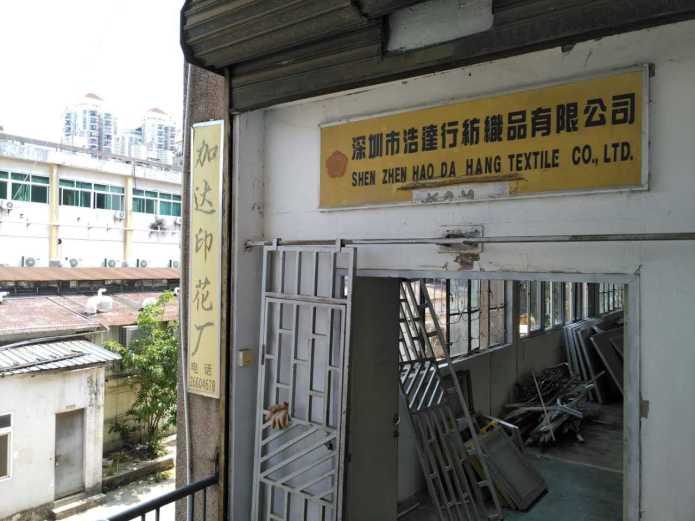
I am translating Deng Shijie’s We Chat post of the Flash Exhibit he created at the Jiada Printing Factory in Baishizhou. It was one of several Labor Day events organized by the current Handshake 302 Artist-in-Residence, Lao Tu. Continue reading

Yesterday, I visited the two-day exhibition that Xu Lan (徐岚) put up in a one-bedroom apartment (2,400 / month) in Tangtou Block 6, Baishizhou. The exhibition took place over two days (Jan 8 and 9, 2017) and comprised mountain and water sketches / illustrations from a week-long stay (previous) in Baishizhou. The series itself is part of an ongoing project of travelling and documenting those travels. The inspiration for the exhibition (as narrated by Xu Lan) was random (偶然). He was thinking of the painter Qi Baishi (齐白石) and painted his own “Baishizhou” and then decided to show the works in Baishizhou, Shenzhen because he remembered having been here once.

They will soon begin digging the basement and putting in foundation where the Shahe Creative Park used to be. As I have yet to invest in a drone, I resort to climbing–past the five&dime, the yoga studio, the taikwando studio, and the Shahe Creative Park Office–to the top of a partially cordoned building to take pictures of the changing landscape:

Last night, the Baishizhou Squad (as I think of the loosely organised group that is dedicated to documenting and finding alternatives to redeveloping urban villages) held a “flash exhibition” of images from their “Don’t Demolish Baishizhou” series. The entire performance took 30 minutes: 25 minutes to put up the images and then roughly 5 minutes for the city management folk to take them down. They chose to put the pictures up near the pharmacy, which is contesting the demolition in order to secure compensation for his investment. Continue reading
This is just a short note on a conversation that I had a few days ago with an entrepreneur who lives in Baishizhou. She’s a millennial, runs a small business, earns over 10,000 a month, and lives in Baishizhou. Why? Because she wants to buy a house in Shenzhen and living in an urban village is the only way to save money for the down payment. It turns out she’s not alone. Her friends who want to purchase a home in Shenzhen are opting to live in a village, while friends and other millennials who have decided not to buy a home are renting in housing estates. On her account, even folks who are making upward to 20,000 a month are choosing a village if they want to buy a home, while their colleagues who aren’t saving for a home are paying three to four more times a month, traveling, and spending their money and time cafes, microbreweries, and music venues. These are, of course, first generation migrants. Most second generation migrants have houses through their parents, who migrated to Shenzhen before the 2004 housing price boom.
Takeaway? We’ve known for a while that many nearby firms provide dormitory housing in Baishizhou, while many architects and designers who work in OCT firms have opted to live in the village for convenience. It seems, however, what we hadn’t picked up on (or has only recently emerged) is the extent to which the desire to buy a house in Shenzhen is shaping the way that millennials are inhabiting the city and reshaping the urban villages.

Walked Baishizhou yesterday with nine others, a group of tourists large enough to attract the attention of children who thought we were English. Sweaty and somewhat irascible, I countered, “We are German and Austrian, Indian, American, Chinese and Taiwanese.” Indeed. The attention that is paid to Baishizhou grows, even as both demolition and upgrading proceed, albeit in different parts of the neighborhood. So a walk through the eastern section of Baishizhou. The above photograph from the sixth floor building is aimed eastward, toward the OCT to contextualize the walk, and bring int into focus the vanishing act in play.
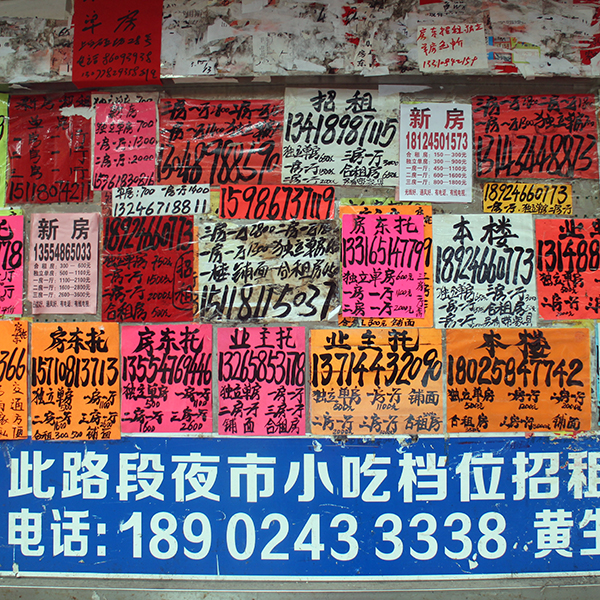
It’s been a long time coming. Or not. Roughly a decade after Shenzhen targeted urban villages as “dirty, chaotic, and substandard” and less than five years after Gangxia changed how we thought about compensation, the official Shenzhen press has indicated its time for the city to change how it thinks about urban villages. Continue reading
The city is man’s most consistent and on the whole, his most successful attempt to remake the world he lives in more after his heart’s desire. But, if the city is the world which man created, it is the world in which he is henceforth condemned to live. Thus, indirectly, and without any clear sense of the nature of his task in making the city man has remade himself.
-Robert Park
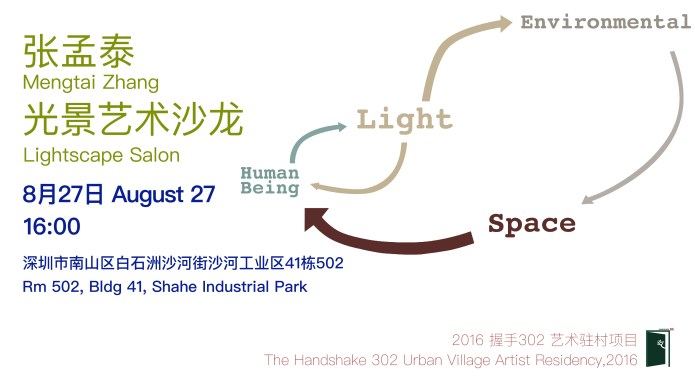
Lightscape focuses on the relationship between sensory experience and external structures within the city. Continue reading

Tomorrow afternoon, Handshake 302 collaborates with Future+ to explore the Baishizhou soundscapes. The workshop program begins with an hour-long tour to collect sounds and a 1.5 hour sound workshop with resident artist Zhang Mengtai. Meet-up at Baishizhou Metro Exit A.

It is one of the ironies of publicity that site and time-specific artworks are regularly transformed into texts. On Sunday, September 31, for example, resident artist Zhang Mengtai held an open house in Handshake 302. He built an amplifier that transmitted sounds he had collected in Baishizhou and then compiled into a soundscape. Abstracted from the noisy jumble of handshake allies and crowded streets, the honking cars and migrating dialects that Mengtai recorded seemed delicate, almost lyrical in their evocation of Baishizhou. We were entranced. But this text is not that experience. Continue reading
 Shenzhen Noted