baishizhou superhero!

Baishizhou Superhero has been installed at Handshake 302. Come and see and play with the first urban village superhero photo stand-in!

superhero

Below, the curatorial statement for the installation.

Baishizhou Superhero

Superheroes navigate the debris of urban despair, haunting the rubbished alleyways and crumbling staircases that lead to cramped spaces at the end of unlit hallways. They appear as exaggerated silhouettes or bursts of neon light. They leap over tall buildings in a single bound and rescue the victims of unfettered greed and malignant desire. Most importantly, superheroes represent the fantasy of latent potential and unlimited transformation in these techno-modernized times; mild-mannered, nerdy and bureaucratically inclined Clark Kent steps into a telephone booth and strides out a decisively manly man, who rights systemic wrongs through physical prowess. Hooray!

In the installation Baishizhou Superhero, Liu Wei’s playful cartoon characters transform Handshake 302 into a magic telephone booth. Visitors step into the space and through the power of a photo stand in become one of seven possible urban village superheroes – Methane Man, Wonder Granny, Stir Fry Fly, the Amazing Beer Babe, Village Guardian, Super Dog, or Cat-a-go-go. Friends can then take pictures of each other as they model the most common social roles in any of Shenzhen’s urban villages.

At first glance, the installation seems a tacky party game until we remember that these social roles – deliveryman, child care provider, food hawker, beer waitress, and village fireman – are the vehicles through which migrant workers transform their lives. Each migrant worker undergoes the sometimes exhilarating and often bizarre transmogrification from ordinary peasant to urbanite. However, the Baishizhou Superheroes also sustain Shenzhen’s economic boomtimes. After all, these superheroes provide the services and social network that Shenzhen’s factory workers need to make themselves at home in the city.

At second glance, the insidious charm of the installation becomes even more apparent. There is no doubt that human beings have latent potential to transform ourselves and our lives. The Shenzhen Dream hinges on this fact and migrants come to the city in order to improve their material lives. Within the maelstrom of globalization, however, the latent potential of human beings to transform ourselves has been limited by the necessity to commodify ourselves. The super power of an unpaid grandmother, for example, is to create value by providing unpaid childcare so that both fathers and mothers can join the gendered labor force, as deliverymen or waitresses.

The “super power” of all Baishizhou migrants is, in fact, the power to sell their labor on an unregulated market for as long as their bodies hold out. A popular expression maintains that migrant workers “sell their youth”. As individuals, there are limits to the scale of transformation. When a deliveryman’s legs can no longer pump a bicycle or when a waitress’ breasts succumb to gravity, these workers are replaced by younger, more energetic migrants. And there’s the fantastic allure of the superhero myth – unlimited strength to endure and transcend physically exhausting and emotionally alienating jobs.

Participating Artists: Lei Shenzheng, Liu Wei, Lv Linxuan, Mary Ann O’Donnell, Yang Qian, Zhang Kaiqin, Zhang Yan, Zhou Tianlu

Hours: Weds 19:00-21:00; Sat & Sun 15:-17:00, or by appointment.
Access: Baishizhou Subway Station Exit A, walk north to Jiangnan Baihuo Supermarket, make left down alley, follow to Shangbaishi Block 2 Building 49 (above the flip flop store). Ring bell and come up.

handshake 302 is on the map!

We’ve been included on the Fringe Urbanism [2013 UABB*HK Exhibition] map by Chris Gee and his collaborators. To check out the edgy contexts of alternative urbanizations in the region click link below the map. Yeah!

what to see when visiting shenzhen…

The other day I had an interesting conversation about Baishizhou with a friend visiting from neighboring Hong Kong. In a nutshell? She asked me what there was to see in Shenzhen that would be intrinsically interesting to someone who knew nothing about Shenzhen. She remarked that it was easy to figure out what to see in Shanghai and Beijing because they had a history. I mentioned that I have blogged on this very topic, including touristy suggestions.

I then said something less gracious to the effect of “If you can’t be bothered to learn about Shenzhen before visiting, maybe you’re not here to visit the city. Maybe you’ve come over to go shopping at the Luohu Mall or Book City.”

The problem, of course, is that ignorent global trotting passes for global chic living. We expect to arrive in an unknown place and to be able to read the lay of the land immediately, as if our homegrown geographies might be easily transported thither and yon. In a sense, the frustration we feel comes from a misplaced sense of entitlement: the world is my oyster. I know oysters. I should be able to open this oyster, grab the pearl and move on to the next delicacy. And while I’m at it, I should have the help of friendly English-speaking underpaid minions, who are not only not going to take advantage of my ignorance, but also show me where to find bigger and better and cheaper oysters because they. like. me.

Arrr.

Of course, tourists don’t want to visit an actual mall; they want something “authentic”. But as my friend pointed out, they don’t want to visit Baishizhou either because it is not self-evidently legible. Tourists — whether homegrown or from elsewhere — want something in-between the global standardized mall and actual working class neighborhoods, something edgey without being dangerously sharp. Something like a cheap Xintiandi (新天地).

And there’s the rub. The expectation that Shenzhen should be immediately legible to tourists and other strangers is itself a species of mall-think. Mall-think refers to the idea that the world has already been standardized into chain-stores that sell, among other things, samples of local history and culture. By extension, mall-think tourism refers to the idea of one-stop tourism (I visit Dongmen, the Civic Center, and Huanggang Village) which will produces a pre-conceived and therefore “intrinsically interesting” experience the Shenzhen difference.

Xintiandi, is of course, the most obvious and obviously successfully of mall-think development. The fact that they are expanding from Shanghai to Chongqing, Foshan, and Guangzhou should really be a wake-up call; Euro-American mall-think is transforming the Chinese landscape into accessible and therefore interesting shopping experiences. The view from Baishizhou reminds us, however, that mall-think tourism confuses global recognition with authenticity, and in doing so fails to see the intrinsic value of working class lives.

there is no city here…

The translation of 城中村 as “urban village” misleads. In fact, it is more accurate to call them urbanized villages, with the understanding that a village is not simply a rural settlement, but also and more importantly a corporate entity. The village settlement became urban, and in the process created a class of corporate land owners, who own the buildings. Thus, for example Baishizhou, where several thousand households control the real estate where 140,000 people live. Dalang Precinct (大浪街道) has an idegenious population of 8,000+ with a migrant worker population of over 500,000. The villages and some villages are not poor, they are the “local rich”.

Dachong, Hubei, Baishizhou — the list of urban villages that have been or are in process of being rennovated (a euphamism for razed and rebuilt) is, of course, the list of the most important real estate developments in contemporary Shenzhen. The plans for these new neighborhoods resemble those of Southern California, with climate controlled buildings, exquisite landscaping, and carefully planned walking areas.All this to say, when not talking about the need for low income housing (for both the working poor and recent college graduates) or rejoicing in the messy, cheap convenience of urban villages, the general Shenzhen consensus about urban villages in general is that the buildings and environment sub-standard. The goal is to replace them with neighborhoods that have enormous shopping malls at their center.

Now, the ideological irritant is the extent to which young intellectuals and urbane Shenzheners have coded the suburban impulse as tasteful, while the guilded buildings of the village corporations are being called “dirt wealth” buildings (土豪楼). In other words, there is something worse than being “exploding” or nouveau riche (暴发户); one could be “vulgar” rich, or 土豪. Indeed, vulgar rich is the term used to describe the skyscrapers and office buildings that villages (or individual villagers) have commissioned. The problem, of course, is that the logic of building vulger rich buildings is the same as building nouveau riche buildings. Urban villages and suburban cities hire the same architectural firms, use the same materials, and aim for the same symbolic ends — to announce their social importance. The only difference is the exterior of these buildings; where’s the guilded tipping point from nouveau to vulgar riche?

More importantly, the cultural coding of suburban urbanization as “tasteful” and rural urbanization as “tacky” misses the point — neither urban typology completely nourishes the human soul because both forms rely upon exploitation and exclusion in order to generate the capital investment necessary to build and rebuild Shenzhen.

handshake 302 opening

Handshake 302 opened yesterday! We held our opening at the Baishizhou Cultural Plaza, where we distributed 1,000 balloons to neighborhood children. People chatted at our information table while waiting to be guided to the art space. For over 3 hours, Kaiqin dialogued with visitors about the installation, Special Forces, and the importance of public art. At 5, the second part of the day began, with a workshop led by Pete Moser. More Music Baishizhou brought together 20 members of CZC special forces to workshop a song about Baishizhou and plastic stool percussion. Then Pete shared his fabulous one-man show with residents. Impressions, below:

This slideshow requires JavaScript.

handshake 302 sneak preview!

We’re installing Accounting at Handshake 302! The opening happens October 20 15:00 to 17:00 come and enjoy an afternoon of public art in the village. Later, at 19:00 Peter Moser brings his community music project to the Baishizhou Culture Square. Impressions and map to Handshake 302 as well as the Culture Square, below.

This slideshow requires JavaScript.

czc manifesto (of sorts)

CZC logosCZC特工队 (tègōngduì) organized in 2012 in order to discuss, plan and support creative engagement with Shenzhen’s urban villages. Three questions have inspired us.

1. What can be learned and gained from returning to the urban villages?

2. How can handshake efficiency apartments, densely crowded streets, and bustling small plazas be repurposed as cultural spaces?

3. How can creative interventions motivate Shenzhen residents to cross cultural and economic difference and discuss our common urban condition?

Our decision to locate our art space and the performance series, Handshake 302 in Baishizhou, one of Shenzhen’s most (in)famous villages, constitute concrete answers to these questions. We hope that each visitor to our art space and every audience of a performance will use these diverse works to discuss and formulate their own answers to these questions, stimulating a rediscovery and re-evaluation of Baishizhou – the good, the bad, and the ugly.

In order to integrate art exhibitions, performances and research with the residents of Baishizhou, we are collaborating with the Shenzhen Baishizhou Investment & Development Company. We also attempt to purchase supplies from Baishizhou shops and vendors.

We welcome collaboration with artists, performers, and scholars from Shenzhen and the rest of the world. Please contact us if you have a project to realize in Baishizhou or another urban village.

Handshake 302 has been selected as a collateral exhibition of the 2013 Shenzhen-Hong Kong Bi-City Biennale of Urbanism\Architecture.

handshake 302

CZC logosCZC特工队 is a group organized to engage Shenzhen’s urban villages through art, theater, and social media documentary projects. Our first project is called “Handshake 302”.

The concept behind Handshake 302 is simple: Baishizhou is our “artspace”, which has its office at Shangbaishi, second block, building 49, apartment 302, a 15 sq meter conveniency apartment in Shangbaishi.

We will use the actual apartment to commission and develop installations. Our first project is “Numbers” and will open on October 10. In addition, we work with visual artists, performing artists, and writers to develop projects that engage and extend Baishizhou. We will use the Baishizhou Culture Plaza (and outdoor stage) to develop performance pieces. On October 20, for example, Peter Moser will work with local street musicians to create a communnity concert. We also encourage artists and performers to create and install / perform works throughout Baishizhou. Fat Bird, for example, is currently developing a piece that uses the Tangtou rowhouses as their stage.

Handshake 302 has been accepted by the 2013 Shenzhen-Hong Kong Architecture Biennale as a collatoral venue, bringing Baishizhou into conversation with the main venues in Shekou.

Impressions of 302 and its immediate environment, below.

This slideshow requires JavaScript.

even maoist spaces crumble and fade…

Only eleven houses remain occupied in Baishizhou’s Tangtou row houses.

Nanshan District tacitly condemned these houses several years ago, but did not become serious about evictions until the Universidade (Summer 2011). As inhabitants were evicted, the District padlocked the doors, so that the buildings could not be reoccupied. However, as the saying goes, “Those on top have policies, those on the bottom have countermeasures (上有政策,下有对策)”. When houses weren’t immediately padlocked, another family or worker or group of friends moved in. The owners continued to collect rent. When enforcers from the Urban Management Bureau (城管) came by either the inhabitants moved, or made friends with them and stayed, waiting for the final eviction.

This wait and see attitude has been much more successful for inhabitants of houses where the landlord is either in Hong Kong or further abroad. As a 4-year resident said, “Property managers don’t care what we do because the absent landlords are legally responsible. All they have to do is collect rents and their paychecks. I’m polite to urban management and they leave me alone. We’re all human, and when it’s time to move, they’ll tell me.”

Nanshan District has decided to close down the area completely because the summer rains further weakened the structures. These buildings from rural collectivism are no longer simply considered an eyesore, but also dangerously unsound. The vanishing of Maoist economic legacies was, of course, one of Shenzhen’s raison d’etre. However, Maoism lingered in the nooks and crannies of previously built spaces, such as Tangtou. Indeed, the Tangtou row houses are one of the few remaining examples of Maoist architecture in Shenzhen’s inner districts and once they have been razed, Maoism will become more of a spectre than it already is.

Thought du jour: in Shenzhen, even crumbling, Maoist dormitories can no longer safely shelter the city’s poorest workers and their families. Wither the left, indeed.

Impressions of Tangtou wet and sunny, and still occupied interior.

This slideshow requires JavaScript.

轮侯制: economizing moralities

In the United States, we make an economic distinction between “needs” and “wants”. We teach children (here, here, and here, for example) to recognize and manage the difference between their needs and wants. Subsequently, we re-code these management skills in terms of individual ethics — good people recognize their needs and wants, and then make rational choices to live within their means. In contrast, bad people make irrational choices based on uncontrolled desires that lead to debt and bankruptcy.

e9ec64bb5bcb

The flip response — “one girl’s need is an aging man’s want” — to this statement merely confirms the underlying double bind of this economizing morality. In this financial literacy exercise, for example, only the social facts of suburban car culture, supermarkets, and fast food restaurants conspire to make white bread, bottled water, and a tent vacation “needs” in contrast to the “wants” of a bicycle and a pizza. What if our built environment depended on bikes for transportation? What if we were homeless and the best we could cobble together was a tent made of discarded plastic and corrugated steel? In these situations, the economizing morality is to recalibrate our personal needs and wants rather than to challenge the inequality that poses this choice as reflecting real world conditions.

All this to say: the economizing morality of individual needs and wants is the elementary school version of neoliberal ethics.

I’m thinking about individual needs and wants and neoliberal immorality for two interrelated reasons. At the level of urban planning, given the prime location of urban villages and the lack of developable plats in Shenzhen, the villages were targeted for redevelopment (or renovation — 更新 as a verb). In turn, the need for neighborhoods for the working poor has been recoded as the need for individuals with Shenzhen hukou to find affordable housing. A shift of hand, and the debate ceases to be about communities and becomes one of individual economies. Moreover, convenience, access to schools and social infrastructure, as well as economic opportunities are concomitantly transvalued as wants to be satisfied through economizing.

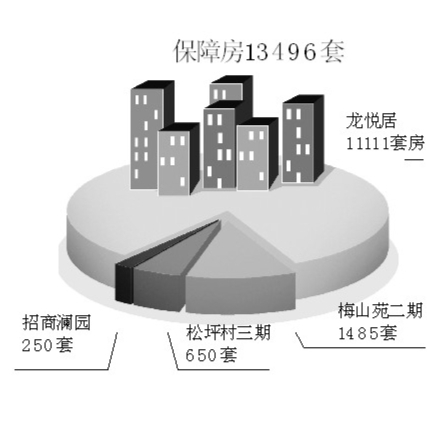
res01_attpic_briefOn January 31, 2013 for example, the Municipality made available 13,496 units of public housing. Of that total, all are located in the outer districts (guanwai) and the majority (11,111) are located in Longgang, roughly 35 kms from the city center. To allocate these units, Shenzhen will be testing what is known as the 轮侯制 or “revolving wait system”. Basically, this system entails meeting conditions, including hukou status, time in Shenzhen, and maximum income to apply for a residence. When any of these conditions change, the family has to move out of the unit, thus opening it for another. The family also has to find another place to live.

In Shenzhen, those opposed to urban renovation projects have been reminding the Municipality out that urban villages like Baishizhou already provide low-cost housing and small scale economic opportunities for working poor families. Moreover, the given the Municipality’s demographics 13,496 housing units are sufficient to absorb displaced populations only when those with hukou may apply. Point du jour: locating public housing far from urban centers only makes moral sense (cents!) in a world in which individual economizing ideologically justifies disrupting neighborhoods for the working poor in order to pave the way for developers. And yes, this is just more evidence that China and the United States really are the same country.