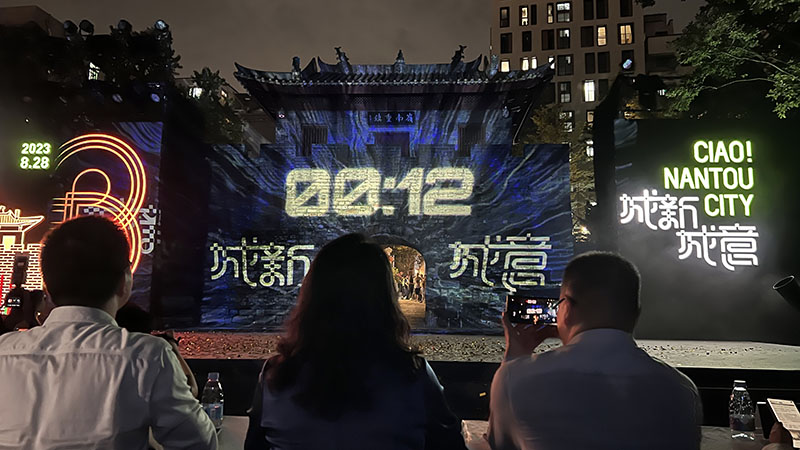
obligatory olympic torch entry


中国加油!

i have been avoiding discussing the olympic torch procession, hoping that the sadness and the confrontation will soon lift, so that conversation might begin again. nevertheless, today i joined the crowds at city hall (市民中心) to greet the torch in shenzhen. originally scheduled to begin at 8 a.m., the procession was rescheduled for 12 o’clock. in those four hours, thousands gathered on city hall lawn and marched in the roads chanting: go china! go beijing! go olympics! (中国加油!北京加油!奥运加油!) meanwhile, police cars circulated, broadcasting the recorded message: the torch procession will not begin until noon, please go home and watch on television. those police officers not directing pedestrians or traffic were, like the rest of those of us, taking pictures.

comments heard:

my throat is so hoarse from screaming i can’t talk.

they [the government] is afraid of something happening (出事).

it’s 32 degrees, how many people do you think have fainted?

a worker from sichuan encouraged me to spread the word about how great this was for shenzhen. he reminded me that he wasn’t from here, but that he had many opportunities. he then started talking about a subject that seemed even more urgent: his lack of english skills and did i know anyone who could help him apply for u.s. copy rights for the products his company produced?

however, all the carnivalesque excitement, notwithstanding, i soon felt bored and started taking pictures of the amazing cloud formations that accompanied the torch. whatever else happened today, pictures of the event will show shenzhen shining beneath blue skies and white clouds. i then joined friends for lunch,who unlike the crowds outside seemed mildly frustrated by the whole thing. one commented that on days like this, he thought chinese people were pitiful; don’t we care about anything else? he asked rhetorically. another joked: thank god for schools and assembly lines, otherwise where would we keep all these people?! the fourth boasted: on a day like today you can get away with anything. no one knows who you are, and so no one stops you.

indeed. obligatory pics of olympic torch procession, shenzhen.

大鹏所城: on cultural history


dapeng suocheng inner garden

Once or twice a decade, I want material proof–as opposed to theoretical reconstruction and anthropological speculation–that Shenzhen has more than 30 years of culture. Usually, I go about asserting long term cultural occupation of the area as if it were a self-evident truth. Even if the landscape isn’t what it was or the buildings are less than ten years old, I say, there are deep histories histories here: listen. However, as I just mentioned, once or twice a decade, my resolve falters and I wonder: is it possible that what my informants and friends say is true? That Shenzhen doesn’t have any culture?

Now 文化 (wenhua) seems to me tricky to translate because its tied up in understandings about history and accomplishment in ways different from the english word, culture. For example, a maid explains that she hasn’t culture (我没有文化) because she didn’t go to high school. Or when I say I like hakka food, a friend agrees that Hakka culture is rich (客家文化很丰富). Or again, when someone asserts that unlike Beijing, Shenzhen doesn’t have any culture (深圳没有文化) because it is a young city. In hese three examples, the meaning of culture ranges from education through culinary traditions to imperial history.

Located in Longgang District on Daya bay,大鹏所城 or Dapeng Garrison is an anomaly in the Shenzhen landscape–by all counts it is culture of the highest kind. The garrison, which gives Shenzhen its nickname “roc city (鹏城)” is one of only 2,351 national important cultural relics (全国重点文物保护单位). Throughout the Ming and Qing dynasties, soldiers stationed at Dapeng protected the area from pirates and colonial forces. Architecturally, was a walled garrison city, including housing for roughly 1,000 people, at least five temples, a school, and several large family compounds, which belonged to the resident general. Socially, it represented one of the military innovations of the ming. the soldiers stationed at dapeng were also farmers; the garrison was economically self-sufficient.

So yes, Shenzhen has culture. Why, then does it go unrecognized? And not only unrecognized, unvisited. Many of my acquaintances have never heard of Dapeng and most have never visited the garrison (even as part of their patriotic education). Unsurprisingly, all the parts and tourist attractions within the garrison are closed for want of visitors.

In part, I suspect that Shenzhen’s so-called lack of culture is a product of the city’s unfettered drive to modernize; no one actually notices historic relics as such. In part, I also think that Shenzhen’s lack of culture has been a rhetorical devise to produce the area as a tabula rasa; if there was nothing here, then the space is clear for all kinds of development. I’d also argue that by claiming that Shenzhen lacks of culture, urban immigrants assert their superiority to local rural residents. But in the end, I sometimes think the answer to the question, why doesn’t Shenzhen have culture is simply practical — most inhabitants lack of the time to be curious about where we are and how we got here. Most in Shenzhen are too busy making ends meet to think beyond their immediate concerns. So we’re stuck here in a present that keeps repeating itself–build, raze, build taller, faster, bigger, raze.

Culture, it seems to me, like education, good food, and history, grows in, through, and over good time, and that is precisely what Shenzhen lacks.

Pictures of Dapeng Garrison.

of plants and smog

shenzheners are developing an environmental consciousness. indeed, the shenzhen 2030 development strategy calls explicitly for sustainable development. so now we encounter billboards to protect endangered species. the irony, of course, is that these billboards have been raised at the former new houhai coastline. about 10 years ago, the elephant would have been standing on the beach. 20 years ago, said elephant would have been up to its knees in water, possibly even deeper.


save endangered species billboard

moreover, only five years ago, if memory serves as well as i hope, the elephant would have been standing beneath “blue skies and white clouds.” these days, smog is an all too often topic of conversation in shenzhen. most folks blame the cars, and then quickly remark that cars are necessary, both for convenience and building the economy. all of us, however, lament that the environment has deteriorated so obviously, so quickly.

at the same time, shenzhen’s furious pursuit of garden cityhood proceeds. recently exotic plants abut the new roads and construction sites of the houhai land reclamation zone. although beautiful, these plants irritate me. unlike the once ubiquitous and local banyan tree, shenzhen’s palms and bushes and flowering trees don’t provide shade. they also require large teams of gardeners, who water the plants with an irrigation system that stretches along the ever changing coastline. these plants confound me. i wonder where their gardeners live and how much they earn; as far as i know, the blue uniformed gardeners in central park, live in dorms in the park itself, but there aren’t any dorms on the landfill, only temporary construction dorms. the extent of the irrigation system also has me wondering, given the city’s water shortage, who isn’t getting water if imported fonds are. and if perhaps, we’ve reached the final coastline.

this afternoon, on the landfill, i stopped to talk with several people. one, a migrant worker who had just came to shenzhen and lived in one of the nearby shanties, said that it was nice to walk on the coastline where the air was fresher. true enough. i actually breathed in salty air. a second interlocutor, was an old shenzhener, originally from ningbo, who like like me, enjoys photography. he showed me some of the pictures in his very nice camera–flowers, parrots, traditional architecture, and old village rivers.

“unfortunately,” he said, “shenzhen is a new city, so there isn’t much beauty here.” as i understood him, beauty referred to things natural and manmade that had a graceful harmony. he admitted that all shenzhen’s glass buildings were impressive, but not yet beautiful, unlike shanghai, where old sections of the city had been preserved and improved. his comments had me wondering if we wait long enough, shenzhen will become beautiful through age. although with all the upgrading and razing of older sections of the city, this path to beauty may not be the most efficient and shenzhen may as well just stick with its the newest is the most beautiful aesthetic. speculation aside, we agreed that the smog had become a serious problem that would become even more serious, “unless the government takes serious action.” as we separated, me to take more pictures of houhai and him to continue searching for beauty, he exhorted me to visit other cities, especially shanghai, “where the environment is really beautiful.”

i am not sure if shenzhen’s utopian origin sets residents up for disappointment, or if memory creates beauty where it may not have been; i’ve been to shanghai, and i remember smog, in addition to the lovely buildings. i do think that the utopian impulse behind the city’s construction continues to inform longterm planning. the idea of shenzhen as a sustainable city is, if it is nothing else, a call to create a better future. and yet. houhai continues to transform the south china environment and climate at a pace unplanned, and more than likely, with unforeseeable environmental consequences.

pictures of plants and smog here.

shekou upgrades part the second


green panels

the transformation of shenzhen from an industrial processing zone into a center of creativity continues, this time with a green twist. rennovation of the old sanyo factories in shekou has begun. panels with green plants have been attached, giving the area an environmental conscious atmosphere, even though i don’t think the plants do anything but grow. pictures here.

仙湖植物园: Fairylake

yesterday, seema and i went to the hongfa temple (弘法寺) in honor of grave sweeping day (清明节). the temple is in the eastern part of the fairylake botanical garden.

during the early eighties, anthropologists noticed that there was a religious revival in china, with many temples being restored. however, in 1985, when construction began, hongfa was the first new temple built since 1949. another shenzhen first. indeed, construction work began five years before china’s first macdonald’s opened in dongmen.

i was struck by the bright orange glazed tile roofs and took a lot of pictures. during imperial times, glazed tiles were used exclusively on the buildings of the imperial palace or the homes of nobles and high ranking officials. chinese architects used yellow (orange), green, blue, and black tiles. each color had symbolic meaning. the yellow (orange) tiles signified the emperor and were only used on the roofs of royal palaces, mausoleums, gardens, and temples.

during the 1980s in shenzhen, architects used glazed tiles to adorn homes, walls, arches, hotels, museums, and restaurants. these remnants of an earlier aesthetic, which is often dismissed today as being “provincial (土)” encourage speculation about how early shenzhen residents borrowed from the past in order to imagine and create the future. on the one hand, the use of glazed tiles speaks to a democratic impulse–what’s good for the emperor is good for the common person. on the other hand, they also speak to totalitarian ambitions–i want to be king. indeed, the experience of freedom and release from convention that early shenzhen residents once described to me as that “shenzhen spirit” seems rooted in this contradiction.

an example from fieldwork, many years ago. in 1996, my mother visited and we went to beijing. we wanted to visit the beijing university campus, however, it was early july and so there were active restrictions on who could and could not enter. that same year, same month, i walked into the shenzhen municipal government without signing in. the guards knew me and waved me through. i then went to my friend’s office to continue interviews about population and urban planning.

this, of course, remains shenzhen’s central contradiction. on the one hand, many of china’s earliest critical magazines and journals were published here. on the other, shenzhen continues to produce some of the most dogmatic propaganda. on the one hand, there is a great deal of choice because everything here can be bought and sold. on the other hand, because choice is reduced to market choice, the political significance of many items is effectively blunted.

most visitors to shenzhen see either the limitless possibility that markets promise or the lack of social movements. in this way, shenzhen is either praised as an examplar of the benefits of capitalism or condemned as lacking any kind of public culture, depending on whether the visitor’s point of view. it seems to me more helpful to think about how this contradiction has been lived in the everyday life.

people who have come to shenzhen do experience a loosening of the conventions that govern behavior inland. however, this loosening has produced many individual efforts to bring about new possibilities for themselves and their families, rather than collective change. what remains to be seen is how this might open itself to a more egalitarian society, rather than remaining an egalitarianism defined by the idea that everyone has a chance to get rich.

五湖四海:shenzhen’s symbolic geography

As Shenzhen continues to raze its past, investing more and more in the symbols of global urbanism, it become increasingly difficult to remember that the city was planned and built within the the symbolic world of Maoism. The manifest logic of building Shenzhen was that of the model city (on the order of Daqing), while the actual practice was that of rustification–shipping young people out of cities to the countryside in order to realize socialism.

The symbolic geography of Maoism included the natural world. During the 1980s, Shenzhen was famous for its “五湖四海 (five lakes and four oceans)”. The referent was a quotation from Mao Zedong, “我们都是来自五湖四海,为了一个共同的革命目标,走到一起来了 (we have come from everywhere [literally: from the five lakes and four oceans] to achieve a shared revolutionary goal.” Early shenzhen leaders mapped these five lakes and four oceans onto Shenzhen’s extant geography. The five lakes were: East Lake, Silver Lake, Xili Lake, Xiangmi Lake, and Shiyan Lake. The four oceans were the Big and Little Meisha Beaches, Shekou, Daya Bay, and Shenzhen Bay.

The thing about blunt interpretations of Maoism is that it opens the door to all sorts of ideological speculation. What does it mean, that Shekou and Shenzhen Bay have been completely reshaped through land reclamation? That the Meisha beaches are now high end real estate? That Daya Bay is the site of Shenzhen’s six nuclear power plants?

The transformation of Shenzhen’s coastline, notwithstanding, traces of Maoism remain more visible near the five lakes, perhaps because they were early on designated important sites and therefore more difficult to raze. Maoist traces in Shenzhen take several forms. First, scale. Maoist Shenzhen architecture is small scale, built for imagined city of half to one million people. Two, technology. Maoist Shenzhen architecture was built out of cement and required little technology to erect a building. these low buildings were framed by the environment. Indeed, Maoist shenzhen had an almost southeast Asian feel.Three, roads. Maoist Shenzhen roads were one to two lanes wide. Four, walking paths. Maoist Shenzhen walking paths meandered through gardens, reproducing original walking paths. Moreover, there were few if no borders within sites. Today, barbed wire and new walls. Five, landscaping. Maoist Shenzhen greenification was based on native plants that thrived even in the absence of aggressive gardening. In short, the Maoist aesthetic was also high modernist.

Yesterday, I visited one of the five lakes, East Lake Park. Established in 1961 as “reservoir park (水库公园),” in 1984, the Shenzhen municipal government changed the park’s name to “East Lake”. East Lake retains much that is Maoist and beautifully high modernist. Indeed, in an explicit reference to the establishment of the SEZ, the Shenzhen Art Museum was celebrating its 30th anniversary. Pictures of the museum give a sense of another aesthetic, which now reads as inscribed history.

This slideshow requires JavaScript.

thoughts on multi-culturalism

two events this week that have me thinking about the global mix in shenzhen.

event number one: a group of elementary teachers from xishuangbanna (yunnan) visited the school. this was interesting on several counts. first, they arrived in “native” costumes which they wore the entire week. as far as i could tell, they weren’t wearing traditional clothing, but actual costumes that one would wear on stage to perform one of china’s 56 ethnic groups. these costumes included christmas garland and plastic flowers to adorn the women’s hair. nevertheless, several of the han teachers told me that this is how ethnics dress, even when working in the fields. when i expressed sceptism, it was as if i had challenged something fundamental about being chinese.

“no, you don’t understand,” one of the teachers said, “they really are this simple and honest [my translation of the constant use of “朴实” to describe our guests].”

then, at dinner, the han official who led the delegation admitted that the yunnan minorities prefer to wear western clothing. he added that he constantly encouraged them to maintain their tradition in the face of modernization. now why ethnic minorities should be any different from the han, who don’t wear traditional clothing except when waitressing or making an artistic statement, i don’t know. however, i sensed that the official and his han audience felt an intense yearning for the minorities to be traditional.

so, during picture taking, the han all wanted their pictures taken with the minority teachers in costume. indeed, the han teachers borrowed the minority teachers’ hats for the pictures. for their part, the minority teachers wanted their picture taken with me, who wore chinos, a bright shirt with scalloped sleeves, and a hot pink scarf.

second, two fifth graders got into a fistfight because a mainland student called a korean student “hanguolao (韩国佬).” the teacher who reported this event to me was shocked.

“i thought our school was innocent and naive [my translation of “天真,简单” to describe children],” she said.

i was more surprised by her shock and obvious distress than i was by the fight. not surprised by the fight because (a) i’m a foreigner and so have more understanding of how foreigners experience chinese stereotyping than do chinese, (b) i read my students’ journals and know that many students have naturalized their mutual resentments through cultural difference, and (c) some little boys do try to resolve problems by fighting.

i was surprised by the teacher’s shock because i hadn’t realized how separate many of our teachers remain from the foreign students and teachers at the school. our student population is half foreign (including hong kong and taiwanese students), and there are eleven foreign teachers at the school. yet, it seems many of the han teachers really have no idea about the strangers in their midst. (this is of course the inverse on the foreigners who have no idea where they are!)

the xishuangbanna visit has me wondering about the ways in which we deploy stereotypes to bring coherence to new experiences that might otherwise open new understanding. for the xishuangbanna delegation as well as for the school’s teachers, this visit was something new. however, tourism to xishuangbanna informed how the minority teachers self-presented and were received. this emphasis was confirmed in the songs and dances that the teachers performed during their stay. most of the songs had already been translated into mandarin, and the dances were all “typical” of a generalized minority rather than specific to any one minority.

the fighting boys have me wondering about what lessons we are actually teaching our children. both knew the character “lao” was less human than “ren”. both experienced themselves as culturally distinct even though both had been classmates for several years, communicating in native mandarin. and neither had been taught more appropriate ways of handling conflict other than name calling and punching.

the other thing that i’ve noticed is that with the influx of foreigners and more ethnic minorities in shenzhen, there is emerging a more coherent sense of what a stereotypic shenzhener is: primarily mandarin speaking but fluent in cantonese; hip and urbane; aware of europe and america rather than the rest of asia. indeed, as far as i can tell, hong kong is no longer the shining star it once was and shenzheners are aiming to build a city that is vaguely western. previously, the fact that most migrants were han chinese from other provinces (or cities in guangdong) meant that most residents self-identified through hometowns. however a generation later, their children have a sense of themselves as belonging to an overarching chinese community that is defined mandarin (and therefore most do not think of themselves as being from guangdong), urban culture, and global dreams. this new identity is being simultaneously defined against stereotypes about rural china, guangdong, ethnic minorities, and large number of asian sojourners, whose presence is everyday stronger.

dongmen fading


street market, hubei village

yesterday, i walked through hubei old village (湖贝旧村) and luoling (螺岭), both of which are under the administration of dongmen administrative neighborhood (东门街道办事处). hubei and luoling are located on the eastern, not yet renovated part of dongmen. the western side, of course, boasts china’s first macdonald’s and one of shenzhen’s first attempts at historic preservation for re-use, transforming old commercial buildings into modern commercial buildings. back on the eastern side, where property values far out pace the quality of the buildings, baoan ruins abut old shenzhen dreams, circa early 1980. like the neighborhoods in western shenzhen, hubei and luoling suffer from neglect. one of the more telling signs of change in the area: workers can no longer afford to rent housing. instead they are renting bedspace.

bright spots amidst gray concrete: religious items and plastic goods. as friends remind me, only waitresses wear qipao; only the ignorant believe in traditional gods. nor are there high quality goods for sale, instead household items–ranging from stools to buckets and mops–are all made of the same flimsy plastic, which comes in neon shades of green and pink, sometimes easter egg blue. such are the aesthetics of class formation. dongmen’s bright spots don’t really shine in the same in the rest of the city, where glass and imported plants suggest homeowners’ well-cultivated taste. moreover, in comparison to nearby highrises, the village buildings appear stunted at best, but more likely defective, somehow lacking. certainly, these buildings lack the WOW factor that has put the shenzhen skyline on lists that rank such things.

once upon a time, dongmen was the center of thriving cross border commerce. indeed, when deng xiaoping first came in 1984, he went to the top of shenzhen’s trade center, which overlooked dongmen. in that flourishing hub, he saw china’s post-mao future. today, dongmen seems abandoned, and even the renovated parts of the area seem tacky. for those looking to see fifty years of history condensed into a thirty minute radius, you could do worse than visit dongmen, where in addition to old village remnants and early 80s leftovers, some of shenzhen’s glitziest buildings are located.

new squatters


abandoned wanxia village, old shekou

this week, my good friend steve came to shenzhen. as we were walking around shekou (from seaworld toward the new pennisula housing estates/dongjiaotou/wanxia village remains), he asked if shekou had become seedier, focusing me on something i’ve noticed but not registered: the quality of life of shenzhen squatters has deteriorated. previously, many lived in the older remnants of inner city villages. however, with the rennovate the inner city villages (旧村改新) in full swing, much of that cheap, squalid, but solid with some kind of sanitation and running water housing stock is vanishing. instead, squatters are building more and more temporary housing on the fewer and fewer boundaries between the expanding city and remains of baoan county.

the erasure of impromptu vegetable gardens symbolizes the increased transience of squatter settlements. indeed, the vegetable gardens once symbolized alternative economic possibilities for those outside the formal economy. it is a dangerous world, when illegal gardens come to symbolize spaces of urban possibility for new migrants. this is, of course, most visible at seaworld, where the last of the oyster farmers are being swept away, and new generation of squatters have moved onto the garbage and landfill heaps that constitute the new coastline. two years ago, the oyster farmers not only had houseboats, on land, they had more or less permanent installations for processing oysters. today, only a few remain, and they are clearly leaving. soon.

pictures from the past three or four months.

海岸城:city on the fill


coastal city, west and east

one of the newest, most expensive, and flashiest of the recent crop of development projects on houhai reclaimed land, coastal city (海岸城) sparkles even in a winter drizzle. i suspect that coastal city will soon enough fade into some post-whatever background, but today as i walked around both the east and west complexes, i wanted this to be important, not just an object of anthropological critique, i wanted all this building to mean something other than wild real estate speculation and irresponsible environmental policy. i wanted it to become a city to fall in love with, even though i can’t bring myself to say i like shenzhen. clearly if not misplaced, my sentiments are vexed.

so pictures.