SiloTheatre visits Fat Bird

This weekend, Jochem and Milou, friends from SiloTheatre (Amsterdam) visited. Jochem and Milou have been in Hong Kong collaborating with Theatreworks to create a site-specific work. Yang Qian and Song Jie (Fat Bird members) first met them during the Macau Arts Festival, 2004. Jochem and Milou, along with other members of SiloTheatre came to Shenzhen University after the festival to create some pieces with Song, Yang, and Song’s acting students.

Jochem and Milou are interested in the exploration of objects and space, and how movement animates the possibilities latent in any arrangement of things. This emphasis on using what is present at every moment, including sounds “outside” the acting space or audience reactions, dovetails with the artistic trajectory that Fat Bird has pursued: improvisation and exploration of one’s limits as both the method and end of performance. Accordingly, every workshop is simultaneously practice and a finished piece, or perhaps its more accurate to say that each workshop constitutes a moment in an ongoing collaboration. In this sense, Jochem and Milou’s visit picks up and reweaves previous collaborations as well as whatever happened in between visits.

Since September 2005, Yang Qian, Liu Hongming, and Yang Jie have been meeting every weekend to work with different objects and explore different spaces. A playwrite and poet, Yang Qian has been exploring the limits to language and sound. A dancer, Liu Hongming has been working through and against his formal training. A violinist and composer, Yang Jie is exploring digital manipulation of sounds. A piece emerges as the three occupy a space and then begin to use the space. The have performed outside in Shenzhen University as well as a rehearsal hall. When there is an audience presence they have incorporated the audience into the workshop. Sometimes, Yang Qian will ask for words, and those will be the core of his poetry composition. Other times, Liu Hongming or Yang Jie will ask for an object. The three take turns leading the piece—so a piece might begin with language, movement, or sound. On May 1st, the three will participate in the Guangzhou Festival of Modern Dance.

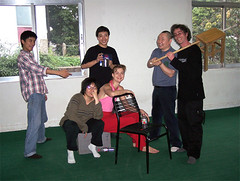
On April 1, 2006, Jochem and Milou joined the Fat Bird Workshop for an afternoon of improvisation, discussion, and dinner. I will upload a clip from the April 1, 2006 Fat Bird Workshop. In the meantime, I have also posted pictures of us siteseeing in Shekou and Overseas Chinese Town. I suddenly realize how found I’ve become of posing as a tourist in order snap pictures and make friends.

a walk in shenzhen

I realized today how remiss I’ve been about posting links to other projects. Last year, Steven Schroeder and I collaborated to create A Walk in Shenzhen. Steve’s poetry is a revalation. For even more beauty, please visit steve’s homepage.

Found Objects–Teapot Series


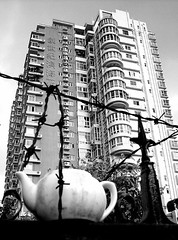
Gated Community Teapot
Originally uploaded by mary ann odonnell.

“Morning Tea”, a series of fifteen photographs and essay from my ongoing photo-ethnography Found Objects has been published in Archipelago, Winter 2006, Volume 9 (http://www.archipelago.org).

home, tianmian garden


home, tianmian garden
Originally uploaded by mary_ann_odonnell.

I realize that I’ve spoken about inhabiting Shenzhen without actually taking about where I live. I’m not sure if this evasion was deliberate or simply the result of habits—research is other than my quotidian reality, even if I write myself into the story. This doesn’t mean that I haven’t taken pictures of Tianmian, the village/development where I live, but have thought about the actual story being elsewhere, in the anywhere but here mode of ethnographic inquiry, which, I’ve come to suspect, is tied up in the throes of middle class American angst about standing still when I should be moving on (to something better, of course). Certainly that impulse, even more than an affinity for things Asian, propelled me out of high school and into China studies.

Today’s project then is to sit and think about Tianmian.

An urban village, Tianmian is located next to Shenzhen’s Central Park, west of the Shanghai Hotel. Throughout the 80’s and most of the 90’s, the Shanghai Hotel marked the western edge of “downtown”. The Luohu Train Station, a main crossing point into Hong Kong, marked downtown’s eastern border. However, since the mid-90’s, development has moved west and with it the city’s center, or perhaps it’s more accurate to say that the edges between downtown and the rest of the municipality have blurred. Once considered part of the “suburbs”, Tianmian is now prime real estate, being located just west of the new City Hall Building (the old building was located east of the Shanghai Hotel) and a ten-minute cab ride from Huanggang, a recently opened crossing point into Hong Kong.

It is important to understand that Tianmian encompasses a wide variety of folks and livelihoods. In this, Tianmian is highly representative of Shenzhen, although at a smaller scale than in Longgang and Baoan Districts, where the villages retained much more land than did villages within the SEZ proper (Nanshan, Futian, Luohu, and Yantian Districts). Millennium Oasis is a high-end housing development, where established professionals and their families live. Interestingly, many of these are extended families, who either live in the same condominium or have bought condominiums in the same building (older sister lives on the fifth floor and younger on the seventh, for example). New Tianmian Village includes the Village’s factories, mid-level housing development (Tianmian Gardens), and the New Village proper. These constitute the basic livelihood of all Tianmian villagers, who have stock options in both the factories and Tianmian Gardens, where young professionals and working families live, again many extended families here in a smaller space than Millennium Oasis. The New Village condos/apartments are the cheapest to own or rent. Many singles live there, as do friends who have pooled their money to move in together. Each of the buildings in the New Village belongs to one of the village men and it provides revenue that is independent of collective resources.

I’m not sure how many people live and work in Tianmian, but there are approximately 670 units (9 buildings) in Millennium Oasis, 780 units in Tianmian Gardens (5 buildings), and 2,048 units in the New Village (63 buildings). There is also a dormitory associated where Tianmian factory workers live. I live in Tianmian Gardens.

I first came to Tianmian in 1996 to interview the developers, who subsequently became good friends. The government requires developers to build a kindergarten and school as part of the development. Once the school has been built, the developers can choose to either give the school to the state to run, or to run the school themselves. My friends chose to run the school themselves. Part of the curriculum included an emphasis on English. They originally hired a teacher, who for various reasons, didn’t come. Subsequently, they asked me teach until another teacher could be found. That was four years ago. The first year, I thought it was a temporary arrangement. I left to take a visiting position at the Rhode Island School of Design and maintained my research affiliation with Shenzhen University. However, when I returned two years ago, I had signed a three-year contract with the school, where I am now vice principal in charge of internationalization. Crudely, internationalization includes reforming the English curriculum, setting up programs with international schools in Shenzhen, and implementing an English language curriculum in the High School.

Sometimes, I think my trajectory from conducting research to setting up a school is very Shenzhen, where folks pride themselves on being practical rather than idealistic. Before I came to the school, my friends joked that I was wasting myself at the University, especially as everything was happening outside the (increasingly porous) University walls. I also recognize in it a disconnect between my research style and that of the US Academy, where I managed to obtain visiting positions, but never a tenure track appointment; I grew tired of looking for the next job. Yet my husband lives and works in Shenzhen. My friends live and work in Shenzhen. One day I realized that I wanted to commit to being present to those lives. So I stayed.

In my personal map of Shenzhen, Shenzhen University has symbolized my attempts at ethnography. From 1995 through 1998, the University was my base while I conducted fieldwork for my dissertation. I have taught there and continue to return for seminars and to meet with friends to talk about our various projects. The University also symbolizes a particular way of being in the world—moving from one academic appointment to the next, placing that ambition in front of everything else. In contrast, Tianmian has represented another impulse, one to settle, to come home after years of always moving on. It is not simply that I have resided here for the past two years, but that Tianmian is where I settled. Please visit.
Back in Shenzhen

After two and a half months in North Carolina, I’ve finally returned to Shenzhen. My first photo opportunity was, not unexpectedly at Shenzhen University, where I first came in 1995. At the time, University lands abutted the bay, and oyster fishing families lived on the strip of land between the University wall and coast. I remember walking along the path and looking out toward the horizon where dump trucks hauled earth to build what is now the Binhai Expressway. Later, I learned that the entire western coast was being transformed through the Houhai land reclamation project.

Today, I came upon Shenzhen University’s new South Gate, which connects the University to Houhai Road. Carved into the land, the gate formalizes this space, makes it part of a larger pattern, when before it had been a wild border, unkempt, untended, with tendrils of purple flowers bursting open. As I walked, I remembered this space ten years ago when fish gasped the last drops of water left. Five years ago, I crawled through a hole in the temporary fence that separated the Houhai Road construction site from the campus, clay oozing into my shoes. I also remembered walking past the frame of a demolished building and thinking I should get a camera and take a picture—document the transformation, not simply being a kind of anthropological imperative, but an attempt to inhabit this space.

Lately however I’ve been wondering about my fascination with Houhai. Indeed, Houhai has been one of my favorite haunts. I visit regularly to see what has changed and what I still am able to re-member as another housing development or shopping mall rises. Yet, I don’t spend any time systematically investigating the actual construction of Houhai. I haven’t tracked down the engineers who planned the project and don’t intend dig through the various urban plans to track the discrepancies between planned and actual land use. I’m not sure if I even want to theorize about the meaning of globalization or environmental reconstruction from what I’ve seen of Houhai.

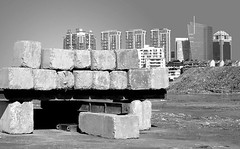
Instead, I seem compelled to pick my way through the mud and take pictures of cranes and transported dirt, the remnants of squatter housing and the lush vegetation that flourishes whenever dust is allowed to settle. I am obsessed with how the Houhai land reclamation project continues to encroach on my cognitive maps of the world and my place in it. And perhaps there’s rub. I don’t know how much of myself I can hold onto as memories that were once constituted through another landscape have already been razed. Two new pictures from the transforming border between Shenzhen University and Houhai are up at: http://pics.livejournal.com/maryannodonnell/gallery/00010qpw. The picture in the corner is for reference; I took it over three years ago from more or less the same place.

You can also visit houhai ghosts, a previous entry that shows these changes even more clearly: http://pics.livejournal.com/maryannodonnell/gallery/00002c4h.

bethesda presbyterian church

i am travelling in the u.s. this month and have finally settled enough to take the odd picture. i am posting them to fieldnotes because they contextualize where i am and how i see when not in shenzhen; just as images from other chinese cities bring shenzhen into sharper focus, i suspect images from my american life will bring the photographer into focus. these images were taken at a church located about four miles from my parernts’ house in north carolina, a place that strikes me as built of trees and sunlight (when i’m looking up), and somewhat menacing (when walking through the beautifully situated burbs). please visit bethesda. i’ll post more images from north carolina over the next few weeks.

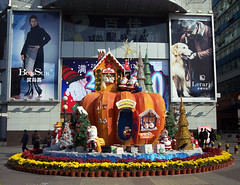
christmas pumpkin


christmas pumpkin The Christmas spirit haunts us otherwise in Shenzhen, where children are given Halloween cards because “It’s fun” and lovers celebrate the season over romantic dinners—“It’s a time for just the two of us,” my friend explains her holiday plans.

And yet, walking past artificial trees and sweating elves, I glimpse the ghost of Christmas past, when I first learned to crave salvation. Here too, it’s the season.

There are a few more Shenzhen Christmas cards in my gallery.
Happy holidays.

Originally uploaded by mary_ann_odonnell.

divine garbage

in the summer of 2003, fat bird theatre members produced a series of workshops on the meaning of shenzhen’s diverse urban spaces. the first piece “the human city” was performed in diverse sites throughout the city. the second “the divine city” was performed at shenzhen university. the video Divine Garbage documents the performance of “the divine city” during december 2003. it was edited in the summer of 2004.

shennan rd, part 2

Walking further east on Shennan Road, from the old city hall building toward the train station, what becomes clear is the extent to which we might describe urbanization in Shenzhen as a process of “the city surrounds the countryside”. This phrase, a reworking of the Maoist revolutionary maxim that “the countryside surrounds the city” points to the geographic shift that has enabled the transition from rural revolution to urban reform. Under Mao, revolution was understood as starting in rural areas and spreading to urban areas. Although the revolutionaries aimed to modernize China, they nevertheless first occupied rural areas and then liberated urban areas. Thus, the Maoist slogan referred to a military strategy. In contrast, under Deng, reform was understood to entail freeing up urban processes in order to allow the economy to develop naturally. Consequently, the Shenzhen inversion of Maoism makes explicit the shift from political to economic concerns, even as it maintains the occupation of land as central to historic process. All too crudely, we might say that for Mao, the occupation of territory was conceptualized as a political process that was to bring about economic change. In contrast, under Deng, the occupation of territory was understood as an economic project, which had political consequences.

What is interesting to think about in terms of Shenzhen’s rural urbanization, is how the rural and the backward (in need of modernization) constantly change as new areas are developed. Thus, areas that ten, fifteen years ago were considered modern are today looking worse for wear. These now constitute the relative rural, which needs to be updated. The process of ruralizing the urban with respect to newer, taller, more modern urban spaces creates a particular kind of urban geography, one of poorer eddies, or (quite literally because they stand in the shadows of taller buildings) dark holes that are surrounded by shiny new buildings. The relative poverty of these pockets is of a different kind than the kind of isolation that has taken place in Shenzhen’s new villages, which are actually well off. Instead, these pockets are the manifestation of a necessary dialectic in which progress is measured by overcoming what already exists—there is a necessary surpassing of these older areas.

I think I’ll write more about the creation of ghettos and its particular manifestation in Shenzhen in another entry. Today, I want to call attention to the ongoing contradictions, but also the shiny brightness of Shenzhen construction during the 1990s. These images can be seen at: http://pics.livejournal.com/maryannodonnell/gallery/0000prqq

inscribed history, briefly: shennan road

Shennan Road is the oldest east-west artery in Shenzhen, until a few years ago when the opening of the northern loop and the Binhai road, it was both Main Street (in the sense of the center of town activities) and the main artery for transporting goods and people from one side of the city to the other. Today, most trucks travel from factories along the northern loop, crossing the border at either Wenjindu or Huanggang, and most cars and all express buses travel along Binhai. However, Shennan Road has maintained its symbolic and functional importance in the organization of the city.

This weekend, I went for a walk along the strip of Shennan Road between the old city hall and the recently opened new city hall. There’s much to be said about the difference between the two buildings, but the point I want to emphasize here is the inscription of history through architecture that is visible along this strip. It is, in many respects a history that can be understood through the movement from the low, concrete municipal building (a Stalinist concrete block), representing the idea of Shenzhen as a manufacturing center to the post-modern glass and steel of the new municipal building, which points to Shenzhen’s aspirations in global finance and management. All this to say, throughout the strip one encounters concrete factory buildings and modernist office buildings that abut newer, taller, and more expensive buildings.

This twenty-five year history is also the history of replacing the collectivist economy with a market economy. This history, while less visible than the progression from manufacturing to finance manifest in the city halls, is nevertheless a structuring feature of this bit of land. This structuring has several levels.

• First, twenty-five years ago, when Shenzhen planners first approached the project of opening the west, they only marked the land from Luohu train station to the Shanghai Hotel. That is to say, for many years when Shenzhen residents said they were going into town, they meant the area between the train station and the Shanghai hotel. This means that the new city center has been moved from the original downtown to what was previously a leechee orchard outside the scope of the original urban plan. Traces of this other history remain in Shenzhen’s center park, which stretches alongside the new city center, large tracks of which are still used to cultivate leechees.

• Second, the transfer of commune land to urban work units predicated this transformation. The Ministry of Aviation developed the area on which the Shanghai hotel was built. The Ministry of Aviation annexed this land from the Shangbu Commune, which is memorialized across the street from the Shanghai hotel in the form of the Shangbu Building, a concrete skyscraper from the mid-1980s.

• Third, this transformation entailed economic re-orientation. The production of electronics for foreign markets financed the construction of the Saige building, which towers over the Huaqiangbei area. Throughout this area, entrepreneurs continue to sell electronic products, which are no longer primarily manufactured in this area. Instead, this area has become a center of leasure and high-end consumption, symbolized by the Zhongxin Plaza, built across the street from the old city hall.

A brief reading of the landscape that unmakes the often heard phrase “Shenzhen has no history”. It also reminds me that simply driving from one end of town to the other involves the reiteration of history through spatial landmarks. What gets confusing in Shenzhen is the speed at which buildings come and go, thereby making us think everything is always new, enabling us to forget what was previously here. It is also a history that connects with the history of landscaping that I talked about in a previous entry. What seems to boggle the mind is the speed, and yet the history is there. How is it we become trained only to see what is new? And how is it that historic difference seems not to matter (in all senses of the word)? What seems important is the ongoing replacement of one set of buildings and environments and lifestyles with another set: I am reminded of how the American West was, in a manner of speaking, won and how then what remained were ghost towns and abandoned mines, farmers with rundown farms.

(I remember when the Shanghai hotel was given new façade over 10 years ago. During the mid 1990s, there was a time when old concrete buildings were dressed up to look like postmodern architecture, but that then gave way to simply razing large areas of land and building newer, taller, and certainly shinier buildings.)

For an incomplete view of this strip of Shennan Road, please visit: http://pics.livejournal.com/maryannodonnell/gallery/0000k20k