This slideshow requires JavaScript.
Category Archives: shenzhen elsewhere
listening to firecrackers

I’m in Tianjin, listening to the firecrackers that go from dusk well into the early hours of the morning. Traditionally, people set off firecrackers from New Year’s Eve through the Lantern Festival. Firecrackers also provided an opportunity for Tianjin friends to distinguish themselves from Cantonese people because “northerners love firecrackers more than southerners”. In fact, they said, the further north you go, the more festive the towns as firecrackers don’t stop.
I don’t actually know how much of my friend’s claim about northern enthusiasm for pyrotechnics is true. I do know that early on, Shenzhen attempted to outlaw firecrackers. In fact, I remember buying illegal firecrackers and setting them off at the coast. We drove with a truck full of illegal poppers to houhai land reclamation area, snuck out, and set them off. This year and last, however, I’ve noticed stands selling firecrackers because — according to a friend — the SZ Municipal government finally accepted the fact that it was safer to sell legal firecrackers and regulate production than the alternative.
I’m also told that people set of firecrackers just to “burn money”. Last year, the economy was good and people celebrated by “burning money”. However, this year I’m told that there are fewer people willing to buy firecrackers because of economic difficulties. Nevertheless, everyone I’ve talked with has set off firecrackers or played with sparklers; we bought a box of fireworks and watched them light up the sky for all of five minutes. New Year’s — relatives and friends emphasize — is the People’s holiday. In contrast, on National Day, only the government willingly burns money and, my friend joked, those fireworks are of different quality.
two walks in guangzhou
Just spent three lovely days in Guangzhou, enjoying conversation at Sun Yat Sen University and visiting tourist spots, including a walk along the river and a ride on the bubble train atop the Guangzhou Tower. Very Tale of Two Cities simply because looking down is so different from looking through even though vertigo set in when I tried to walk out onto a glass bottom viewing deck. No, I didn’t leave the opaque floor and yes, strangely did not feel as afraid when I walk outside onto the viewing tower and into the bubble train. Images below:
What’s the difference between Shenzhen and a 直辖市?
直辖市 means “directly governed city”. There are four directly governed cities in China — Beijing, Tianjin, Shanghai, and Chongqing. The difference between a directly governed city and a special zone (特区) like Shenzhen is political ranking. Directly governed cities have the same political rank as a province. This means that directly governed cities have access to resources and policies that other cities do not.
Shenzhen is a sub-provincial city, which means it is subordinate to Guangdong Province. As a Special Zone, Shenzhen has some economic exceptions, however, in terms of political planning and any kind of social innovation, Shenzhen must operate within the purview of Guangzhou. Consequently, the SEZ has repeatedly chosen to frame any kind of social transformation in terms of “economic” reform.
From the outside looking in, Shenzhen seems different, certainly the most neoliberal of China’s large cities. But from the inside, Shenzhen just seems nouveau riche, a better version of the country’s second tier cities, but not a first tier city like Beijing or Shanghai. Or even Guangzhou. Continue reading
Why does the West misread Shenzhen?
Here’s a quote introducing the SEZ’s investment environment. I lifted it directly from the English website of the Shenzhen Municipal Government. I like it because it makes explicit the different ways that the Chinese government and neoliberal Western think tanks evaluate Shenzhen:
Economic Power
Shenzhen is fourth on the Chinese mainland in terms of economic power and one of the cities that has generated the biggest economic returns.
Shenzhen was second in an economic performance listing by the Brookings Institute and the LSE Cities. The Global Metro Monitor report published in November 2010, which examined data on economic output and employment in 150 of the world’s largest metropolitan economies, showed that Shenzhen’s economic performance was second in the world and first in China.
And that’s the point. In China, Shenzhen is fourth, behind Beijing, Shanghai, and Guangzhou. China ranks its cities not only in terms of economy, but also political clout. So yes, Shenzhen’s economic success has launched it ahead of other Chinese cities, such as Tianjin, which under Mao was city number three, but no matter what the SEZ’s international economic ranking, politically, Guangzhou is the highest ranking city in Guangdong Province. Full Stop. Continue reading
learning from shenzhen?
Long time friend, Josh Kilroy directed me to a recent blog post by William Pesek, who argues that if Japan wants to fix the country’s economy, it should learn from China, or at least Shenzhen and set up a special economic zone. Pesek claims,
In 1980, Deng Xiaoping started China’s first special-economic zone in a coastal village that was nothing to look at. Today, Shenzhen is a teeming collage of huge skyscrapers, thriving industrial parks, 10 million people, one of the world’s busiest ports, and some of the biggest manufacturing and outsourcing industries anywhere…It’s the center of Chinese experimentation. There, officials can test what works and what doesn’t: which corporate tax rates offer the best balance of attracting foreign investment while filling government coffers in Beijing, which labor standards make the most sense, which corporate-governance standards are most advantageous, which immigration procedures are optimal, which regulations stay or go.
Why does this article distress me? In a nutshell, it distresses me because there is nothing in this statement that did not come directly from the propaganda that the SEZ churns out about itself and, even with that caveat, it teems (if I may) with errors: Continue reading
lecture notes – SCUT
Yesterday, I participated in a Biennale event at 华南理工大学 (South China University of Technology campus slideshow, below). The event was organized into three sections: SZHK Biennale 2011 Main Venue; SCUT professors who had participated in SZHK Biennale 2009; and a SZHK Biennale 2011 sub venue event, the Enning Road Transformation Study Group (恩宁路改造学术关注组), an alliance of students and residents to voice concerns about Guangzhou’s plans to raze this historically important part of the city.
Now, visiting Guangzhou, especially with Guangzhou people is pleasurable because they love their city. They also love to compare their city to Shenzhen, which is interesting for what it tells us about the different ways we create a sense of belonging to “our” cities. The conversations I had highlighted important differences between the creation of urban identities in Guangdong Province’s two most important cities. Continue reading
roundtable in guangzhou
For those in Guangzhou, this Weds, Sept 28, I’ll be participating in a biennale roundtable at Huanan Ligong. Please join us:
Time: 6:00-8:35 pm, 28 September 2011
Place: Multimedia Room, Building 27, School of Architecture, Huanan Ligong
时间:2011年9月28日18:00—20:35
地点:华南理工大学建筑学院27号楼一楼多媒体教室
What is a boomtown?
Many readers are no doubt aware that Shenzhen’s sister cities are all (more or less) boomtowns. Two of the most famous are Brisbane, Australia and Houston, Texas. Both Brisbane and Houston, like Shenzhen have seen major demographic changes over the past thirty years, both have also profited from restructuring to the global economy.
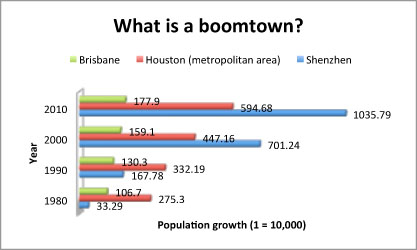
To get a sense of the scale of Shenzhen’s population boom, I created the following chart, which compares census statistics from Brisbane, Houston and Shenzhen from 1980 through 2010.
What this simple chart clarifies is the extent to which we (westerners) need to reconceptualize “booms” in order to think about the kinds of demographic, social, and political change that is happening not only in Shenzhen, but throughout China. In a smaller nutshell than even an excell chart, what we see is that Shenzhen blew past Brisbane in 10 years and then past Houston in under 20. Final tally: Brisbane – 1,779,000; Houston (metropolitan area) – 5,946,800, and; Shenzhen – 10,357,900 (plus undocumented inhabitants), begging the question: how do we, who share the planet and this worldwide political economic system talk about and across disparate experiences of urbanization without giving over to either Chinese exceptionalism (as in, that’s just China) or ethnocentrism (as in, why is China acting like us?)
And yes, for practical purposes I’m still using 1 = 10,000 to count.
Contextualizing Dachong: A Story from Chongqing
In order to contextualize the gross injustice of equating Shenzhen urban villagers with neidi farmer-workers, as well as to understand the rhetorical force of this symbolic equivalence, it is important to keep in mind ongoing problems with defaulted wages throughout China. According to Xiong Ju (熊炬) their are four kinds of bosses who cheat workers out of wages:
1. Real Estate Developers who buy land and have a contractor employ workers to build the housing, intending not to pay workers in a timely fashion. Instead they wait until the housing is finished, prices have risen, and only after selling the property do they pay their workers. They cheat the workers out of the interest on their salaries.
 Shenzhen Noted