Landscaping at the Spring Cocoon is moving forward as Shenzhen gears up to great the world. Today, I was given a neon green sticker that says “Start Here”, which Nanshan Second Foreign Language School students were distributing. I offer seven photos to give a sense of before and after changes at that particular corner, right in front of the Kempinski Hotel and next to the school. #1 The entrance to the stadium, that mascot string of bubbles, which sometimes have faces and speak in cartoons; #2 that corner in June 2003 and then #3 in April 2011; #4 the old coastline at that corner, June 2003 and then #5 in April 2011; #6 a picture of the area taken from Binhai road, looking northwest, and; #7 topiary details.
Category Archives: photos
Qingming
Yesterday, went to Hongfa Temple for Qingming, or grave sweeping day. The traditional day to celebrate was the 15th day from the Spring Equinox, which usually falls around April 4, 5, or 6. Ever curious, I asked friends why a traditional Chinese holiday was celebrated according to the solar calendar. It turns out their were two explanations. First, Qingming was a lunar festival, usually celebrated on the third day of the third month. Second, Qingming was one of the 24 solar periods (二十四节气), when people came out to see the sun after winter. It could have been instituted as a shifting day holiday like the Spring or Mid-Autumn Festivals. Why it was not, I still don’t know. I do know, however, that when the Mainland reinstated Qingming as a public holiday in 2008, it was immediately associated with venerating national heroes and martyrs. Pictures from Hongfa Temple, the first temple built in China in the Post-Mao era. Yes, Reform-era public support for religious practice was also a Shenzhen “first”.

cultural homogenization in shenzhen. and not.
Most discussions of Shenzhen emphasize that as an immigrant city, Shenzhen is a Mandarin speaking outpost of national culture in the midst of Guangdong Province. However, this description glosses over the historical division of Baoan County into Cantonese and Hakka cultural areas, and how urban development focused on the SEZ (rather than the entire Municipality).
The establishment of Baoan and Longgang Districts in 1992 institutionalized these historic divisions, with a Cantonese cultural-linguistic area (Baoan District) and a Hakka cultural-linguistic area (Longgang District). At the same time, the traditional SEZ (bounded by the second line) formed the core of Mandarin national culture in the city.
Thinking about Shenzhen as a tri-cultural city enables understanding of how cultural homogenization does and does not take place. Today, I’m thinking specifically about the creation of a recognizably “rural” local identity versus an “urbane” Shenzhen identity. In the area surrounding the Universiade Village, for example, these various trends are most visible in ongoing construction and demolition projects.
Construction wise, the planned Universiade Village boasts beautiful, glass stadiums and swimming areas, which reflect urbane aesthetics. Indeed, the nearby 5-star hotels and upscale residential areas lump Shenzheners (the Mandarin nationals) with cutting edge international taste and consumption. This aesthetics contradicts that of the mid-90s generation of handshake buildings that constitute much of the Longcheng Street residential area. Architecturally, it all seems a straight-forward contradiction between rural and urbane Shenzhen, which in turn is often misread as a contradiction between Cantonese and Mandarin spheres.
In fact, walking through a small Hakka Village, like Dawei indicates how recent handshake buildings as an architectural sign of the rural are in Shenzhen. In Dawei, the handshake buildings have been built into and on top of a traditional, small Hakka compound (similar to the one in Sungang). In other words, handshake buildings create a common “rural” or “Baoan local” identity for (once culturally and linguistically distinct) Cantonese and Hakka villages only in contradistinction to a Mandarin identity.
Visual evidence in slideshow, below.
street life
From a walk through one of Shenzhen’s older areas, Hubei New Village and slightly north of Dongmen.
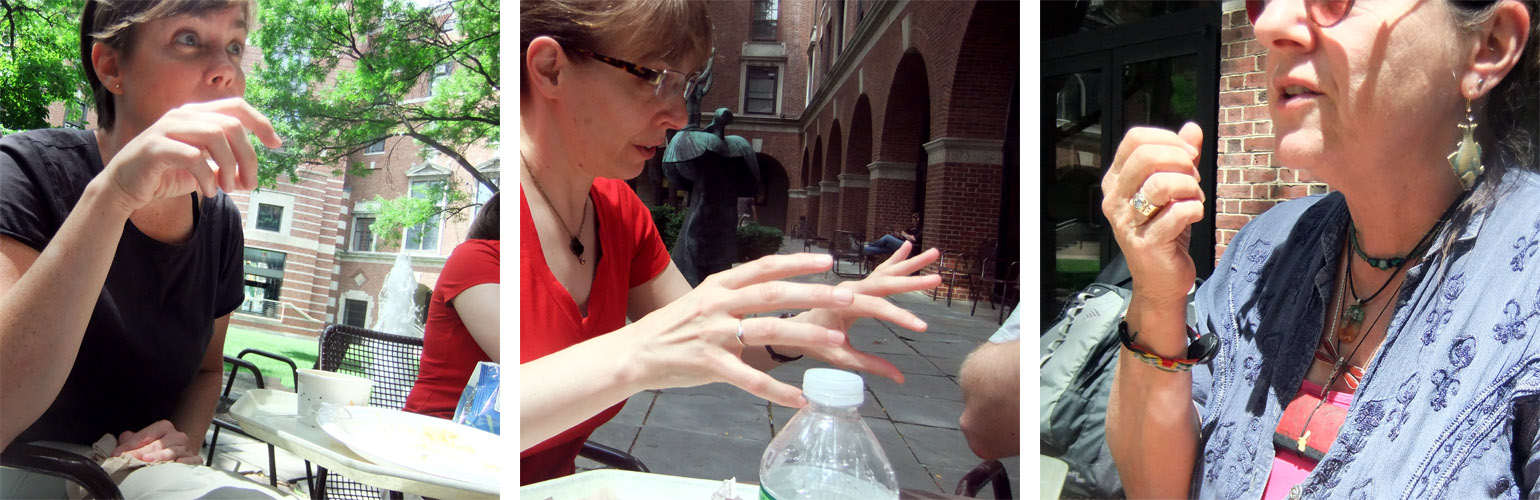
conversation
Shen Kong wholesale flower market
Located in Xili, the Shen Kong Wholesale Flower Market provides wonderful plants and hosts the annual Shenzhen Spring Festival Flower Arranging Competition. Nevertheless, the market is so far off the beaten track that rentals are cheap cheap cheap, which means that several artists have rented space for workshops, while several families have moved into the large spaces. And yet. The extensive market is a strangely empty,as if waiting for the rush of development. Pictures from my wanders today.
Sunlit Pines
Early Spring, North Carolina: long needle pines and dogwood.
beauty soars
The Pacific Northwest remains, for me, a mythic homeland. Unlike in other urban settings, where I often strive to find the mythic, in Seattle, Portland, and smaller cities along the coast, here, yes. So wondering, about the modernist project in Shenzhen. Does mass architecture elevate the soul? Or does that imaginative leap happen when an architect or investor takes pen to paper and calls the future into being? And can such a feeling constitute social science or is better suited to literature? Meanwhile, the rest of us scuttle through Gotham.
wide open skies
Much new development in Hexi Tianjin means that the skies are wide open, the farmers missing in action, most buildings uninhabitted, and sunlit beauty that reminds me of Texas.
firecracker aesthetics
Yesterday was 初二 or the second day of the lunar new year and firework play continued with children of all ages setting off bright red crackers and sparklers and colorful blooms.
In the early afternoon, I walked along the City River, where over sixty years ago, the PLA liberated Tianjin. And here’s the point: Walking past aligned rows of apartment buildings,k grey lots of orderly trees, and the straightened riverbank – indeed, the sky seem slotted against the horizon – I suddenly understood the necessity of fireworks. Not only do colorful flames shine bright against the muted landscape, but also disrupt the relentless and massive grid that organizes this spaces.
Rumor has it that the Tianjin Fire Department charged 100,000 rmb for a license to sell firecrackers this year, up from 50,000 from last. I’m not sure what Shenzhen Municipality charges because I didn’t think to ask. But here, in a winterscape of star,k light and modernist squares, I craved red flames and the power to soften hard lines endlessly looming.
 Shenzhen Noted