I participated in the “Learning from Shenzhen” Symposium on Dec 10, 2011, which was part of the biennale. For the curious, I’ve uploaded o’donnell-awkward encounters, a pdf file of images and arguments from the paper I gave.
Category Archives: photos
Meilin: historic footnotes
Located between Lianhua Mountain and the ridge of low-lying mountains that once marked the second line, Meilin interests for several reasons.
First, Meilin completes the central axis in the same way that Hong Kong does – as an historic footnote. Meilin and Hong Kong are the implicit extensions of Shenzhen’s ideologically charged central axis, which announced the SEZ’s transition from an industrial manufacturing economy to a financial service and high-tech research and development economy. However, Meilin was built for functionaries in the 80s and 90s, and realizes the scale and type of residential area to which SZ once aspired. Likewise, Hong Kong was the orientation of SEZ globalization throughout the 80s and 90s, but like Meilin, it was globalization on a different scale. Shenzhen’s post axis global aims have long since reached beyond Hong Kong.
Second, the integration of Shang Meilin and Xia Meilin New Villages is neat because handshake building scale was the scale of 80s and 90s neighborhoods. Continue reading
Mandala!
Production stills from Mandala, or one version of what the future looks like!
BOOM! Shenzhen in process
We finish installing Boom! tomorrow. Through the process of designing, building, and installing the pieces, I have become increasingly aware of the labor necessary to make such a project. In fact, I’ve found it humbling to realize how little I have contributed in the face of my collaborators’ and workers’ skills and willingness to get it right; yes, this kind of artistic production begs Marxist critique. Below, impressions of folks who have worked hard to make Boom! possible. The tag Boom! Shenzhen will bring up other posts from the show.
BOOM! opens 9:00 pm, December 8 in OCT, B-10 venue. Please come.
新秀: end of another line
This weekend walked around the Xinxiu area. Located just east of Caiwuwei, Xinxiu was part of early, early Shenzhen development. However, as the SEZ developed in a westerly direction (away from Wutong Mountain), Xinxiu got stuck in mid 80s architectural forms, with occassional circa 1992 eruptions. And yes, Shen Gang New Village recalls the early days of cross border investment and like “xiao kang” has vanished from everyday conversations. More importantly, these impressions suggest the human scale of early Shenzhen. Look closely and note the clear water, the open neighborhoods, and low cost housing options that are scheduled for upgrading. All this to say, unlike many other built, rebuilt and razed again housing developments, Xinxiu feels like a neighborhood, in the old-fashioned sense of the term.
downtown
Downtown Shenzhen used to be the area around the Luohu train station, moving east (toward the Wenjingdu border crossing) and west (toward Caiwuwei, the site of Baoan County Headquarters before 1979). Caiwuwei remains the Municipality’s financial center. However, there are still traces of early Shenzhen scale and place names to be found, even when standing at the intersection of Shennan and Hongling Roads, site of the billboard to Deng Xiaoping and the promise of stable political policies. Impressions, above.
nitty gritty shenzhen – the photography of Sarah Li Cain

Sarah Li Cain does what I want to do; she takes consistently real photographs of Shenzhen gritty, but with an eye to how we live despite our situation. Her subjects include migrant children, sleeping old men, and straggly, germy kittens, which (as in the picture above) nevertheless shimmer through surrounding grime. I wax Oscar Wildesque – gutter, stars, and what not.
Sarah’s work is currently on display at The Kitchen Futian. If you find yourself in Cocopark over the next few weeks, step in and see Shenzhen through her eyes.
Impressions of the differences between Nantou and neighboring villages
Guankou and Yijia Villages are located just outside the Nantou Old Town Arch and revamped walking museumon by way othe Shennan Road – Nanxin Road pedestrian overpass. The villages abut each other along the old, narrow road, which used to run parallel to Yuehai Bay and connected Nantou to Shekou. Guankou and Yijia are slated for renovation at some point in the future. In the meantime, they are “just places where poor people live” as someone said to me, indicating disapproval of my photo-walk through the two neighborhoods.
Guankou and Yijia interest me because the village architecture is actually older than much found in the Nantou Old Town walking museum. Many Nantou residents built handshake buildings before the area was designated for historic preservation. Consequently, what remains in Nantou are handshake and factory buildings from the early 1990s, as well as particular buildings that had been designated historic landmarks. In contrast, the old centers of Guankou and Yijia were untouched during the 1990s village building spree and littered (and I use the word deliberately) with all sorts of old and interesting buildings.
Now, inquiring minds may wonder: why is Nantou, the imperial capital of the area with a 1,000 year history gutted of historical architecture (except in the renovating) and Guankou and Yijia not? Continue reading
渔农村: border lives
Connecting the Shenzhen Metro and the Hong Kong KCR, the recently opened Futian Checkpoint has provided incentive for building higher end real estate for those who live in, on and from the Shenzhen-Hong Kong border. The area teems with residential and leisure developments that target variations of Shen Kong lives.
Yunongcun (渔农村) is one of the closest urban villages to the checkpoint; simply exit, turn right, and walk 500 meters or so. The walk from the checkpoint to the village area reveals layers of history, both in the making and the discarding. One sees, for example, a soon to be razed 90s food street and mid 90’s housing, and then buildings from roughly ten years later, including a large spa and even newer shopping mall, as well as the Shenzhen river, which is guarded and sealed off from pedestrians.
What one does not see on this walk is Yunongcun’s important place in Shenzhen’s village renovation movement (旧村改新). Over five years ago on May 22, 2006, the Shenzhen government began the movement with a nod to Shekou’s “first explosion (circa 1979),” by detonating “the first explosion” of the village renovation movement and bringing down fifteen illegal buildings all at once. Villagers had put up these buildings as part of their negotiation for a better settlement package. A kind of holdout, but at a much larger scale than the individual family because the area only became prime real estate with the completion of the checkpoint. Continue reading
意maging baishizhou
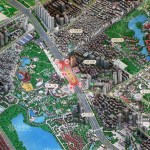

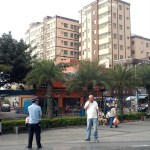
Three pictures of the northeastern corner of Baishizhou along Shennan Road. The map and detail are from a map in the Window of the World subway station, the third is a photo of the actual corner, taken from the plaza in front of 沙河世纪假日广场 (Shahe Century Holiday Plaza), the large landmark in the two maps. The contrast between the map and the territory interests me because it the ongoing (re)imagineering of Baishizhou in particular and Shenzhen more generally.
Baishizhou, as mentioned in earlier posts, is one of Shenzhen’s more “chaotic (乱)” urban villages. However, it occupies prime real estate – directly across from Window of the World and on the Line 1 Subway. Consequently, upgrading Baishizhou is an ongoing project and has included major real estate development. Tellingly, most information about Shahe Century Holiday Plaza real estate (here, here, and here, for example) emphasizes the subway convenience, views of Window of the World, and modern amenities, downplaying and often ignoring the Plaza’s neighbor, Baishizhou.
 Shenzhen Noted