the difficulty of representing shenzhen’s urban “villages”

Talking about Shenzhen’s urban villages is difficult because legally they are not villages, but “communities (社区)” that have been integrated into the urban state apparatus. Moreover, depending on their location, these neighborhoods have different social functions — slums, gateway communities, and affordable housing for both the working poor and recent college graduates.

Mark Leung‘s photo essay,  Welcome to Wuwucun, a Village in the City offers a detailed and sympathetic look at life in Wuwucun, a Shenzhen urban village and is well worth checking out. However, the images beg contextualization, illustrating the difficulty of interpreting images  in the absence of historical knowledge. Is Wuwucun poor? Are these villagers? Is manufacturing a good thing?  On the one hand, a shorter version of the same essay, for example, explained that these images showed how manufacturing in Shenzhen was providing small steps forward to improve the lives of China’s rural millions. On the other hand, these images depict one of the more peripheral villages in Shenzhen, where the level of poverty depicted justifies ongoing campaigns to raze working class neighborhoods in other parts of the city. In other words, these images can be used either to show that industrial manufacturing in Shenzhen has been good for the country or to justify the Municipality’s ongoing program of razing urban villages in the inner districts. Continue reading

shenzhen new year’s flower market

Shenzhen’s largest and oldest new year’s flower market is located on Aiguo Road, which has been closed for the bustling street fair. For a good quarter mile, several hundred venders hawk fresh and artificial flowers, Brazilian turtles, Chinese medicine, and plastic bubble hammers that read “Diaoyu Island belongs to China”. To join the festive multitudes, take the Third Line Subway to  the Cuizhu Station and exit onto Yijing Road. Follow the crowds one block to the Main Gate, where photo opportunities abound. So go and get your snake on! Portraits, below:

This slideshow requires JavaScript.

street life, baishizhou

Xintang and Shang Baishizhou lie northwesterly to Tangtou within the larger Baishizhou neighborhood. Where the allies widen into roads, a vibrant, bustling urbanity hints at unexpected encounters. The Baishizhou Pedestrian Commercial Street, the Baishizhou Christian Church, and inadvertent plazas, for example, speak to the social possibilities that high density street life creates.

This slideshow requires JavaScript.

digital soul: the 2013 independent animation biennale

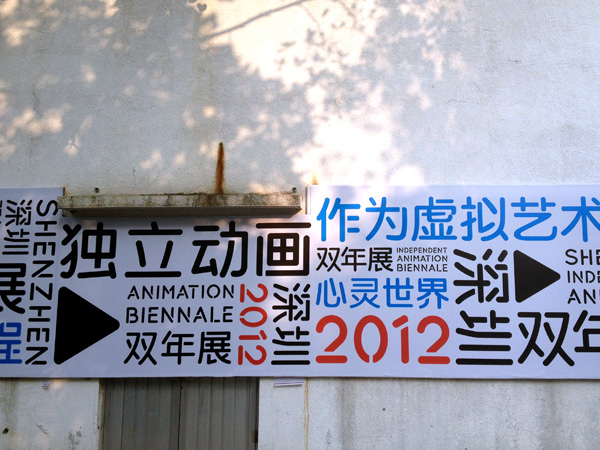
Actually it’s called The World of the Soul: A Virtual Art Engineering Project (心灵世界:作为虚拟艺术工程) and it’s the first Shenzhen Independent Animation Biennale. Interestingly, in addition to the usual OCAT sponsors, Southern Weekend and Youku, two leaders in China’s youth culture also contributed to the event, which includes lectures in Beijing and Guangzhou.

Curators Wang Chunchen, Zhang Ciaotao, and He Jinfang provide viewers with a smorgasbord of videos that range from short shorts through mid-length pieces to feature films. They have also selected styles that include virtual reality avatars, hand drawn characters, and experiments with Chinese ink painting. So, if you have a leisurely afternoon, a stroll through the exhibition offers much to sample. What’s more, if you decide to watch the longer pieces, you may decide to return for a second or third time.

In addition to the exhibition, the biennale offers a series of monthly lectures. On January 22, artist Lei Lei (雷磊) gave a talk on free and easy animation. Just after the Chinese New Year on February 26, artist Sun Xun (孙逊) will discuss “Animation is a Layer of Skin”. Clearly, animation is a way of life and digital soul as earnest as painterly counterparts.

Venue: B 10 Gallery, OCAT Loft North

Dates: Dec 22, 2012 through Mar 22, 2013

Time: 10:00 to 17:50 on weekdays; 10:00 to 20:00 Saturday and Sunday

This slideshow requires JavaScript.

the yaopi float glass factory

The Yaopi float glass factory hovers at memory’s edge, abandoned to ideology and chance encounters.

In 1987, the Shekou factory represented the highest level of float glass technology production in China. Today, it evokes nostalgia for the heroic romance of early industrial manufacturing. And that’s the rub. Even before it was built, the technology and mode of production used at the factory had been downgraded in terms of added value. In terms of global competitive advantage, Yaopi had been outdated even before it was built. Perhaps more telling of the ideological structure that ranks advanced and backward nations with respect to production capacity, the Yaopi factory elicits comparison with the Terracotta soldiers in Xi’an. This unhappy comparison relegates Shenzhen’s modernization efforts to the ancient past, even as it confers uncanny modernity on the First Qin Emperor’s army, which of course was mass produced on low-tech, but large-scale assembly lines.

This slideshow requires JavaScript.

orange tubes

This morning while touring an abandoned factory in Shekou, I encountered massive orange tubes. By themselves somewhat uninteresting, yet arranged beneath a banyan tree suddenly transformed into art. And that seems the way of it. As a new friend commented recently, “In a city, despite the buildings, ultimately the trees speak to the human soul.”

This slideshow requires JavaScript.

suzhou garden, huanggang, shenzhen

Visited the Suzhou style garden in Huanggang Village today. The Village axis runs from the arch on Fumin Road via a main street and the central plaza to the ancestral hall and temple. The garden is located behind the ancestral hall.

Also of note: in the main plaza, the village has crafted a self representation that mimics Shenzhen billboards, in which key buildings symbolize the strength and unity of the group. Nevertheless, unlike the municipal central axis, the village central axis runs east – west. Indeed, that’s the rub. If the central axis were opened up through the convention center, it would split Huanggang and plow through the garden.

Impressions, below.

This slideshow requires JavaScript.

xiasha plaza

This afternoon, I sat in Xiasha Plaza watching children and their caretakers. The plaza is vast and the people hug the edges, chatting in the shade. The coi pond is particularly popular.

This slideshow requires JavaScript.

沓饼节: the second annual pounded biscuit festival

Yesterday, Bao’an District organized the second annual pounded biscuit festival (沓饼节). Pounded biscuits are a traditional local sweet that are especially popular at Chinese New Year’s. It so happens that a Shenzhen brand, 合成号 has been making said biscuits since 1901. The company celebrated its 100th anniversary in 2011, and to kick off its next century, in 2012, it became the sponsor of Shenzhen’s latest festival.

Local historian, Mr. Liao Honglei (廖虹雷) invited me to join the celebration. Mr. Liao curated the event and has been active promoting local Chinese culture. He is particularly attentive to cultural differences between Cantonese, Hakka, and Chaozhou settlements. Shenzhen inhabitants from outside Guangdong, refer to Cantonese as “baihua (白话)”, or local language. In contrast, Mr. Liao makes a point of calling each of these cultural strands by their official names, Guangfu (广府 literally provincial capital of Guangdong), Hakka, and Chaozhou in order to draw attention to Bao’an’s heterogeneous roots.

Also present was special guest, Professor Wu Bing’an (乌丙安), an 86-year old specialist in Chinese folklore. Professor Wu began his discussion by explaining why he opposes calling Chinese New Year “Spring Festival”. On his analysis, festival (节 jie) refers to a date on the calendar. In contrast, year (年 nian) refers to a period of time. Thus, jie mark the passage of time within a given nian. Professor Wu said that in order to leave one year and enter the next, Chinese people need sound and color. After praising the reintroduction of noisy, pounding to make New Year’s biscuits, he mentioned that firecrackers were the traditional “sound” for sending off and greeting the new year. Professor Wu also complained that too many safety restrictions had made Chinese New Year too quiet.

Impressions of the pounded biscuit festival, below.

This slideshow requires JavaScript.

bardo

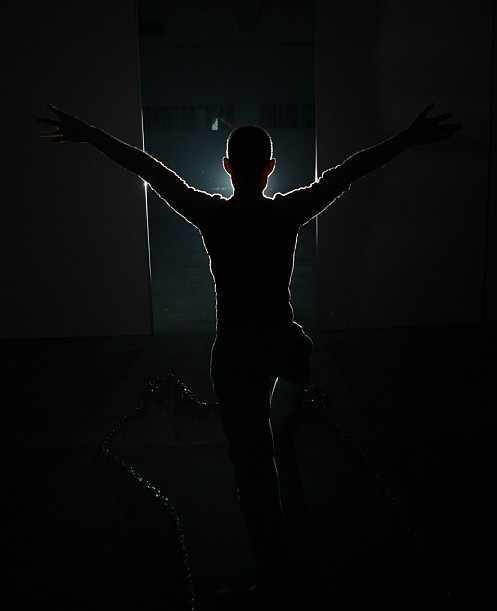
Chen Dong, the director of Da Ken Art Center (大乾艺术中心) commissioned me curate a performance for the Mayan apocalypse, December 21, 2012; Bardo was the result. Choreographers, Eagle Ho and Samuel Morales performed the split soul; composer Robert Copeland created the emotional landscape through which the soul traveled, and; Chen Yujun crafted its two faces. Photographs by Shan Zenghui, Chen Dong’s partner in bringing new kinds of art to Shenzhen.

This slideshow requires JavaScript.

Online reviews, here and here.