2013 szhk biennale of urbanism/architecture, thoughts on

This year’s Biennale occupies two spaces, the The Value Factory (venue A) and The Border Warehouse (Venue B), which are connected by a shuttle bus. Metonyms for Shekou history, the two sites index the industrial zone’s early manufacturing and connections to Hong Kong.

Team Ole Bouman curated The Value Factory with an eye to making it a catalyst for urban change. They cleaned up and slightly modified six areas of original factory complex — the entrance, the machine shop, two silos, the warehouse and the grounds themselves. This clean-up allows the site to be repurposed for new kinds of production. The grounds have been transformed into a garden, for example, and the silos opened for viewing, while the machine shop houses exhibitions as well as spaces for creative encounter, such as workshops, performances, and lectures.

Team Li Xiangning/ Jeffery Johnson conceptualized the Warehouse as a space to reassert the importance of knowledge and research to urban design. The exhibition includes a vast catalogue of investigations into borders and intances of boundary crossing, including a timeline, case studies, videos, installations, and national and regional pavillions. The sponsor, China Merchants has also curated an exhibition of Shekou history, which is displayed in the warehouse.

China Merchants Shekou (which built the ferry terminal and float glass factory) sponsored the fifth edition of the Biennale as part of its Shekou Relaunch campaign, in turn an element of the larger project to rebrand Shenzhen as a creative industry hub. This underplayed, but vital fact predicates visitors’ experience of the Biennale as a cultural enterprise. Creative activity in the Factory produces the knowledge archived in the Warehouse, which in turn provides tools for new creative activity in the Factory… Consequently, although some exhibits critically engage the inequalities that comprise capitalist production, nevertheless the Biennale as a whole ultimately celebrates accumulation as the highest social value.

In this context, my perception of Pierre Bourdieu’s critical analysis of The Forms of Capital abruptly shifts. Instead of a blueprint for socialist intervention, I see a conceptual toolkit for transforming the SEZ into a nexus of cultural industry:

“[C]apital can present itself in three fundamental guises: as economic capital, which is immediately and directly convertible into money and may be institutionalized in the forms of property rights; as cultural capital, which is convertible, on certain conditions, into economic capital and may be institutionalized in the forms of educational qualifications; and as social capital, made up of social obligations (‘connections’), which is convertible, in certain conditions, into economic capital and may be institutionalized in the forms of a title of nobility.”

Thought du jour: I’m not sure if it is necessary the Biennale Borg as it is easily avoided, but I do wonder about my continued participation in these events. To redeploy the theme of this edition: just when do we cross the boundary between engagement and complicity? Or is it more the case that “boundary crossing” is simultaneously both a judgment call and an instance of social speculation?

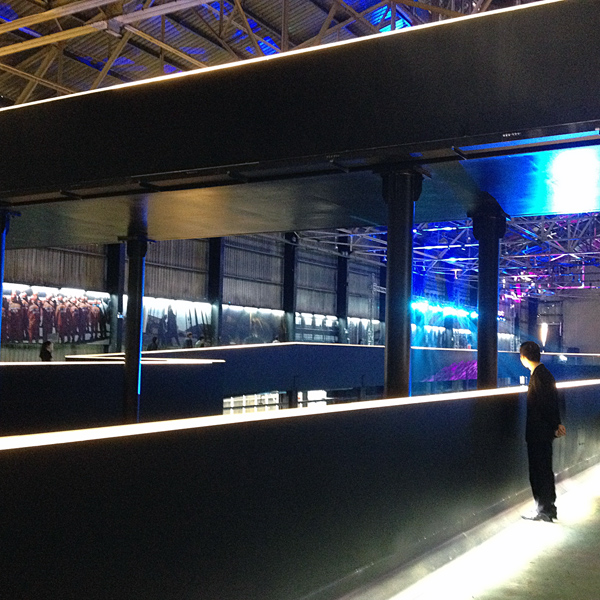
To get to the Biennale, take the Shekou Subway to Shekou Ferry station and walk about 500 meters. To then move between the spaces, take the shuttle. Or, if in Nanshan, my favorite bus line, the 226 stops at both venues. Jump off at Shekou Ferry Terminal (to visit the Warehouse) or Glass Factory (玻璃厂 to visit the Value Factory). First impressions from The Value Factory in previous post. Impressions from The Border Warehouse, below.
This slideshow requires JavaScript.

2013 biennale opening impressions

The biennale is up. Venue A, the old float glass factory has been cleaned up, but the space retains its high modern industrial charm. First impressions of the Machine Shop, below:

This slideshow requires JavaScript.

creative culture INDUSTRY

Visited the old Nanfang Glass Factory in Shekou. The factory is being renovated by 凤火, an advertising company that made its mark marketing real estate. It is now investing in cultural renovation and creativity in old Shekou. The other day we visited the site, which will open as (yes, another) art-culture space. Once again, my fondness for heroic high-modernism makes itself felt in impressions, below:

This slideshow requires JavaScript.

dachong update

Located west of Baishizhou and east of Shenzhen University and the Shenzhen Science and Technology Park, Dachong was once a large urban village with over 1,200 handshake buildings. It is being redeveloped into an upscale residential area, with office buildings and mall.

Yesterday, I had the opportunity to re-visit Baishizhou and get a sense of how the construction is being organized. Of note? A section of handshake buildings have been renovated as temporary housing for Dachong villagers, construction workers and young project administrators. By removing buildings, the developer, China Resources has created an intimate neighborhood with a park, basketball courts, and winding roads as well as a temporary shrine and ancestral hall. Indeed, this repurposing of extant handshakes is not only smart, it also suggests the contours of possible upgrades to extant urban villages, where the selective removal of one or two buildings would open up necessary public space without massive displacements of working class families, migrant workers, and young white collar workers.

Impressions of the temporary handshake neighborhood, below.

This slideshow requires JavaScript.

handshake 302 opening

Handshake 302 opened yesterday! We held our opening at the Baishizhou Cultural Plaza, where we distributed 1,000 balloons to neighborhood children. People chatted at our information table while waiting to be guided to the art space. For over 3 hours, Kaiqin dialogued with visitors about the installation, Special Forces, and the importance of public art. At 5, the second part of the day began, with a workshop led by Pete Moser. More Music Baishizhou brought together 20 members of CZC special forces to workshop a song about Baishizhou and plastic stool percussion. Then Pete shared his fabulous one-man show with residents. Impressions, below:

This slideshow requires JavaScript.

handshake 302 sneak preview!

We’re installing Accounting at Handshake 302! The opening happens October 20 15:00 to 17:00 come and enjoy an afternoon of public art in the village. Later, at 19:00 Peter Moser brings his community music project to the Baishizhou Culture Square. Impressions and map to Handshake 302 as well as the Culture Square, below.

This slideshow requires JavaScript.

performance art in shenzhen

Yesterday, Cai Qing hosted an afternoon of performance pieces in his OCAT studio. I’m sure others have commented on this, but performance art and weixin seem a match made in virtual heaven. Below, impressions of Fang Fang’s piece, “An Individual” in which she first proved her existence and then had others eulogize her. The response to her claims that she was a living human being was that no one doubted her existence, but they had no way of verifying the legality of her documents — hee! Meanwhile, the entire event was variously documented by over 1/2 the audience.

This slideshow requires JavaScript.

taihua and the emergence of a shen-zen. seriously.

I went to have tea at the Taihua Estates clubhouse in Bao’an. The estates were built in the late 1990s by Taihua Real Estate (泰华地产). But since its early success, the Taiwanese firm has re-envisioned the social role of real estate development — they are searching for designs that culturally and environmentally sustainable.

The clubhouse / office / kitchen is open to the outside and uses hanging fans rather than air-conditioning to cool the office space. Employees have lockers and laptops and they change workspaces as desired. Each day, a different department is responsible for preparing lunch for the entire team. There is a meditation room, a tea room, and as much spatial flexibility as possible. Moreover, the entire office and surrounding environment has been transformed through bamboo and water installations.

I find theirs a compelling vision. We introduced ourselves, meditated together, enjoyed two hours of tea and conversation, and then ate lunch. The space itself delights. Impressions, below.

This slideshow requires JavaScript.

land reclamation continues apace

The relentless occupation of the ocean continues. These images of Houhai Road (the former coastline) show the development that has engulfed Yuehaimen Village, subject of my last post. Clicking the houhai tag will bring up a decade of transformation.

This slideshow requires JavaScript.

yuehaimen village

When I first arrived at Shenzhen University, Yuehaimen was the urban village where I rented a conveniency apartment for 600 rmb a month. Located at the southeastern border of the SZU campus, there was an open gate between the village and the campus. However, by the time of SARS (2003) the gate was sealed off and students took to clambering over the wall between the village and campus in order to get to school. The university built dormitories at its southwestern border in Guimiao campus. That small, backdoor gate was the easiest to slip through during the SARS quarantine.

Piece by piece, urbanization near the SZU campus isolated Yuehaimen from the city. On its eastern border, Yuehaimen abuts the southern section of the Shenzhen Science and technology park. During construction of the park (from mid to late 1990s), another wall was built between the village and the white-collar work and residential area. The village’s southern border was the coastline that is now Houhai Road, and yes, a wall was built to separate the village from land reclamation, and has remained in place to cordon off ongoing construction of SZU’s southern campus.

These successive construction projects (SZU campus, Science and Technology Park, and reclamation of Houhai Bay) meant that Yuehaimen was an important home for construction workers, SZU students, and office staff. Having limited land resources, villagers built early and tall; these 6-8 story buildings are not prototypically “handshake” buildings, which emerged in the mid-1980s. Instead, Yuehaimen buildings resemble early 1990s work unit housing. More importantly, given land constraints and building styles, villagers did not own individual property, but units within jointly held buildings.

Yuehaimen is scheduled for razing by the end of the calendar year, or early next year. Most of the residents have been evacuated. What remains is an urban ghost village, where a few stragglers wait until the very last-minute before slipping into another urban enclave. In turn, Yangguang Real Estate developers promise to build another gated community on the footprint of Yuehaimen — this one shiny, modern, and meant to house Shenzhen’s technocratic managers and leaders.

Impressions, below.

This slideshow requires JavaScript.