Pictures of the Shanghai Hotel, one of the earliest and most important landmarks on Shennan Road taken in 2005 and 2010, respectively. Other than the skies, of note: In 2005, the bus stop was being expanded and the six story Rainbow Department Store was tucked away behind the Grand Skylight Hotel. By 2010, the new Rainbow Department Store dwarfs all other buildings. This is all part of the upgrading of Huaqiangbei.
Category Archives: photos
public intellectuals we be
Last Friday evening, Yang Qian, Chen Hongjuan (Melon), and I participated in a public talk on “Designing Escapist Experiences”. The event was the first in a four-part series on experience design that is co-produced by the OCT A3+ space and the Baptist University of Hong Kong, Master’s of Visual Arts in Experience Design. As with many talks in currently salon obsessed Shenzhen, the talk quickly exceeded its proscribed limits, this time steering into discussions of whether or not art was by definition “escapist” or if it constituted an opportunity to re-imagine the world, with particular reference to the every changing utopian project of the PRC. Also as with many of these discussions, commerce came in, guns blazing: was it really so horrible to pay for the delights of Disney princesses or to imagine oneself as middle class if only for a few moments? Indeed, it is an exciting time to be in Shenzhen where public debate–especially minjian debate–is enjoyed and well-attended. Young and old, well educated Shenzheners and recently arrived professionals, everyone wants to learn and is eager to share “true thoughts” with receptive interlocutors. After two hours of intense conversation, we took a group photo and went home, refreshed and somewhat hopeful in the lingering delights of conversation.
Crossing the Border Between Shenzhen and Hong Kong, 1951
great photos of the luohu border crossing, when it was just being established!
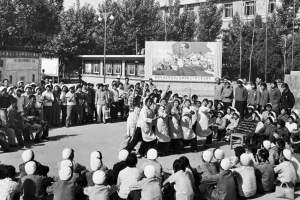
Dancing for the Nation’s Birthday at Our Factory, 1971
The past IS a different country.
celebrating yuan geng’s 98th birthday in shekou
Yuan Geng continues to inspire hope for social reform in Shekou. Yesterday, the recently established Shekou Community Welfare Fund mounted the exhibition “Me and Yuan Geng” to celebrate the 98th birthday of China Merchants-Shekou’s first CEO. The Shekou Community Welfare Fund is the 14th such fund registered in Shenzhen, but it is the only one started by community members through donations, rather than through a government bureau. This matters because Shenzhen Municipality has called for the establishment of 100 funds, and we hope for more and more community–rather than government sponsored community–funds to emerge over the next year or two. Continue reading
大鹏所城 (II): history in the making
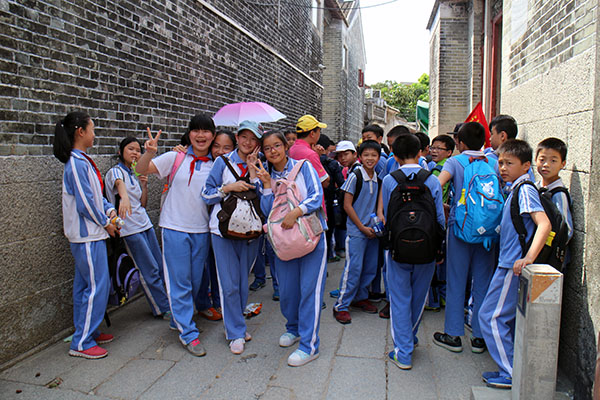
Almost seven years ago to the day, I posted thoughts on cultural history. The prompt for my speculations was Dapeng Garrison, which at the time was the lack of recognition for the site, which is Shenzhen’s only national level cultural relic. Two days ago, I returned and the space was hop, hop, hopping in all sorts of telling ways. What changes had allowed Dapeng Garrison to suddenly attract students, busloads of tourists, and random day-trippers? Like most Shenzhen stories, the answer is a twisting, convoluted story of profits, grey economies, the allure of accomplishments, and the real consequences of administrative failure. Continue reading
noodle shop, baishizhou
This past week has been a rush, with little time for organized thinking, let alone putting those thoughts together in written form. Nevertheless, while waiting for my noodles at the shop below Handshake 302, I watched the interactions of the proprietor and a local beggar. He sat at the table, silently, staring out at the road. She cleared tables, made noodles, and then graciously served him a bowl. He didn’t acknowledge her and ate. She returned to her work.
sunday afternoon in dafen
Dafen is now a destination, with artists posing as painters, and visitors posing with paintings. Meanwhile, the subway is open and many of the new developments are opening and real estate is booming, so that it’s now difficult to find the painting village–it’s a sinkhole in the midst of rising towers. Impressions, below:
gentrification in baishizhou
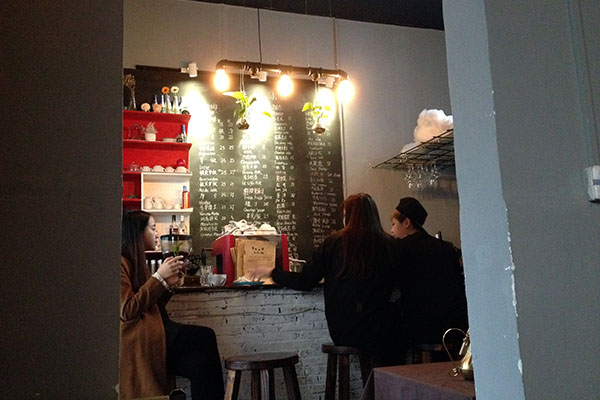
Here’s the thing about urban renewal in Shenzhen; it takes time. Consequently, although withering practices can be sensed in Baishizhou, nevertheless, day-to-day it all seems like the hustle and bustle hasn’t changed. Indeed, the neighborhood continues to experience low-level gentrification. There is, for example, now an independent coffee shop in Baishizhou, while outside on Shahe Road, individual upgrades continue. So photos from the coffee shop and ongoing upgrades suggest that even if young people in Baishizhou aren’t exactly hanging out and playing sports, nevertheless, there even low-income residents engage in leisure activities and consumption, which in turn points to the complexity of Baishizhou’s demographics and ongoing construction of Shenzhen’s youth culture.
handshake 302 in the classroom
Our current project, “Shake Hands with the Future” started last week, when curator Liu He and I went to Shenzhen Middle School to talk with students about an after school project to investigate and creatively respond to the urban villages in their neighborhood. And, because Shenzhen Middle School is located right next to Dongmen, the school is also next to several of the most iconic urban villages. So very excited about what the students will bring us.