reforming rhetoric 1: 摸论

“Feeling stones to cross the river” is one of the more famous sayings of early reform. Western pundits often interpret this phrase as a straight forward description of the uncertainties inherent in reforming the Maoist system and concomitant trepidation about moving toward – what? – xiaokang with capitalist features? However, this expression belongs to a rhetorical form called 歇后语 or two-part analogy, in which the first part is spoken and the speaker’s intended – and often critical – meaning is left unspoken. Paying attention to the unspoken response highlights how conflict and disagreement was handled within Party debate over the direction and scope of reform.

Chen Yun first raised “Feel theory (摸论)” as it became known during a Central Working Conference in December 1980. Importantly, Chen Yun used the two-part analogy to conclude an opinion on how to reform the Maoist apparatus, “…[I]n other words, we need to ‘Feel stones to cross the river’ (也就是要‘摸着石头过河《陈云文选》第3卷第279页)”. In conventional Mandarin, the unspoken critique in this analogy is “tread carefully (步步稳当)”. Later during the Conference, although Deng Xiaoping agreed with Chen’s unvoiced but present call for a more conservative approach to reform and opening, nevertheless, he shifted the discussion by emphasizing pragmatic action.

With “Cat theory (猫论)” and “Don’t debate theory (不争论)”, “Feel theory” became one of the three main principles guiding early reform.

population and hukou update, 2012

The decision to further loosen hukou requirements is once again front page news in Shenzhen (南方都市报). Interestingly, however, the municipal hukou system is only one reform target. Yesterday, the Municipality released its 2012 Reform Targets, which like hukou reform seem to be about rationalizing public administration, and include centralizing the City’s pension, philanthropy, credit, and prison systems. Nevertheless, hukou reform captured the headlines. Why?

Simple answer: Despite the fact that the children of both early migrants and Baoan locals, as well as the children of long-term residents now claim Shenzhen identity, nevertheless, the majority of the population does not have a legal claim to the Municipality, let alone an emotional sense of belonging. Indeed, the City’s statistics noticeably do not mention uncounted members of the floating population.

According to recent statistics, Shenzhen’s official population is now 15.1 million, of whom only 2.3 million have Shenzhen hukou. The Municipality’s other 12.8 million are in various states of limbo, which range from those who have overstayed a temporary residence permit through workers who have enough points to apply for a hukou to graduate students at Shenzhen’s University Town, who will be given hukou along with their diploma.

Nevertheless, even if we don’t know how many inhabitants actually identify themselves as Shenzheners, we do know that the Municipality is vigorously promoting the slogan, “If you come, you’re a Shenzhener”. To give a sense of how the Municipality strains to graft a sense of place onto deterritorialized bodies, I offer a loose translation of a recent bit of musical propaganda, the song, “If you come, you’re a Shenzhener (来了就是深圳人)” sung by Xu Qianya.

If You Come You’re a Shenzhener

(chorus) Wherever you’re from, you’ll hear your hometown language; It’s hard to distinguish between elsewhere and hometown; Wherever you’re from, this city opens its doors to you; If you come, you’re a Shenzhener; The earth has dreams to be harvested; The heart expands; Shennan Road is like a production line; Producing Spring after Spring; Clouds search for green mountains, mountains search for clouds; People seek opportunities, opportunities seek people; Heroes populate this world; You and I have the same heart; repeat chorus

Rap: There’s an immigrant town; Inhabited by youth and their dreams; Our latitute is 22 degrees north; Here a handshake means something; Here smiles last a little longer; Every day is young; The heart expands; Shennan Road is like a production line; Producing Spring after Spring; Clouds search for green mountains, mountains search for clouds; People seek opportunities, opportunities seek people; Heroes populate this world; You and I have the same heart; repeat chorus ad nauseum.

Lyrics:

不论你从哪里来 都能听到乡音,异乡和故乡很难分,不论你从哪里来 这座城敞开门,来了就是深圳人,土壤有梦多收获,胸襟开放多风云,深南路像一条流水线,流过青春又青春,云找青山山找云,人找机缘缘找人,天地间苍茫千万里,你我相知一颗心,不论你从哪里来 都能听到乡音,异乡和故乡很难分, 不论你从哪里来 这座城敞开门,来了就是深圳人

RAP:有一座移民之城,住满着青春和梦,这里刮着北纬22度季候风,这里的握手比较有力,这里的微笑比较持久,这里的每天都年轻,土壤有梦多收获,胸襟开放多风云,深南路像一条流水线,流过青春又青春,云找青山山找云,人找机缘缘找人,天地间苍茫千万里,你我相知一颗心,不论你从哪里来 都能听到乡音,异乡和故乡很难分,不论你从哪里来 这座城敞开门,来了就是深圳人 (Repeat)

the wanfeng model and its demise

Today, episode 10 from The Transformation of Shenzhen Villages (沧海桑田深圳村庄三十年): “Lonely Wanfeng”.

In 1957 at the height of collectivization, Wanjialang (万家郎) was changed to Wanfeng Village. Located on the eastern banks of the Pearl River, Wanjialang had been settled for over 600 years, and was part of the larger Shajing xiang or village federation. As narrated in the documentary, the rise of Wanfeng Village was inseparable from Village Secretary, Pan Qiang’en (潘强恩), who in 1981 made a pre-emptive decision to raze village agricultural land and build factories despite the fact that Wanfeng was located in New Bao’an District and thus, technically, still a commune.

Pan Qiang’en based the design of Wanfeng’s industrial zone on the Shekou Industrial Zone, which had been designated only three years previously. Also, like Yuan Geng at China Merchants, Pan Qiang’en mobilized Hong Kong capital for initial investments. Also, like Yuan Geng, who deployed official networks to raise investment capital, Pan Qiang’en took advantage of opportunities created through his position as a local cadre. Indeed, it was in his role as a Wanfeng cadre that he would have had opportunities to visit Shekou and meet with Yuan Geng.

The critical difference between Wanfeng and Shekou, of course, was and remains, status within the state apparatus. China Merchants developed Shekou as a Ministry work unit with a national ranking. This meant that China Merchants developed Shekou as a direct expression of national policy, and Yuan Geng could hire and deploy an educated workforce, as well as negotiate legally binding contracts. In contrast, Wanfeng was a village with traditional land rights, but limited appeal to urban educated intellectuals and limited knowledge of international business practices. Nevertheless, Wanfeng Village boomed, with 145 companies opening factories in village industrial parks and when the documentary was made, village fixed assets were estimated to be over 20 yi yuan or 316.5 million US dollars (based on today’s exchange rate), earning Wanfeng the nickname, “the first village in the South (南国第一村)”.

In 1985, Pan Qiang’en spearheaded the transformation of Wanfeng from a hybrid village-brigade into a stock-holding corporation in which stock and property rights were determined by one’s status as both a villager and a worker in the collective. Pan Qiang’en did not call his experiment a stock holding company, instead, he referred to it as “socialist collective holding system (社会主义公有制)”.

According to the blog 中国法制 (China’s Legal System), the Wanfeng Model had three distinguishing characteristics:

  1. The means of production belong to all villagers. The model has five kinds of stock options — state holdings, enterprise holdings, legal person holdings, workers’ holdings, and personal holdings. The first three stock options are collective and the final two are private;
  2. Government and enterprise are completely separate, specifically, the enterprise is completely responsible for economic losses, and thus enjoys all rights to profit. Government administration is based on a different budget and thus the government has no right to interfere with economic decisions made by the enterprise;
  3. Villagers stock holdings were based on three considerations: their salary as a worker in the collective; their status as an owner of collective property; and, their rights to social welfare.

In 1990, the Chinese Academy of Social Sciences held a conference on the Wanfeng Model (万丰模式) and in 1992, the president of the Academy came to Wanfeng, declaring that the Village had out urbanized urban areas. Wanfeng’s national influence reached its highest point in 1993, when the People’s Daily published,”The Wanfeng Model: On the Farmer and Social Philosopher Pan Qiang’en and His Social Praxis (万封模式--记农民社科理论家潘强恩和他的实践). Subsequently, village leaders from throughout the country came to learn from Wanfeng.

However, in 2001, when Pan Qiang’en decided to stop paying dividends in order to finance the village’s expanding enterprises, opposition to his leadership became increasingly widespread. By 2006, he was openly opposed as a “village tyrant (村霸)” and he stepped down from power in favor of his son. The documentary ends here, speculating on the relationship between individual effort and historic transformation.

However, an important footnote follows. Also in 2006, Shenzhen nationalized all land within the city borders, taking away villagers’ absolute right to the land. Henceforth, the city and district governments also shared in the profits generated by village land sales. This would have critical consequences for Wanfeng, where Pan Qiang’en’s son and government cronies sold village lands without either notifying villagers or distributing dividends, generating huge profits for those involved in the sales. Consequently, in 2012, Wanfeng Village “learned from Wukan” and brought down the Pan Qiang’en’s son, and elected a new village head to investigate how much of “collective holdings” had been expropriated by Pan Qiang’en, his immediate family, and corrupt officials.
shekou industrial road 7: echos of jane jacobs

One of the ongoing questions of urban planning is: what are the material conditions that support community life? To answer this question, we can’t simply look around and see what has been built, but rather have to reflect on what makes human life interesting, lively and fresh.

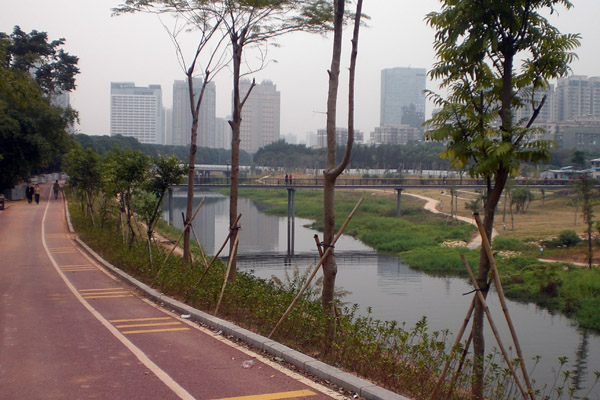
This morning I wandered Shekou Industrial Road 7 (蛇口工业7路) and realized that one of the reasons I enjoy this street is not simply the mix of residential, commercial, and industrial spaces, but also the expanse of public space and schoolyards. This public space has been created through the designation of Sihai Park and neighboring sports center, and also because the road is only two-lanes wide, with banyan trees that provide shade. Importantly, one stretch of Industrial Road 7 abuts Wanxia Village, where handshakes line-up in neat rows along one-lane roads and narrow alleys and give way to bustling urban village life.

Street life on Industrial Road 7 manifests the Chinese virtue of renqi (人气), which literally means “human air” and might be translated as “active” or “popular”. Hawkers set up stands under the trees, while elderly men practice water calligraphy on the sidewalk and pre-school children snack on steamed buns and soymilk. Window shopping (逛街) is thoroughly social as neighbors bump into each other on their way to preferred shops, or see each other’s children on their way to school. In the evening, once the sun has set and dinner bowls washed, the area becomes even more lively with families strolling and teenagers hanging out.

Admittedly, there is not much public space on Industrial Road 7. Significantly, however, many of the streets private spaces were built in the early 80s. Landscaping within residential compounds is a continuation of street landscaping, rather than planted with imported topiary that signal the end of the street and the beginning of elite consumption. More tellingly, guards do not actively prevent pedestrians from entering what are now considered low-income housing areas. Likewise, da pai dang (al fresco) mom and pop restaurants also integrate consumption into public life.

In The Death and Life of Great American Cities, Jane Jacobs documented and lamented how middle class flight from American cities to the suburbs contributed to the polarization and decay of our inner cities. In contemporary Shenzhen, a similar process is underway as the city’s middle class consolidates its identity and class consciousness through urban renewal projects and gentrification that not only result in clear razing urban villages, but also the construction of expensive malls and gated communities. The movement of people is different — the US middle class abandoned urban cores, and Shenzhen’s middle class is occupying the urban core and pushing the majority low income residents further to the periphery — but the result is the same. The unremitting blandness of these spaces announces and maintains social distinctions between the middle class and working poor, even as they homogenize differences between members of Shenzhen’s rising elite, creating an identifiable “Shenzhen” identity.

Over fifty years ago, Jacobs maintained that people like to live neighborhoods like Industrial Road 7. Moreover, she held that youngster and elders alike need accessible areas of mixed activities, cross-use of land, short blocks, mingle buildings of varying size, type and condition, and encourage dense concentrations of people. The point is to nurture marginal activities and small businesses, little restaurants and bars, as well as everything deviant, bohemian, intellectual or bizarre that make an area charming and vigorous.

I agree.

I also believe that this diversity humanizes us to the extent that we recognize ourselves in someone else’s life and consequently the wider our experience of difference, the more human we may become. In contrast, when we lay 4-lane roads without shade trees, build gated communities that isolate themselves from the street, and decide that malls, rather than parks better serve the public interest, we have proclaimed that to be human in the early 21st century is to aspire to life as a high-end mallrat.

Impressions of morning walk along Shekou Industrial Road 7, from Houhai Road west to Yanshan Road.

This slideshow requires JavaScript.

mini-series plot recap (by country and episode length)

Television dramas remind us that love is cross-culturally a means of negotiating gender inequality, but that is expressed through culturally specific forms of unhappiness and resolution there of. My trip to Taiwan reminded me, however, that even within Chinese speaking communities, young lovers face different challenges. Below, a list of mini-series plot recaps by country and episode length based on my own television habits. As a general rule of thumb, two episodes of an Asian mini-series is the equivalent in length of one US American made for television movie. Also, in my plot recap, I first note the happy ending and then in parenthesis a sad story version. And yes, please add insight from your experience watching these pervasive and addictive forms of popular culture.

US American = boy meets girl, boy and girl have sex, a murder brings them closer together (or one of them may be the victim) in one made for television movie;

Japanese = boy meets girl, boy and girl fall in love, a suicide brings them closer together (or one or both commit suicide) in 12 episodes;

Korean = boy meets girl, boy and girl fall in love, inherited and usually unsuspected history between their parents brings them closer together (or results in them being separated for years that each stoically endures) in 16 or 20 episodes;

Taiwanese = boy meets girl, boy and girl fall in love, their mothers begin a battle that brings them closer together (or forces one or both of them to choose between their lover and their mother) in 30 to 40 episodes;

Mainland = boy meets girl, boy and girl are attracted to each other, they soon realize that together they can rule the country more justly (or together they can’t seize power because corruption is just too endemic) in 80 episodes.

figuring out the street, shekou gongye number 8 road

I live on Shekou Gongye Number 8 Road, translated, my address is “Shekou Industry Road #8”. There are 10 industry roads in Shekou, remnants of the Shekou Industrial Zone. Walking these roads gives a good sense of not only how the city is gentrifying, but also the different street lives that various generations of urbanization have engendered.

To understand my discussion of class differences and symbolic geography of Industry Road #8, please reform to the map below which gives a rough sense of extent of land reclamation on the Nantou Peninsula. For purposes of this discussion, key landmarks, Industry Rd #8 and Houhai Road, which connects to New Shekou Road:

The older core of #8 threads through the residential parts of Old Shekou, linking up with what was the area’s commercial center and industrial parks. However, as part of the stutterstep Houhai Land Reclamation Project, #8 has lengthened with each burst of fill. Houhai Road used parallel the coastline and marked the thick edge where Mangrove trees gave way to piers and oyster cultivation, it now marks the historic divide between the old and new coastlines, between which upscale residential areas and shopping malls continue to be built. Thus, Houhai Road also constitutes a boundary between older but poorer and new rich neighborhoods

On #8, Houhai Road also divides the area into two different kinds of street life. The older section has concrete sidewalks that connect housing developments with 7 story walk-ups, community park areas with local foliage, and simple (also concrete) benches. The gate between the housing development and the street is a security bar that controls traffic flow in and out of the area. The new section has stylized sidewalks that are embellished with granite and marble at residences. The buildings are over 20 stories, the community park areas landscaped with imported topiary, and the benches ornate designs of iron and wood. The gates are over one story high with faux noble emblems that control pedestrian traffic in and out of the development because cars have a separate entrance that leads to underground parking.

During the day, the older section bustles with ad hoc businesses — soybean milk and steamed bun venders, people sitting on plastic chairs chatting, and various kiosks selling drinks, snacks, and newspapers. In the newer section, all these activities take place indoors and no one uses the public benches because the trees haven’t grown in enough to give shade. At night, in the older section a bbq station sets up and older people play chess. In the newer section, several entrepreneurs have set up roller blade classes for the children of the housing estates.

All this to make a simple observation about the ongoing construction of the Houhai Land Reclamation Area — in Shenzhen’s symbolic geography, the reclaimed areas function as a negation of the previous areas. This is not surprising given the SEZ’s historic role as a negation of Maoist space. However, it is important to note the vocabulary through which the ongoing formation of class identities in Shenzhen is expressed. The most recent, the newest is the best, representing the improvement of the past.

In practice, this symbolic geography has depended upon building large projects on unclaimed or reclaimed land. As unclaimed and reclaimed land become increasing scarce, however, this has meant that razing older areas has become the preferred way of creating “new” space. Consequently, these new spaces do not only negate the old symbolically, but increasingly depend razing old neighborhoods and the displacement of poorer residents, so that the negation becomes explicit — you and your type not welcome in the city. At present this logic is most visible and visceral in the urban villages. Nevertheless, here in the older section of #8, we hear the bulldozers on the horizon. More notes and images of the Houhai transformation, here.

Hair Washer Number 5

Her last name is Xu, but she insisted that I call her by her number, 5, Hair Washer Number 5. She called me Pretty Lady, or 美女 (meinv), a common form of address for women between the ages of 17 to mid 30s, but nothing I’ve ever been called. After I laughed and asked if I was truly a meinv, Xu explained that women like to be called pretty, and even when they were as old I was, to call them Auntie (阿姨 ayi) or Older Sister (大姐 dajie) might make them unhappy. I acknowledged how difficult it was to know how to address strangers, especially without an introduction.

Xu came to Shenzhen 3 years ago, when she was 15. She has been working in the beauty industry for two years now and took a job at this salon, which markets Korean style service and products because “For people without education, or money, or status,” she explained, “the only thing we can do is learn a skill and make our future ourselves.” She hopes to learn enough to someday open her own shop. She works 12 hours a day, 7 days a week, but says that once her trial period is up she will have one rest day a week.

As she kneaded my arm, Xu shyly asked, “What do you do when you’re upset?”

“I meditate and go for walks.”

She nodded slowly and then, eyes intently fixed on the skin of my inner arm, she told me that this afternoon at lunch she cried from weary exhaustion. Then her manager and several co-workers urged her to stop crying and toughen up, after all, if she didn’t learn to eat bitterness when she was so young, it would only get harder as she aged.

I asked if the crying helped.

“No, nothing’s changed.”

I fumbled to clarify, “I didn’t mean the question rhetorically. I just wanted to know if you felt better after you cried.”

She nodded her head once.

“Then cry,” I said, “and when you feel better, analyze your situation and figure out what to do next. You’ll make worse decisions when you’re tight and unhappy than you will after a good cry.”

She looked at me and then resumed kneading my other arm, adding softly when she finished, “Next time you come, ask for Number 5 and we can talk again.”

Humbled, I left the salon, hoping for the courage to return, ask for Number 5, and listen to her story.

海湾村: land locked futures

The Transformation of Shenzhen Villages (沧海桑田深圳村庄30年), Episode 9: Haiwan Village tells the story the Nantou Peninsula and the reclamation of land in Houhai (the southern coast facing Hong Kong) and Qianhai (the northern coast facing Guangzhou). This was the platform from which Hong Kong entered China and Baoan villagers once launched themselves to Hong Kong.

During the Mao era, Wanxia Village was divided into two production brigades, one land based for agricultural cultivation and the other water based for oyster farming. Eventually, the Wanxia Oyster Brigade was renamed Haiwan Brigade, creating two administrative villages through the division of one natural village. This division points to the importance of production — rather than history — in defining Maoist administrative units, especially in rural areas, where villages were integrated or split depending upon production needs. Importantly, however, these administrative categories were not naturalized in the same way during the early years of Reform and Opening, when some administrative villages re-instituted traditional boundaries while others did not. Haiwan retained Maoist status and began building village level factories.

Access to the sea shaped village demographics, with a population gap of people, ages 45-65 who escaped to Hong Kong in the last large flights in 1968 and 78, respectively. Nevertheless, traditional land rights enabled Haiwan to prosper. In addition, we learn from an older, Cantonese-speaking villager that Haiwan Village is an Overseas Chinese village, with many descendants scattered throughout the world with village association buildings in the United States and Hong Kong, representing support, ranging from monetary to knowledge to investment connections. The village has also maintained its identity through traditions and ritual that centered on a small Tianhou Temple.

Watching this episode, I suddenly realized something that was clearly obvious to the filmmaker: Deng Xiaoping’s 1992 Southern Tour coincided with the establishment of guannei villages as stock-holding corporations and urban neighborhoods. In other words, the second tour did result in new policies or breakthroughs as they are known. My a-ha moment was in seeing the connection between politics and the radical restructuring of the south china coast.  The episode ending rhetorically juxtaposes images of Wall Street with Houhai, asking if Shekou can become the next Manhattan. The question is illuminating not for its booster-hype pretensions, but rather because it clearly reiterates the primacy of investment and real estate over traditional livelihoods such as oyster farming. In such a world, insofar as the sea becomes a factor in determining property values and not an independent source of value, reclaiming the sea makes good business sense.

winners of the “dare to upset” china prize

Today, I received a list of 10 winners for the “dares to upset China (敢动中国)” Awards. The Awards are a snarky spoof on the Annual “Touches China’s Heart Awards (感动中国奖)”, punning the words “dares to upset” and “touches the heart”. Heart awards are presented at the Spring Festival and given to persons whose heroic actions inspire us to be more than we think we are. A pervasive and not unimportant bit of contemporary propaganda, heart award presentations are highly stylized performances and broadcast nationally. To get a sense of the ideological packaging, view the tribute and award presentation to Liu Jinguo for his courage during a fire.

The dares to upset awards point to the emergence of China as a global player and public reception of that process in vaguely hawkish terms. Notably, the dare to upset awards have been presented Asian countries that involved in maritime disputes with China, especially in the mineral rich South China Sea. Of note, the word “dares” points to the point that the winners are “small’ countries that should not be giving China problems. The fact that so many little nations dare to upset China is consequently interpreted as a sign of national weakness and the snarky commentary on the list states, “China has used habitual responses: the enemy invades, I endure; the enemy retreats, I endure; the enemy is exhausted, I endure; the enemy occupies, I endure… this is called pretending to use Sun Tze’s Art of War (敌进我忍,敌退我忍,敌疲我忍,敌驻我忍。。。装孙子兵法).”

According to the latest text message, the 10 winners for the 2012 Dares to Upset China Awards are:

1. Japan (for the Senkaku or Diaoyu Islands Dispute);

2. The Philippines (for the Huangyan Island or Panatag Shoal dispute);

3. North Korea (for holding Chinese fishermen in a dispute over fishing rights, although there is no dispute over North Korean refugees in China because the PRC regularly repatriates them);

4. South Korea (for demanding that Beijing release a South Korean activist who has been detained in the PRC without legal representation. The activist works for democracy in North Korea);

5. Thailand (is the new coordinating country for ASEAN – China relations, inheriting the three-year term from the Philippines)

6. Palau (the location of another disputed island, Okinotorishima);

7. Indonesia (has persecuted Overseas Chinese, but in April signed a cooperation agreement with China);

8. Myanmar (is opening its economy and China and the US are rushing in, however, last year the Myanmar government halted Chinese construction of a dam because locals felt that Chinese petroleum interests were too hardnosed);

9. Nigeria (is host to one of the largest Chinese presence in Africa. More than 200 Chinese companies operate in Nigeria, more than 40,000 Chinese nationals live in Nigeria, and total Chinese investment in Nigeria is close to $US 8 billion);

10. Somalia pirates (have been targeting Chinese vessels since 2008 and there have been calls for Chinese military intervention);

what i realized this june 4

On June 4, 1989, I was in Japan. That year, I had been diligently learning Japanese pronunciations for Chinese characters and memorizing [subject]-time-place-object-verb sentence patterns. The Chinese democracy movement, the call for transparent and clean governance, and the military crackdown came to me filtered through Japanese television because CNN was not yet global. Only after the fact would I learn about the two month build-up to the sight of tanks grinding through the Beijing streets. It took me years to understand the significance of Shenzhen reforms to inspiring the movement as well as how the crackdown unmade many of the political reforms, culminating in the 1992 Southern Tour, when Deng Xiaoping announced that economic liberalization would continue. Political liberalization would emerge piecemeal and in unexpected places, but no longer with the hopeful momentum of the early 80s.

Nevertheless, over the past years, I have noticed that my knowledge of events has been less important than the nitty gritty of everyday life in transforming June 4 into a meaningful symbol.

On Saturday, for example, I went to a coffee shop, where a man was lying on the ground, hands clawed, some kind of froth at his mouth, trembling. Two guards stood and another man sat, watching. I asked if an ambulance had been called. They answered, yes and I went into the coffee shop. Over twenty minutes later when I came out to look for someone, the man was still on the ground and no help to be seen. This time, I dialed 120 and connected with a dispatcher, asking a former student to explain what was happening. This decision disturbed the watchers who explained that the man was a thief and that he had faked a seizure when the guards had caught him. Moreover, according to the guards he frequently came by and stole things. The guards seemed less concerned about the man then they did about being seen not taking care of him. They stopped me from taking a picture and, when help did finally arrive, they kept repeating, “There’s nothing to see,” and pushed people away.

I left the coffee shop, came home, jumped online, and saw blog posts and articles on June 4, which caused me to make sense of the incident in larger, cultural terms. “China is a place where dissatisfaction with the regime or petty thievery can cost a human life,” I thought, “therefore people tend to be cynical and to ignore the suffering of strangers.” The coffee shop incident also allowed me to hear Chinese leaders repeating to other world leaders and journalists, “There’s nothing to be seen.” Consequently, my anger at the coffee shop guards grew into a nightlong bout of “what the fuck am I doing in China?” These were not happy or useful thoughts. Instead, as the anger cooled, I realized that I had argued with the guards about what should be done and our different values (them bad, me good). In retrospect, however, what is clear is that in actual practice our values were the same — we became increasingly angry with each other rather than wiping the froth at the man’s mouth or placing a pillow under his head.

This was not the first time that my sense of outrage has led me to fight with others rather than to comfort a suffering being. Consequently, June 4 this year, I listened to Pema Chodron‘s teaching on Shantideva’s The Way of the Bodhisattva in hope that by working with and through my anger, I will achieve something of the revolutionary patience necessary to change the world:

The hostile multitudes are vast as space –
What chance is there that all should be subdued?
Let but this angry mind be overthrown
And every foe is then and there destroyed.