Landscaping at the Spring Cocoon is moving forward as Shenzhen gears up to great the world. Today, I was given a neon green sticker that says “Start Here”, which Nanshan Second Foreign Language School students were distributing. I offer seven photos to give a sense of before and after changes at that particular corner, right in front of the Kempinski Hotel and next to the school. #1 The entrance to the stadium, that mascot string of bubbles, which sometimes have faces and speak in cartoons; #2 that corner in June 2003 and then #3 in April 2011; #4 the old coastline at that corner, June 2003 and then #5 in April 2011; #6 a picture of the area taken from Binhai road, looking northwest, and; #7 topiary details.
Category Archives: noted
吃一堑长一智 – lessons from being robbed
Yesterday, while waiting for my rice to be weighed at the Coastal City Jusco, my purse was robbed. The thief made off with cash, a camera, my keys, bankcard, and Shenzhen metro pass. Unexpected and disquieting. What did I learn?
First of all, I learned the proverb, 吃一堑长一智 (chī yī qiàn zhǎng yī zhì), which literally means in taking a moat, you gain knowledge. A bit of wisdom a la trench warfare, where for the military to take a city, they lost a lot crossing the moat. It seems to be used, however, in the way I might say “live and learn” or Oscar Wilde once said, “Experience is the name we give to our mistakes”. Continue reading
特 – a manifesto against special privileges
More from 乌有之乡, this time an essay on “Why is creating SEZs a logical fraud? (为什么说搞“经济特区”是一个“逻辑骗局”?)” And yes, these thoughts have been expressed before, but they really do bear repeating. And then, it’s worth applying the analysis to other, non-Chinese spheres where legal exceptionalism remains the primary form of creating competitive advantage. As the anonymous author argues, governments have made it their business to help multinationals squeeze even more out of workers.
Why is Creating SEZs a Logical Fraud?
Key point: The original purpose and core intention of creating “Special Economic Zones (SEZs)” was to explore possible paths for reforming and opening China. However, the problem appeared with the character “special (特)”. If what is being created is a “special” zone, logically speaking it isn’t relevant to ordinary life. In other words, the paths that are suitable for a “special” zone are “special paths”, and not the ordinary path of reforming and opening China.
[translation note: 法律特权 literally translates as legal privilege, however, it functions analogously to the American English concept of legal exceptions — the rules don’t apply to me — and where appropriate that is how I have translated it. In most places, however, I’ve tried to stick to “privilege”.] Continue reading
song of the china merchants group
Lest we forget the relationship between art, patriotism, and corporate success, the Song of the China Merchants Group reminds us how easy it is to fall for the singer, rather than observe what’s happening on the ground, say in Shekou. Click and sing along, “You ask how far my ship has travelled”.

who’s the happiest in your circle?
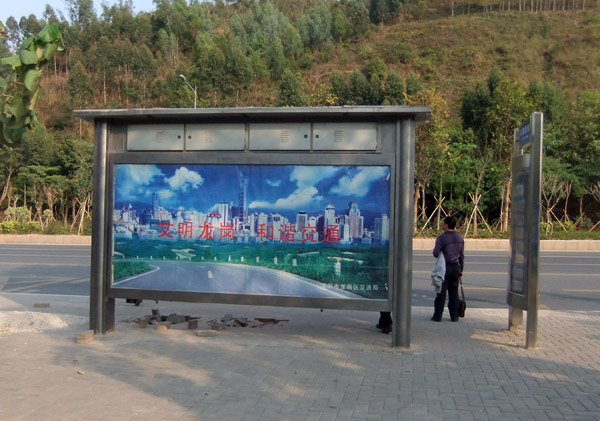
I have gotten somewhat inured to spiritual civilization campaigns like Longgang’s “Civilized Longgang, Harmonious Traffic” (above). After all, the offices have to do something with their budget and I actually support calls for more and better observation of traffic regulations, as well as teaching children to wait for others to get off a bus before charging on. However, this weekend YQ informed me that Shenzhen’s various Spiritual Civilization Bureaus (usually a division of the Ministry of Propaganda 精神文明办公室) have been asked to produce documentaries on “the happiest person I know (我身边最幸福的人)”. Nanshan is filming him because “we want to teach Shenzhen people that there’s more to life than making money.” Apparently, I was not selected because “foreigners do whatever they want, so there’s no educational value in [my] life.” — hee!

cultural homogenization in shenzhen. and not.
Most discussions of Shenzhen emphasize that as an immigrant city, Shenzhen is a Mandarin speaking outpost of national culture in the midst of Guangdong Province. However, this description glosses over the historical division of Baoan County into Cantonese and Hakka cultural areas, and how urban development focused on the SEZ (rather than the entire Municipality).
The establishment of Baoan and Longgang Districts in 1992 institutionalized these historic divisions, with a Cantonese cultural-linguistic area (Baoan District) and a Hakka cultural-linguistic area (Longgang District). At the same time, the traditional SEZ (bounded by the second line) formed the core of Mandarin national culture in the city.
Thinking about Shenzhen as a tri-cultural city enables understanding of how cultural homogenization does and does not take place. Today, I’m thinking specifically about the creation of a recognizably “rural” local identity versus an “urbane” Shenzhen identity. In the area surrounding the Universiade Village, for example, these various trends are most visible in ongoing construction and demolition projects.
Construction wise, the planned Universiade Village boasts beautiful, glass stadiums and swimming areas, which reflect urbane aesthetics. Indeed, the nearby 5-star hotels and upscale residential areas lump Shenzheners (the Mandarin nationals) with cutting edge international taste and consumption. This aesthetics contradicts that of the mid-90s generation of handshake buildings that constitute much of the Longcheng Street residential area. Architecturally, it all seems a straight-forward contradiction between rural and urbane Shenzhen, which in turn is often misread as a contradiction between Cantonese and Mandarin spheres.
In fact, walking through a small Hakka Village, like Dawei indicates how recent handshake buildings as an architectural sign of the rural are in Shenzhen. In Dawei, the handshake buildings have been built into and on top of a traditional, small Hakka compound (similar to the one in Sungang). In other words, handshake buildings create a common “rural” or “Baoan local” identity for (once culturally and linguistically distinct) Cantonese and Hakka villages only in contradistinction to a Mandarin identity.
Visual evidence in slideshow, below.
Woody Watson’s forty years on the other side of the border
I’ve just finished reading James Watson’s piece “Forty Years on the Border: Hong Kong / China” and am struck by the ongoing creation of national culture throughout the area, even before the establishment of the SEZ and concomitant migration deepened this trend. Consider Watson’s description of the Lok Ma Chau Lookout:
Stretched out in front of us is a meandering, muddy creek that constitutes the border, or what the British called “the Frontier.” On the south side, in the British zone, is a set of three, steel-link fences, topped with barbed wire. One hundred yards back from the fence are gun emplacements for Gurkha troops. Land Rovers filled with Scots Guards and the Black Watch drive by, along single-lane roads. British regiments are in full battle garb; weapons are on loaded and ready. Continue reading
shenzhen administrative structure
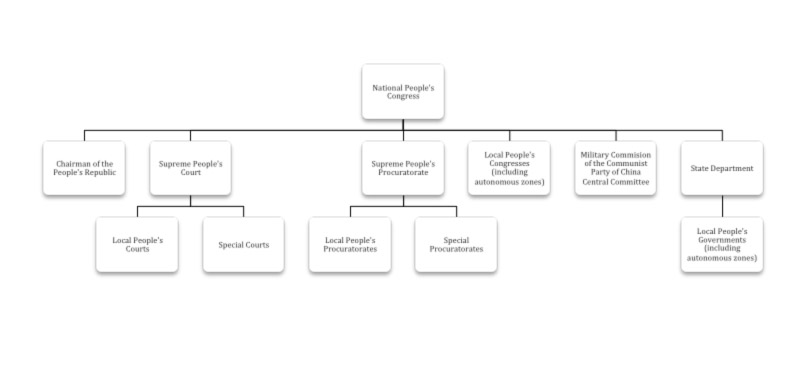
I’ve been making charts to organize my thinking. Below is an organizational chart of Shenzhen, circa 2010.

Also, a simplified version of the organizational relationship between the Central government and local governments. Guangdong is the provincial local; Shenzhen is a sub-provincial city, however, as an SEZ, Shenzhen has all sorts of legal privileges that provinces and direct cities do not.
copycat luxury
Had a buffet lunch at a five star hotel today. Delicious, especially the blueberry tart. If my friend invites me again, I will probably return to enjoy the breads and lovely fruits. Nevertheless, what has stayed in my mind is how it all felt unbearably like a Hollywood set. Or maybe it’s simply that I am inured to the scale of copycat luxury in Shenzhen; it takes more than dorian columns and ornate chandeliers, gold colored hallways and mosaic floors, Dafen paintings and leather sofas to impress me. What’s one building, when neighborhoods of 10,000 come and go each year?
the way we were
Going through old speeches of Deng Xiaoping, I came across his 1974 address to a Special Session of the United Nations General Assembly, using Third World theory that Zhou Enlai had presented at Bandung 1955. Those were the days, when socialist utopianism inspired the oppressed Peoples of the Third World to roar their anger and retake what had been taken. Of course, two years after Deng’s New York gig, Zhou Enlai and then Mao Zedong would pass, the Gang of Four would be vanquished in a bloodless transition of power (if we don’t take the PLAs one-year foray into Vietnam as a concession to hardliners), and Deng Xiaoping would emerge as the new leader of the People’s Republic of China, employing cats of various colors to jumpstart the economy first in Shekou (1978) and then in Shenzhen (1979), with the SEZ established in 1980.
And yet. As events in the Middle East force us to reflect on the resentments that inequality and oppression foster, Maoist language resonates. And yes, Socialism with Chinese characteristics would qualify for condemnation as “that country which styles itself socialist” if only because the USSR, the other country that styled itself socialist disbanded as Gorbachev, Reagan, Thatcher, and Deng renegotiated the post Cold War order. Memory snippets from the Marxist Internet Archive.
[…] In this situation of “great disorder under heaven,” all the political forces in the world have undergone drastic division and realignment through prolonged trials of strength and struggle. A large number of Asian, African and Latin American countries have achieved independence one after another and they are playing an ever greater role in international affairs. As a result of the emergence of social-imperialism, the socialist camp which existed for a time after World War II is no longer in existence. Owing to the law of the uneven development of capitalism, the Western imperialist bloc, too, is disintegrating. Judging from the changes in international relations, the world today actually consists of three parts, or three worlds, that are both interconnected and in contradiction to one another. The United States and the Soviet Union make up the First World. The developing countries in Asia, Africa, Latin America and other regions make up the Third World. The developed countries between the two make up the Second World… Continue reading
 Shenzhen Noted