entitled: the demise of comrade and ritualization of inequality

The other evening northern friends of a certain age lamented the demise of “comrade (同志)” as a form of address. They weren’t so much distressed by the Cantonese queering of the term, as they were by the fact that Chinese forms of address no longer assumed (or aspired to) equality between comrades. Instead, etiquette now demanded that social fields be charted and hierarchical relations marked. Officials, for example, are called by their bureaucratic position. Not surprising in the case of higher ranking officials — the City Party Secretary and Mayor, for example — but somewhat excessive in the case of neighborhood heads.

Even if they chafe at the ritual acknowledgement of political hierarchy and concomitant social inequality, nevertheless, they also remarked that official status does simplify the question of how to address someone. In contrast, they noted that the real awkwardness lay in deciding how to address someone without either a clear social role or a defined relationship to the self. They addressed professionals by their job (Lawyer Chen, Teacher Dong, Doctor An, Theatre Director Yang, and Engineer Liang come to mind), but often blanched at calling rich acquaintances “boss (老板)” or the more refined “executive (总)”. Friends were addressed by nicknames and fictive kin terms, while new friends could be called “Mr. (先生)” or “Ms. (小姐)”, but workers, including waitstaff and other service workers posed a problem because they could also be hailed as fictive kin or just young people. Moreover, gender and age play an important role, and in conversation my friends often call working men “craft master (师傅)” or “boy (小伙子)” and working women “auntie (阿姨)” or “younger sister (小妹)”.

In anticipation of the 18th National People’s Congress and to give a sense of just how complicated is the system of Chinese bureaucracy and relevant titles, I have translated the fifteen official levels of government from a Baidu entry. Positions are listed in order of ranking within a category. Hence, the General Secretary ranks higher than the President, who in turn ranks higher than the Chair of the Military Commission. When making introductions, most people will qualify a title with the appropriate administrative status, as in City Level Vice Mayor, after which however, they will use the full title “Mayor” unless the actual Mayor is around. These rankings also matter because they map the bureaucratic journey that ambitious functionaries must make. Shenzhen is a sub-provincial level city, for example, and so its Mayor cannot be directly considered for a national post, but must first obtain a provincial or ministerial position. In contrast, a the same position in an independent city, like Beijing or a full provincial ranking, would be a rank higher, placing the office holder in contention for national assignments.

Should your eyes not glaze as you read the list, you’ll get the hang of assigning rank and how using titles has ritualized inequality by reiterating the Chinese bureaucratic system from the General Secretary all the way down to a functionary in a community or village office.

First level, national level (国家一级):General Secretary, President, Chair of the Military Commission, Chair of the National People’s Congress, State Council Premier, Vice General Secretary, Standing Member of the Political Bureau of the CPC Central Committee.

Second and third level, national government (国家二至三级):Member of the Political Bureau of the CPC Central Committee, Alternative Member of the Political Bureau of the CPC Central Committee, Secretary for the Central Disciplinary Commission, Vice Chair of the NPC Standing Committee, Vice Premier of the State Council, State Council Member, President of the Supreme People’s Court, Vice Chair of the CPPCC National Committee.

Third and fourth level, national ministries and provincial government (部级正职、省级正职三至四级): Provincial governor, Vice Secretary for the Central Disciplinary Commission, Standing Member NPC, Secretary of State, all sub-national administrative chiefs and enterprise heads (including Party organizations), leaders of all People’s organizations (including Party organizations) at the provincial, autonomous region, independent city level. These organizations include Party Committees, People’s Congresses, Government, and Chinese People’s Political Consultative Conference. Exceptions can be made to give provincial rank to leaders of sub-provincial organizations;

Fourth and fifth level, vice ministries and sub-provincial government (部级副职、省级副职四至五级): Vice Governor, Members of the Central Disciplinary Commission, all sub-provincial administrative chiefs and enterprise heads (including Party organizations), leaders of all People’s organizations (including Party organizations) at the sub-provincialand sub-autonomous region. These organizations include Party Committees, People’s Congresses, Government, and Chinese People’s Political Consultative Conference. Exceptions can be made to give sub-provincial rank to leaders of Office of the Council or Regional organizations [Shenzhen Municipality];

Fifth through seventh level, Council Heads, Regional Chiefs and Counsels (司级正职、厅级正职、巡视员五至七级);

Sixth through eighth level, Vice Council Heads, Sub-regional Offices and Assistant Counsels (司级副职、厅级副职、助理巡视员六至八级) [Shenzhen Districts];

Seventh through tenth level, Department Heads, County Commissioner and  Investigators (处级正职、县级正职、调研员七至十级);

Eighth through eleventh level, Vice Department Heads, Vice County Commissioners, and Assistant Investigators (处级副职、县级副职、助理调研员八至十一级) [Shenzhen Precincts];

Ninth through twelvth level, Section Heads, Xiang Heads and Chief of Staff (科级正职、乡级正职、主任科员九至十二级);

Ninth through thirteenth level, Vice Section Heads, Vice Xiang Heads, and Vice Chief of Staff (科级副职、乡级副职、副主任科员九至十三级) [Shenzhen Communities/Neighborhoods];

Ninth through fourteenth level, Staff Members (科员:九至十四级);

Tenth through fifteenth level, Office Workers (办事员:十至十五级).

三打两建:ideology in guangdong

Guangdong Party Secretary, Wang Yang has been busy shoring up his position as a reliable, upstanding, and neo-liberal party member.

Since February this year, all of Guangdong has been engaged in “three attacks and two establishments (三打两建)”, a movement that has its own, quite extensive website. The three targets of attack are “illegal monopolization of the market through violence (欺行霸市)”, “manufacturing and selling fake goods (制假售假)”, and “commercial bribery (商业贿赂)”. The two principals to be established are “a system of social trust (社会信用体系)” and “a system of market oversight (市场监管体系)”.

It seems on first glance a call to rationalize highly local systems of production, consumption, and regulation because I have usually seen movement banners in urban villages, rather than in malls, making villagers the target of Guangdong’s current ideological movement. For example, “illegal monopolization of the market through violence” and “commercial bribery” seem to be descriptions of how markets and shops are actually run (with their reputed mafia ties) in villages. Likewise, “manufacturing and selling fake goods” also seems to be located in villages, with low-level investors setting up shanzhai factories in older, under the radar of municipal oversight spaces and then distributing these goods through local outlets. In contrast, the double aim to establish systems of trust and market regulation point to the government’s determination to bring all production, distribution, and consumption under a system of generalized oversight.

Currently, Shenzhen’s villages have all been incorporated into the municipal apparatus and villagers given citizen status. However, to the extent that industrialization in the Pearl River Delta has created rich villages that cultivate loyalty to the collective (or extended family) rather than to the state (as an abstract system), the next step in rural urbanization has become transforming villagers into citizens. Currently, one of the defining characteristics of a citizen in contrast to a villager is that “citizens” position themselves with respect to national laws (shared with strangers), while “villagers” position themselves with respect to traditional values (shared with familiars and intimates).

Point du jour, an important task of Chinese governance has become shifting how the state interpellates rural residents, hailing them as individualized “citizens”, rather than as collectivized “farmers” even when and despite the fact that many villages (such as Xiasha) are investing in symbols of collective identity, and the “urban village” has become a stereotype of Shenzhen cultural identity.

下沙陈杨候王庙: mapping the transition of property rights in shenzhen

Dedicated to Chen and Yang, a scholar and general, respectively, the Xiasha Houwang Temple 候王庙) is worth a visit and not only because these kings-in-waiting represent the Confucian ideal of uniting literary and military talents in governance, but also because they remind us that the contemporary figures of “high intellectual (高知)” and “high cadres (高干)” have historical president. What’s more, a glance at the plaque of sponsors suggests the extent to which reinvented traditions have been incorporated into Shenzhen’s urban village renewal projects. In addition to Xiasha Village Holdings Limited CEO, Huang Chaoying, CEOs from the various companies involved in Xiasha renewal also donated to temple construction, including Chen Hua (CEO Kingkey – 3 million yuan); Huang Chulong (CEO Galaxy – 2 million yuan); Huang Kangjing (Lvgem – 2 million): and Huang Guangmiao (CEO Centralcon– 2 million).

These four Shenzhen based conglomerates have a been major players in the implementation of the Municipality’s post 1996 urban plan, with investments that began either as a joint venture with an urban village or winning a bid from the government. Over time, these conglomerates have emerged become active in larger projects, participating in this second “village urbanization” effort and thus extending their holdings through collaboration with other Shenzhen urban villages as well as extended holdings throughout neidi. Kingkey, of course, is best known for the KK 100 in Caiwuwei, but also built the upscale mall, KK Baina in the reclaimed Hongshuwan area. It began as a Luohu developer, most notably the Jingdu Hotel, near the train station. Within the past decade, Kingkey has also expanded to open branches in Tianjin, Beijing, and Zhejiang.

The three other developers also followed this path – from developing buildings or housing complexes in a particular district (Kingkey began in Luohu, while Galaxy, Lvgem, and Zhongzhou had their start in Futian)  through urban village renovation (negotiating to lead the renovation of entire urban villages) to national player. All were formed in the early 90s, when Shenzhen began dismantling the State’s benefit housing system. The key point about the rise of real estate developers is that they are all less than twenty years old, profit(eer)ing from the Chinese State’s decision to discontinue public housing for middle class workers (For more details, see Historic Footnote, below).

Less than fifteen years after the end of public housing, the fact that four Shenzhen real estate developers are collaborating with Xiasha isn’t surprising. After all, the only remaining land to be developed in Shenzhen is under the control of Village Community Limited Corporations. Indeed, much of what is currently glossed as “renovation” is in fact, a process in which land rights transfer from the Village Holding Company to the Municipality by way of a developer, who sells buildings but not land. What is interesting, however, in how these developers are working with Xiasha to create a recognizably traditional and Confucian identity. In other words, Xiasha is being presented as a viable form of upgraded urban village that explicitly references tradition, rather than Communist history and the establishment of New China. Significantly, renovation at Xiasha not only marks the convergence of Village Community and Enterprise interests, but also reveals the ideological form of this convergence as an upscale urban village. What remains to be seen is whether or not Xiasha Limited can expand as the real estate companies have, or if it will remained tied to its traditional land.

Below, impressions caught on a walk from Chegongmiao to Xiasha. Several notes. 1. Chegongmiao was a mid-80s industrial park. It is now being renovated with restaurants and office space, but it does save the older urban layout as well as benefit housing stock. Thus, the area offers middle class workers relatively affordable and convenient housing. 2. Just across the street, Xiasha will soon boast a major KK skyscraper, which will make the urban village prime real estate. 3. I finished my walk by having my fortune told, by a Tianjin grandma, whose hand-written notebook reminds us that popular religion is not simply about respecting social hierarchy (as in the Chen-Yang Temple), but also manipulating fate to get ahead.

This slideshow requires JavaScript.

Historic Footnote: The Privatization of Work Unit Housing and the Creation of Shenzhen’s Housing Market

Before the 1992 Southern Tour, housing in Shenzhen was typically of two kinds — either work unit housing, which was built by state work units for their staff or rental properties in the urban villages. Accordingly, state work units and independent crews were responsible for most housing design and construction. After the Southern Tour, however, Shenzhen began extensive housing reform (房改), which entailed both privatizing extant housing and creating commercial housing stocks. Until 1999, when the last work unit developments had been approved, Shenzhen had three kinds of housing — benefit housing (福利房), small profit housing (微利房), and commercial housing (商品房). Benefit housing belonged to the work unit, which assigned housing to staff by calculating such factors as seniority, tenure and hukou status. Small profit housing was just that, work unit housing whereby the unit building the housing was able to earn a small profit. Commercial housing was just that, housing that was developed with an eye to making a profit.

During the 1990s, most middle class Shenzhen residents lived in either benefit or small profit housing. In order to make their housing attractive to people who might otherwise settle for benefit or small profit housing, nascent real estate development groups sold life styles, the most popular of which was known as “European style”. Many middle class workers who already had a benefit or small profit home invested in commercial housing. However, most middle class workers aspired to either benefit or small profit housing. Nevertheless, housing reform transformed this system and by the end of the 90s and especially first years of the new millennium, commercial housing stocks had become the most common option for middle class migrants, who arrived in the city after benefit and small profit housing had been discontinued. For the next five years, work units allocated the last of benefit and small profit housing. Then, in mid 2007 – early 2008, Shenzhen’s real estate market took off, with housing and building prices abruptly doubling within one calendar year.

可怜天下父母心: generation 80 and 90 go abroad

I tend to think that middle class Chinese parents have it good. Grandparents take care of young children, elementary school children go to school and can generally be pressured into doing several hours of homework a night, and older children hang out with their parents, not only out of respect, but also because they acknowledge that being with children makes parents happy. In fact, a visit to any park or mall, or even an ordinary bus commute suggests how well behaved Chinese infants are. One or two fuss, but most sit calmly on their grandparents’ laps or play with a water bottle. School age children get themselves to and from campus, attend cram sessions, and organize their homework.

Even after graduating from college, middle class children take care of their parents’ well-being. I know more than one member of Generation 80, for example, who returns home for weekly meals. Working Chinese children also arrange for their parents and parental-in laws to live with or near them in order to attend to parental needs. So common is the assumption of parental care that throughout Shenzhen, hospitals and shopping malls market themselves as places where children can express care for parents — arranging a mother’s dental appointment or family dinner, for example. Certainly, facilitating migrant remittances from Shenzhen to neidi and family network phone plans are huge sections of the financial and service industries. In other words, my experience has shown me the extent to which middle class Chinese children — even members of Generation 80 and 90 —  remain remarkably filial. Or certainly seem so when compared with their age cohorts in the United States.

I realize that mine is a minority position. Commentators in both China and the West have focused on how China’s middle-class parents work exceedingly hard to provide the material conditions for their only child to live well. These parents sacrifice all sorts of ambitions and desires so that their child can go a famous university. They also point out that since promulgation in 1980, China’s one-child policy has produced not a few “little Emperors (小皇帝)”, who in common English are simply “spoilt brats”. Now it may be that when two sets of grandparents and often a nanny orbit the lone descendent, some children become unreasonable. But not all. And certainly not the majority, who study hours as long or longer than their parents work to achieve academic results that will make their elders proud. Indeed, I am still impressed by the number of young Chinese people who make their parents’ dreams (rather than their own) their lodestar.

As I have begun to gather stories about generations 80 and 90 abroad, however, my perspective has shifted. I am beginning to realize the extent to which their parents have made these young people their life’s purpose. It is not simply that middle class parents bask in the glory of their child’s accomplishments, but also and more importantly, that they have crafted lives out of raising this child. These parents often confuse high grades with success and low grades with failure, or interpret independent thinking as “rebellion” and “intransigence”. Nevertheless, once their child successfully matriculates in an overseas high school or college, these parents suffer acute ” empty nest” syndrome, as we call it in the States not only because they realize that they will no longer be able to direct their children’s development, but also because they finally understand, no matter what and how they dream for their child, ultimately they cannot give their child a smooth and carefree life.

Yesterday, I helped a mother read and understand US insurance documents. Her daughter is in California and was in a car accident. The other party has filed for damages, and the daughter’s insurance company has begun to negotiate with the claimant’s lawyer. Ironically, the mother sold her own car so that the daughter could purchase a car, which she explained, “is more necessary in California than Shenzhen.” The daughter whose English is fine, but not strong enough to feel confident about her understanding of documents in legal English sent her mother digital copies, asking for guidance. The mother does not read English and used half a day to find a connection to me to make an appointment. After I explained the content to her, we came up with a plan of action and contacted the daughter, who is no doubt figuring out what needs to be done and doing it. Her mother, however, is in Shenzhen managing the anxiety of helplessness; she deeply wants to help her daughter, but cannot.

All this to say that I am hearing the expression “take pity on the hearts of the world’s parents (可怜天下父母心)” differently, and perhaps more accurately. I used to hear it as spoilt parent moaning about a child’s attempt to establish a bit of independence. Today, I am better able to pity parents, not because their child received poor grades or has a stubborn streak, but rather because they would do anything to make their child’s life smooth and happy. Of course, that is precisely what they cannot do, and so they suffer.

Interesting cultural postscript: in Chinese, empty nests refer to lonely grandparents and the phrase “empty nester” is translated as 孤寡老人. Thus, when their children go and remain abroad, Chinese parents not only become empty nesters in the US sense of “children have moved out”, but also potentially in the Chinese sense of “old person without a grandchild”.

branding shenzhen fashion

The Shenzhen Clothing Association held it’s its 12th trade fair at the Convention and Exhibition Center. Exhibitions ranged from themed installations in the main showroom to high end spreads in other showrooms. The annual trade fair is part of the Municipality’s ongoing efforts to brand itself as a center for Chinese fashion and indeed, many of China’s top fashion brands are Shenzhen firms. Impressions below, and yes, when the sun shines the exhibition center sparkles impressively.

This slideshow requires JavaScript.

land reform, again.

An Old Shenzhener once complained to me that since the 1989 Crackdown, in Shenzhen “reform” has been too often interpreted to mean “refining the state system”, rather than actually reforming society. His point was simple. During the first decade of Reform, people had an opportunity to participate in and even direct the direction of development in Shenzhen. The fact of widespread participation made Shenzhen “special”. In contrast, after June 4th, Shenzhen became increasingly bureaucratized – like Beijing – and participating in social transformation was no longer possible for the common people. Instead, the Government had become the key social force and thus, social agency meant “works under the guidance of government bureaus” for the benefit of government officials and their cronies.

The Municipality’s latest “land reform (土改)” program illustrates the problem that aggrieved my friend. Last week, the government released three documents that legislate the scope and direction of land reform: The Comprehensive Plan to Reform Shenzhen Land Administration (深圳市土地管理制度改革总体方案), The Immediate Short Term Plan (2012-2015) of the Comprehensive Plan to Reform Shenzhen Land Administration, (〈深圳市土地管理制度改革总体方案〉近期实施方案(2012~2015年), and Notification of the Establishment of the Shenzhen Land Administration Reform Guiding Committee (关于成立深圳市土地管理制度改革领导小组的通知). Together these documents determine the target of reform, the method of reform, and the people who will interpret and implement land reform. Moreover, even a cursory reading the documents indicates that at stake in these documents is (1) finalizing the transfer of outstanding land rights from village holdings to the Municipality and (2) determining the status of informal property rights in urban villages so that (3) developers can more easily realize the goals outlined in the Municipality’s Comprehensive Master Plan, 2010-2020.

And there’s the rub: During the 1980s, villagers and various entrepreneurs collaborated to build the urban villages. My friend understood this situation be “true” or “ideal” reform because ordinary people could realize projects outside the purview of government plans. At the time, none of those projects were “informal” or “illegal” because the villages held legal land rights. He also thought that this freedom to develop land was the precondition for true social reform. He didn’t think that all villages had done a good job with the opportunity, but nevertheless believed that the idea of small-scale development and common participation was the point of reform. However, once the villages had been incorporated into the Municipal apparatus, that first round of development could be reinterpreted in terms of illegal buildings and informal property rights, alienating villagers and unofficial developers from participating in future development projects except as recipients of compensation packages.

Shenzhen property rights are a muddle that the Government needs to handle carefully to avoid aggravating extant (and growing) inequality. On the one hand, by incorporating village lands into the state apparatus and compensating villagers and independent landlords for their extant holdings, the Government creates ill will on two counts. First, people without hereditary land rights or informal property rights have no chance to benefit from this process. Second, with the exception of farmers, the process enriches government officials and corporate executives, which is the common sense definition of “corruption”. On the one hand, if the government were to reform property laws to allow for individuals to develop land, this would mean completely restructuring the state apparatus and concomitant property rights. This is what my friend would like to see – capitalist opportunities for individuals, rather than for government officials and large corporations. But this seems more a definition of “revolution” than “land reform” as it would mean redistributing rights to high-rises, shopping malls, neighborhoods, housing estates, and industrial areas.

Guanwai village lands were not only extensive, but also remain underdeveloped. Consequently, the experimental target of overall land reform in the 2012-2015 short term plan is Pingshan New District, while the experimental targets of “second round development (第二次开发)” are be Gonghe Community, Shajing Precinct, Baoan and Shanxia Community, Pinghu Precinct, Longgang.

reforming rhetoric 1: 摸论

“Feeling stones to cross the river” is one of the more famous sayings of early reform. Western pundits often interpret this phrase as a straight forward description of the uncertainties inherent in reforming the Maoist system and concomitant trepidation about moving toward – what? – xiaokang with capitalist features? However, this expression belongs to a rhetorical form called 歇后语 or two-part analogy, in which the first part is spoken and the speaker’s intended – and often critical – meaning is left unspoken. Paying attention to the unspoken response highlights how conflict and disagreement was handled within Party debate over the direction and scope of reform.

Chen Yun first raised “Feel theory (摸论)” as it became known during a Central Working Conference in December 1980. Importantly, Chen Yun used the two-part analogy to conclude an opinion on how to reform the Maoist apparatus, “…[I]n other words, we need to ‘Feel stones to cross the river’ (也就是要‘摸着石头过河《陈云文选》第3卷第279页)”. In conventional Mandarin, the unspoken critique in this analogy is “tread carefully (步步稳当)”. Later during the Conference, although Deng Xiaoping agreed with Chen’s unvoiced but present call for a more conservative approach to reform and opening, nevertheless, he shifted the discussion by emphasizing pragmatic action.

With “Cat theory (猫论)” and “Don’t debate theory (不争论)”, “Feel theory” became one of the three main principles guiding early reform.

population and hukou update, 2012

The decision to further loosen hukou requirements is once again front page news in Shenzhen (南方都市报). Interestingly, however, the municipal hukou system is only one reform target. Yesterday, the Municipality released its 2012 Reform Targets, which like hukou reform seem to be about rationalizing public administration, and include centralizing the City’s pension, philanthropy, credit, and prison systems. Nevertheless, hukou reform captured the headlines. Why?

Simple answer: Despite the fact that the children of both early migrants and Baoan locals, as well as the children of long-term residents now claim Shenzhen identity, nevertheless, the majority of the population does not have a legal claim to the Municipality, let alone an emotional sense of belonging. Indeed, the City’s statistics noticeably do not mention uncounted members of the floating population.

According to recent statistics, Shenzhen’s official population is now 15.1 million, of whom only 2.3 million have Shenzhen hukou. The Municipality’s other 12.8 million are in various states of limbo, which range from those who have overstayed a temporary residence permit through workers who have enough points to apply for a hukou to graduate students at Shenzhen’s University Town, who will be given hukou along with their diploma.

Nevertheless, even if we don’t know how many inhabitants actually identify themselves as Shenzheners, we do know that the Municipality is vigorously promoting the slogan, “If you come, you’re a Shenzhener”. To give a sense of how the Municipality strains to graft a sense of place onto deterritorialized bodies, I offer a loose translation of a recent bit of musical propaganda, the song, “If you come, you’re a Shenzhener (来了就是深圳人)” sung by Xu Qianya.

If You Come You’re a Shenzhener

(chorus) Wherever you’re from, you’ll hear your hometown language; It’s hard to distinguish between elsewhere and hometown; Wherever you’re from, this city opens its doors to you; If you come, you’re a Shenzhener; The earth has dreams to be harvested; The heart expands; Shennan Road is like a production line; Producing Spring after Spring; Clouds search for green mountains, mountains search for clouds; People seek opportunities, opportunities seek people; Heroes populate this world; You and I have the same heart; repeat chorus

Rap: There’s an immigrant town; Inhabited by youth and their dreams; Our latitute is 22 degrees north; Here a handshake means something; Here smiles last a little longer; Every day is young; The heart expands; Shennan Road is like a production line; Producing Spring after Spring; Clouds search for green mountains, mountains search for clouds; People seek opportunities, opportunities seek people; Heroes populate this world; You and I have the same heart; repeat chorus ad nauseum.

Lyrics:

不论你从哪里来 都能听到乡音,异乡和故乡很难分,不论你从哪里来 这座城敞开门,来了就是深圳人,土壤有梦多收获,胸襟开放多风云,深南路像一条流水线,流过青春又青春,云找青山山找云,人找机缘缘找人,天地间苍茫千万里,你我相知一颗心,不论你从哪里来 都能听到乡音,异乡和故乡很难分, 不论你从哪里来 这座城敞开门,来了就是深圳人

RAP:有一座移民之城,住满着青春和梦,这里刮着北纬22度季候风,这里的握手比较有力,这里的微笑比较持久,这里的每天都年轻,土壤有梦多收获,胸襟开放多风云,深南路像一条流水线,流过青春又青春,云找青山山找云,人找机缘缘找人,天地间苍茫千万里,你我相知一颗心,不论你从哪里来 都能听到乡音,异乡和故乡很难分,不论你从哪里来 这座城敞开门,来了就是深圳人 (Repeat)

the wanfeng model and its demise

Today, episode 10 from The Transformation of Shenzhen Villages (沧海桑田深圳村庄三十年): “Lonely Wanfeng”.

In 1957 at the height of collectivization, Wanjialang (万家郎) was changed to Wanfeng Village. Located on the eastern banks of the Pearl River, Wanjialang had been settled for over 600 years, and was part of the larger Shajing xiang or village federation. As narrated in the documentary, the rise of Wanfeng Village was inseparable from Village Secretary, Pan Qiang’en (潘强恩), who in 1981 made a pre-emptive decision to raze village agricultural land and build factories despite the fact that Wanfeng was located in New Bao’an District and thus, technically, still a commune.

Pan Qiang’en based the design of Wanfeng’s industrial zone on the Shekou Industrial Zone, which had been designated only three years previously. Also, like Yuan Geng at China Merchants, Pan Qiang’en mobilized Hong Kong capital for initial investments. Also, like Yuan Geng, who deployed official networks to raise investment capital, Pan Qiang’en took advantage of opportunities created through his position as a local cadre. Indeed, it was in his role as a Wanfeng cadre that he would have had opportunities to visit Shekou and meet with Yuan Geng.

The critical difference between Wanfeng and Shekou, of course, was and remains, status within the state apparatus. China Merchants developed Shekou as a Ministry work unit with a national ranking. This meant that China Merchants developed Shekou as a direct expression of national policy, and Yuan Geng could hire and deploy an educated workforce, as well as negotiate legally binding contracts. In contrast, Wanfeng was a village with traditional land rights, but limited appeal to urban educated intellectuals and limited knowledge of international business practices. Nevertheless, Wanfeng Village boomed, with 145 companies opening factories in village industrial parks and when the documentary was made, village fixed assets were estimated to be over 20 yi yuan or 316.5 million US dollars (based on today’s exchange rate), earning Wanfeng the nickname, “the first village in the South (南国第一村)”.

In 1985, Pan Qiang’en spearheaded the transformation of Wanfeng from a hybrid village-brigade into a stock-holding corporation in which stock and property rights were determined by one’s status as both a villager and a worker in the collective. Pan Qiang’en did not call his experiment a stock holding company, instead, he referred to it as “socialist collective holding system (社会主义公有制)”.

According to the blog 中国法制 (China’s Legal System), the Wanfeng Model had three distinguishing characteristics:

  1. The means of production belong to all villagers. The model has five kinds of stock options — state holdings, enterprise holdings, legal person holdings, workers’ holdings, and personal holdings. The first three stock options are collective and the final two are private;
  2. Government and enterprise are completely separate, specifically, the enterprise is completely responsible for economic losses, and thus enjoys all rights to profit. Government administration is based on a different budget and thus the government has no right to interfere with economic decisions made by the enterprise;
  3. Villagers stock holdings were based on three considerations: their salary as a worker in the collective; their status as an owner of collective property; and, their rights to social welfare.

In 1990, the Chinese Academy of Social Sciences held a conference on the Wanfeng Model (万丰模式) and in 1992, the president of the Academy came to Wanfeng, declaring that the Village had out urbanized urban areas. Wanfeng’s national influence reached its highest point in 1993, when the People’s Daily published,”The Wanfeng Model: On the Farmer and Social Philosopher Pan Qiang’en and His Social Praxis (万封模式--记农民社科理论家潘强恩和他的实践). Subsequently, village leaders from throughout the country came to learn from Wanfeng.

However, in 2001, when Pan Qiang’en decided to stop paying dividends in order to finance the village’s expanding enterprises, opposition to his leadership became increasingly widespread. By 2006, he was openly opposed as a “village tyrant (村霸)” and he stepped down from power in favor of his son. The documentary ends here, speculating on the relationship between individual effort and historic transformation.

However, an important footnote follows. Also in 2006, Shenzhen nationalized all land within the city borders, taking away villagers’ absolute right to the land. Henceforth, the city and district governments also shared in the profits generated by village land sales. This would have critical consequences for Wanfeng, where Pan Qiang’en’s son and government cronies sold village lands without either notifying villagers or distributing dividends, generating huge profits for those involved in the sales. Consequently, in 2012, Wanfeng Village “learned from Wukan” and brought down the Pan Qiang’en’s son, and elected a new village head to investigate how much of “collective holdings” had been expropriated by Pan Qiang’en, his immediate family, and corrupt officials.

shekou industrial road 7: echos of jane jacobs

One of the ongoing questions of urban planning is: what are the material conditions that support community life? To answer this question, we can’t simply look around and see what has been built, but rather have to reflect on what makes human life interesting, lively and fresh.

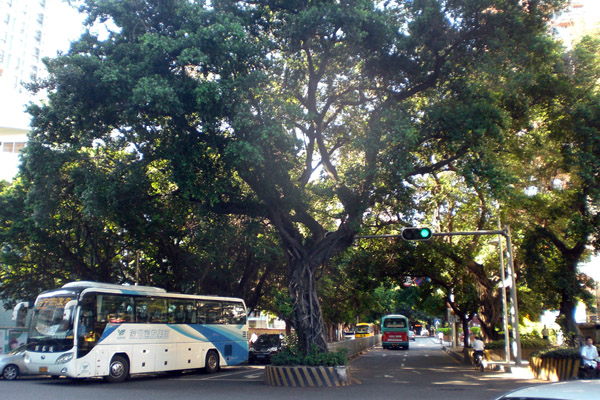
This morning I wandered Shekou Industrial Road 7 (蛇口工业7路) and realized that one of the reasons I enjoy this street is not simply the mix of residential, commercial, and industrial spaces, but also the expanse of public space and schoolyards. This public space has been created through the designation of Sihai Park and neighboring sports center, and also because the road is only two-lanes wide, with banyan trees that provide shade. Importantly, one stretch of Industrial Road 7 abuts Wanxia Village, where handshakes line-up in neat rows along one-lane roads and narrow alleys and give way to bustling urban village life.

Street life on Industrial Road 7 manifests the Chinese virtue of renqi (人气), which literally means “human air” and might be translated as “active” or “popular”. Hawkers set up stands under the trees, while elderly men practice water calligraphy on the sidewalk and pre-school children snack on steamed buns and soymilk. Window shopping (逛街) is thoroughly social as neighbors bump into each other on their way to preferred shops, or see each other’s children on their way to school. In the evening, once the sun has set and dinner bowls washed, the area becomes even more lively with families strolling and teenagers hanging out.

Admittedly, there is not much public space on Industrial Road 7. Significantly, however, many of the streets private spaces were built in the early 80s. Landscaping within residential compounds is a continuation of street landscaping, rather than planted with imported topiary that signal the end of the street and the beginning of elite consumption. More tellingly, guards do not actively prevent pedestrians from entering what are now considered low-income housing areas. Likewise, da pai dang (al fresco) mom and pop restaurants also integrate consumption into public life.

In The Death and Life of Great American Cities, Jane Jacobs documented and lamented how middle class flight from American cities to the suburbs contributed to the polarization and decay of our inner cities. In contemporary Shenzhen, a similar process is underway as the city’s middle class consolidates its identity and class consciousness through urban renewal projects and gentrification that not only result in clear razing urban villages, but also the construction of expensive malls and gated communities. The movement of people is different — the US middle class abandoned urban cores, and Shenzhen’s middle class is occupying the urban core and pushing the majority low income residents further to the periphery — but the result is the same. The unremitting blandness of these spaces announces and maintains social distinctions between the middle class and working poor, even as they homogenize differences between members of Shenzhen’s rising elite, creating an identifiable “Shenzhen” identity.

Over fifty years ago, Jacobs maintained that people like to live neighborhoods like Industrial Road 7. Moreover, she held that youngster and elders alike need accessible areas of mixed activities, cross-use of land, short blocks, mingle buildings of varying size, type and condition, and encourage dense concentrations of people. The point is to nurture marginal activities and small businesses, little restaurants and bars, as well as everything deviant, bohemian, intellectual or bizarre that make an area charming and vigorous.

I agree.

I also believe that this diversity humanizes us to the extent that we recognize ourselves in someone else’s life and consequently the wider our experience of difference, the more human we may become. In contrast, when we lay 4-lane roads without shade trees, build gated communities that isolate themselves from the street, and decide that malls, rather than parks better serve the public interest, we have proclaimed that to be human in the early 21st century is to aspire to life as a high-end mallrat.

Impressions of morning walk along Shekou Industrial Road 7, from Houhai Road west to Yanshan Road.

This slideshow requires JavaScript.