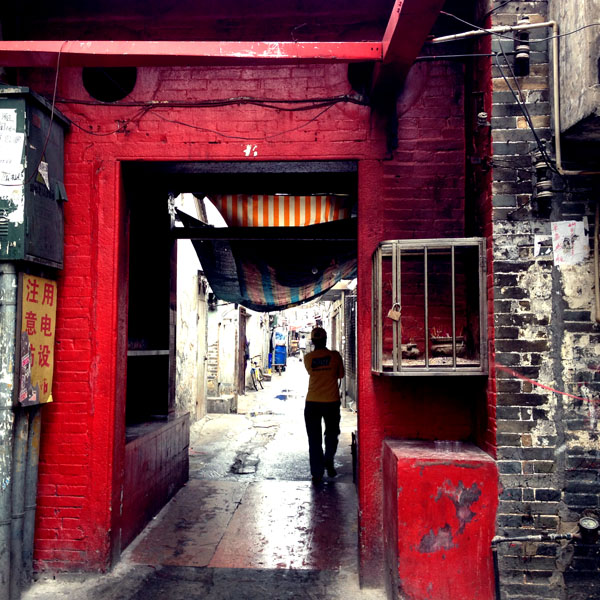
bardo

Chen Dong, the director of Da Ken Art Center (大乾艺术中心) commissioned me curate a performance for the Mayan apocalypse, December 21, 2012; Bardo was the result. Choreographers, Eagle Ho and Samuel Morales performed the split soul; composer Robert Copeland created the emotional landscape through which the soul traveled, and; Chen Yujun crafted its two faces. Photographs by Shan Zenghui, Chen Dong’s partner in bringing new kinds of art to Shenzhen.

This slideshow requires JavaScript.

Online reviews, here and here.

…and the juggernaut rolls on

By the year 2017, Shenzhen plans to have built 95 shopping malls, totaling 17.8 million square meters. Moreover, the raze and raise juggernaut seems unstoppable, even in the face of growing support for historic preservation and public recognition of the social, cultural, and historic value of village settlements.

In October this year, the Municipality announced that  China Resources (华润) will raze Hubei Village and raise another high-end mall despite the fact that Hubei was built during the Ming Dynasty between 1465 – 1487, boasting a settlement history of almost 550 years.

The “three horizontal and eight vertical roads (三纵八横)” layout of Hubei exemplifies Guangfu (广府) or Cantonese style. The village also includes an ancestral hall that was rebuilt in 1804, a village gate, well, and over 200 houses. In addition, the ancestral hall used granite, a building material rarely seen in the area.

Hubei Village was part of the original Shenzhen Market (深圳墟), which has already been extensively razed. Indeed, Hubei Village is the largest and most concentrated of historical architecture in the area. Moreover, the village also serves as cheap housing for those who work in the surrounding hotels, spas, restaurants, and malls.

The recent and loudly protested decision to raze Caiwuwei and build the KK 100 is the immediate context for ongoing calls for some kind of preservation effort.

Impressions from a recent walk in Hubei, below:

This slideshow requires JavaScript.

shenzhen security holds second annual open house

As part of its ongoing efforts to create transparent government, today the Shenzhen Security Bureau is hosting its second annual Police Station Open House (警察开放日活动). In each of the Districts, one Police Station has opened its doors to the public and is offering various scenarios and performances that provide insight into the working and capacity of the municipal police force.

The events illuminate the contours of officially recognized crime in Shenzhen.

At the Shenzhen Police Academy (on Qiaocheng East Road), detectives will be answering questions about intellectual property rights, patrol cops will answer questions about not paying salaries, white-collar crimes will teach methods for preventing property related theft, and traffic will hold Q&A sessions about traffic regulations.

At Meilin (梅林办证大厅停车场出入境管理处办的会场),officers will answer questions about policies on entering the SEZ, including questions about employment and education opportunities for people without Shenzhen hukou. At the Luohu Grand Theatre Plaza, functionaries from the Population Management Department will answer questions about Shenzhen hukou policy.

The Fire Department will hold a large event in Europe Plaza, the large retail complex on Shahe East Road, including an exhibition of pictures, presents, and fire prevention demonstrations. The Anti-Drugs Office will open its doors (罗湖区金稻田路1128号戒毒所行政楼二楼) to allow for tours of the medical facilities, library, labor retraining, and psychological treatment facilities.

Several Subdistricts will also hold similar open houses, including photo opportunities for students, demonstrations of calligraphy and painting skills, and interaction with police dogs. As with the municipal level events, District and Subdistrict events will be held at easy to reach public sites.

Tian’an Subdistrict, Futian will hold events at Building 9, Tian’an Digital City ( 福田分局天安派出所会场福田区天安数码城9栋 ); Dongmen, Luohu will hold its events at the Dongmen Cultural Plaza (东门文化广场); Gaoxin, Nanshan will hold events at Langshan Road (南山区朗山路2号 ); and Fuyong, Bao’an will hold events in Shajing (宝安区沙井街道新沙路492号).

dec 2012: more hukou rumors

According to a knowledgeable friend, Shenzhen’s latest census results indicate that the city’s population has breached 17 million. However, the number of residents with hukou remains between 2 and 3 million. In other words, although the population continues to grow and despite liberalizing hukou regulations, nevertheless, the hukou population has remained relatively static.

What’s going on?

Another at the table said that although the regulations had been liberalized, nevertheless, applications had bottle-necked at different ministries and offices. The common denominator seems to be that its not enough to have fulfilled the requirements, but one must somehow exceed those requirements, offering something that will enhance Shenzhen’s statistical profile.

This rumor echoed similar rumors that I have heard about education. Although Shenzhen schools are required to admit waidi (outside) students in their cachment area, nevertheless, schools often refuse to admit these students unless they are incredibly talented and likely to produce results. Importantly, people emphasize that its not possible simply to buy one’s way into a school because teachers’ salaries and school rankings are at stake — no one wants to waste their time on students who will drag down class and school averages.

The general point seems to be that simply having money isn’t enough to buy one’s way into Shenzhen; one must also add cultural value to get in with the in crowd.

local historian, liao honglei

How we evaluate the meaning of Shenzhen’s emergence and increasing prominence, both nationally and internationally, often hinges on when we entered the SEZ maelstrom of frenzied development and nouveau riche ambition.

Local historian Liao Honglei (廖虹雷) concludes a post on the thirtieth anniversary of Shenzhen’s founding with the following words:

It’s been thirty years. I remember what thirty years in Shenzhen have given me, I also can’t forget what the thirty years before Reform and Opening left me. What has been the greatest gift of these sixty years? “Life” — two completely different lives. The first thirty years constituted a difficult, pure, honest, and bitter but not painful life; the second thirty years constituted a nervous, struggling, deep pocket, wealthy, and sweet but not optimistic life. (30年了,我记得深圳30年给我什么,也不忘改革开放前30年给我留下什么。60年给我最大的礼物是什么?“就是生活”,两种截然不同的生活。前30年是一种艰苦、清纯、扑实,苦而不痛的生活;后30年是一种紧张、拚搏、殷实、宽裕,甜而不乐观的生活。)

As a local historian, Liao Honglei is sensitive to the disparagement in phrases such as “Shenzhen was just a small fishing village” because he knows that before the SEZ, Baoan Shenzhen was not simply a “one college graduate town” or “border town with only 300,000 residents”. He remembers the first experiments with cross border culture — in the 1980s, Shenzhen made famous al fresco dining (大排档) and night markets (灯光夜市), which were local graftings of Hong Kong’s Temple Street and Western Vegetable Streets (庙街 and 西洋菜街). As well as when and how Shenzhen adopted Hong Kong protocols for the institution of joint ventures, stock issuances, and futures trading. And, of course, the language that came with this change — illegal booth owners (走鬼), settle a matter (搞掂), did you get it wrong (有没有搞错呀), bye bye (拜拜), and bury (pay for) the check (埋(买)单).

Liao Honglei’s blog, 廖虹雷博客 is a wonderful resource for anyone interested in Shenzhen’s history. On the one hand, the gritty details of lived experience permeate each post, taking into account how profoundly the establishment of Shenzhen transformed Baoan lives. On the other hand, he calls for the active inclusion of pre-1980 Baoan culture and material history as the basis of any kind of Shenzhen identity. Liao Honglei is a rare Shenzhener: an organic intellectual who advocates the recognition of Baoan as one of the SEZ’s true and necessary roots. Moreover, he actually knows this history, rather than has generalized a Lingnan type past onto the territory. Thus, on his reading, Shenzhen is not just an immigrant town, but also and more importantly, a hybrid mix that has a responsibility to acknowledge and to nurture its diverse origins.

xi jinping rocks shenzhen

On his first trip out of Beijing, Xi Jinping visited Shenzhen and none of the streets or areas were cordoned off. And he walked the unguarded walk with Wang Yang, proponent of ongoing neoliberal reforms (transparency and ending corruption). Weibo went wild. As the two toured, Shenzhen residents swarmed taking pictures and uploading them to weibo, taking the trip as a sign that Guangdong may be the first Chinese provence to actually take on corruption.

“Anti-corruption” is, of course, the new content of political “reform”. Hence Xi Jinping’s explicit and repeated references to Deng Xiaoping. The trip itself inscribed the cartography of neoliberal reforms that are glossed as the Shenzhen Model, visiting the Qianhai Cooperation Zone and Tengxun’s corporate headquarters — both symbolize Shenzhen’s role emergence as a leader in new forms of international investment and high technology. In addition, Xi Jinping’s southern tour not only celebrated the 20th anniversary of Deng’s 1992 southern tour, but also included a visit to Luohu’s Yumin Village, the village that became famous during Deng’s 1984 tour. And in case anyone missed the point — Deng Xiaoping reformed Maoism, Xi Jinping will reform corrupt practices — Xi Jinping laid a wreath of flowers at Deng’s statue in Lianhua Park.

It is in this context that “no cordons” between the Party Secretary and the Shenzhen People resonated so strongly. One of my friends commented on the weibo posts saying, “If the biggest (老大) is willing to go out unprotected, the rest of them won’t dare to set up cordons!”

Another replied, “Well Comrade Jiang keeps himself safe.”

“Bah,” was the immediate reply, “He’s an old man, so we’ll give him face. That’s just a question of respect.”

This brief conversation hints at the cultural context of anti-corruption / political reform in China. Both friends were correct. On the face of it, Xi Jinping and new best friend Wang Yang are anti-corruption. Yet, they confront an entrenched power structure that doesn’t retire. All this conjecture matters because many of us are hopeful that Guangdong will be the first province to require corporations and public officials to release financial records to public scrutiny. This is being called “the clean government storm (廉政风暴)”, another reference to the Shekou Model, the Shekou Storm of 1988, when Yuan Geng protected students from investigation by visiting Beijing officials.

bureaucratic nomenclature

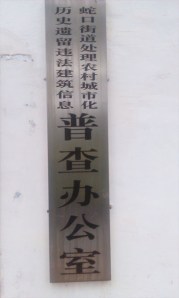
bureaucracySeriously. There is a Shekou office called the Shekou Subdistrict Census Office for Information on the Handling of Illegal Buildings Leftover from  the History of Rural Urbanization. But the signage is well balanced. And think of the cocktail party conversations this business card could spark!

schools at the edge

These past few days, I have visited elementary schools in the Xishuangbanna Dai Autonomous Prefecture.

The prefecture capital, Jinghong is undergoing a small (by coastal standards) boom: in 2003, Jinghong had an estimated population of 370,000 and roughly ten years later, school officials estimated a population of over 1.2 million people, suggesting that the same processes of internal migration and rural urbanization that we have seen along the coast; China’s population is not growing so much as it is redistributing (results of the 2011 Census). Indeed, the goals of China’s socialist new village campaign sound explicitly urban — “to develop production, enrich life, civilize the countryside, clean up the villages, and use democratic governance (生产发展、生活宽裕、乡风文明、村容整洁、管理民主的社会主义新农村)”.

Extraction and tourist capitalism have fueled the boom. On the one hand, the primary source of production revenue has been the expansion of rubber tree farming. However, the region also produces pu’er tea, mahogany, and has ancient jade mines. In addition, because Banna (as it is colloquially known) borders Burma, Thailand, and Laos, the prefecture also serves as an entrepôt for Burmese jade, Thai agricultural products, and Laotian hard woods. On the other hand, internal tourism to experience stylized representations of minority cultures continues to grow. Indeed, much of the building development in Jinghong involves adding stereotypical Dai flourishes to concrete buildings, which are structural heirs to Maoist dormitory and mass architecture.

The boom is a reform twist on Maoist efforts to integrate minority communities into the larger Chinese state. The situation of Yunnan ethnic minorities varies, reflecting indigenous pre-Mao state building (the Bai Kingdom at Dali, for example, in contrast to the rain forest tribes of Mengla, Banna), integration into the ancient tea trade, and the building of modern roads and transportation systems. During the Mao era, for example, it took several days to make the trip from Jinghong to the provincial capital, Kunming. Today the trip is a 40-minute plane trip and ethnic Han people hold most political positions and control access to economic opportunities. Indeed, the situation of ethnic minorities in Yunnan resembles that of villagers in Han cities like Shenzhen; whatever opportunities locals have it is tied to traditional land rights as they have been re-interpretted by the state.

However, unlike in Han settlements, where (crudely speaking) rural urbanization has meant making access to some aspects of elite Han culture accessible to peasants, while strengthening class differences, in Yunnan, rural urbanization has had a double thrust — cultural homogenization while asserting Han superiority. In other words, through new village programs, Banna minorities are both sinified and regulated to the lowest rank within Han hierarchies. Of course, many of the Banna born Han are themselves relatively impoverished, but nevertheless better placed than ethnics to capitalize on extraction and tourist opportunities. Thus, what seems to have emerged in Yunnan generally, but Banna specifically, is a situation similar to other colonial situations — on US American indian reservations and throughout the Brazilian Amazon, for example.

The Banna schools that I visited teach the national curriculum to ethnic children. The schools are not destitute, but the problems they face are similar to those faced in peripheral societies elsewhere.

  1. There are not enough students to for large scale investment in education. Consequently, in Banna there are three kinds of elementary schools — education spots (for settlements that only have resources to educate grades 1-2), early elementary schools (combined schools to educate grades 1-4), and complete elementary schools (combined schools that teach the full primary curriculum).
  2. In order for higher level education, most students must leave their home settlements at a young age, some as young as 8 years old to board at an early elementary school. However, any education beyond elementary school entails moving to a county seat; for high school, Jinghong offers the best opportunity to succeed on the gaokao. Not unexpectedly, in Yunnan, Han children, whose parents use a version of Mandarin, are most likely to achieve relative high scores, which are not so high when compared to the results achieved in coastal city schools.
  3. The low birth rate means that even when a complete elementary school exists, there are not enough children to have a class. Consequently, many students end up waiting 2 years to begin their education.

The children were wonderful. The teachers generous. The officials (mostly Han, but some ethnic representatives) determined to improve the situation. However, unless, the values motivating the integration of Banna minorities into the Han state change, I am not sure that the results will differ from other national efforts to integrate minorities elsewhere — cultural loss, relative impoverishment, and the destruction of rain forest. It bears repeating: Underdevelopment and concomitant forms of inequality are the result of human actions, which arise when we confuse profit with the common good.

Impressions from Banna schools, below:

This slideshow requires JavaScript.

trees for sale

Three indications that trees in Banna are up for sale. What’s more, the terms of trade are transforming the landscape.

  1. Since the 1990s, local farmers have been actively razing rain forrest to plant rubber trees. According to a local friend, it takes about 400 trees to support one family in modern style. Also, rubber trees need a lot of water and this has already changed the water table. Less obviously, this evening at dinner, another friend explained that because families can now live off their rubber tree holdings, they’ve stopped traditional cultivation. Entrepreneurial farmers are claiming this fallow land by moving in and planting other crops.
  2. On the road from Jinghong to Mengla, I learned about mahogany — it’s a hard wood, Chinese literati have filled their homes with mahogany furniture for centuries, and there is so little left in Yunnan that Chinese entrepreneurs are harvesting mahogany in neighboring Laos.
  3. This afternoon, I visited the sky tree park, and walked one of the highest treetop rope corridors in the world. High end eco-tourism in a small bit of rain forrest that has been cut off from remaining bits of rain forrest. Indeed, one of my companions mentioned that these rain forrest islands are too small and so the Central and Local governments are investing in building connections between these islands so that the animals have enough room to roam and reproduce.

Impressions of a day in the trees, Mengla, Xishuangbanna, Yunnan, just northwest of the Laotion border.

This slideshow requires JavaScript.
mountain retreat

Enlightenment is where we find it. Today, the mountain village of Zhanglang, Menghai County, Xishuangbanna, Yunnan. Impressions, below.

This slideshow requires JavaScript.