Yesterday evening shared poetry with good friends old and new: Steve Schroeder, Walter Bargen, Clarence Wolfshohl, and Huichun Liang. Impressions, below:

Yesterday evening shared poetry with good friends old and new: Steve Schroeder, Walter Bargen, Clarence Wolfshohl, and Huichun Liang. Impressions, below:

Fat Bird has been in Columbia MO, running a theatre workshop at Mizzou. Today at 4 pm we will have a staged reading of “Crossroads” by Yang Qian, directed by Song Jie and performed by Mizzou students. Happiness all around. Updates forthcoming.


The article title is “A Good Shenzhen Doctor was Beaten, He Refused to Prescribe Unnecessary Medicine or Vitamin Drip”. The article reminds Shenzhen readers that although it is common to abuse doctors in neidi, it has not been common in Shenzhen. Moreover, as the article points out, often the beatings occur even when the Doctor is doing her job.
The use of the word “good doctor” and the assumption that sometimes doctors deserve to be beaten for (corruption, expensive medicine, fill in the angry blank) underscores the tense relationships between patients and doctors in China generally, but also Shenzhen, our low number of reported conflicts notwithstanding. As in the US and elsewhere, in contemporary China lay people assume that role of medical care is to return patients to perfect health, immediately. More distressingly when this result cannot be obtained, patients and their families assume that their ongoing dis-ease is deliberate and that the Doctor is withholding care in order to receive a bribe. Hence, the beatings.
In my experience, it is important to know one’s doctor because some Chinese doctors do put a price tag on treatment. Sometimes they do prescribe expensive, unnecessary treatments. Like US doctors they often preen and show off their knowledge. But more often than not, like their patients, Chinese doctors are caught in an ugly web of mistrust and impossible desires. Doctors cannot heal everyone all the time, and they are shackled by all sorts or regulations and administrative cost. Moreover, as in the US, hospitals and clinics do turn away those who cannot pay but won’t die from lack of treatment. Also as in the US, patients want the best modern medicine without paying for it and often those who can afford medical care oppose government subsidies for those who cannot.
But there’s the rub: except for the very rich few people can afford out-of-pocket treatments and so they only go in when very sick or for antibiotics and other instant (preferably cheap) cures. There is little conversation about general prevention, and less about two unavoidable facts–our collective lifestyle makes us sick (cancer and diabetes, for example) and despite all our technology, we will get sick, age, and die. Hopefully, with grace and dignity.
The hope for graceful lives and dignified deaths changes the conversation about whither medical care. As a society, we need investigate what it would mean to provide equal and gracious access to care. We need to think seriously about what constitutes a dignified death. And we need to take responsibility for the contamination that our dependence on petrochemicals and nuclear power has introduced into shared environments because not only humans are suffering from our hubris.
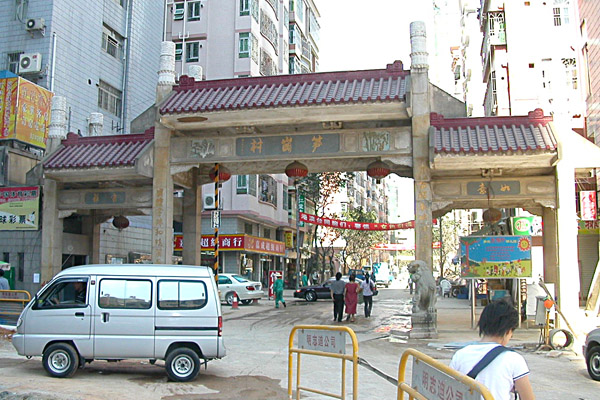
I have been reviewing my photo archives and came across pictures of new village gates that I took roughly ten years ago. The pictures show village gates old and new and point to the persistence of community identity precisely because it is malleable to the needs of the present.
Shenzhen parents worry about education — it’s quality, content, methods, and test results. Indeed, I have yet to meet a parent unwilling to spend several hours discussing their child’s education, while activists raise social problems in terms of education.
I have recently received a revisinist version of the childhood classic, “Kong Rong Shares a Pear“. The rewrite is fun and illustrates one of the ways in which the United States (as a symbol) has been put to work in contemporary Chinese debates about the contradiction between a society that values an integrated whole at the expense of individual desire and a society that values individual desire at the expense of social integration.
Kong Rong Shares a Pear
For thousands of years, the moral tale of “Kong Rong Shares His Pear” has been told, becoming the standard for parents who want to teach their children manners. But how do American kids think about this story? Below is a transcript from a class of American students who are studying Chinese. The students range from 8-12 years old.
Teacher: When he was young, Kong Rong was an exceptionally bright student. When he was four, he could already recite many poems. He was polite and courteous. One day, his father’s friend brought a box of pears to the family. His father asked Kong Rong to share the pears with his brothers. Kong Rong took the smallest pear for himself, and the shared the pears based on age rank, giving the largest pear to the oldest, the second largest pear to the second oldest and so on. As he distributed the pears he said, ” I’m the youngest, so I should eat the smallest pear.” His proud father heard him and asked, “But you’re older than your baby brother. Why didn’t you give him the smallest pear?” Kong Rong said, “I am older than him, so I should give it to him.”
What do you think of this story?
Student: Why did the father’s friend give the Kong family pears?
Teacher: they were a gift.
Student: If it was a gift, then all the pears would be good. Why were there obviously big pears and small pears? Why weren’t they all the same size?
Teacher: Ahhh…
Student: Now, if there were big pears and little pears, why did the father put all that responsibility on a four year old’s shoulders? What would have happened if Kong Rong had made a mistake? Would the father have taken back the pears and distributed them correctly?
Teacher: Ahhh…
Student: Why did everyone have to eat a pear? Couldn’t alone leave the pears and let those who wanted a pear choose for themselves?
Teacher: That might have been unfair.
Student: But Kong Rong didn’t necessarily distribute the pears in a just manner. All the brothers had to accept whatever pear Kong Rong decided to give them. Their right to choose was violated. The brother who received the largest pear might have been the brother who hated pears.
Teacher: That’s correct. This story is based on the premise that everyone likes pears.
Student: Why did Kong Rong give pears to the oldest first? If he was going to use age rank, why not start with the youngest?
Teacher: He was being polite.
Student: But after he took the smallest for himself, he didn’t give anyone else a chance to be polite. Why didn’t he give anyone else a opportunity to share pears?
Teacher: So what do you think about Kong Rong?
Student: I don’t like him. What he did wasn’t fair to others, taking away their right to choose and their chance to be polite. Kong Rong isn’t sincere.
Teacher: Why?
Student: This matter is internally contradictory. What if Kong Rong didn’t like pears, so he chose the smallest for himself? Nevertheless, his behavior earned praise? This is hypocritical. On the other hand, if he really liked pears, he should have said so. Otherwise, giving the biggest pears away wouldn’t have made him happy. When we like something we should bravely say so.
I also didn’t like his father.
Teacher: Why not?
Student: He didn’t take responsibility and asked a four year old to do something he couldn’t do. Also, he had no standards, he praised Kong Rong for being polite, but we’ve already seen that Kong Rong was disinterested in sharing the pears.
Teacher: Ahh…
Student: This was a bad story. It encourages subjective standards and praises one for violating democratic rights. This kind of twisted logic story praises a child for developing unhealthy psychology.
Teacher: So what do you think Kong Rong should have done?
Student: Put the pears on the table and let people who wanted to eat pears take what they wanted.
Postscript: From the perspective of an American student, a Confucian classic becomes a tale of twisted psychological motivations. Where do you think the problem lies?
Mary Douglass reminded us that dirt was merely matter out-of-place, and correspondingly that the work of cultural categories was to keep human beings in line. Moreover, these lines are not neutral, but like dirt in the kitchen, have all sorts of practical and moral implications for the organization of human life. In turn, border zones comprise sites of categorical breakdown, where border crossing creativity is possible, and also illicit transgressions.
This morning, I stumbled across The Politics of Cross Border Crime, a book that documents prostitution, smuggling, and gambling along and within the borders of Greater China. According to author, Shiu Hing Lo, patterns of regional cross border crime have been changing. During the 1970s and 1980s, the main types of China-Hong Kong, China-Macau, China-Taiwan crime included illegal immigration, cross border robbery, airline highjacking, and drug trafficking. Since the turn of the millennium, however, crime has become more organized, with kidnapping, human trafficking, money laundering, and transborder triads strengthening their control over these activities.
Shenzhen has been trying to shed its frontier town reputation for shady deals and immoral excess. Nevertheless, the city’s internal borders (urbanized villages, older neighborhoods) and restructured borders with Hong Kong and East Asia provide ambiguous sites, where the unsavory might thrive. The most distressing reports of Shenzhen’s role in cross border crime entail forced prostitution of minors and virginal rape. According to Lo:
Cross-border prostitution is a serious problem in Greater China, where supply and demand are both out of control. On the supply side, many children are smuggled by mainland criminals from poor provinces to Shenzhen, where there were 1,000 child prostitutes in June 2006. On the demand side, many unscrupulous Hong Kong men demanded that prostitution dens provide young virgins for them…The main factors contributing to the grave problem of transborder prostitution in Greater China are a lack of strict enforcement for anticorruption campaigns targeted at Guangdong police, especially in Shenzhen’s infamous villages, and the HKSAR government’s failure to cooperate with the mainland government to severely penalize Hong Kong men who solicit mainland prostitutes, especially children.
Lo concludes that:
Unlike the official rhetoric that underscores the mutual benefits of economic integration, the reality is that economic liberalization along the PRC–Hong Kong–Macao boundaries has generated an increase in criminal activity in the region. As economic relations between Taiwan and mainland China have become closer since the presidential election of Ma Ying-jeou in March 2008, cross-border crime between the two places is destined to increase further.
This kind of report distresses me for two reasons. On the one hand, the prostitutionalization of Shenzhen has been an ongoing theme in reports about the city. Indeed, finding prostitutes, establishing their level of willingness, and complaining about their mercenary tendencies have been common metaphors to describe reform and opening and what it has meant for social mores in the SEZ. A similar rhetoric is used within Shenzhen to describe and undermine urban village neighborhoods. On the other hand, as Lo notes, prostitution and human trafficking have increased because Shenzhen and urbanized villages do offer more spaces for unregulated commerce, which may be either an opportunity or a risk for society. In this sense, there is need for increased vigilance to protect children and vulnerable residents from triad members and traveling businessmen who have more in common than we like to think.
Sigh.
I’ve just joined the editorial collective of all roads will lead you home, an online gathering place for music, poetry, visual art, and conversation about the creative process. Please join us.

Marc Augé famously suggested that airports are non-places because they are too transient to have an identity. Other non-places include highways, hotel rooms, and waiting rooms. Augé used the idea of the non-place to describe the dislocations and standardizations that characterize super modernity.
Of note, our shopping mall cities, Shenzhen for example, offer few concrete (literally!) objects that have particular and recognizably distinct identities. At the MixC in Luohu and coastal City in Nanshan, for example, we see the same mix of chain stores, domestic and international arranged in a space that is more luxurious than the Rockaway mall of my teenage years, but in essence no different. The comparison, chez Shenzhen is with an imagined countryside and the urbanized villages. In other words, supermodern shopping malls are a place holder in the search for something better, but not interesting in and of themselves.
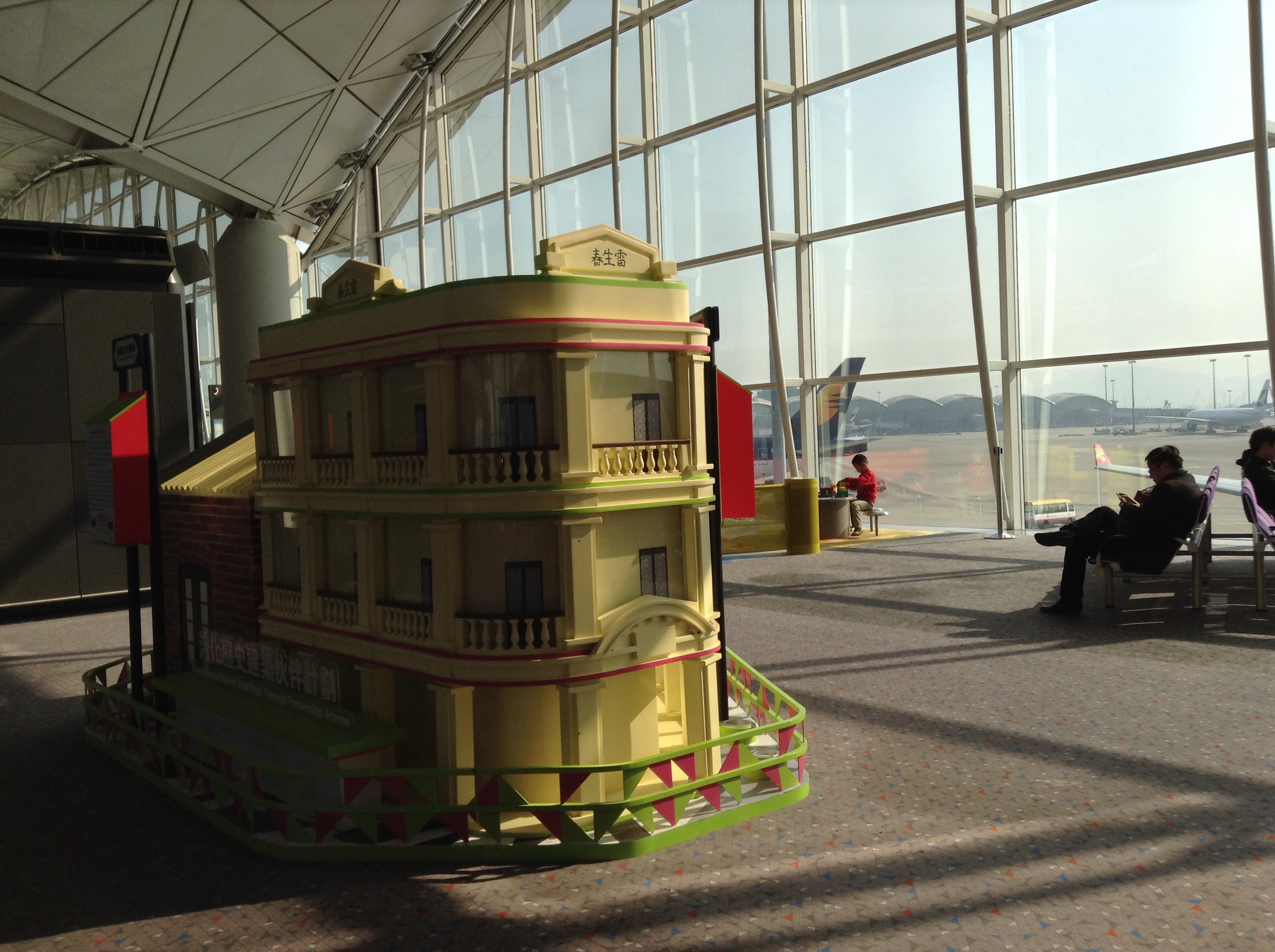
Today, I am in Hong Kong international airport and have noticed a few replicas of preserved buildings. Such is the anonymity of the super modern city that we even become nostalgic for colonial architecture — smaller and distinct from the airport, which dwarfs these toylike memories of a quaint accessible, familiar and endearing city that never was.
Yesterday, the mass movement of Chinese literally known as “Spring Shipping (春运)”, but could also be translated as Spring Rush began and will continue until February 24. This year it is estimated that there will be 3.6 billion one way trips made during these 40 days. This is roughly one round trip per Chinese person. Some people will make more than two one way trips, and some will stay in place, but the figures indicate the scale of movement as people travel to be with family or to have fun.
Today, the city felt emptier and it will continue apace until the end of the first week, or after the 15 the day of the first month.
Party on!
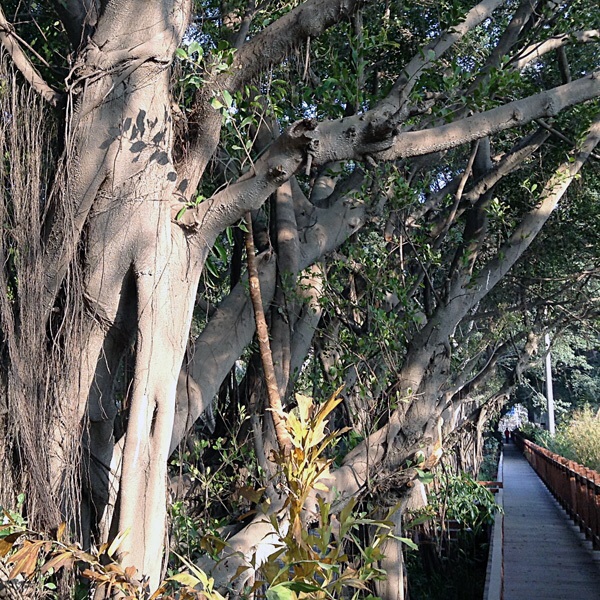
One of my favorite details at the Value Factory is the approach. Impressions below.
 Shenzhen Noted