WHERE ARE YOU FROM?

This afternoon, as I struggled out of a damp shirt in the yoga studio changing room, a woman turned to me and enthusiastically asked, “Where are you from?”

“Where are you from?” I countered, recognizing her as new to a studio, where I’ve been practicing for four years.

“Here,” she gestured generally behind her, “What about you?”

“Here, too,” I replied mirroring her gesture.

“I don’t believe you,” she challenged.

“That happens,” I admitted, “a lot.”

17 years into my Shenzhen sojourn, I am still trying to come to terms with my decision to live outside the United States because (a) I reside in a community that treats me as a just arrived guest and (b) my snail mail address notwithstanding, at times I’m not actually sure I left my homeland, and not always because the US and China function as each other’s neoliberal doppelganger. Instead, I abruptly realize the US is all in my head.

As a misplaced second grader in rural Wisconsin, I explored the library through weekly visits, where I maxed out my card (five books at a time) and convinced the librarian that yes, I could finish Bambi in a week and still get through another Nancy Drew or three. No, I would not be playing after school with “little friends”, I would be reading, but only if I had enough books. She laughed at my determination, but permitted me to borrow my limit and even sneak another mystery into my father’s check outs.

I fidgeted through high school classes, and when not lurking in the library, I stayed in the art room, painting and building “The Tommys,” a series of convoluted trees and meandering vines molded in clay and glazed in over-saturated complementary colors that repelled sustained appraisal. I remember arranging vivid magenta petals on a neon green trunk, and writing unreadable letters in yellow ink on purple paper — catch me if you can. When I launched from the Jersey suburbs into a Vermont college, I believed that a new place and a new people, a new life would satisfy my yearning; I studied Chinese language and literature convinced that once settled elsewhere, it would be HEA 24-7.

My early life wasn’t all teenage angst because my craving for distraction had an upside; I read deeply, broadly, and well. I cried each time Charlotte died, and then Old Yeller, was seriously confused by Fiver’s visions, and imagined myself taking on IT with Meg and, yes, I still read YA literature, most recently Hunger Games. I crushed on Oscar Wilde and his baroque fables, fell in love with Adrienne Rich and TS Eliot, H.D. and WH Auden. Emily Dickinson, Jane Austin, Willa Cather, Edith Warton, Louis de Bernieres, Salman Rushdie, Graham Greene, Dashiell Hammett, E. Annie Proulx. And although I started college bored by  Robert Frost’s plain simple, I have since realized that the moral conundrums which grip my heart also root me in his New England soil — Something there is that doesn’t love a wall…

And that’s point du jour. The literary sojourns that once enabled me to ignore shag carpeting and sod, encouraged me to have adventures, now remind me coming full circle doesn’t mean anything so pedestrian as showing up on a childhood front porch, not that I wouldn’t enjoy walking the lake to see how the neighborhood has changed. Instead, that brutal question shocked me into what I might have seen earlier if I interpreted my life with the same close attention I give to reading; perhaps my childhood dramas of displacement have compelled me into literal — rather than literary — exile, where I can confidently say, yes, yes, the stories are true.

union elections in shenzhen

In keeping with Shenzhen’s place at the core of Guangdong reforms, Shenzhen has announced that 163 companies with more than 1,000 employees will introduce elections for union leaders. These elected representatives will then work with the City, District and Precinct level union organizations in order to represent worker rights in negotiations with company management. According to Southern Daily, the impetus for this move has been ongoing independent worker demands for better wages and benefits. Indeed, the first company to implement the election system was OMO, a German company with a plant at Bantian. The article notes that holding union representative elections seemed to have dispelled worker dissatisfaction.

I’m not sure how to interpret this development other than to note that provincial Party Secretary, Wang Yang is actively promoting this reform. Indeed, as we approach the Two Conferences season, Wang Yang has been very active promoting “Happy Guangdong (幸福广东)” and its recognizably middle class values. It is also worth mentioning that the targeted 163 companies are large and many are foreign. Hopefully progressive change at larger plants will help less protected members of the workforce. The problem, of course, is that like the US American workforce, the Chinese workforce is fragmented into segments that receive more and less protection depending not only on worker skills, but also public visibility. Large, international companies are monitored not only by Chinese unions and news media, but also to some degree by foreign groups and media. In contrast, a large segment of the population works under unseen conditions in smaller factories, restaurants, and services or does piecework at home.

But still. One hopes.

just what is china studies anyway?

These past few days I have been reading essays on the social organization of power in the PRC. Most of these essays were written by political scientists and economists, but the odd anthropologist makes an appearance as does the occasional historian.

Here’s the rub: I can’t really tell the difference between this kind of scholarship and everyday gossip in Shenzhen.

Our gossip tends to be about people we know, but importantly also about people with power to make decisions that directly affect our well-being. We see someone do something and then speculate about how and why it happened. We try to anticipate what they will do and how we might get them on our side. But this data gathering and analysis is all tenuous and shaky, and often leaves me feeling both convinced I know what’s happening (vaguely), but also unwilling to make definitive statements because I don’t actually know. Instead, I have a residual belief that someone somewhere can explain what is happening; there is, we maintain, a position of knowing, just not with me, here.

Now it’s not as if this tendency to conflate gossipy analysis with research has gone unnoticed within scholarly circles. Consider, for example, the following 1995 quote from Frederick C Teiwes (Paradoxical Post-Mao Transition: From Obeying the Leader to Normal Politics):

Despite the unprecedented openness of the 1980s and a surfeit of purported inside information, in crucial respects we know less about politics at the top today than we do for the Maoist era. Given the secretive nature of the top leadership, it is hardly surprising that participants in the system often express the view that ‘nobody knows’ what goes on ‘up there’. … Even highly placed figures, including those with personal knowledge of the very top leaders, feel limited in what they know, and their assessments sometimes are at variance in significant ways with those of younger, more middle-level officials either in China or living in exile. Given these limitations, scholarship has unfortunately relied extensively and often indiscriminately on suspect Hong Kong sources to fill the gap. As Lyman Miller has observed, the Hong Kong press has recorded ‘a flood of reports, stories, rumors, and sometimes speculations and fantasies about political events in China’.

My speculative sense du jour is that 15 years after Teiwes cautioned us about how much could actually be known and methodologies for securing some kind of confidence in what we think we have learned about China’s highest ranking leaders, weibo may have allowed this unstable situation to perfect itself. The yearning to know, the speculation and furtive analysis. The 140 character limit, the anonymity, the instant forwarding of unconfirmed posts has blossomed in China not only because its fun, but also because it is parasitic upon and supplements the extant situation — what we know, we glean and extrapolate from conversations, incomplete news articles, and our experience of acting within and against everyday life, whether in China or abroad. Thus, I read caveats about how information and conclusions about China’s ruling elite might be and think, yup that tallies. Not just with my experience of unbridgeable distance between moi and the Center, but also with my experience trying to navigate office politics in Shenzhen unreliable and listening to my friends talk about their experiences trying to navigate even more complicated office politics.

So what?

I’m thinking that there’s a kind of cross-cultural overdetermination in the popularity of weibo and its increasing importance as a subject and source of academic knowledge about Chinese political culture. Chinese people use weibo to create public spaces and then scholars speculate on what it means about Chinese society because in large states, like China but also like the United States for that matter, none of us, even those of us in power actually know what’s happening. We live by creating networks of trust and when public trust falters, we turn elsewhere. Recently, Professor Zhao Dingxin (joint appointments at Chicago and Fudan) gave a talk on”Weibo, Political Public Space and Chinese Development” and Owen Lam has translated portions of the transcript and netizen responses to the talk. Zhao Dingxin asserted provocatively:

Weibo is an absolutely democratic but highly manipulative mode of communication. It is democratic in the sense that the user only need to write a few sentences. Once a person knows how to login, s/he can start writing regardless of the quality. It is manipulative in the sense that each voice does not register the character of an equal vote… If a person controls a lot of money or certain technology, s/he can hire an online army to magnify their voice and create fake public opinion. The space for manipulation is huge.

And my immediate response is, well, yes because within any human relationship the space for manipulation grows with levels of distrust and competing desires. But that space is within each of us and not simply the product of technology. Clearly, the kind of speculative practice that thrives on weibo pre-dated the invention of social technologies. Perhaps instead of an exclusive focus on technology, it might be helpful to ask what about human nature makes weibo so attractive? What fears and desires leave us open to manipulation by digital phrases? The Chinese government is trying to contain the effects of rampant rumors and gossip-mongering by instituting the real name registration system (实名制). I wonder if it wouldn’t be more useful to think creatively about how to rebuild public trust, knowing that this is itself the work of a lifetime.

accidental exhibition, thoughts on the 7th sz sculpture biennale

Co-curated by Liu Ding, Carol Yinghua Lu, and Su Wei, the 7th Shenzhen Sculpture Biennale, Accidental Message: Art is Not a System, Not a World (偶然的信息:艺术不是一个体系,也不是一个世界) has two sections, “Unexpected Encounters,” which presents the curators’ take on pivotal Chinese work from the 90s, and “What You See is What I See,” which showcases international artists with whom the curators have engaged over the past few yeas.

Liu Ding and Carol Yinghua Lu have written that their decision to juxtapose 1990s Chinese artwork with recent global artwork (including several Chinese artists who now travel on those circuits) in terms of a “secret glue” and the “mental bonds” that exist between creators, rather than needing “to be delineated according to artificial art politics and planned boundaries of the art system (exhibition catalogue page 25).” In other words, this is not an exhibition about the developments in sculpture over the past two years, or even about placing sculpture into conversation with other medium to get a sense of how digital art and video (the two strongest elements in the show) have reshaped our appreciation of what Benjamin once identified as sculpture’s yearning for immortality. Instead, Accidental Message is a celebratory catalogue of the desires, taste and experience of three people.

I actually get the curators’ urge to categorical disruption and their yearning for “unexpected encounters, chance glances, open hearts and respect for individuals (p 25)”. We all of us want to be recognized as unique personalities, creating connection through idiosyncratic gestures and resonating heartbeats. Nevertheless, I’m pretty sure I get the impulse for random hook-ups because alienated, individual and individualizing subjectivity and celebration thereof are symptoms of neoliberal political economics and I was raised in the neoliberal suburbs of New Jersey and currently reside in a neoliberal with Chinese Characteristics Shenzhen neighborhood, [1] where pleasure is derived by crafting oneself into a subjectivity that can be picked up and broadcast over diverse, global networks, unhampered by borders or culture or paychecks or jobs or even history, in short to become a “creation of serendipity and individual spirit.”

Thus, point du jour is actually quite simple. Liu Ding, Carol Yinghua Lu, and Su Wei did not randomly encounter artists and ideas, but did so within the institutional context of art schools and certification, art grants and residencies, and arts funding choices, all which increasingly reflect the ongoing privatization of art for the benefit of corporations and their shareholders.

This year’s show, for example, coincided with the decision to rebrand the Shenzhen International Contemporary Sculpture Exhibition as the Shenzhen Sculpture Biennale and hold it at the Overseas Chinese Town Contemporary Arts Terminal and B-10 gallery. OCT is a major Shenzhen real estate developer that has marketed itself through appeals to high cultural consumption, personal taste, and of course individualized pleasure. Indeed, the event also signaled the general upmarketing of OCT culture industry as an integrated component of its real estate projects. OCAT has been formally established as an independent, not-for profit art museum and as Overseas Chinese Towns (now a recognizable lifestyle brand) develop across the country, the Museum will take the lead in creating a series of art centers under the “Art Museum Cluster Program,” which the curators will take an active lead in developing.

Accidental Message runs until August 31. I enjoyed some of the pieces. I worry that taken as a whole, however, the show is not as subversive as the curators hoped, but instead exemplifies “business as usual” in Shenzhen’s push to become a player in global cultural industry. I close with impressions, below:

This slideshow requires JavaScript.

[1] In her paper Enjoying Neoliberalism, Jodi Dean provides a relevant definition of neoliberalism as “…an economic doctrine that channels state intervention toward the elimination of projects of social solidarity in favor of privatization, economic deregulation, tariff reduction, and the use of public and monetary policy to benefit corporations and their shareholders.”

the houhai river, dusk

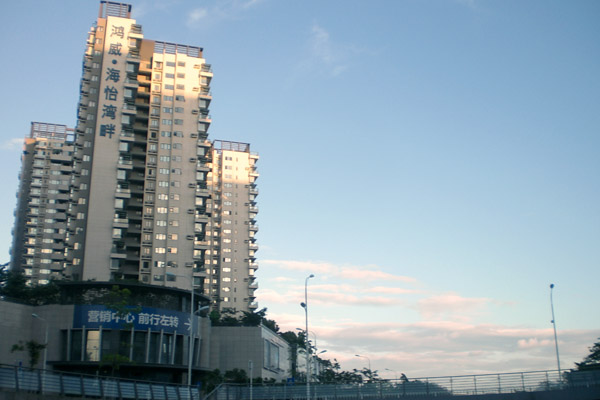
I have learned that the runoff stream that threads the Houhai land reclamation area along the southern coast of the Nantou peninsula is called, the Houhai River. It has been mapped and landscaped to accompany the futuristic luxury homes that boast both estuary and river views, and it leads to the Shenzhen Bay Park. Nevertheless, remnants of an older landscape linger, fishing families and the sand processing docks of the no longer extant Dongjiaotou pier.

This slideshow requires JavaScript.

more confucian business ethics: collect the bags!

Roughly twenty years ago, he, his wife, and their son immigrated from China to Southern California. They came to Shenzhen last year to do business with successful college classmates and brought a daughter and a younger son. The older son remained in California. The man was 40 something years of age, and he told me that his wife and son met a friend and business associate at LAX. When the three went to pick up the visitor’s luggage, his wife went to collect the bags. However, because she is a woman, the visitor stopped her and collected the bags instead. The man didn’t say, but I’m assuming the wife and friend engaged in some who-can-hold-onto-the-bags shuffle, with the result that the visitor ended up carrying his own bags. The son waited for the ritual to end and then led his mother and his father’s friend to the car. The son drove them home.

The man told me this story because he wanted to know what I thought; how had the son behaved?

“Based on what I know of American or Chinese cultural norms?” I hedged, thinking that any young man who drove his mother to the airport to pickup a guest was an accommodating son, and that if his parents and their friends wanted to engage in who’s-the-most-polite shuffles, then that really was their business and why not wait for the storm to end. In fact, personally, I sympathized with the son’s position because I am frequently nonplussed when confronted by demonstrations of Chinese courtesy that are also not-so-sutble assertions of dominance.

He explained that afterward his friend had approached him to talk about the matter. The friend worried that the son did “did not understand things (不懂事),” an expression with meanings that range from ‘immature’ through ‘is insensible to the feelings of others’ to ‘has no concept of proper behavior’. The friend had acted out of concern because he worried for his friend’s son future prospects. To declare a college graduate “does not understand things” means that those in positions of power “cannot use him (不能用人)” and thus will not place him in positions of responsibility, thereby foreclosing opportunities for advancement.

At the time, the father had replied that he thought skill (能力) was the most important criteria for promotions. However, when he discussed the issue with another friend, this time the CEO of a small company, he realized that from the point of view of makers and shakers in China, his son in fact “could not be used”. The CEO explained that he had two employees, A and B, who went everywhere with him. The CEO did not have a driver and so A and B took turns driving. When A drove, he made sure to open the CEO’s door for him before getting into the car. When B drove, he immediately sat in the driver’s seat and A, again, opened the CEO’s door before settling himself in the car.

“Now, who should I promote?” the CEO rhetorically asked the man. “Obviously, A is more meticulous/ attentive (更细心) than B. Consequently, he can be trusted, whereas B doesn’t see the big picture.”

The big picture included hierarchy and etiquette, or understanding one’s relationship with another and each time A opened the CEO’s door, he demonstrated his understanding. In contrast, B did his job. On the CEO’s interpretation, it didn’t matter how talented B was. The real problem was that B couldn’t be trusted to treat guests and by extension business colleagues and clients, properly. A could.

I’m told there are serious differences between etiquette in state-owned industries, where bureaucratic privilege trumps skill and the private sector, where talented people are more valued than sycophants. Also, it seems that things “are different” in the IT sector, but again, people quickly remind me, that techies are young and often westernized. Westernized, perhaps, but as in Western business culture, Chinese business culture distinguishes between those who give good face and those who do their jobs well; rare is the individual who can both manage people and complete tasks.

Interestingly, although the characters for the Chinese words for CEO (董事长) and “understand things” are different, nevertheless they are homophones, which alerts us to the moral of today’s story. At an airport, there are several rules that apply when greeting Chinese guests:

1. If the guest is older than you — collect the luggage to show your respect;

2. If the guest has a higher rank than you — collect the luggage to show your respect;

3. If the guest is a friend — collect the luggage in order to demonstrate your good will.

There are three possible exceptions to the “collect the luggage” rule for greeting Chinese guests, gender, age, and White ethnicity. A friend would neither expect a friend’s wife to collect luggage, nor would that friend expect an elementary school child to collect luggage. Although if the child grabbed a bag, be sure to laugh happily, muss her hair, and exclaim, “Wow, she really understands things!” And yes, white Americans are forgiven for all sorts of social faux pas that Chinese-Americans are not so that when we go for the bags, we suddenly appear “Chinese”.

But to return to the father’s story. What do we say to a Chinese man, who clearly wants his American son to succeed, knowing that amongst globe-trotting Chinese he will be judged by ancestral values and not those of his hometown, Los Angeles?

the 5.12 beichuan incident, nuclear war games, and why the party fears religious organizations

The Party’s refusal to either share power or make political decision making transparent and open to public debate creates mistrust: just what have they got to hide anyway, inquiring minds want to know. In addition, through its control of cultural resources, including the arts and the right to convene, the Party has demonstrated a refusal to acknowledge any viewpoints other than those that shore up the influence of high-ranking officials.

Neitizens and western journalists have responded to Party control over and access to information with reports that (more often than not) conflate conspiracy theories with the “truth”. Not unexpectedly, citizens spend an inordinate of time trying to piece together a big picture out of rumors, veiled allusions and gut feelings. Sadly, the more the Party doesn’t say about Beichuan or Bo Xilai or Chen Guangchen, for example, the more accusatory rumors circulate via the net, weibo, and text messages and with them the festering anxiety that no one can be trusted to speak truthfully. Thus, in today’s China, common sense has it that Party members don’t tell the truth because the truth would harm them politically, while the rest of us are incapable of telling the truth because we don’t know it.

Keywords of the day – trust (信任), good faith (诚意), and loyalty (忠诚) – pivot on the relationship between a healthy society and how good our word might be. The characters for person (人) and word (言), for example constitute 信, the first character in the compound for trust. The character word (言) also appears in sincerity (诚, literally “word” “is realized”), which is an element of the expression good faith (literally “sincere meaning”) and loyalty (faithful sincerity). Moreover, the question of belief (信仰, literally a person who trusted and admired) resonates throughout all levels of society and the most trusted forms of organized alternative to Party disinformation and rumor mongering tend to be religious – Tibetan Buddhism, Xinjiang Islam, and popular Buddhism, Falungong, Christianity in Han communities.

“A Report on and Lessons from the 5.12 Underground Nuclear Explosion at Longmen Mountain, Beichuan,” a recent Epoch Times (大纪元) article illustrates the co-dependent relationship between belief, opposition, and efforts to figure out the truth. The Epoch Times, of course, is the official Falungong news outlet and the article author Lu Deng is the spokesperson for the Chinese Christian Democratic Party. The gist of the article is that the Party used the 5.12 Wenchuan earthquake to cover-up the fact that on the same day, it detonated a nuclear devise at Beichuan, destroying an entire region. Based on a few facts, knowledge of how the Party operates, and deductive reasoning, the argument is compelling and compellingly legal:

The article reconstructs the events of May 12, 2008 by giving a quote from Feng Xiang’s decidedly poetic and vague blog and then re-interpreting it in terms of a nuclear blast. For example, in February 6, 2009 post, Feng Xiang wrote, “In 80 seconds, the mountain collapsed, the ground split open, the mountains shook and the earth moved, the river changed its course. The green mountain lost its color, and all I see is disaster. This was Beichuan’s most devastating moment. A level 8 earthquake, with level 11 destruction”. According to Lu Dong, the phrase “the green mountain lost its color” refers to the fact that all the mountain foliage was burned. Lu Deng also analyzes sections where he asserts that Feng Xiang’s original text, including references to a Chief Pan of the Anti-Chemical Corps of the Second Artillery (二炮防防化部隊隊長番号) have been changed.

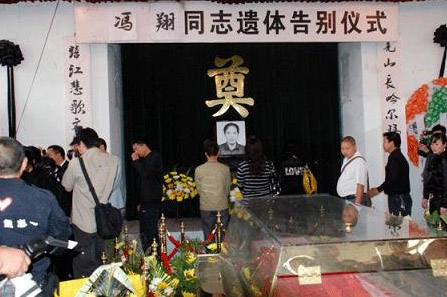
As an opening witness, Feng Xiang  (冯翔) is a compelling figure because his position within the Party hierarchy placed in a position to learn the truth, while his loss as a father and a teacher gave him moral authority. Feng Xiang was a teacher and then a vice minister in the Qiang Minority Autonomous County, Beichuan Ministry of Information (北川羌族自治县宣传部). His eight-year old daughter died in the Wenchuan earthquake. Subsequently, his efforts to uncover the truth about her death led to charges that an underground nuclear explosion rather than the Wenchuan earthquake caused the Beichuan disaster. The truth of his position was confirmed through allegations that Feng Xiang was harassed into committing suicide when he attempted to bring this story to the public.

Lu Dong then moves on to analyze corroborating evidence from other sources; it is an “open secret (公开秘密)” that the damage at Wenchuan was minimal and the strength of the quake insufficient to have destroyed Beichuan. In his book “The Epicenter was in Human Hearts (震中在人心)” Mainland author, Li Ming claimed that the Wenchuan quake gave Party officials an excuse to cover-up the real disaster at Beichuan. Web reports suggest the same pattern of information: Wenchuan was serious, but not a disaster and certainly not enough to have decimated Beichuan. Moreover, web posts included reports that indeed anti-chemical corps had gone into the Longmen Mountain Nuclear facility. In addition, local eyewitnesses said that the heat from the blast burned off the skin of water buffalo. Blogger Xiong Furong said, “The geologists may have different explanations for what happened here, but for us ordinary people, we know it was a detonation (熊芙蓉說,“地質專家對此可能有各種不同說法,但對我們普遍人來講,這就是爆炸。)”

Examples from media reports are brought in: a video on youtube; reports from 21st Century Economic Report (21世紀經濟報導) that the mountain continued to reverberate through the night; Southern Weekend (南方週末) reported that the tremors were so strong that villagers clung to each other to keep themselves from falling into the sinkholes; Western China News (華西都市報) reported that in the Green tablets river basin, there were nearly 10 kilometers of cracks in the mountain, some of which were 42 centimeters deep; and even Party media acknowledged the extent and scale of Beichuan exceeded that of Wenchuan. Beichuan TV broadcast, “The entire 2869 km2 County Area was destroyed, 10s of thousands of buildings were destroyed in mudslides. Over one million square meters collapsed and over 100 areas effected by mud. (北川電 「全縣境內2869平方公里受災,出現了數萬處塌方,泥不流和大滑坡。垮塌百萬立方的特大滑坡達100多處.)” A quote from an elderly gentlemen summarizes and ends this section, “The earthquake had the force of the nuclear explosion at Hiroshima (能量相當干400顆廣島原子彈.)”

Lu Dong is relentless in his case. He notes differences between the pattern of damage at Wenchuan, which fell away from an epicenter and Beichuan, which fell in a different pattern, away from Longmen Mountain. Evidence from the Tangshan earthquake is brought in. Even at Tangshan, after the quake subsided there were some buildings and trees standing. In contrast, at Beichuan everything collapsed: 498 kilometers of highway, 6066 kilometers of ordinary roads, 1503 bridges, 131 power stations, 8,944 kilometers of electrical transmission lines, 26,000 kilometers of fiber optic cables, 597 water reservoirs, 9,416 kilometers of channels, 282 broadcast stations, and 2,432 different sites of geological disaster.

Even more disturbingly, after the 5.12 Beichuan disaster, doctors from Sichuan Medical University, the University of Illinois, and Imperial College released studies documenting that many people and animals in the disaster area suffered from radiation poisoning. In addition, specialists suggested that iodine 131 is a radioactive isotope that could have caused spontaneous abortions similar to those seen at Beichuan. However, the Sichuan Party Secretary ordered a blackout on all reports on over 100 fetuses that had died in utero.

If all this wasn’t enough, the Japan Aerospace Exploration Agency reported that an earthquake did not adequately explain the yellow color and condition of vegetation in Beichuan. Lu Dong ominously concludes, however, that these conditions were consistent with the effects of a nuclear blast. And yes, ongoing Party inspection tours and scientific reports from Beichuan seem consistent with the after effects of a nuclear blast and not an area healing from a natural earthquake.

Clearly, Lu Dong believes that there were underground nuclear experiments at the Longmen Mountain Facility and that an accident occurred. He is a compelling rhetorician, concluding his argument with the reminder that Hawkish General Zhu Chenghu (朱成虎) has threatened to use nuclear weapons to destroy the United States if the country should ever help Taiwan and calling for the Party to meet face these accusations in court.

And there it is. The reason that the Party fears religious organizations.  The unstable situation of chronic Party secrecy and corrosive public suspicions has created an environment in which many people “don’t feel safe (没有安全感)”. However, religious groups continue to investigate and make public charges (if even from abroad), rather than hiding behind anonymous weibos and innuendo. The Chinese Christian Democratic Party has thrown down a political gauntlet in a Falungong newspaper, which also publishes pieces that support the Dalai Lama, forcing those of us living in murky half-truths and deliberate cover-ups: when all is said and done, who do you believe?

The Violence of Childhood

In talking with people about sociocratic principles, I find myself reminicing about my time as a vice-principal or college councelor and am once again reminded of the violence of childhood and how that violence shapes our understanding of governance because governance is, ultimately, about figuring out how to live together.

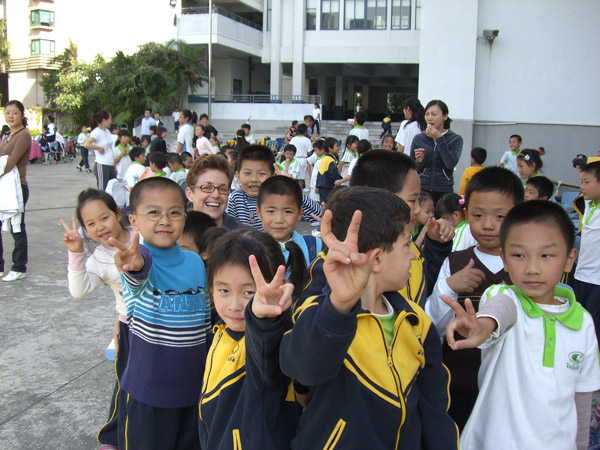
I have a clear memory of a first-grader who didn’t like math. Not hard to understand from my US American perspective perhaps, but unacceptable from the perspective of his parents, teachers, and other Chinese adults in his life. The reasoning was both psychological and pragmatic: to excel in math, self-confidence was important and the best way to develop self-confidence was through high test scores. Moreover, the logic continued, elementary math tests were simple and so there wasn’t any reason, except perhaps laziness or stubbornness for a child not to do well in math.

The boy’s first grade math scores were low by local standards; he was averaging between 88 and 93ish on tests, but his classmates were all forging ahead with perfect scores plus extra credit and, a friend helpfully reminded me, in elementary school most students received over 95 on math tests. Clearly the boy had a problem. Nevertheless, his parents were progressive in that they believed that if a student liked a class, he would do better in it and so it became imperative to talk their son into liking math. They thought that if he liked math then he would (1) stop being lazy and work harder and (2) stop resisting their efforts to make him do extra math problems and cooperate with his tutor.

So the parents talked to him. His grandparents talked to him. His teachers talked to him. Several months into this process, they scheduled a meeting with me so that I too could talk him. Nobody actually listened to him.

At the time, I spoke directly to the parents suggesting that the boy had a responsibility as a student to work hard in class and finish assignments, but had no corresponding obligation to like math or spend time each week with a private tutor preparing for Olympic maths, I was told that (1) I was too idealistic and (2) I was American and didn’t understand Chinese children. What didn’t I understand? The importance of elementary school math test scores? They aren’t actually important. And thus, our conversation came to ignoble cross purposes and the boy continued to dislike math and do relatively poorly at it. Over the next few years, parental and teacher conversations escalated into scolding and punishments, although to my knowledge the boy was never beaten for his math scores.

In retrospect, I think the boy’s parents were trying to tell me that I hadn’t assuaged their fears for their son’s future. I’m not sure I could have because for them math tests symbolized future potential to navigate the “real world”. What would happen, the analogy goes when a child went out in the real world, where life tests weren’t simple and failure meant… although this is actually where the logic stumbles because no one knows how low math scores might ultimately destroy a human life. The immediate source of parental fear seemed to be that if the boy didn’t excel in elementary math, he would do poorly on the Shenzhen high school entrance exam, subsequently do poorly on the gaokao, and then end up in a vocational school or worse, laboring as a construction or sanitation worker. Although here again, the logic blurs, because in Shenzhen rural boys who fail to get scholarships to high school end up working on construction sites and although these same rural boys also collect garbage, cleaning jobs go to rural girls who fail to get high school scholarships. In contrast, the boy’s parents were actually worried that the boy couldn’t do better than getting into a foreign university equivalent of Shenzhen University.

I regret that I didn’t actively listen to either the boy or his parents. Its possible that with more practiced skills I might have helped the boy come to terms with the inevitability of classes we don’t like and how to deal with contradictions between our feelings and our responsibilities. I might also have helped his parents have more reasonable expectations for their son’s test scores and a more respectful attitude toward his likes and dislikes; not their job to tell him how he feels.

When we don’t actively listen to children, we teach them that their desires and fears and joys and accomplishments aren’t important. What matters is that they fit into our graded boxes. Clearly the boy’s parents didn’t care if he actually liked math, they simply wanted to find a way of achieving better test scores. They disagreed with traditions of forcing a child to something he didn’t want to do, and so the solution seemed to be forcing him to like it, so that he would then become a pro-active math student. Equally clearly, I didn’t care about the parents’ fears, I just wanted them to stop wasting my time lamenting a first grader’s math scores. I disagreed with their valuation of exams and didn’t see any way of convincing them that disliking math is okay and thus the solution seemed to be getting them out of my office as quickly as possible.

And there’s the rub: I’m starting to understand the violence of childhood as the lack of respect we have for children’s abilities and desires. And this lack of respect blossoms into grown-up inabilities to actually resolve problems in ways that nourish each other’s lives. His parents left my office more deeply convinced that a huge cultural gap separates Chinese and US American people. I remained in my office anxious that another set of parents would schedule a meeting to talk their daughter into liking a difficult subject, like English. But what seems to have actually occurred was another instance of childhood violence in which none of us adults had the wherewithal to help a six year old learn simple concepts of addition and subtraction.

nanling to danzhutou, impressions

Nanling and Danzhutou Village-Communities are located just next to Dafen in Buji Precinct. Walked the area today with Sarah, Carina, and Lorena. Impressions, below:

This slideshow requires JavaScript.

CZC Special Forces

Am collaborating with a multi-national group of architects, urban planners, and concerned citizens to jumpstart an effort to renovate the Tangtou section of Baishizhou. Yesterday, at one of the Design Center’s Cool Tea (酷茶) events, I gave a short presentation on our four meetings to date and an introduction to sociocracy, the form of governance we are attempting to set up. The talk was well received, especially the discussion of how to run a meeting.

I have recently realized that there is not only desire to transform Chinese society, but also many such salons and talks springing up all over Shenzhen. Significantly, the terms of the discussion are the built environment. Last night, for example, the first talk by the Shenzhen Green Building Association charted the expansion of government sponsored discussions about environmental standards — their group has several hundred members and they are quite active. SGBA seems to be moving in the direction charted by Wang Yang in his recent address to the Guangdong Party and one of their core ideas is happiness index (幸福指标). As mentioned in an earlier post, Wang Yang has defined happiness in neo-liberal terms: a feeling of personal well-being brought on by doing what one likes to do. Upside, this definition leaves space for heterogeneity. Downside, it justifies all sorts of social neglect and individual appropriations of common resources. Nevertheless, the point remains: Shenzheners are talking about what it means to inhabit the city as members of a society AND the discussion is being coded in architectural and urban planning terms.

A copy of my talk (in Chinese), here; the accompanying bi-lingual powerpoint, here.