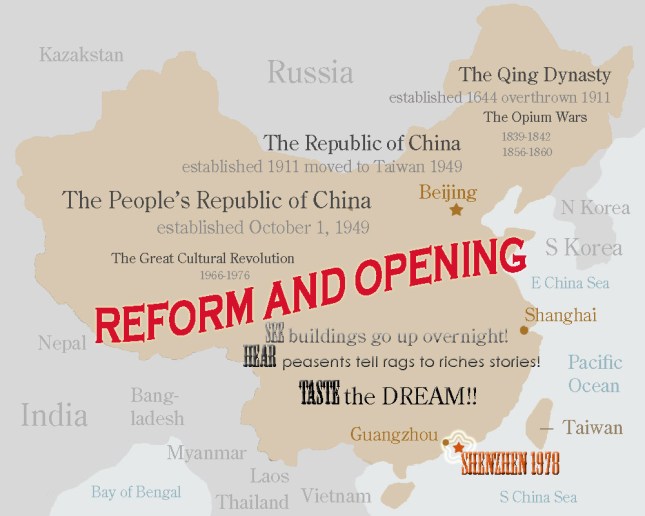
 This is the first panel in the image poem “Your Presence is Requested” from Prosthetic Cosmologies. My artist statement follows.
My work aims to make visible the shared processes – cultural, environmental, political, and economic – that define daily life in both the People’s Republic of China and the United States of America. I believe that any person, any organism, any word, indeed, any object, connects us in transformative dependency and as yet unrecognized possibility. I proceed in the faith that respectful seeing reveals the structure of interconnection and new forms of hope. I compose images that testify to the poetic beauty of this complexity.
While at the Sitka Center for Art and Ecology, I added ten panels to an ongoing series of image-poems entitled Prosthetic Cosmologies, which chronicles the globalizing myths that situate Shenzhen across diverse levels of historical experience. The formal structure of each image-poem combines genre conventions from classical Chinese poetry, anthropological theories about the human quest for meaning, and photographic images from Shenzhen and elsewhere. I used my time at Sitka both to reflect on the mythmaking that emerges in delta cultures and to track those myths along the Oregon Coast.
The incorporation of photographs of Sitka pines, West Wind pelicans, Three Rocks, and Salmon River red alders into the over arching narrative structure of Prosthetic Cosmologies has three functions. First, the physical use of these photographs literalizes the environmental, cultural, political, and economic systems that connect residents of the Pearl River Delta to those of the Salmon River estuary. Second, the finished panels invite Oregon coast viewers to see the pulsating presence of Shenzhen in their daily lives. Third, in Shenzhen, these images render accessible the vital beauty of coastal rain forests.
The basic unit of an image-poem is a square. According to Chinese tradition a square represents the world. Chinese children also learn to write within squares that permit exploration of the calligraphic flow and asymmetric harmonies of Chinese characters. In conventional couplets and longer poems, characters are placed with respect to the (now) invisible boxes. Indeed, the assumption of an underlying template of squares not only makes Chinese legible by providing an implicit map to written territory, but also enables those imaginative leaps into living “outside the box” that free-style Chinese calligraphy aspires to manifest.
Each panel functions as both an independent poem and a stanza within the larger project. For example, the panel, Shenzhen Zhuangzi 1842 deploys the image of a West Wind pelican to narrate the colonial murder of classical Chinese cosmography. With two “wings” stretching east to the Pearl River and west to the South China Sea and a narrow bit of central torso stretching south into the Delta, Xin’an County – Shenzhen’s imperial predecessor – was known as the City of the Roc, a mythic bird that rises in the south to traverse the universe. After the first Opium War, the British colonized Hong Kong Island in 1842, the land south of the Kowloon mountains in 1860, and the New Territories in 1898, dismembering the Roc step by martial step. I have therefore transcribed Zhuangzi’s account of the Roc’s flight on a collage of colonial maps, poppies, and the flag of the British East India Company. In the stanza, Origin Stories this mythos is further elaborated through juxtaposition with Delta Walls, which witness the presence of migrant labor in Shenzhen.
The stanza, Your Presence is Requested is composed of four panels – The Invitation, Cold War Gods, Peppermint Gyre, and Gilded Coast. The first panel lists important dates, places, and events to the establishment of Shenzhen. In the subsequent three panels, two theory squares synthesize the implications of the “data” in three photographs. Thus, in Cold War Gods a montage of Deng Xiaoping, Margaret Thatcher, Mikhail Gorbachev, and Ronald Reagan first crosses from the Soviet Union to the People’s Republic and then approaches the Sino-British border at Shenzhen / Hong Kong. Photographs of Mao Zedong, the Jade Emperor shrine at the Southern Gate of Old Nantou, and the engraved base of the Deng Xiaoping memorial in Lianhua Park index the processes through which political decisions are built into the environment and political leaders variously deified. Likewise, Peppermint Gyre tracks the currents in the Pacific Ocean that bring both warmth and artificial Christmas trees to Oregon. Gilded Coast uses NASA images to illustrate the investment environment of the Nantou Peninsula.
The stanza, Naturalizations is in progress. I have mounted four studies for this stanza – Virtuous Transformations, Heads Buried in Delta Sands, Shennan Road, and Building Blocks. In these panels, I am meditating on the relationships between fengshui principles, imported exotica, and Shenzhen street culture. I am particularly interested in tracking human desire as an element of ecological transformation.
I conclude by thanking those whose work and gifts enabled this time of creative reflection. In Shenzhen, Yang Qian and Liu Gaoming encouraged me; Zhang Tong, Hu Lin, and Jiang Jining provided resources and deep history. At Sitka, Jalene Case, Molly Champion, Eric Vines, and Ryan “the handyman” removed hindrances. Paul and Cheryl Katen, Frank and Jane Boyden, Jack and Laura Doyle, and Dan and Kate Twitchell nourished me with their hospitality. Duncan and Melany Berry introduced me to the inspirations of West Wind. Sarah Greene taught me about “death by salt” in the vitalization of the estuary. My fellow residents, Matt Bower, Dawn Stetzel, and Kim Stafford embodied generous creativities. Elizabeth Black and Vicky at the Lincoln City Cultural Center facilitated this show.
 Shenzhen Noted