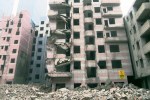
Shenzhen’s urban villages confound easy categorization precisely because they are sites where Mainland Chinese distinctions between “farmers (农民)” and “city people (市民)” have been constantly negotiated and renegotiated for over thirty years.
In the 80s and early 90s, the question facing the Shenzhen government was: how to transfer collective land to urban work units (to establish urban patterns of property ownership) while providing villagers with a livelihood. The resolution to that problem took the form of “handshake buildings (握手楼)” and village level manufacturing and commerce. These villages were called “new villages (新村)” – as in “Guimiao New Village and Xiangnan New Village, for example. However, the economic success of both the new villages and the pace of Shenzhen’s growth has meant that new villages have constantly bumped up against more intensive forms of urban expansion. Consequently, since the mid-90s, the question facing Shenzhen’s government has been: how to integrate the new villages into the city. Suddenly, the government was pursuing a policy of “[urban] village renovation (旧村改新)”. Of course, the so-called “old villages” were in fact the “new villages” of the past decade. More tellingly, the “new villages” were now called “urban villages (城中村)”, an expression which might conjure images of a massive city surrounding and absorbing a small yet resistant village.
The project to renovate Gangxia [New] Village began in 1998 with a plan to construct the Shenzhen central axis along and through Gangxia. However, it was not until 2008 that the government began negotiating with residents of Gangxia Heyuan (岗厦河园片) to transfer land from villagers to city developers. By that time, Gangxia Heyuan had 580 buildings (mostly handshake buildings) and an estimated population of 70,000 people. Obviously, most of the 70,000 inhabitants were migrant workers and not Gangxia Villagers with landrights and property holdings. Nevertheless, the government had to begin a complicated process of negotiated the terms under which Gangxia Heyuan would be transferred from Gangxia [New Village / Juweihui – and there’s a whole ‘nother story told in another post] to Shenzhen City by way of Futian District.
The crux of the matter was, of course, how to define an equitable transfer because once Gangxia Heyuan became a part of the Central Axis it would cease being an “urban village” and become an “urban center”, with all the symbolic and economic capital implied. Consequently, city reps, the development company, and the Gangxia Heyuan villagers needed to work out the amount of ratio of replacement housing to actual housing and the compensation per meter of housing to which each villager was entitled. In the end, the ratio was established at 1:082 for first floor holdings and 1:088 for second story and above. Compensation was fixed at 12,800 per meter of housing space and 23,800 per meter of commercial space.
Inquiring minds want to know: just how much richer did some villagers become anyway? Well, it depended on how much housing one owned and where it was. A villager who owned one of the 580 buildings, which might have 6-800 square meters would be entitled to anywhere from 475-600 square meters of new housing and 7.5 million to 10.2 million rmb if they only owned residential space and much, much more if commercial. In total, there are figures as high as 9 billion rmb in compensation flying through the rumor mill.
Here’s the rub. All this money seems like a lot until we go back and start factoring in the 70,000 migrant workers and several thousand Gangxia villagers who had unequal access to handshake buildings less than 20 years ago. Thus, because Gangxia New Village included unequal redistributions of handshake buildings and landuse rights, some villagers are now much much richer than others. Rumor has it that one such villager had 6,000 square meters of space, while several others had 3,000 square meters. All told (in hushed voices, of course) Gangxia is rumored to have over 20 billionaires and at least 10 residents with over 10 million in property holdings.
And it doesn’t stop there. None of this takes into account how much the real estate developers are going to earn off the wheeling and dealing that re-building Gangxia into Central Axis luxury condos, high-end commercial areas, and business centers. There are a few non-villagers who will become even richer than the few Gangxia billionaires.
So yes, urban village renovation is not only creating new landscapes, but also accelerating the pace of economic polarization in Shenzhen.
If we include Maoist attempts to ameliorate differences between rural and urban settlements, we’re looking at over sixty years of concerted negotiation of Chinese identity as a debate about rural (tradition) versus urban (modernity). Such that its possible to think of the past 100-odd years of Chinese modernization as a process of rural urbanization and concomitant forms of inequality, legislated, negotiated, and otherwise.
For the curious, the Chinese web has facts, figures, and rumors: here, here, and here.

 Shenzhen Noted