
we live in the shadow of advertizing, at a scale much smaller than the model. in fact, it’s all already in place–the temptations, the rationalizations, the critique. just look.
Tag Archives: snapshot
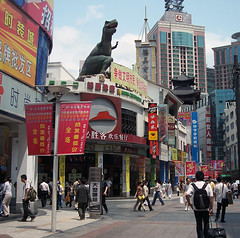
罗湖:a tale of two cities

sometimes, the ethnography is already there, simply waiting to be recorded. above is a picture of the era of two cities building, located just next to the luohu train station. shenzhen and hong kong are the two cities implied and celebrated by the building. yet, just a quick walk through the bus station, past the two cities building, and next to the bus station parking lot, one enters an alleyway, where other folks live. a third city. one then moves onto luohu new village, where a poster encourages shenzheners to build a civilized city. below is a map that locates you while on your walk about luohu.

mystery

yesterday morning, I walked along nanyou road from the west gate of shenzhen university over the binhai expressway access ramp pedestrian overpass to the k204 bus stop, where my 25 minute trip to tianmian would begin. exhaust fumes, irritated honking, and instinctive jostling usually characterize this short trip. consequently, i normally rush from the university gate to the bus stop with little sense of how i arrived, or rather, without actually experiencing where i am. however, yesterday, i started out at 6:30 a.m. only a few cars and busses grumbled past and the pedestrian overpass itself suddenly opened. i sensed more than met the eye, and thus compelled, looked and saw otherwise. that vision now (and until the firewall envelops us all) shimmers online.
footnotes to previous entries (can be accessed either under recent entries by title or under archive by date).
(1) an answer to the question, where have all the qilou (骑楼) gone? the hong kong government mandated that all buildings downtown needed to be linked in such a way that pedestrians stay dry in the rain and cool in the sun. a laudable reinvention of local knowledge to contemporary architectural norms (see reflections, may 16, 2006).
(2) two examples of 陪 (pei):
yesterday, i bought tickets to see the mabou mimes production of “a doll house” in hong kong. i invited a friend to go, and another said, “don’t force her to pei you, she’s too busy right now.”
at dinner later that same day, we were talking about how much wait some of us had gained since college (roughly 20 years ago). one of the officials at the table said, “well it depends on whether or not your boss/department head (头头) likes to drink or not. if he’s drinking, then everyone at the table will pei him to drink. and of course, if you’re drinking you’re eating lots of small dishes that just happen to be fatty and unhealthy.”
from this it can be surmised that people like to be pei-ed, but don’t necessarily like to pei. why then would anyone voluntarily pei someone? because pei-ing is usually characterized as something 无奈: it can’t be helped. individuals have socially defined obligations to pei certain kinds of people: guests, parents, friends, but also bosses, visiting dignitaries, ranking officials, relatives of friends, classmates and their relatives… i’m starting to make a list to see if in fact pei obligations can be exhausted. (see there are also good people in hunan, may 8, 2006).
reflections

the past few days, the sun has radiated a white haze that makes it difficult to look directly at any building or person. even with sun glasses, i find the environment strangely flattened as contrasts are both more extreme and less subtle than usual. an abrupt reminder that all that is surface is in fact superficial, although not necessarily postmodern.
i also find myself wondering about the history of glass siding that shoots up to heaven and how that artificial sky gets appropriated in sites where we don’t need more sun, but less. i feel suddenly nostalgic for an annotated everly brothers: where have all the 骑楼–old style cantonese buildings with shaded walkways (nice also in the rain)–gone? revolution passing. where have all the qilou gone, short time ago. where have all the qilou gone, become outdoor shopping malls, every one–like dongmen (东门)in shenzhen and the beijing pedestrian road (北京步行街)in guangzhou. what have we really learned, what do we know?
anyway, i’ve put up several views of reflected sky. when in doubt, bear witness.
Dongmen zoo
home, tianmian garden

I realize that I’ve spoken about inhabiting Shenzhen without actually taking about where I live. I’m not sure if this evasion was deliberate or simply the result of habits—research is other than my quotidian reality, even if I write myself into the story. This doesn’t mean that I haven’t taken pictures of Tianmian, the village/development where I live, but have thought about the actual story being elsewhere, in the anywhere but here mode of ethnographic inquiry, which, I’ve come to suspect, is tied up in the throes of middle class American angst about standing still when I should be moving on (to something better, of course). Certainly that impulse, even more than an affinity for things Asian, propelled me out of high school and into China studies.
Today’s project then is to sit and think about Tianmian.
An urban village, Tianmian is located next to Shenzhen’s Central Park, west of the Shanghai Hotel. Throughout the 80’s and most of the 90’s, the Shanghai Hotel marked the western edge of “downtown”. The Luohu Train Station, a main crossing point into Hong Kong, marked downtown’s eastern border. However, since the mid-90’s, development has moved west and with it the city’s center, or perhaps it’s more accurate to say that the edges between downtown and the rest of the municipality have blurred. Once considered part of the “suburbs”, Tianmian is now prime real estate, being located just west of the new City Hall Building (the old building was located east of the Shanghai Hotel) and a ten-minute cab ride from Huanggang, a recently opened crossing point into Hong Kong.
It is important to understand that Tianmian encompasses a wide variety of folks and livelihoods. In this, Tianmian is highly representative of Shenzhen, although at a smaller scale than in Longgang and Baoan Districts, where the villages retained much more land than did villages within the SEZ proper (Nanshan, Futian, Luohu, and Yantian Districts). Millennium Oasis is a high-end housing development, where established professionals and their families live. Interestingly, many of these are extended families, who either live in the same condominium or have bought condominiums in the same building (older sister lives on the fifth floor and younger on the seventh, for example). New Tianmian Village includes the Village’s factories, mid-level housing development (Tianmian Gardens), and the New Village proper. These constitute the basic livelihood of all Tianmian villagers, who have stock options in both the factories and Tianmian Gardens, where young professionals and working families live, again many extended families here in a smaller space than Millennium Oasis. The New Village condos/apartments are the cheapest to own or rent. Many singles live there, as do friends who have pooled their money to move in together. Each of the buildings in the New Village belongs to one of the village men and it provides revenue that is independent of collective resources.
I’m not sure how many people live and work in Tianmian, but there are approximately 670 units (9 buildings) in Millennium Oasis, 780 units in Tianmian Gardens (5 buildings), and 2,048 units in the New Village (63 buildings). There is also a dormitory associated where Tianmian factory workers live. I live in Tianmian Gardens.
I first came to Tianmian in 1996 to interview the developers, who subsequently became good friends. The government requires developers to build a kindergarten and school as part of the development. Once the school has been built, the developers can choose to either give the school to the state to run, or to run the school themselves. My friends chose to run the school themselves. Part of the curriculum included an emphasis on English. They originally hired a teacher, who for various reasons, didn’t come. Subsequently, they asked me teach until another teacher could be found. That was four years ago. The first year, I thought it was a temporary arrangement. I left to take a visiting position at the Rhode Island School of Design and maintained my research affiliation with Shenzhen University. However, when I returned two years ago, I had signed a three-year contract with the school, where I am now vice principal in charge of internationalization. Crudely, internationalization includes reforming the English curriculum, setting up programs with international schools in Shenzhen, and implementing an English language curriculum in the High School.
Sometimes, I think my trajectory from conducting research to setting up a school is very Shenzhen, where folks pride themselves on being practical rather than idealistic. Before I came to the school, my friends joked that I was wasting myself at the University, especially as everything was happening outside the (increasingly porous) University walls. I also recognize in it a disconnect between my research style and that of the US Academy, where I managed to obtain visiting positions, but never a tenure track appointment; I grew tired of looking for the next job. Yet my husband lives and works in Shenzhen. My friends live and work in Shenzhen. One day I realized that I wanted to commit to being present to those lives. So I stayed.
In my personal map of Shenzhen, Shenzhen University has symbolized my attempts at ethnography. From 1995 through 1998, the University was my base while I conducted fieldwork for my dissertation. I have taught there and continue to return for seminars and to meet with friends to talk about our various projects. The University also symbolizes a particular way of being in the world—moving from one academic appointment to the next, placing that ambition in front of everything else. In contrast, Tianmian has represented another impulse, one to settle, to come home after years of always moving on. It is not simply that I have resided here for the past two years, but that Tianmian is where I settled. Please visit.
christmas pumpkin
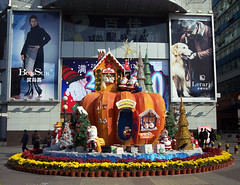
christmas pumpkin The Christmas spirit haunts us otherwise in Shenzhen, where children are given Halloween cards because “It’s fun” and lovers celebrate the season over romantic dinners—“It’s a time for just the two of us,” my friend explains her holiday plans.
And yet, walking past artificial trees and sweating elves, I glimpse the ghost of Christmas past, when I first learned to crave salvation. Here too, it’s the season.
There are a few more Shenzhen Christmas cards in my gallery.
Happy holidays.
Originally uploaded by mary_ann_odonnell.
skyscraped pink, shenzhen
Point of view haunts me. A frightening thought, that. Yet the specter of junior high English class has followed me to Shenzhen, and my feet stumble, wondering: where to stand? From what point of view do 30-story pink buildings make sense?
First person, street corner.
Second person, homecoming.
Third person, omnipotent?
I have published one postcard at: http://pics.livejournal.com/maryannodonnell/gallery/0000hqe3
what might street art be?
I’ve been thinking about the possibility of creating “experimental art” on Shenzhen’s streets. About a year ago, two Dutch artists led a two-day workshop here. They asked us to think about art as something that highlights the nature of everyday life. They suggested that by contrasting “unnatural” or “not normal” activities with quotidian routines, we could explore naturalized (but not natural) social forms and spaces. For example, a group of us sat on the steps of a building, playing with our cell phones. Normal activity for this space. However, every two minutes, we all looked up from our phones, stared straight ahead, and then turned our heads to the right. After a minute, we returned to playing with our cell phones. This kind of collective, planned activity constituted abnormal behavior for this space, highlighting the nature of “hanging out on steps” (among other things.)
At the time, I found this way of thinking quite useful, and have even used a version of it for my Found Objects series. However, the more I think about it, the more I wonder how much this strategy depends on the collective maintenance of social norms in order to be effective. What happens, for example, when the artist’s experiments can’t exceed extant uses of space? For example, walking from my apartment to a friend’s office in downtown Shenzhen the other day, I passed a woman eating out of a garbage can. She scooped handfuls of rice from a styrofoam container into her mouth. A child slept on her lap, his legs dangling near her left hip. Today, as I walked through the park, I noticed a man sitting on a park bench, legs spread, a limp penis in his right hand. Clearly, he intended to be seen because he was sitting next to sidewalk, rather than behind a bush. I’m not sure if he had just finished masturbating or urinating, but hand and organ both glistened in the afternoon sun. What kind of street art could say more about Shenzhen than these two performances? Or perhaps the question is, how might street art respond to these two performances?
Now, I’ve thought about photographing these and similar scenes, but part of me (and thus far the dominant part of me) resists. I don’t want to invade their privacy. This is the sentiment that prevents me from looking more closely and keeps me from snapping that picture. Clearly, they’re not worried about privacy in the way I’m used to thinking of it (behaviors that remain unseen, taking place behind closed doors). But I can’t convince myself that they would therefore welcome a photo shoot opportunity. At this moment, is turning one’s head away correct? Or would a more interesting form of art-response be to sit down and eat with the woman? Offer her food. Is the point to acknowledge the very specific reality at hand (so to speak), making street art a more explicit form of interactive improvisation? I’m as repelled by the idea of sitting down to eat from the garbage can as I am by taking pictures. Certainly, I had no desire to approach that man. What is it in me that turns away? Doesn’t want to look and yet wants to document this world?
It’s not even that these two performances are isolated events. I regularly see “abnormal” use of public spaces in Shenzhen. At construction sites and under park trees, workers take afternoon naps on woven bamboo mats. Beggars arrange themselves on most of the pedestrian overpasses throughout the city, while barbers set up shop underneath, placing a fold-up chair in front of a mirror that they have hung on the cement wall. At mealtime, many bring their rice bowls outside, squatting next to the road and people-watching. And I gaze, but out of the corner of my eyes, unable to bring myself to look directly at all this. It occurs to me that the reason they may have brought their lives to the street is that they can’t afford closed doors. So perhaps I am ashamed to look at poverty? But there may be other reasons they have brought their lives outdoors, just as there are other reasons I keep mine inside. If so, what then pre-empts a conversation? Or the possibility understanding? Is it that by looking away I am offering an exchange—don’t look too closely at me, and I won’t look too closely at you?
In Mandarin one of the words for “shameful” is “not fit to be seen by people (见不得人)”. What does that expression actually refer to? Is it the woman and her child? Is it the conditions that have forced her to eat out of a garbage can? Is it an American woman turning away? Is it how during public events police officers push her and others like her out of sight? Or is the question not what we look at, but how we go about looking? At that moment, is some kind of connection possible?
rainy day

It’s raining, again. Our summer has consisted of weeklong downpours and toxic heat that leaves me dizzy after even short walks. Outside my window, yet another typhoon (third in the past two months), which hasn’t landed in Shenzhen, but nevertheless blown in and lingered. Stir-crazy after so much time indoors, I decide to go to the Mangrove Bay Park and check out the water. Mangrove Bay Park is technically a natural reserve, but since the land reclamation project and re-zoning of coastal land reshaped this part of the city, it’s at best a mini-reserve with a few herons and birds I don’t recognize.
To reach the Mangrove Park, I ride the 101 from Tianmian to Window of the World, along Shennan road. My plan is to jump of the bus and then walk through the new roads that have been laid in the reclaimed land—on my way to Mangrove, I’m interested in photographing views of the old coastline before it has been filled in with housing developments, shopping malls, and greenspace. However, the actual layout of the land thwarts my plan. I knew that the themeparks had been built along the old coastline, but what I hadn’t realized that therefore there was no way through them to the new coastline. Accordingly I have to walk another mile or so west along Shennan road toward Shahe road, where I can finally veer south toward the bay.
I walk under grey skies, trudge through sidewalks covered in pools of muddy water (construction site run-off), and then squish past a clump of people waiting out the rain under a plastic awning. My umbrella keeps my face and torso dry, but my pants are already soaked and now cling to my knees. Once on Shahe road, I make another discovery—the reclaimed land has been fenced off and I find myself maneuvering to get my body, umbrella, and camera safely through openings in order to snap a quick picture. Can anthropology be reduced to this technically illicit, but in fact simply drippy sneaking around?
But then the sunlight stuns me. The rays that do manage their way past the storm clouds illuminate the landscape with unexpected beauty, indeed with a delicacy that I had never associated with Shenzhen. Nanshan Mountain shimmers on the horizon. A rainbow touches earth in Hong Kong. Even Shennan Road and Binhai Highway glow. Shenzhen transformed, radiant even. Photos from that walk can be viewed at: http://pics.livejournal.com/maryannodonnell/gallery/0000dbeh.
 Shenzhen Noted